Insurance: Risk Pooling, Incentives, and Institutional Design
Insurance: Pooling Many Small Risks
So today we wanted to talk, the idea was to talk about insurance. And it's a very old idea. In fact, in some sense it even is used by animals, non-human animals. If they share risks, then it's some kind of insurance, maybe. So it's very basic. And I think you have some idea already what insurance is, but it involves an insurance company, of some kind, or a government insurance, but the policyholders have a contract with the insurance company to protect them against certain well-defined risks, and for that they pay a premium, a regular payment to the insurance company for its standing ready to manage those risks.
So they achieve their, there's a theory behind insurance The theory is risk pooling, that what is a risk for one person is not a risk for society at large if they are independent. Because by the law of large numbers, the number of bad outcomes are fairly predictable. The insurance company pools all these risks, and by the law of large numbers, is not really risky in itself.
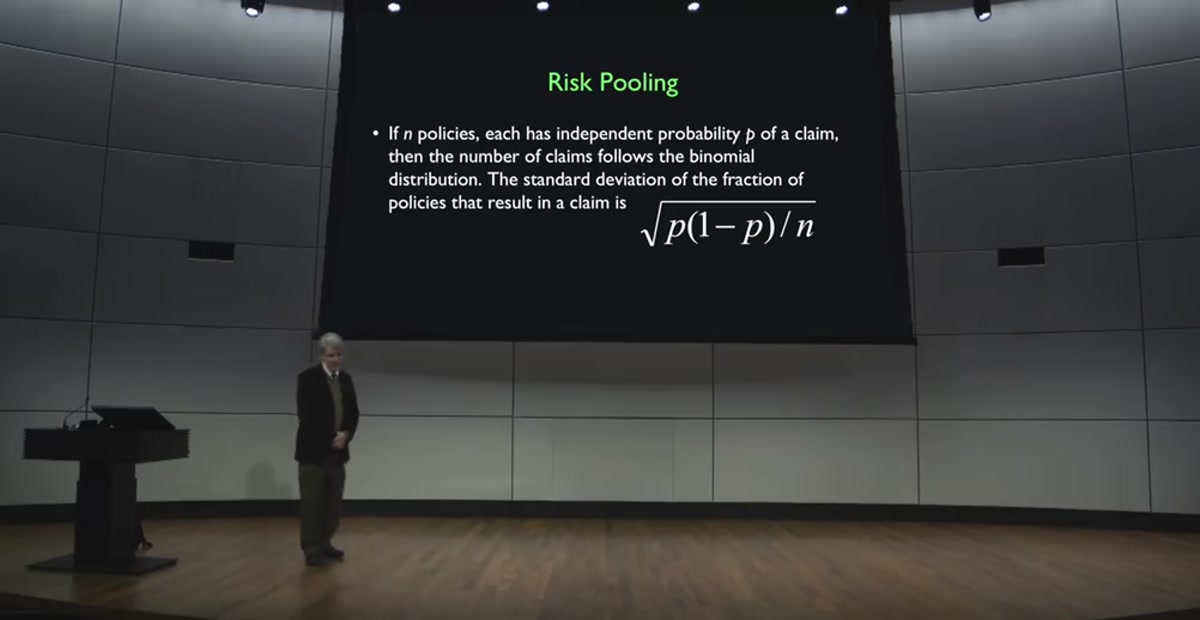
There's a little mathematical formula for risk pooling, which is assuming independent If every, let's say it's a life insurance, if every death is independent of the other, there's no epidemics or wars that bring a lot of deaths all at once. Then the risk that you face, if you're writing n policies, each against one life, is the standard deviation is given by the square root of p times 1 minus p, where p is the probability of death, divided by n and the square root of that.
And you can see that as N gets large, this standard deviation approaches zero. So the fraction of policies that result in death becomes practically a known number. That's the key idea of insurance. According to the law of large numbers, the average of the results obtained from a large number of trials should be close to the expected value and will tend to become closer as more trials are performed.
The law of large numbers is important because it guarantees stable long-term results for the averages of some random events. So let's take an example. While a casino may lose money in a single spin of the roulette wheel, its earnings will tend towards a predictable percentage over a large number of spins. And that's how the casino can confidently pay its monthly bills.
Another example would be if we took a six-sided dice and rolled it many times. The average of their value, sometimes called the sample mean, is likely to be close to 3.5, with the precision increasing as more dice are rolled. So unfortunately, it's not so easy to make this idea work in practice largely because of moral hazard and selection bias. Moral hazard occurs when people knowing they're insured become, take more risks.
So for example, if your house is insured against fire, you may say, I don't care, I'll be careless with fire because it's insured. So then the risk goes up. Or even worse, if the insurance company insures your house for more than you think you can sell it, you would say, I'll just burn it down. I'll pretend it was an accident. And then I'll get more money than I would have for selling the house.
Selection bias is different. It is that the insurance company may not be able to see all of the risk parameters that define risk. Then people, their customers may see them more. So for example, health insurance tends to attract sick people. So health insurance companies ask for a medical exam. traditionally to screen out people who know they're already going to be sick.
If they're not successful in doing that, then the selection bias can harm their business. And it can destroy an insurance business. Because if people know that they're going to be sick, then only sick people sign up. The insurance has to be expensive. So healthy people won't sign up because they don't want to pay the expense. And so they don't want to pay the expense.
and so the whole thing collapses and doesn't work. So you have to deal with selection bias the best you can by exams and disclosure. And also by mandatory, the government can make it mandatory that insurance companies do not look at the selection. So Obamacare is known for that, health insurance companies are not allowed to take pre-existing conditions into account.
Let me give you an example of moral hazard and selection bias in insurance. Many people in this world today are living in marginal economies, subsistence farmers. You have a farm in some very underdeveloped part of the world, and you depend on the crop every year to feed your family. So, but unfortunately, the weather throws loombs. those curveballs every now and then.
There'll be a typhoon or there'll be a draught of some sort. So the farmers should buy insurance, right? But how do we do that? So one kind of insurance that's been offered for many centuries, I suppose, is crop insurance. So the farmer buys insurance against the crop failing. That sounds good and workable. There's a problem with it, though. The problem is that it's subject to manipulation.
The farmer can lie about the crop, right? You can say, I didn't get much of a yield this year. He can sneak some of it off and sell it and then try to claim on the insurance. Or the farmer can just get careless. You know, maybe he's just not that focused a guy, right? He doesn't do things right. He gets drunk and it doesn't do the necessary thing. That's moral hazard.
And then there's selection. bias, farmers who know that they're living on marginal land will pay for the, will be the ones who will go for the insurance. So crop insurance has been around, but it hasn't worked that well. So this leads to an advance that occurred in the last 20 years or so, as pushed by the World Bank, which is an international development institution.
How about insuring the weather instead of the crop? Okay? Because the farmer can't cheat on the weather, he can't make bad weather. We have weather stations. So that's not a good idea? Well, it's a new idea, weather insurance for farmers. And it's starting to catch on, especially in the developing world where it's extremely important. It can be life or death for some of these farmers.
But then, does that sound obvious and workable? Do you think of any problems with weather insurance? You have to define the weather very carefully if you're going to describe the effect on crops. It turns out that you plant seeds on a certain date and they start germinating. They're very vulnerable to have dropped after a certain number of days after planting.
And if the bad weather comes right then, so you have to measure it locally and know exactly when the planting was, details like that to make it work. Along the lines of moral hazard, Jason mentioned. You assign this an article that says that we're transforming from the financial capitalism into more of the like philanthropy capitalism. And my question is, do you think that the increase in the number of philanthropists and NGOs causes people in the developing countries to have less of an incentive to and ensure against natural disasters?
Okay, well that's a complicated question. The reason we want insurance as opposed to gift giving is because insurance is much more logical and priced out. So we know exactly what costs and what you can expect. And so, for example, flood insurance in this country was created to prevent people from making big mistakes. The big mistake that was being made was that a lot of people were building houses in floodplains.
And, you know, sometime in the next 20 years, it's going to be a big flood. And then these people are apparently counting on, well, someone will bail me out. So in the United States, in 1968, Congress passed the National Flood Insurance Act, which specified that you had better buy flood insurance and the government will subsidize it. But it will be priced appropriately.
So if go ahead, build your house in a floodplain, but you're going to have a sky-high insurance rate. We're going to price it out. And that's the idea. So people, you know, are forewarned. You better watch out because this is a high risk area and the flood insurance rates will tell you that. So that's a coherent system. If it's just philanthropy, then people would always, lots of people would be building on a flood plain.
So you've got to have it priced out and done right.
The History of Insurance: Data, Marketing, and Social Attitudes
So in order to make insurance work, it takes a lot of developments. And it's not easy and obvious. The concept of insurance, as we pointed out, goes back to ancient Rome. But it doesn't seem to have taken over. It wasn't managing most risk. It was a narrow scope of risk. If you look at the history of insurance, developed because of specific technical advances, like the development of actuarial theory.
So it was in the 1600s that they produced the first life tables. And what they were, it showed the probability of dying at each age. That's what you need to know if you're doing a life insurance policy. What is the probability that the insured will die? Nobody had any statistics anywhere in the world on that until the 1600s. So they started doing life insurance, but it didn't take off well, and fire insurance.
It wasn't. widely accepted. People mistrusted it and didn't understand it. Even in my family, my grandfather, who owned a farm in Michigan, lost their house to a fire and they weren't insured. So this is part of our family. My family moved into the chicken coop and lived there because they came home one day. They were on an outing and they came home and the house was gone.
It completely burned down when nobody was there. So, There are some milestones in insurance history about how we can get things going so that it works. In 1840, Morris Robinson, who was the head of the mutual life of New York, a mutual insurance company, got the idea that what an insurance company really needs is insurance salesmen. And these had to be pillars of the community type people, and so they had to be paid very well. So the idea was he was going around hiring exemplary men.
I assume they were all men in those days. And he had to make door-to-door call. It's unusual. You get a man that looked like someone you'd heard of as a pillar of the community coming to your house. Maybe they would do it through your church or somehow get introduced. But you needed salesmen because people resisted the idea of paying for something like insurance, which seems abstract and you can easily forget the risks.
It turned out that you had to pay these guys a lot and they had to keep coming back and reaffirming. They had to pay another visit to you because you would tend to stop paying on the insurance after some years when you hadn't had a claim. Then Henry Hyde in the 1880s discovered having the sales appeal of having insurance with a large cash value. So if you stop paying your insurance, you lose the cash value.
And it's also a saving vehicle as well. Why combine insurance with saving? Well, because it seems to affect the psychology of the purchase. And Viviana Zelizer, who is a sociologist at Princeton, did a big study of how insurance was marketed in the 19th century. And she said that talking particularly about life insurance, women were the main beneficiaries of life insurance because men were the breadwinners out-earning an income and they tended to die young in those days.
But women seem to be, according to her studies, objecting to life insurance, saying, no, I don't want that. So why would a woman say that in the 19th century? Well, partly because Viviana Zell is a Viviana Zelizer concludes, they were fundamentalist Christian, and they believed in the power of prayer. And they thought, women thought that insurance was some crazy gimmick scheme.
And they wanted to trust in the Lord rather than in some thing that looked like gambling. So one woman said apparently, you know this insurance policy, it looks like I'm making a bet that my husband will die. And she said, that will incur God's wrath. I should stay out of that. because I'm challenging God to take my husband, and I should not do that. So they developed a different sales pitch.
And the new sales pitch was, don't try to explain probability theory. Don't try to explain how this business works. You come to the wife and you tell her, I have a mission. My mission is to help your husband protect you from beyond the grave. If God forbid something horrible were to happen to your husband, you know he would love and protect you if he could. I'm making it possible.
And that pitch seemed to work and women went along with it. So these are little inventions. They're marketing inventions, but they're important. Now we don't need life insurance as much because people live longer. Really, life insurance is to protect families against the death of a father or mother while young. Right. Yeah, if they didn't have the insurance, the seller of the property has no incentive to tell you about the flood that we had 20 years ago.
You can't see the damage anymore, so you might not know, there's no incentive. But if you are looking to buy insurance and then you see, they want $1,000 a month for insurance, what are we talking about here? This is crazy. Why is that? Then, yeah, it makes an impression on people. You know, I talk a lot about human psychology and human failures, but there is a certain element of rationality.
And that moment happens when you're about to sign the papers for your insurance and you say, wait a minute. you want me to pay $1,000 a month just for the flood insurance add-on? Then it makes you think. And most people will make somewhat rational response to that. What do you think about the...
Local Regulation, Guaranty Funds, and Too Big to Fail
Insurance is a complicated thing because it has been regulated for centuries and it's often regulated at the local level. In the United States, insurance is a really local phenomenon. The Dodd-Frank Act of 2010 created a federal insurance office, but it's really mainly just a monitoring for risk. It's not really, there's no national insurance companies. They all have state charters. Also, what protects you if your insurance company goes under? Well, the regulator is supposed to have checked that they're doing things right. But what if the regulator messes up and you buy insurance, and now there's some big catastrophe, and the insurance company goes bankrupt and can't pay
you? So the state governments have set up insurance guarantee funds. There's a lot of complexity to this whole business. It's not a not so simple and easy. So the first step, it wasn't until the 20th century that these even set up. It's like deposit insurance, when you have a bank. When you go to the bank, you'll see FDIC insured, Federal Deposit Insurance Corporation.
But we have similar insurance of the failure of the insurance companies, but not until 1941. There was no insurance guarantee. So here's our local insurance guarantee fund, Connecticut Life and Health Insurance Guaranty Association. It was created in 1972. That's not that long ago. It's kind of remarkable that before 1972, if your insurance company failed in Connecticut, you were just out of luck.
So now they will insure your insurance against a maximum death benefit of $500,000. It's still not big enough because if you are as a young person, what is your present value, your lifetime present value. It must be several million dollars. So $500,000 just doesn't cut it, but at least it's something. Other countries have insurance. The China Insurance Regulatory Commission has set up a state-owned nonprofit called China Insurance Protection Fund that protects people against the failure of an insurance company.
But again, they're limited to 50,000 yuan, which is not much money. So we still live in a world that's highly, you've got to watch what you would get into, check things. One thing I like, this is a course in financial markets, and I like this institutional detail, because to me it's what makes things work. So when you were talking about AIG, the last lecture, and how they got the whole government bailout.
What's preventing them from committing their own moral suspicion or moral dubiousness? If they know that there's something like the big catastrophe happens again, they'll get another bailout because they're so big. Are there regulations in place? Well, the financial crisis of 2008 took everyone by surprise. The bailouts weren't the plan, the course of action, It just happened, it got so severe so suddenly that the government stepped in the U.S. and in other countries to protect the integrity of the whole financial system.
Now, the issue now is, does this set a precedent that insurance companies will say, hey, we don't need reserves because we'll just get bailed out. Well, that's a concern, and it's been a concern of lawmakers. Part of the issue, though, is that AIG was bailed out, but the stockholders did not do well. They didn't enrich the stockholders. It was a disaster. On top of that, I think that our new regulations are stiffer and more aware of that crisis.
But you are getting at a really important problem, that too big to fail is a natural problem when you have a complicated interoper dependent economic system. And if one big company like AIG fails, that was the biggest insurance company in the world, once one company like that fails, the government isn't wanted to just let it everything fall where it may. There's a natural tendency to bail out and it's hard to get past that.
We're making efforts to, but it's a fundamental problem. The U.S. government took over securities regulation in the 1930s after the Great Depression. They formed the Securities and Exchange Commission to regulate stocks and bonds from the federal level. They never did that for insurance. In fact, the McCarran-Fergerson Act of 1945 delegated insurance regulation to the states.
So there's 50 different state regulators, all different. Now this is chaos because companies like to operate nationally, but they have 50 different regulators, one for each state. So there was a nonprofit called National Association of Insurance Commissioners, N-AIC, which is not government. It's set up by the insurance industry. And they have regular meetings creating suggested laws for insurance.
That helps reduce the complexity of the U.S. insurance system, because At least the state governments talk with each other and standardize their insurance laws somewhat.
Health Insurance: Incentives, Selection, and Universal Coverage
Okay, the first health insurance apparently was in 1694. The first US health insurance company was Franklin Health Insurance Company of Massachusetts, 1850. There was an important step forward in health insurance with the Health Maintenance Organization Act of 1973, which required employers with 25 or more employees to offer what's called an HMO. a health maintenance organization.
The idea at that time was that the medical services were generally provided by practitioners to uninsured people who had to pay when they were sick. The problem was that doctors made more money if people were sick. They didn't have any incentive to prevent disease. So there were people who complained that we needed to have our health managed by practitioners who had an incentive to keep you healthy, to do preventive things.
So how do we do that? We have to create an organization like the Yale Health Plan that keeps you for a lifetime, let's say, that gives regular checkups to you and encourages you to come and talk to the doctor. has no incentive because the doctor has paid a salary, has no incentive to urge unnecessary surgery on you or the like. So this is what Yale Health Plan, which was a pioneer, it was one of the first HMOs.
What they do, I think you've been there, right? They assigned to you a primary, which is the gatekeeper for you, and they encourage you to come in for any, minor thing, which might reveal a more serious problem. In 1986, the US Congress passed another law called EMTALA, Emergency Medical Treatment and Active Labor Act, which required hospitals and ambulance services to provide care to anyone needing emergency treatment.
So basically it was a tax on everybody to provide emergency services. Now, you could probably go to an emergency room before 1986, because there was some public spirit that hospitals would treat you if you came in. But it became mandatory in 1986. But it's not the same thing as health insurance because they kind of hope that you take your sick people to another hospital's emergency room, not ours, because it all comes out of our pocket if you can't pay.
So it's not a great, system. Then we came, as you've heard of, the US Patient Protection and Affordable Care Act of 2010, called Obamacare. And it tries to deal with the selection bias problem by forcing everyone to sign up. So there's a penalty for individuals not buying insurance, a tax penalty. and a penalty for companies not offering insurance for their employees.
So they set up health exchanges that tried to regularize the competition among insurance companies. It's a complicated system that the Republicans want to shut down as soon as possible. But to me, Obamacare reflects some really important issues in insurance, namely that, the U.S. has had something like 45 million people uninsured. And if they're uninsured, then they will go to the emergency room when they are dying.
But they don't, it's not a good system because they don't get preventative care. And they only end up in the last stage of collapse at the medical system. So it's not perfect. Right. See, health insurance has suffered an important shortcoming in the United States. It's not, hasn't been offered by the government, it's private. And it's often through employers.
So suppose you lose your job, then you've got to go out and buy health insurance. Now, the problem is that they will look at you and if you are sick, they'll say, we'll charge you a very high rate. And so, and they, they, they'll, they'll charge you a very high rate. They also have a selection bias problem. We talked about this in class, that the people who sign up for insurance are the people who know they're sick and need it.
So that means you have to charge very high rates. And then people who know they're healthy will not sign up because they don't want to pay the high rate. So nobody is insured, or not many people are insured. So the Obama, the Obamacare Act in Congress, made it mandatory. Well, you'd pay a fine if you don't sign up for insurance. But that was supposed to put everyone back into a pool where everyone is insured and was supposed to bring the rates down.
So you have to do something like that. This is a fundamental problem with insurance. If it's not a risk, it doesn't work. If people know that they're at a special risk, then it's not going to work. You can only work. insure against the unknown. But you can make laws that prevent companies from taking account of risk factors so that people can buy insurance.
And that's what Obamacare did.
Catastrophe Insurance: Haiti, Katrina, and Terrorism
Most people in the world do not have insurance against earthquake risk. Now that seems almost astonishing because the risk is so well quantified and there's such an incentive to manage the risk. So this is a picture from the Haitian earthquake of 2010 and you can see the damage it caused. And yet most people there were not insured. So the earthquake came in 2010.
Before the earthquake, there was a movement to try to get Caribbean countries to buy insurance. And so they did so only a little bit. The Caribbean Catastrophe Risk Assurance Facility managed to create about $8 million of life dollars of loss insurance. But the losses from the Haitian earthquake reached into the billions. So why weren't the Haitians insured?
There was an organization trying to get them to do it. And they could have bought it. But apparently there was a resistance, a thought that maybe a mistrust of institutions, a tendency to, believe in good luck or something like that. Here's another example, Hurricane Katrina, in 2005. Now this was in the United States, where people are much more sophisticated, I would say, or at least attuned to financial solutions.
So the city of New Orleans was heavily damaged in the earthquake of Katrina Hurricane But again, the insurance wasn't perfect there as well. So now, this is totally different from Haiti because we have a lot of insurance in the United States. There was, in fact, losses of $34 billion caused by the hurricane. And these were settled and paid out. But there were problems then, again, the problem was that a lot of the insurance policies were insured against wind damage, but not flood damage.
Now, before the fact when you sign the insurance contract, this might seem like a minor distinction. Because Hurricane Katrina was both wind and flood, but many of them did not have flood insurance. Now, why didn't they? Maybe they couldn't imagine how could it flood here in New Orleans? They didn't understand the impact that a hurricane can have. So also, maybe because of global warming and greater fears of hurricanes, the insurance companies had been raising their rates on hurricane insurance.
So many people in New Orleans had canceled their insurance because they thought it got too expensive. So there was a substantial failure to compensate people in New Orleans as well. Not as bad as Haiti. You're saying, why should I buy flood insurance? If I just say, I didn't do it, sorry, I've made mistake, someone will come and help me. And so I'm going to build the house on the floodplain anyway, because I don't care.
Now, that was a problem. When they passed the National Flood Insurance Act in 1968, people didn't just go and buy it. They were ignoring it. So one thing that later, Congress in 1973, passed another act that made it mandatory to buy the... It wasn't a choice anymore. You had to buy the insurance if you were building in what was a designated high-risk area. On top of that, the U.S. government has tried to tell you we are not going to help you that much if you didn't buy in areas where you're going to in areas where it wasn't mandatory.
If you didn't buy flood insurance, the government will limit their help to loans. So, okay, your house was washed away in a flood. You didn't buy flood insurance. Well, we're not going to just forget about you. We are going to lend you the money to build another house. So the government is there, but it's not helping you that much. So they're trying to create a system with the right incentives.
The bottom line is, stop building. in flood-prone areas, and if you do make the mistake, you will only get minimal help. And you better know that when you build a house. Some people who disregard everything. You know, I'm sure it's still happening. But it's kept down to a small number. And I think this is one of the wonders of modern capitalism that we do as well as we do.
And then finally, I want to talk about terrorism risks. Insurance policies have in the past generally not focused on terrorism risk. Before 9-11, 2001, most insurers did not exclude terrorism risk because they didn't think that it was even a risk. But after 2001, they started changing their policies to say that we don't cover terrorism. This led to a sense of frustration that this is a big risk that people are suddenly concerned about and they can't buy insurance against it.
Well, the insurance companies said that this isn't the way we do business. We don't insure against correlated risks like that. There could be a huge terrorist attack. How do you expect us to pay it out? So in this case, this kind of is an example where the government plausibly becomes involved. and has been involved in history as well in providing insurance against acts of war because the insurance companies can't do it by themselves.
So in 2002, the United States Congress passed TRIA, the Terrorism Risk Insurance Act of 2002, which required insurers to offer terrorism insurance for three years. But the government would pay for it, or at least 90% of it, because they decided it was too much of a tax on the insurance company to ask them to bear this risk. Or what would they charge for?
That's the thing, because they don't know where it's going. So the government agreed to pay 90% of the insurance industry losses above $100 billion. So that act keeps expiring and keeps being renewed again. So by 2015, the act was renewed again until 2020. But you think they should just make it permanent, right? Why is it a temporary thing? It reminds me of bankruptcy law in the 19th century.
If you went bankrupt, let's go back to 1800. If you couldn't pay your bills in 1800, they had special prisons for you called debtors' prisons. But there were repeated financial crises through the 19th century. And a lot of people went to debtor's prison who were perfectly innocent. Well, the only crime they're guilty of is not understanding that they would lose their job in a financial crisis and they couldn't pay.
And their company would fail or something like that. It's not really their fault. It's not something we want to see punished by jail. So in the 19th century, whenever there was a financial crisis, they passed some special bankruptcy law that had a time duration like this and expired. They thought, well, we're just dealing with the current crisis. But as time went on, these crises kept coming, and eventually bankruptcy law became a permanent fixture, not just the reaction to a crisis.
So that's probably what should happen to TRIA eventually. There are certain things that are hard to ensure, and we require the government to come in to do the job. We'll come back to that when we talk about public finance later.