Futures Markets
Introduction to Forwards and Futures: Prices Must Reflect Time
forwards and futures are kind of esoteric topic. Most people never deal in them. They're derivatives. The so-called derivatives because they're buying or selling something on a forward or futures market is not as simple as buying on the spot market. So the spot market for anything is the market for immediate delivery. You pay the money, you get the item. Forward and futures reflect contracts involving future delivery, and it's more complicated.
But I think that they're really important to economics, because our markets have to reflect time as well as quality. And time is an essential feature of our lives. And so we're really important. But we have, with forward and futures markets, we have not just one price, but a different price for every different future delivery date. So instead of a single number for something, or a commodity say, it's a whole array of numbers reflecting the different delivery dates in the future.
So as I said, most people don't seem to know much about them, don't really think about what they are. But I referred earlier to an essay that Charles Conant wrote in 1904 called Wall Street and the country, the function of stock and the produce exchanges. And he was lamenting that the public just doesn't get it. They think that these markets are places where rich people gamble.
They speculate. But in fact, Well, there is such people do gamble on these markets, but they do have a function, a real function. As he emphasized, they're tied to business. They're not games. Gambling is an entertainment industry. They conceive of games that will be fun to play. But it's not particularly fun to trade in pork bellies. Why would you want to do that? It's not a game. So it reflects some underlying economic activity.
But I actually documented in a paper I wrote 25 years ago with Maxime Boyko how much people mistrust these markets. So we did a survey in 1990 in two cities, Moscow and New York, comparing attitudes to markets. And we asked about grain trading. We didn't mention forwards and futures, because most people don't even have a clue that they exist. But they know there has to be grain traders.
And of course, grain traders trade typically in futures or forward markets. So the question was, grain traders in capitalist countries sometimes hold grain without selling it, putting it in temporary storage in anticipation of higher prices later. Do you think this speculation will cause more frequent shortages of flour bread and other grain products? Or will it caused such shortages to become rarer?
Well, the number one response was that shortages are more common. And in fact, the amazing thing is the Americans thought that. They're even more than the Russians. We thought that communist ideology would encourage the Russians to think that speculation creates shortages. But in fact, it was less than half of them who picked the that. So what would you think about this? Does storing grain make shortages more common? I mean, I think just, when you think about it in simple, common sense, an oversimplified version of the world, that there's one harvest of grain every year, okay?
Does storing grain over the year make shortages less common? How could that possibly be true? Storing grain is essential if you only harvest it once a year. Somebody's got to store it. Nobody's got to store it, unless you could eat it all on the day of the harvest. But you can't do that. You've got to eat it over the year. So it's an essential business in every country storing grain, okay?
You understand that. When you buy a sandwich or a, have a breakfast bowl of cereal, you know that that cereal was in somebody's storage warehouse. For, especially think about your, right now is a good time. We're in February, we're in March. It's just before a harvest. We're coming out of the winter. And you better, everything you eat has been stored unless it comes from the South America or Southern Hemisphere. But the public doesn't get that.
What sort of products or assets have futures markets associated? Good question. The people at the futures exchanges would like to know the answer. There's an old story, a futures market story that, you know how they figure out what markets will be a success? It's the same rule that chefs use, they call it the spaghetti rule. How do you know when they speak with spaghetti is done?
You take it out of the pot and you throw it against the wall and if it sticks, it's done. Okay, it's the same thing. You start a futures market. It sounds plausible and you try it and if it goes, it goes. If it doesn't, you shut it. down. So I've had experience with starting a futures market with my real estate, my colleague, Carl Case, and I worked with the Chicago Mercantile Exchange and created the home price futures market.
It's now 10 years old. It's going. But I have to say it wasn't as big a success as we'd like. And we just don't have a clear answer. Real estate is a, huge market that occupies a lot of attention. People worry about the values of their houses. They are looking for answers. So you'd think they would trade a lot in a futures market. I think that they may yet do that, but as of this date, it hasn't been big.
Now, one thing, your question is a little bit like asking, how do you know when someone will have a nice part at his house where everybody comes. Well, when you throw a party, you never know that it'll be a nice party. And if everyone here, there's a great party at so-and-so's house, they all come. It's that sort of thing. It's a social phenomenon. Some efforts to start futures markets have attracted a huge attention, and others haven't.
It must have something to do with risk and the feeling that there's a lot of risk to be managed. And so maybe the problem with single family home futures is that the homeowners are not professional risk managers and they're there for a long time and they can forget about the risk of their home. Maybe that partially explains it. But I don't know that we have any really solid explanation for why some markets exist and why some don't.
Forward Contracts: Customizing Future Trades while Bearing Counterparty Risk
A forward contract is a contract between two individuals, you might call them counterparties, to deliver at a future date, called the exercise date or maturity date. Historically, forward contracts preceded futures contracts. A futures contract is a more sophisticated idea. So, for example, what was happening in Dojima before the 1670s, rice farmers would make a deal to make a deal to sell their rice to a warehouser.
Now they could just wait until the harvest is in and then bring it to Dojima and see what price they could get. But they have an alternative of establishing the price earlier and locking it in. And farmers like to do this because they don't know what the price will be when they sell it. So you put in a lot of expense to produce the product and it might not pay you back all of your expenses, so you don't.
I don't like that. So they typically like to lock in the price. That's called, if you do it directly, and typically you would sell it to a warehouse or a grain elevator, as they're called, there would be a local grain, if, you know, I don't know about rice, wheat or corn or any of these. In the countryside, there's a local grain elevator. And you can go to that person and say, I'm planning to harvest rice at such and such a month.
Will you buy it and can you give me a price today? Most farmers don't hedge in the futures market. It's too complicated and sophisticated. But the grain elevator or the warehouser, I think they almost always hedge their, because they're going to be storing. The storage, the storage business is a tight margin business. It's very competitive. You could store a lot of grain and then not, or promise to buy grain at a price that turns out to be unprofitable for you. So what happens is the stores of grain are the hedgers, and they will quote prices to farmers as a forward price.
There's other kinds, it's not just grain. Grains are historically the origin of forwards and futures, but let's talk about other things. You can also make a forward contract to exchange pounds for yen, or dollars per yen, or any number of combinations. So if I make a forward contract, both sides are locked into the contract, so they have no liquidity. Why do they do it?
Well, they do it because they don't want to fit into one of those standard contracts that are offered at the exchange. They might want a different delivery location, they might want a different date, they might want a different quality, and so they make forward contracts are big. But the problem with forward contracts is you can't get out of them. And you don't necessarily trust the counterparty.
What if the farmer just doesn't, he gets drunk? It doesn't plant. And you're standing on the other side of the contract. So you're out of luck. The advantage of futures contract is that you don't have to worry because your counterparty is the futures exchange. It's not. between the producer of wheat and the manufacturer of breakfast cereals. The producer of wheat deals with the futures exchange, and so does the manufacturer of breakfast cereals who might be taking effectively the other side.
So they have to, if you're going to go with forwards, you have to worry about your counterparty, and you have to check the counterparty out and you need to establish that the counterparty has good credit, so they're inherently limited. Futures markets, you want to trade, you can call up a broker tomorrow and trade. The broker will do it with anyone who posts margin.
But let me come back to that. Forward exchange futures, a forward exchange contract, FX forwards, can be thought of as a pair of zero coupons. zero coupon bonds stapled together in two different currencies. Suppose I'm selling goods, I'm a Japanese producer of goods which I'm selling in the United States. I'm going to sell them for dollars, of course, Americans pay dollars, and then I want to repatriate the money to Japan, so I'm going to exchange it into yen.
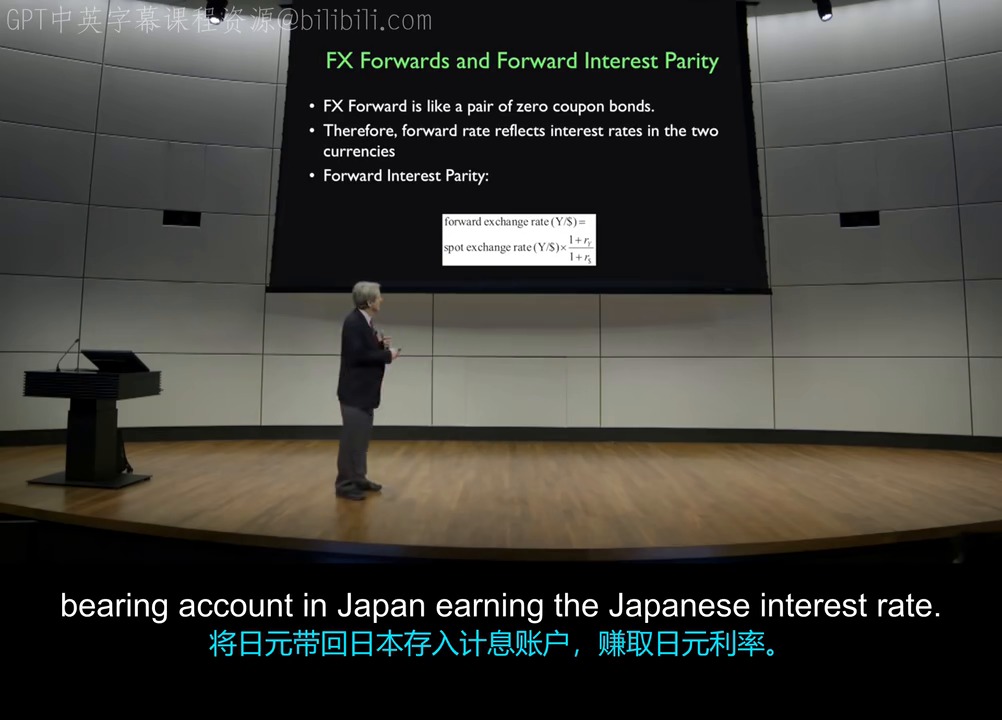
But I want to have a forward contract which locks in the price today. I don't have to go through the forward market. I can borrow the money today in dollars, exchange it at the spot exchange rate today, into yen, take the yen back to Japan, and put them in some interest-bearing account in Japan, earning the Japanese interest rate. So I'm going to be charged the dollar interest rate, but I'm going to be credited to the Japanese interest rate.
And so I'll have an understanding amount left at the end equal to the product of the spot exchange rate times 1 plus r yen divided by 1 plus r dollars so that so that's what I could do without entering the forward exchange market just by trading currents by by by borrowing and then investing in Japan so so this number should equal the forward exchange rate by arbitrage because there's this number should equal the forward exchange rate by arbitrage It's two different ways of doing the same thing.
And so they should be the same number. So that means that the forward exchange rate, yen dollar exchange rate, is not as interesting a number as you might think. that the forward exchange rate is some prediction of the spot exchange rate. Well, maybe it is, but it's also just this. It reflects the relative interest rates in the two countries. If you look at forward exchange rates, and compare them with spot exchange rates and check out this formula.
It works pretty well explaining the forward interest rate. So that's called forward interest parity. Forward rate agreements use a formula which looks a little, it's not exactly what I just showed you. They typically actually just have a settlement, which is the actual interest rate on the contract date, minus the contract. rate, times the days in the contract period, times the contract amount, divided by B, which is, depending on the convention, either 360 or 365 days.
We're in leap year this year, so we have 366 days. So that you know the formula won't be exact. Because it's either, they went back to 360 days for formulas like this because people couldn't divide. It was hard. They wanted a round number. So that's an old tradition. And 366 doesn't appeal to anybody. But that's the settlement formula.
Futures Contracts: Exchanges, Margin, and Daily Settlement
A futures contract is like a forward contract, except there's an intermediary, the exchange, who you make your contract with the intermediary, not with the ultimate counterparty. And they're standardized. If you drive through the country where they grow grains, you will see silos or warehouses here and there on dotting the landscape. So grain elevators are important.
If you turn on the radio and you listen to a local radio station, you will hear them quoting the futures markets because farmers locally are very interested in those futures price. Some of them aren't protecting themselves. And so it's really big for them. Now you don't hear spot prices very much. Maybe you can go, tell me otherwise, but I think when I've been driving to the country, I've been listening, because spot prices don't mean anything.
They're just, It annoys because you just never know who traded that and what the situation was. But futures contracts are the things that farmers listen to all the time. Now, futures contracts rely on margin calls. When an investor uses margin to buy or sell securities, they are paid for using a combination of his or her own funds, as well as money borrowed from a broker.
The investor received. a margin call from a broker if the securities in the portfolio decrease in value past a certain point, after which the investor must either deposit more money into the account or sell some of the assets. So I mentioned it with a forward contract, you're worried that the other guy might be a drunk or might be irresponsible or might not plant the crop.
Who knows? How do futures contracts deal with that? Well, futures contracts, when you sign a contract, it's an active living thing. The contract requires you to pay a settlement every day from your futures margin account based on the change in the futures market on that day. So the broker will have you sign a contract. Now, you might not be a very reliable person.
You might be a person who sometimes goes for weeks without answering the phone. All right? They've taken care of that in the contract. says, if you don't do anything, if we call you up and say your margin account is falling low because the futures price is moving against you and you don't answer the phone, we will close you out and your margin account will be maybe close to zero.
We won't let it hit zero because they don't trust you because they don't know who you are. They don't care who you are. They only look at the market. account. So you're supposed to allow them to, they won't call you every day. If you are buying the futures and the price is going down, it's moving against you. bought the futures because you were worried that the price would go up, right?
And you wanted to lock in a price. If the price goes down, then it's moving against you. And so they will remove that amount from your margin of account. You can get out at any time. But if you... bought futures and prices gone down, you just, reality is you have to get out at the new price. So they've already taken the money from you. That was the deal from your margin account.
And you don't have to answer the phone, you don't have to do anything. And it's no crime if you run out, if your margin account is deleted. Of course, you won't be hedged against price risk anymore, but you got to answer the phone. That's why most farmers don't trade in futures. It's just too nerve-wracking. calls are very unpleasant. The guy tells you, well, you put $10,000 in your margin account.
I'm sorry to say, it's down to 1,000. So they have what's called initial margin is what they require you to put up. And they have something called a maintenance margin, which is when they make the phone call to you saying your account has gone against you, you either put up more margin or we will close you out, which means buy a offsetting, or if you bought, they would sell on your behalf.
you're out of the market.
Rice Futures: How Standardization Creates Liquidity and Public Prices
The world's first futures markets came in the city of Osaka, Japan. In fact, a part of Osaka called Dojima in the 1670s. This was during the Tokugawa period in Japanese history, when Japan was isolated from the rest of the world, except for the Dutch. For some reason, the Dutch had special dispensation to come in and do business in Japan, but everyone else didn't.
Funny thing that this futures market idea originated in Japan, but I think it had something to do with the Dutch, because the Dutch had just invented, in the beginning of the 1600s, the first real stock market, and they were doing options trading and short selling. They were the most advanced financial country in the world in the 1600s. So maybe some of it kind of spilled over into Japan, but the Dutch didn't get this.
They didn't get the idea of a fact that. futures market. So now, Dojima was the storage center for rice in Japan. They had a lot of warehouses. I was recently in Osaka, and I asked, actually I'm going to be in Osaka next week again. Maybe I'll ask again. I said, where can I see some remains of the futures market? And they said, well, that's all long gone. You know, nothing left, nothing to see.
But it was big. There were, how many? There were 91 rice warehouses, according to one historians count, in Dojima in 1673. Well, it was a substantial part of Japanese diet, and somebody had to be storing it. was a serious business. So people in Japan who dealt in rice or rice products would go to Dojima to buy the rice. And what they ended up doing is making contracts for future delivery.
So there were a thing called rice bills, which were, rice was a little bit like money. You could borrow rice and pay it back at a future date. So you could buy your rice at a future date. I'm anticipating my forward contract story. But the futures exchange is something a little bit more sophisticated. It was a center for information and hedging about rice, rather than focusing on delivery of your rice when you want it.
So what it did is it had a specific list of delivery dates for rice at Dojima so that you could sell rice in the future for delivery to a warehouse in Dojima or you could buy it, but at a future date. That means they can't look at the rice now, so they have to specify what kind of rice it will be. So the dojima futures exchange had precise definitions of quality delivery date and place.
And they had experts at the warehouse whose job was to evaluate quality of rice. And so you would be signing a contract for delivery. But you didn't necessarily have to fulfill the contract because it was a standard contract and you could always buy your way out of it. So if you were a rice farmer and you had promised to deliver rice to Dojima as of a certain date, and now you thought, well, you know, maybe I won't plant as much rice, so I don't really want to deliver, I won't have enough. I've changed my mind. You could go back and just sell that many contracts so that you've reduced your exposure. It creates liquidity in the rice trade. So since then, actually, rice futures became big in Japan from the 1670s until World War II.
And it somehow got lost in Japan after the war because there were a lot of things happening. And it got set up elsewhere in the United States. And then anyone in Japan who wanted to hedge rice futures could have to do it in Chicago. became in the World Center for a lot of future. So we have rice futures, but now don't deliver them to Dojima. If you go there, I think what I got my impression, it looks like downtown Osaka to me.
I'll have to look again, but there's no place for you to deliver it in Dojima. You have to deliver it in Chicago. Okay. And so here is the standard contract. It says Chicago Board of Trade, C-B-B-O-T. Historically, that's what, although CBOT merged with the Chicago Mercantile Exchange in 2007, and they now call themselves the CME group. But we'll still call it a CBOT contract.
So now, it's different from a contract that you might sign if you wanted to buy rice. Right? If you are a maker of Rice Krispies or whatever, you might want some other amount than this or delivered somewhere else, but that wouldn't be a standard contract. This is the standard contract, which is the liquid contract. So the contract, one contract, is for 2,000 hundred weights.
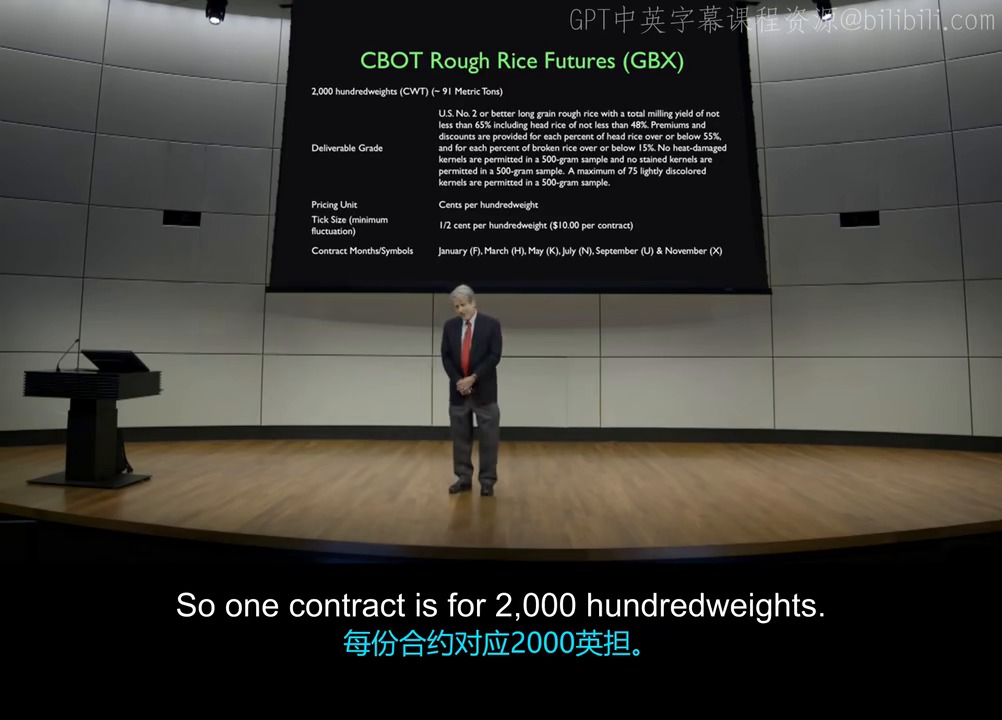
What is a hundred weight? That's just a hundred pounds, Averde-Pois. But you can't buy less or more, that's the size of one contract. And here's what it is, it defines that U.S. number two or better long grain rough for the total milling yield of not less than 65% including head rice of not less than 48%. And it goes on and on. That's what you have to deliver.
And it's priced in cents per 100 way. The tick size is the, it's like it's an exchange. It only allows you to change the price by a certain amount. Now, why would be people interested in doing a standard contract rather than a contract I don't want 2,000, I want 2,500 bush, 100 weights, or something like that. But see, this is the genius of the futures market.
It creates a meaningful price, and it creates clarity for the future. So there's lots of prices for rice, lots of spot prices for rice. You can go to some place where they're selling rice spot, but if you go there, they'll say, well, the rice that we got today doesn't look good, I haven't studied it, but I think it's not deliverable for the CBOT. See, nobody's watching.
Well, the buyer is watching. The buyer looks at it and said, okay, I'll pay this for this. But it might be bad rice, and there's no official statement. You know, you find a 100-weight that's sold for some price. You don't know why. Maybe there was something. Maybe the guy threw in a toaster of it or something. It's a gift. So if you really want to know what is the price of rice, you can't know what the price of rice here is.
You can only know what the price of rice in Chicago is because there's a futures market. And look how precise they are. So they have these delivery standards. Now I'll tell you one thing. Nobody delivers better rice than the standard. I went to the coffee, sugar, and cocoa exchange once in New York. I had a tour and I said, can I sample some of your coffee?
Here I am at the world's headquarters for the coffee trade. And he says, well, I wouldn't, let's go to a Starbucks across the street. Our coffee isn't great. It's very ordinary coffee. But of course it's ordinary coffee because they want it to be liquid. They want it to be a big market. So if you are buying, here's the idea, if you are buying, expecting to buy good coffee, let's say, next year, you can sort of lock in the price by buying the ordinary stuff on the futures exchange.
And then any price fluctuation, which will probably be shared by both types of coffee, will affect your futures contract. And you can close out, sell out your futures contract just before you would have bought the good stuff, and you've protected yourself against price fluctuations because the two probably move together. So most futures contracts, are closed out without delivery.
Most people, it's simply like this, suppose you are a rice farmer in the United States, or in Japan, and you're worried about the price you can get for your rice when it is harvested. You will sell your rice in Chicago, knowing full well, I'm not going to ship it to Chicago, but I just believe that its price in Chicago will move with the price wherever I am.
and it's just an insurance against price drops. If I'm a farmer, I'm worried that I won't get enough money for my crop and I won't make it. So this is really important concept that is not obvious, that futures markets are rarely delivered. The only time they're delivered is when the sharp operators, called arbitrageurs, decide that there is a difference between the futures price and the spot price in Chicago, or enough of a difference.
So I once had a, to deliver, or to take delivery on the other side. Now, so I once had a tour of the CBOT, and we met a, I don't know what it was, some kind of grain trader, and we had a chance to interview him because we were guests of the exchange. And I was impressed, this guy had a memory. We had a plot of futures prices, and the price was up, spiked up once in Chicago.
And I said, look at that spike. Why did that happen? He said, oh, I remember that perfectly well. There was a shortage in Chicago, but there was a rail strike or something. And the grain was waiting in Iowa, and we couldn't get it. We were really trying to arbitrage that spike because the spike was only in Chicago, but we couldn't get it to Chicago. So I went out and I rented trucks, but it was expensive, I couldn't get that many trucks.
So they live this story. Normally, the arbitrators pay little attention to futures prices and relative to spot prices, unless when it's getting close to the delivery date, they diverge. Then they look, should I have an opportunity taking delivery, and I'll bring my trucks to the warehouse in Chicago, I'll load up the rice, and I'll bring it to Iowa and sell it where the price is higher, or the reverse.
I'll deliver. And there's a small group of very sophisticated rice traders who do that. And the rest of the world hedges. So in Japan, a farmer in Japan could hedge in the Chicago rice market. And I had absolutely no thought of delivering to Chicago. Wouldn't know how to do that. So here is the rice futures curve as of yesterday at the CBOT. CME group. It's going for, the nearest contract, I think, is May.
It's going for a little over $10 per 100 weight, or 10 cents per pound. So if you go to the store and look at, what is a pound of rice cost when you buy it in the grocery store here? It must be something like a dollar, right? You can't get it for 10 cents. Because you can only get this price if you buy, what was it, the 2,100 weights? What did I say? Yeah, 91 metric tons.
That's a lot of rice. You want to deliver it to your store in a nice little package with colorful graphics on it. Now the other thing you note that it goes up with time, and that's a fundamental thing. Most of the time, futures prices. You understand, this is all as of March 8th, 2016. This is for delivery in May of 2016. And at the other end, it's delivery in maybe May of 2017.
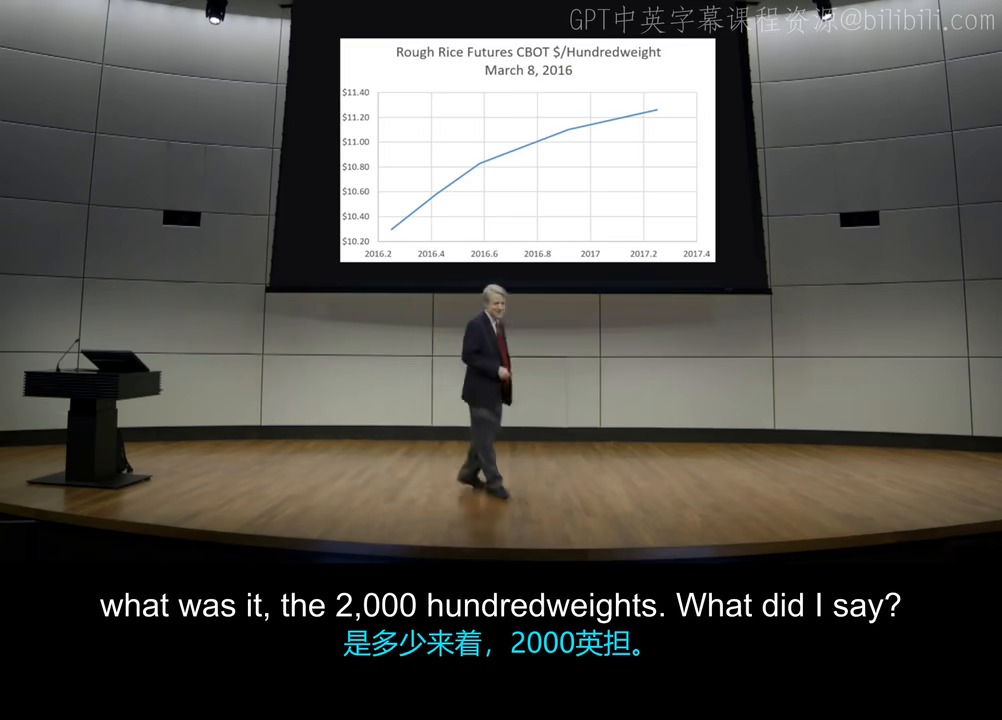
So it goes up with time. This is a price that I can lock in today, if it's March 8th, 2016, for May 2017. And this upward sloping nature of the futures curve has been called contango. I need to know the etymology of it, but contango is normal in futures markets. If you want delivery at a future date, it's going to cost you more. Not always, though. It can sometimes be in backwardation, which is where it falls into the future.
But that's, well, I'll give you an example, sort of that, but it's anomalous.
Wheat Futures: Speculators, Seasonal Prices, and Price Discovery
There seems to be a widespread distrust, though, of the futures market, and much of the blame falls on the speculators and the algorithmic trading systems that creates this volatility. Do you think this is justified and is it unfair to the hedgers to actually have these speculators in their trading? Well, I think there's nothing wrong with being a speculator because they're the ones who really think about where things are going.
They're not the same as, okay, someone who is managing an oil facility and storing oil is comes in as a hedger. I'm looking at this oil that I've got there and I'm worried I'm going to sell it in another month, but what's the price going to do in between? That's a hedger. The speculator has a different mentality. The speculator may be thinking about international politics and thinking about technology changing and thinking that, you know, this oil price isn't going to hold, that that's because that speculator just has an intellectual curiosity about markets and is thinking broadly on a broad plane.
And he may actually have wisdom to see that there's something wrong with the price. You want that guy in there to allow that expression, that opinion to be expressed in the market. So I think there's nothing wrong with being a speculator. I think it's a noble profession. So why are there prejudice against them? It goes, you know, I think it's largely because people, most people, have not had an economics course and they have not read Adam Smith, his 1776 book, The Wealth of Nations, that talked about prices as allocators of scarce resources.
They haven't thought about that. They haven't thought about how one could reduce risks through trades. That's hedging. What do they do? The most natural comparison for the typical person is with gambling because they do that. Surveys have shown that most people gamble, at least a little. You've gone to the casino, right? I don't know if you want to admit that here. So that's the personal experience.
So it looks a lot like gambling. But you have to make a clear distinction between speculation and gambling. is an entertainment industry. They are trying to get people looking for fun, and they're putting them in an environment that they enjoy. Speculators, they may have a gambling impulse, but on top of that, the speculators that I think of as important are those who think as intellectuals about the big picture drivers of prices.
And they may think that this price is wrong today. I can't prove it, but I strongly suspect it's wrong, and I'm just going to take a position against it. Even though I'm not hedging because I don't have any reason, I'm not storing something, I'm not running a business that's vulnerable. I'm just in it because I'm interested in where the market is going. Now, some people doubt that speculators do anything good.
But I think that they must. Because if there weren't speculators, I think the markets would be even crazier than they are because there would be nothing tying them down accurately. Now this is wheat futures. Now, this is number two soft red winter wheat. Or, number one, soft, red, winter, I don't know what the, oh, number one, it's a different grade of quality at a three cent premium.
And the pricing is in cents per bushel. The tick size is 1.8 cents per bushel, and you're buying 1,000 bushels. That's $1.25 for contract. Is that all understood? So what is, we have both winter wheat and summer wheat. Soft red, wind, you don't know. I don't know these things because you don't, you're not a farmer. Maybe you know if you're a good cook. Soft red winter meat, they make it into flour and it's called cake flour.
It's good for cakes and biscuits and cookies and also breakfast cereals like to use soft red winter wheat. Not so good for bread and other baked goods. They also sell something called all-purpose flour, which I believe is a mix. of different kinds of wheat. But winter, why do they call it winter wheat? That's because you plant it in the fall and it lies dormant over the winter and it's harvested typically in May, depending on your climate.
So it's a springtime crop. So I don't know if you cared to know about all these wheat effects, but I looked up the futures curve for soft red winter wheat for March 8th, 2016. And it shows the contango again, but not everywhere. Now actually, in other years it's shown more of a variation. But there's a tendency for a lot of commodities that have a crop once a year in a fairly well-defined time for the futures price to go into backwardation at the time of the crop.
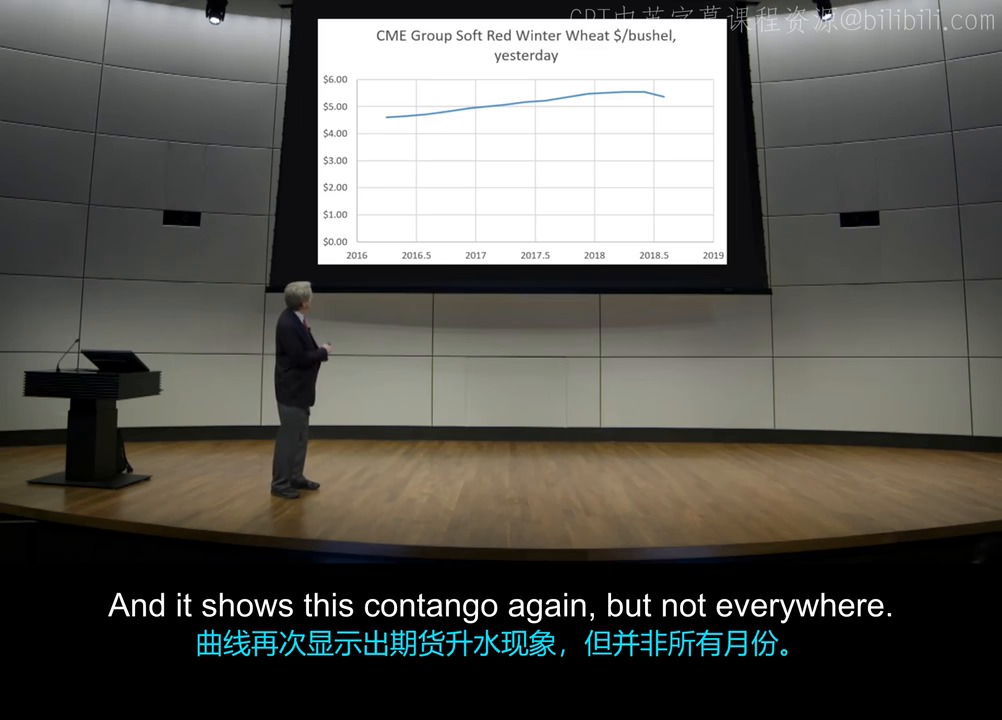
And you can see it. roughly May. So in May of 2016, it's not going into backwardation at all. May of 2017, it's slowing down a little bit. I think the prices are kind of low. A lot of commodities prices are low at this time in the new normal. But you can see it's going down quite a bit in May of 2018. But all that reflects is that they've just had a harvest. They just, you know the harvest is coming in there, they're going to dump it on the spot market, and the price is going to fall.
Just before the harvest, a lot of people are running out. The warehouses are empty. There might even be a surprise. They might have gotten emptied out faster than we thought, and there could be a shortage. That would be reflected in futures prices. The futures market makes the shortages less severe, because you can see it coming in the futures curve. So if there were a big drop in May of each year, then you'd think, oh-oh, there's going to be a shortage.
At least the market is predicting that. I better think about it, and I better hold off selling some of my wheat now because I don't want that short. So it provides what you call price discovery. So it doesn't look like there's much fear of a shortage of wheat before the next harvest. Well, right now, just before the harvest. And I've been watching the harvest.
I've been watching the squirrels in my yard, and I feel some sympathy for them, because they're tearing up my whole lawn, looking for the last acorn that they buried. They're like, it's really a basic business. Squirrels are in the same business, storing acorns over the winter. And depending on the acorn crop last year, the squirrels are either in an okay shape or they're starving.
This is the tough time of the year to be a squirrel. So I don't know, if you look at a squirrel. I don't know, if you look at lawns, they're really tearing up the lawns. And I think that's because they're, maybe it's a bad year for squirrels. So the futures price for acorns in the squirrel land is really high right now. They need a futures market, but they're not smart enough to invent something like that.
Trading and Settlement: A Contract's Life from Trade Date to Expiration
So again, when someone buys a futures contract, one agrees with the exchange to a daily settlement procedure. Now, on the floor of the exchange, they traditionally used hand signals, because, and this goes back to Dojima. It shows that Dojima is really the source of the whole idea of futures trading. So you get all these people together in a so-called pit, where traders talk to each other, but there's so much noise that you can't hear someone's statement, someone standing right next to you, they're all shouting.
So they developed a sign language. So if you want to buy features, you put up your hand like this, meaning buy. And then you had ways of singling the number, the price. And if you sell, I guess you have your hand out, meaning I want to sell. The Dojima contract also had some funny features. They wanted to impose a trading hours in Japan back then, a long time ago.
And so they, they did. They didn't have clock, so they couldn't put up a nice clock on the wall in those times. So they had a burning fuse. And at the, just before the closing of trading, they would light the fuse and everyone would see the fire. And when the fire went out, that was a warning, you know, like a five-minute warning, the market will be closed as of that time.
And they wanted to stop trading after the market closed. And so they had what were called watermen who came with buckets of water and they walked around the trading floor and they looked for someone who was still trading and they splashed them with water to stop trading. We don't do that anymore. In fact, now it's all largely electronic. There still are, if you can still go to the CME in Chicago and see people on the floor trading with their hand signals, but it's last time I heard.
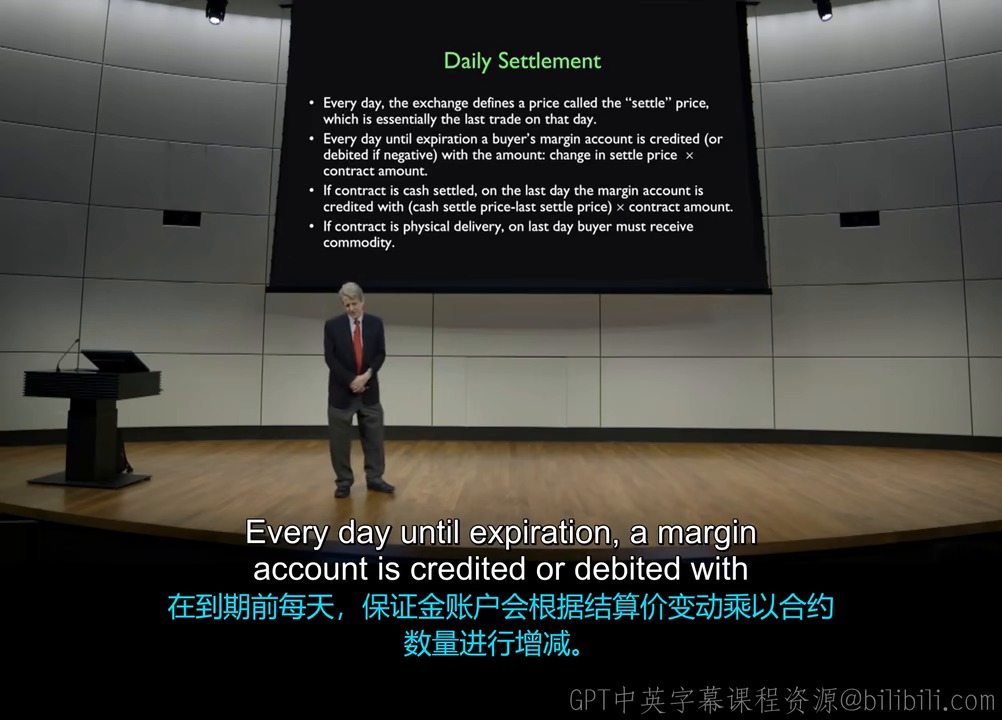
I was there on the floor a few years ago. It looked awfully quiet. It's dying down because so much more is electronic. So I mentioned. before there's daily settlement every day until expiration. A margin account is credited or debited with an amount equal to the change in the settle price times the contract amount. Oh, by the way, the settle price, you might think of that as the last trade of yesterday.
But the problem is that they're worried about people trying to manipulate the last trade of yesterday because it could be a small trade, and then there would be big settlements based on the trade. So in order to protect that, they have a settlement committee that looks at the final trades and asks whether they're representative. And they might choose a settled price, which is not the same as the closing price, the last price.
All right. So the only difference is the last day. So if it's a physically settled commodity, physical delivery futures market, the last day is different. The last day, if you haven't closed, out by the last day. If you're a seller, you'd better be there with your trucks of grains. And if you're a buyer, you'd better be there with empty trucks to load it in.
But the only people who do that, everyone else is closed out before the last day. The only people who do that are arbitrageurs. So a farmer in Iowa who is planting a crop expected to yield 50,000 bushels is essentially the is essentially long 50,000 bushels, and so sells, let's say, 10 Chicago-September corn contracts for the price on that date and post-margin.
A corn produced products manufacturer plans to buy corn at that time and buys the 10 contract. But again, they never talk to each other or meet each other or worry about each other because they're both doing this with the exchange. So they locked in the price for both of them. I'm really curious about the role of arbitrage in the futures markets. Someone could, for example, take possession of rice or iron ore, but then if the price is too low, sell it at the spot price.
However, if the underlying commodities actually an index rather than a tangibly traded future, what is the role for arbitrage in creating sort of that layer of efficiency? Okay, good question. So let me get back to the core idea of the core idea of a futures market. Let's start with, as you described, physical delivery. So let's talk about a corn futures market. We have that at the Chicago Mercant, CME group.
One contract is 5,000 bushels. You can buy corn for a year in the future. What does it mean to buy corn a year in the future? What it means is I put up margin today. So 5,000 bushels might cause something like $50,000 depending on the price. So if I agree to buy 5,000 bushels in one year at $10 a bushel, do I have to put up $50,000 today? No. You only have to put up margin today. And then your margin account is credited or depleted as the price changes.
And at the final, there's a final settlement at the end where you either have to deliver the corn and take the then futures price. And what tends to bring the futures price in line with corn price in the future is as you say, the fact that if the futures price differed a lot from the price of corn, if the futures price were, let's say, below the spot price of corn on that date, then people would be buying the futures and bringing the corn for delivery and selling it, which they tend to make the two convert. That's what you understand already. But the other side is, what if the contract is cash settled, then you have the same daily resettlement. So if I buy S&P 500 index futures for delivery in one year. What it means is that the price today, if it never
changed, would lead me to a settlement at the end. Well, there's two S&P 500 index futures. There's one, the regular conventional one, which is $250 times index, and there's the E-mini, which is $50 times the index. Now there's nothing you can deliver. You can't deliver the S&P 500 index. It's just a number. But it's the same thing that you have to put up margin at the beginning, and then the daily resettlement of your, based on changes in the futures market, will raise or lower your margin account.
But when you come to the end, there's a final settlement. Now this is maybe what is a little bit, tricky to understand. The final settlement does not involve you coming with 5,000 bushels of corn and arriving at the facility that receives corn or empty trucks to receive 5,000 bushels of corn. There's no such thing. But on the last day there's a final settlement, which is the difference between the last futures price and the actual index.
So it's as if you had, it represents the profit or loss you would have made if you actually delivered the index. So that means that if the futures price is below the S&P 500 index on the day before the final settlement, you can be an arbitrator's just the same. You don't have, all you have to do is buy a contract. And that's all you need to do because it'll automatically settle at the end as the difference between the index and the futures price.
So it's even easier to arbitrage the financial futures contract. So it happens quite reliably. That is, what's quite reliable is on the last day when the final, when the delivery day, that corn price future is going to be exactly the same as the price of a, well, of a bushel of corn. And the S&P 500 index, future is going to be, I mean, within a tiny margin of error, the same as the S&P 500 index.
So it's a clever system, I hope I made that clear, but it's, but cash settlement opens up the possibility of doing many more kinds of index, I was mentioning my home price future. That's a cash settled contract. We can't deliver homes. That would be kind of tough. How would you deliver? a home. And also homes are not standardized. They're all different. When you have a physical delivery as a settlement procedure, it has to be possible to define precisely what it is that's delivered.
But homes are so variable, and some of them are beat up and run down, and some of them are beset by crime, and some of them are wonderful neighborhoods. I mean, it's all so intangible. So you need cash settled futures. It's kind of remarkable that cash settled futures didn't really occur until a few decades ago because it's a great idea. It's one of those inventions in finance that I like to talk about.
Fair Value of Futures: Interest, Storage, and Convenience Yield
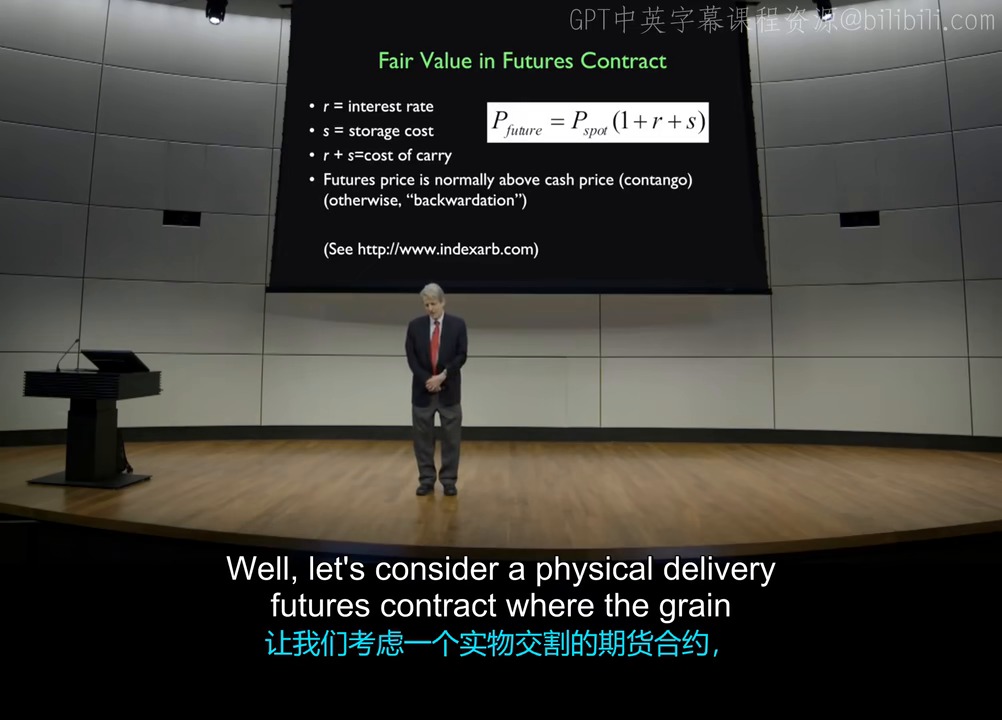
Now here's an important concept. Fair value in futures contract. It's a little bit like the forward interest parity that we talked about in forward rates. What should the futures price be? Well, let's consider a physical delivery futures contract where the grain is in storage and there's a percent storage cost, per unit of time, let's say per year. So s is the percent of the value of the commodity that it would cost you to store it for one year.
That's something that is quoted to you by a warehouse. The warehouse will tell you, I'll store it for you for one year by such and such an amount in dollars. You divide that by the value of it today, and that's the storage cost as a percent. R is the interest rate for the same interval of time. So we're talking now about a futures contract, let's say one year ahead, or it could be any other year ahead, times ahead, but we have to adjust if it's one month ahead, then we want the one month interest rate and the one month storage cost.
The fair value equation, the famous equation, says the price of the future is equal to the price of the spot times 1 plus r plus s, which says that normal because R and S are normally positive, futures contracts are generally in contango. They're generally upward sloping. Because the longer in the future that the contract is dated, the higher R is, remember this is, R per month if it's one month in the future, it's R per year if it's one year in the future, which would be 12 times bigger.
So you can see that it makes for an upward sloping futures contract normally. except at harvest time, maybe. At harvest time, you can say this doesn't apply anymore. You can put it in different way. One way is saying it doesn't apply anymore because nobody's storing anymore. But then, of course, somebody is storing. I mean, you've got it stored somewhere, but maybe it's gotten kind of rare.
Another thought, some people say that we can end up in backwardation if the storage cost becomes negative. Now that's a way of thinking of how can the storage cost be negative? Well, it can be. Here's how it can happen. Go to a manufacturer of breakfast cereals. This guy feels it's very important that we ship so many cartons of breakfast cereal every month.
And there's uncertainty about shipments and deliveries. So the guy there wants to keep a store of grain. let's say wheat, in the factory warehouse. Because if you don't, suppose you're a maker of wheaties and you suddenly run out of wheat, then your employees all show up one morning to make wheaties and there's no wheat. So you have to pay them for the day's work and they didn't do anything.
So you're losing money. So you want to have wheat in store at all time. So suppose wheat is getting really scarce. It's the end of the season, and the harvest is not in yet, so you can't buy it from the farmers. You might actually quote a negative storage cost to someone who wants to store wheat, right? You'd say, look, I don't want to risk my factory shutting down, so I'll just charge you minus 2% if you let me store the wheat.
So that's in effect what happens in backwardation. Or another way of saying it is that if the commodity is not in storage, then it is possible that the future, if you want to call this as a normal storage cost, the price of the future can be less than fair value. So that's sometimes happened.
Oil Futures: Storage Technology, Politics, and Price Volatility
Now, I wanted to talk about oil futures, because that's especially interesting right now with the volatile oil prices. So there's Chicago Mercantile Exchange bought the New York Mercantile. CME is gobbling up other exchanges left and right. They bought NYMEX, the New York Mercantile Exchange, which was the principal oil futures market. And so now it's also CME.
But their big contract is crude, light, sweet oil. I don't know why they call it sweet. I wouldn't taste it, but the contract size is 1,000 barrels. And there's a lot of these open interest is the total number of contracts that are outstanding as of any time. So that's an outdated number, 431,000. And it trades by physical delivery. There's also a Brent crude contract at the International Petroleum Exchange in London, et cetera.
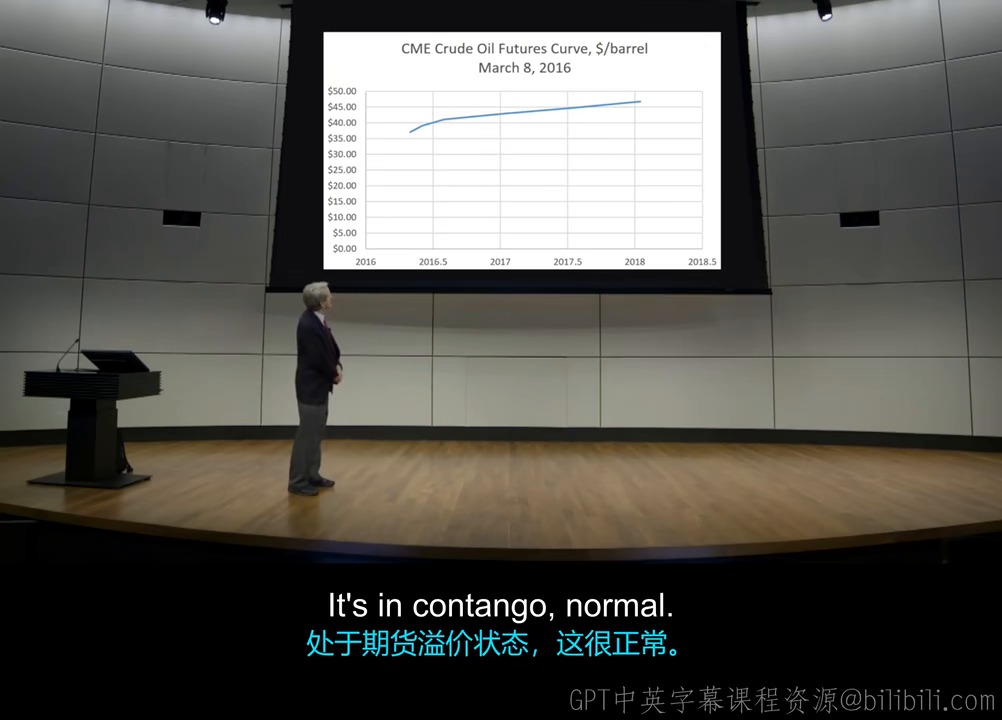
Here's the futures. curve as of March 2016. It's in contango, normal. It's upward sloping. So when you hear oil prices quoted, you'll probably hear the nearest futures market. And that's the close, I think it's April. And then it just keeps going up. So we have relatively low oil prices now. But the market thinks that they're going to go up. But it's also maybe just fair value, because people who are storing, this is, how much is it going up?
Because somebody's storing oil, they wouldn't, see, it's a mixture of whether this is really an expectation of future oil prices, or it's just interest rates and storage costs. It's also an expectation of increases in prices, but it equilibrates to equal fair value. Now, the, interesting thing about oil that most people don't probably realize is that most of the inventory of oil is moving through the metaphoric pipeline.
I don't need necessarily, literally an oil pipeline. But most of the oil is in the ground. We don't have storage for most of the oil. It's not above the ground. There's no point in pumping it out of the ground and then paying for an expensive storage facility. So it's mostly in the ground. And what's out of the ground is moving through the pipeline. And it's going all different places.
Most of the, do I have a slide on this? Most of the oil that is sold is sold in long-term contracts. Most of the buyers of oil, we're talking about crude oil, are refiners who have a regular process. They want to have it regularly delivered every month, however often. And they have a special contract. which is long term. So there is no spot oil price, there's no obvious spot oil price.
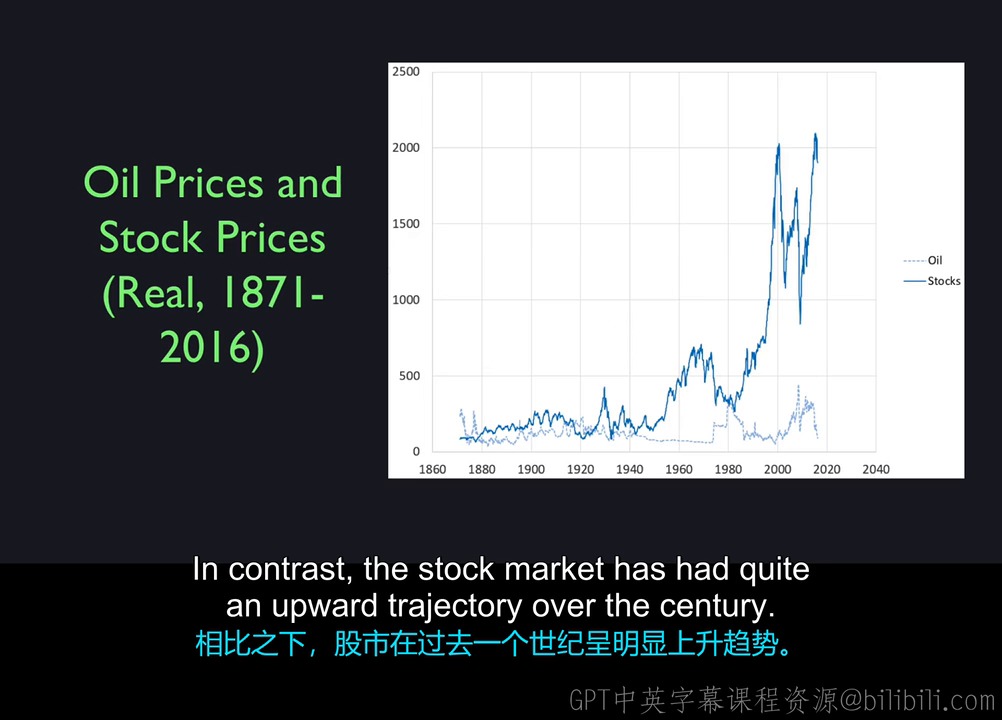
Now there are spot oil prices, but it's overwhelming majority of oil is not sold on the spot market. And the spot oil price is a volatile number that differs from place to place. So again, when you look at oil price, typically when they quote that, they're quoting the nearest future contract. So it's slightly in the future. So this is a plot of oil prices from global financial data.
Well, the oil prices are back to 1871. And I've converted them to real terms. That's the dash line. The thing I'm emphasizing is the oil price, but it's kind of outclassed by the stock price, which I put on with it. So this is an interesting chart because what it shows is that for the last hundred years in real terms, oil has not gone up in price. In fact, it's quite a bit lower right now, a lot lower, than its 1871 price.
In contrast, the stock market has had quite an upward trajectory over the century. Now, most people think that we're running out of oil. Well, we are obviously running out of oil because we are, we only have so much in the ground. We won't have it. in the future once we use it up. So there's always been talk of running out of oil. So there should be an up trend, but there is no uptrend at all.
I think that's because they're discovering alternative energy sources. They're discovering more oil all the time, new ways of extracting oil that was unexracting. extractable in the past, and we always keep surprising ourselves with the abundance of oil. And whether it will ever go up, for sure, is not really known, because there are, we're getting solar power developed more, nuclear power may be developed in a better way, and it may just fizzle the whole thing.
Nobody knows. But let me go back to some of the history. In 1891, the Texas Railroad Commission was established to regulate railroad rates. But in 1917, the U.S. Pipeline Petroleum Law put pipelines of oil as common carriers under the control of the commission. So they effectively controlled and stabilized oil prices from 1917 until 1919. 1970. And you can see that on this chart, more or less. Well, that's 1917.
And that's 1973. Especially right in this period from after World War II until 1972 or three, it was absolutely constant. They just didn't allow oil prices to change. We had a government control of oil prices. But then, this was the first oil crisis. You can see there was a huge spike up. This is what actually happened was the U.S. ran out of oil. The U.S. was the first country to be a big oil refiner.
We drilled oil wells all over the place. We discovered oil in many places in the U.S. And we just went through it and exhausted it. Then we had to rely on foreign oil. We were starting to rely on it around here. And then we hit the first oil crisis. So, oh, there. are other things happened. Governments around the world started nationalizing oil. Mexico was the first in 1938, Iran in 1951.
It began to be a military thing. Ownership of oil was not, like other things. The government would grab it. The word nationalization became popular in the 19th century. Because oil was considered our national heritage. How did these oil companies get control of our oil? Let's just take it back. And they got away with it. Organization of Petroleum Exporting Countries was established in 1960 by these countries.
And then they kept adding members. And the purpose of OPEC was fixing prices. They wanted to keep them up. And they didn't want the other people. These countries dominant, US is not a member of OPEC. We didn't have any more oil. So we couldn't be a member. We didn't count. But these other countries, we had some oil, but not a big producer. These other countries would get together and agree to limit their production of oil to keep the price up.
Now, there's a fundamental problem with the world oil market. And the problem is the property rights are not clear. Most people thought, over all this time, that oil prices were going to head higher. But they didn't. But they thought they would. So you'd think they would hold oil off the market. But they never did, not as a world. And that's because I think they didn't feel confident in their ownership of oil.
Typically, oil is controlled by some government, non-democratic government, tenuous hold on power. Their feel threatened, there's terrorists attacking them. They want people to be happy. So they just pump oil at a real a really high rate. And they don't care about the future, because I might not be dictator in the future. And so they didn't limit their... OPEC was trying to get them to limit their production of oil.
They keep prices up. But they've had various problems. And they're particularly weak today because of conflict in the Middle East. In the first oil crisis, it was due to Arab countries' retaliation for U.S. support of Israel in the Yom Kippur War. They cut back, they managed to because ideologically, they weren't very good at rigging prices, but when they get mad and embarrassed by a war that they lost, they wanted to do something.
And they could cut, they did succeed in causing an oil crisis, which caused a worldwide recession. It was also the biggest drop in the U.S. stock market, the biggest two-year drop since the Great Depression. The second oil crisis, again was caused by a political situation, the Iranian revolution, which led to war in the Persian Gulf and disrupted oil supplies.
And it caused the greatest recession ever, second grade, after the great, they called it the Great Recession. But we've re-taken that word and used it to refer to the 2007-2009 recession. But it was the worst depression since, recession since the Depression, of the 1890s. The political situation in OPEC deteriorated, and the OPEC cartel got weak after the 1980s, which allowed oil prices to fall.
The United States has a list, has a bunch of oil reserves because of volatility in oil prices. So we've created here in the U.S. a strategic petroleum reserve that started. It stores hundreds of millions of barrels of oil, or 60 days' supply, roughly, but it hasn't been used to stabilize prices. It's been used as a reserve in case of war or some serious event.
In 2000, Clinton established a heating oil reserve originally in New York and New Haven, right here, storing heating oil. And today, the heating oil reserve is in Groton, Connecticut, and Revere, Massachusetts. The government has taken oil, because they're worried about people not being able to heat their homes. This is a smaller reserve, and they have sold from it to try to stabilize prices.
The Persian Gulf War, 1990, 1991, was another major disruption, not as big as the first and second oil crisis. So, and then there was a second oil. It seems to be oil. is driven primarily by politics. Oil price fluctuations. The second Gulf War oil price spike came in in 2003. And now, 2008, we've had, after the financial crisis, we've had extremely volatile oil prices.
of oil got to $113 a barrel at the height of the financial crisis. Again, it makes it look like it was caused by, maybe it was partly caused by, we've had financial. and economic crises whenever oil price spiked. But this one wasn't caused by a war in the Middle East or anything like that. Then, after this peak price, it fell to under $30 a barrel by 2016. Part of the reason it fell is new technology.
In response to this very high price per barrel, the new technology called fracking was developed to produce an increased supply of oil. There is a danger of market manipulation. And we already have surveillance against market manipulators. The stock exchanges have their own surveillance departments. So, yes, that's a possibility. That's not a speculator. That's a manipulator.
Yeah, so there have been talk about during wartime a country could take a position in a stock market of another country, and then make some proclamation of war or something to move the market a lot, and then sell, and then change you and say, no, we weren't really starting a war. We're just talking. But I don't know how many historical examples there are of that.
I think market manipulation is a proven phenomenon, but it's not as big, I think, as people imagine, especially when we have market surveillance. So, now the other thing is I am not one to say that markets are efficient. I was just here praising speculation, but I'm not saying that they work perfectly. And I've written papers saying that there's excess volatility.
And that's coming from speculators. So it's an in-between picture. We do have speculator-induced volatility. reduced volatility. But we also have a price that makes some general sense. It would be much worse without the speculators.
S&P Index Futures and Federal Funds Futures
Now, there's another kind of futures contract, which is a financial futures, developed much later. And so one example of that is the S&P 500 stock price futures. And that's cash settled rather than physical delivery. And the settlement is, at the last day, is equal to $250 times the index on the last day minus the futures price the day before. So the fair value for this, it looks similar to the fair value for commodities.
The fair value, which is what the price should be, is equal to the price, I could say, times 1 plus R minus Y, where Y is the dividend real. But that's the same formula if you make y equal to minus a negative storage cost. The storage cost for stocks is negative because they pay a dividend, And if you, storing stocks, you get the dividend. So it's the same fair value formula, except that minus y equals S.
The federal funds futures market is another example of a financial futures market. But it's a market on the federal funds rate, which is the interest rate charged by banks on loans to each other. And it's also the overnight interest rate that the Fed targets in its monetary policy. It was created by the Chicago Board of Trade in 1988. And of course it's cash settled.
You can't physically deliver the federal funds rate. The settlement price is 100 minus the annualized federal funds rate averaged over the contract month. It's used widely to show expectations of actions of the federal open market committee. So I don't have a fair value for the federal funds futures market because it's not storable. But it's an overnight contract you're just predicting.
But it's often used to tell you what the expectations are for interest rates in the future. So basically you understand that the price represents 100 minus the annualized federal funds rate. I'm interested in the federal funds rate futures market. How accurate is it in predicting the Fed's behavior and what economic value does it add? Well, the federal funds rate is the policy tool of the, or target of the Federal Reserve system.
They announced targets for the federal funds rate in their regular statements of the FOMF Federal Open Market Committee. So the federal funds futures market is watched a lot. Often, people are paying attention to the near-term market. So they're trying to predict the federal funds rate just months into the future. There's a lot of thought that goes into this.
So this is a futures market that I think would be filled with a lot of intelligent speculators who want to really hit the target. And as such, I think it is a successful market that the price reflecting, expectations of future federal funds rate is widely accepted as a barometer of the likely outcome of the next FOMC meeting. I think it's a good indicator, and I think there's a reason for that. The kinds of things that are, where speculation is poorer, is in markets like the stock market. What does the stock price predict?
Well, theoretically, ideally it predicts some kind of present value of future dividends or earnings. Well, but how long into the future is that? A long time into the future because the stock market isn't going away. When you own a company, you own it for eternity as long as that company lives. So it's a prediction not of something that's coming right up and is being talked about concretely.
It's a prediction about something. in the indefinite future. So that market doesn't seem to work as well as a prediction market as the federal funds futures market. So I think markets work really well. Market efficiency works really well when it's a short-term, clear outcome prediction that is talked about and that is studied. When you look at the federal funds futures market, people who trade in that, they seem to be focused on what is that number going to be?
When you look at the stock market, it's much more nebulous and less perfect.