Nonprofits and Alternative Forms of Organization
Nonprofits: No Shareholders Does Not Mean No Incentives
So what I'm getting at now is the part of our economy that is not selfish, apparently, or that might be an overly simplifying way of putting it, but the economic theory, traditional economic theory, describes people as having a utility function, which is arguments include own consumption, and they care only about that. Only, people are unremittingly selfish in this view of the world.
Economists like to describe that as practical and sensible. But I think the attitude that economists often have is colored by interdepartmental rivalry, as we've discussed before. And we're not the psych department. So we want to describe people in a chillingly realistic frame as totally selfish. But in fact, people are not totally selfish. They may be often selfish, I don't deny that, but when you get down to, maybe as you mature in life, you get down to a feeling that, why am I trying to amass all this?
What am I going to do? with it? What do I need? Do I really need all this consumption? I'm sure that that's an important part of our economy. And it's reflected in the nonprofit sector. So as I've said, pointed out before, right now, we're at Yale University, which is a non-profit. That doesn't mean that it's all motivated by benevolence, but it's not profit.
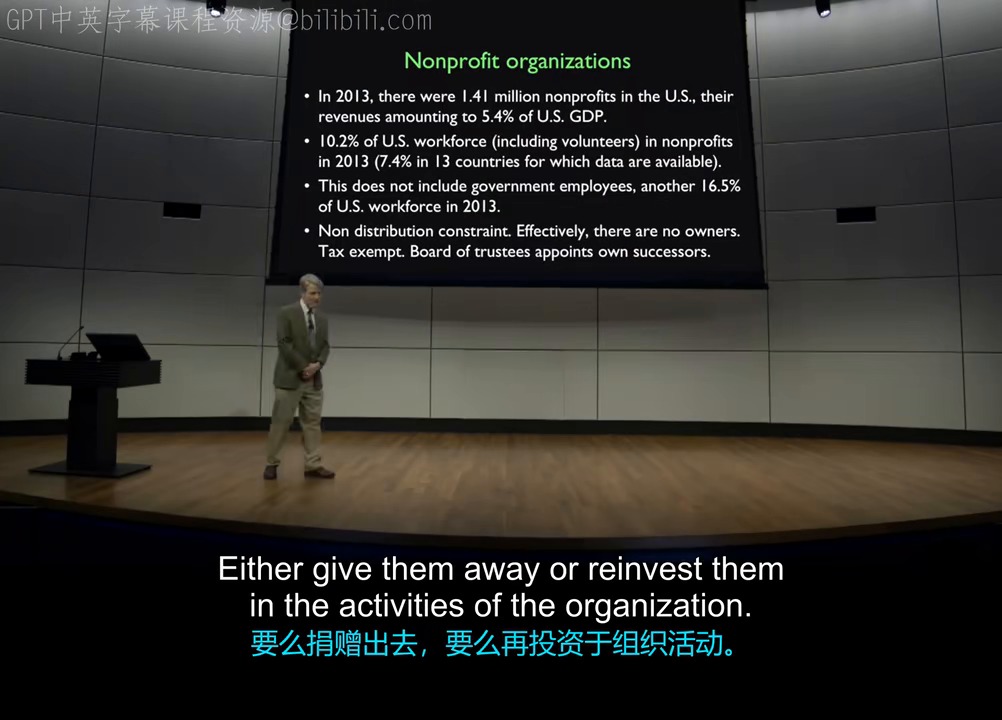
Nobody gets to, there's no dividends, there's no stock. So people may be pursuing their own advantage, but underlying it, there's a different frame. And I wanted to talk about that. Let me start with nonprofits. How many are there? In 2013, there were 1.41 million nonprofit companies in the United States. This is not the government. It's not paying a dividend to anyone.
There's no shares in it. owns itself. So they're like individuals. They exist for the benefit of, well, of their cause. And people have causes and nonprofits have causes. In the United States, in 2013, employment in nonprofits was 10.2% of the workforce. Some of those are volunteers who are working for nothing. So you wonder, why would anyone work for nothing?
Often they're older people, so you retire, and now you don't have to work for nothing. and now you don't have to work anymore, but then you're sitting at home watching television and you're saying, what am I doing? Why should I do this? It doesn't have any deep meaning at all. It should be working. So they end up working for nothing. As long as they have the income to support themselves, why not?
Makes perfectly good sense. The average over 13 countries, mostly advanced countries, was 7.4%. of the workforce is nonprofit. So what is a nonprofit? It's an organization. It's a business, but with one key different, there's a non-distribution constraint. They don't give back the profits as dividends. They have to reinvest them, either give them away, or reinvest them in the activities of the organization.
This is the percentage of workforce in nonprofits by country. in 2013. And it ranges from 12.7% for Israel down to 3.7% for Brazil. Tends to be higher in advanced countries. Maybe that's because they're wealthier and people aren't at the edge and needing all of their income. But I think it's also something about the development of civil society that seems to be part of emerging countries.
Start with a low relatively low civil society. See, I think ultimately giving away is essential to civil society. Well, civil society goes back to ancient Greece. Aristotle coined the term, although it's called Coinonia Politique in Greek. Later, Cicero, the Roman senator, translated into Latin, and called it Societas Civilis. that civil society. But it's just people looking out with a benevolent impulse at all of our society and wanting to help, finding meaning in that.
So one example of civil society, I'm just thinking, is Charles Darwin. You've heard of him. Well, he was a student at Cambridge, Christ College, Cambridge, and he never went on to be a professor. But he took a course in botany, and Professor John Stevens Henslow was so impressed with this young man who wanted to explore then a new idea that man descended from the apes.
I discovered there was an 1848 book called Vestages by Chambers, which threw out a lot of evidence that man descended from apes and that there was a long evolutionary history. It was a very controversial book. And it wasn't scholarly enough. I mean, it was in a sense. It showed pictures of fossils. But Darwin wanted to study this. And he impressed his professor, and the professor got him money for a two-year voyage to collect information.
It wasn't the government that did this. It was just a philanthropist. So this guy, was a bit of a spiritualist, and he somehow thought he would discover something about theology from supporting Darwin. He could not have gone to Parliament to make a case to support Darwin. It's not the kind of thing that happens. I think great scientific discoveries are often not appreciated by members of Parliament, and so they don't happen.
So, Now, non-profits do not distribute profits as dividends. However, they have a history of distributing profits as bonuses to employees. In a recent study, 42% of all nonprofits have a formal executive bonus system. That's because nonprofits have to compete. When you take a job, you look at what they're offering you, even if you are selfless, you are influenced by what they pay you.
Moreover, you have to be incentivized to do good work. It doesn't matter whether you're working for a profit or a nonprofit. You have to be incentivized. So they do the same thing that other businesses do. If you do good work, we give you a bonus at the end of the year. So suppose you decided that your town needs a hospital. Someone you know is sick and you see the hospital is overcrowded.
They need more. funding, more, so you wonder, why isn't it happening? There is a shortage of hospital beds. Somehow it isn't happening. So you decide, you're entrepreneurial, you decide, hey, I can make this happen. So what do you do? Well, you can start a for-profit hospital, and we know how that is. You bring people together, you go to an investment banker, you talk about placing shares in this for-profit enterprise, you can do that.
But maybe that isn't the best way to do it. And I'm talking to you as a real, alive person, maybe you don't want to do it that way. So the other way you do it, again, you are just, you have a purpose. You want better hospital. This is very real. It's something about inequality, if only rich people can afford to go to a hospital. You want to deal with this problem and you care about your community.
So what do you do? Well, you might want to go, instead of going to go, Instead of going to an investment banker, you go to the biggest church or temple, or I should add mosque in town, and ask them, I want to start a hospital, and I'm thinking I could name it after your church or some saint or someone that is meaningful to you, and then make it a religious hospital.
This then brings the whole community of adherence to that religion into sympathy with your cause. and you can get donations. Instead of going to an investment banker, you get free contributions. So the thing is, what is it that motivates people to do non-profit businesses? I think that people's motivations are very complicated, and as we learn more and more about science of psychology and neuroscience, we're understanding that there are societal impulses, there are community impulses, there's need for companionship, senses, of loyalty.
All these are there. But there are other impulses that are not necessarily so good. There's an impulse to hoard. In an extreme case, it's called compulsive hoarding. I understand there's a television show. I've never seen it. I don't watch much TV about compulsive hoarders. But there are some people who are illustrated in this show. in the show who just never throw anything away and fill their whole house up with junk.
So Richestan is a book by Robert Frank, not the academic Robert Frank, but another writer about the rich element of our country, arguing that we're separating like into two countries where we have the rich and super rich. There is growing a sort of entrepreneurial spirit in this country, as he documents, that is repulsed by political correctness. might not allow any kinds of inequality, but there should be a certain amount of inequality for hiring or rewarding talented people to use their talents for good causes And so there is some, even amongst rising inequality, there is some sense of temperance of the hurting instinct and recognition that inequality within limits serve certain purposes.
Cooperatives: One Member, One Vote—Turning Consumers into Owners
So now a cooperative, a cooperative is different. So the simplest way, as I have said before, of defining a cooperative, it's a business that it may distribute profits, so it's not a non-profit, but it doesn't do it in the same way. And the voting system is different. That is, it's one person, one vote. So in a sense, this allows it to be taken over by someone with very little money, but the assumption is that it won't happen, that it will bring idealists together.
So this is the first cooperative society in history. They weren't encouraging women. They were all men. They were kind of modern when this photo was taken. This is 1844. Photography was kind of still a rather, when did the first photographs come in? Late 1830s, I think. So this is a pretty good job. this group portrait from then. So in 1844, in that building, it's in some town in England, looks like it has an ad on one side of it now, they set up a food store called the Rochdale was it Roachdale Pioneers?
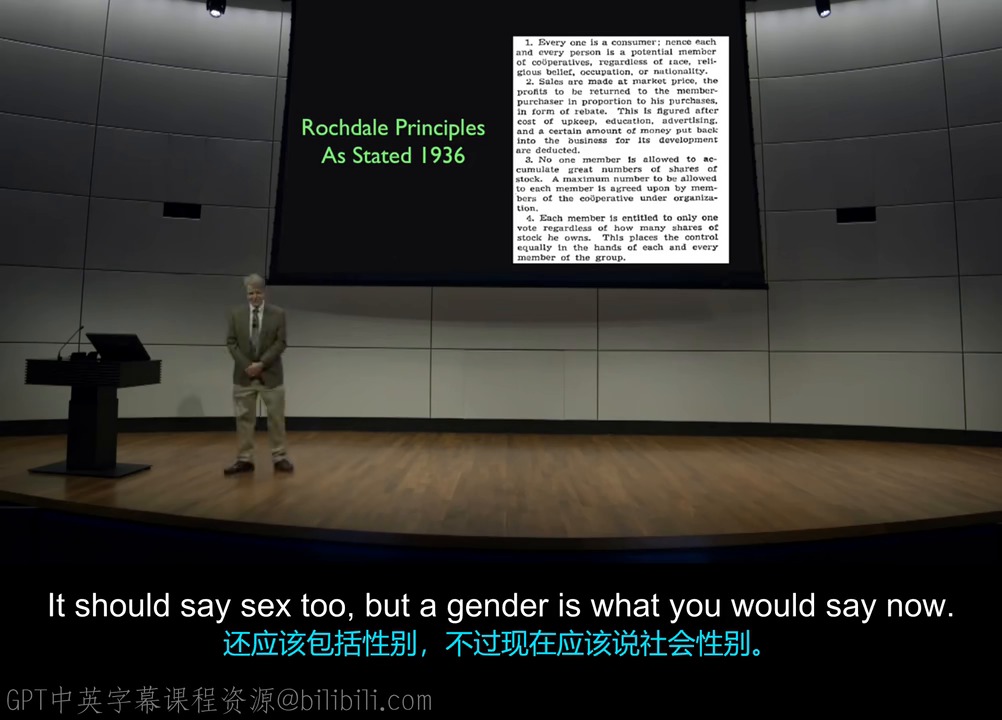
Do anyone know about this? I think you can go there and shop there. I think it's still going. More is it still going. thing now. So they set up what were called the Rochdale Principles, but I couldn't find the original Rochdale Principles, but maybe these are the, but this was as stated in 1936. But I think it reaches back to their original principles. Everyone is a consumer, hence every person is a potential member of cooperatives, regardless of race, religion, belief, occupation, or nationality.
It should say sex too, or just. or gender is what we would say it now. It did put race in already. So they're benevolent to all people. So the profits are returned to the membership in proportion to purchases in the form of a rebate at the end of, probably at the end of a year. They've tallied up everything you bought at their store, and then they give you the profits back as a percentage of how much you shopped.
So, no, I think they may not have exactly had one person, one vote, but they had a limit on the number of shares of stock that one could get. Oh, it does say, right. Each member is entitled to only one vote, regardless of how many shares of stock, he, I should add, or she owns. The places, this place is controlled equally in the hands of each and every member of the group.
The idea of a cooperative is that it It's totally different spiritually than a for-profit corporation, even though it is for-profit. But the profits are distributed to the people who shop there. It's a fundamentally different feeling. So in 1885, Yale students set up a cooperative for Yale student, undergrad, and they call it the Yale Cooperative Society. And they had a store.
It's now called the Yale Bookstore. It's no longer. They have a funny habit of failing cooperative societies. So the idea that the Rochdale people created was an idea that corporate structure matters and that they would set up something with a different voting structure and a different core charter for the company, and it would make for a different movement.
So here is an article that points out that voluntary, open membership, Democratic member, control, membership, member economic participation so that the store you are not trying to sell, you're not fishing for fools out there, trying to sell to suckers who will buy something that's not good for you. You're selling it to yourselves, and it hopes to survive by some sense of loyalty.
So you describe the same business, for example, a grocery store can operate in either a full-profit form or as a co-operator. Right. So how could you speak to the difference in the business strategies for these kind of different business forms? Yeah, in fact, the very first cooperative, according to historians, is the Rochdale Society. It was a grocery store in the 1840s in the United Kingdom.
And you can look at, they've issued a statement, look at what their statement was. It was something. about wanting to serve our community better. And what I think that ultimately means is not just creating the appearance of doing better, but actually doing better. For example, giving foods that are healthy. And of course, for-profit stores have an incentive, of course, to give food that it's healthy.
But the incentive isn't exactly aligned, right? They're not going to be like a good mother to you and put the best things out for health. They have an incentive to play little tricks on you, maybe harmless, that tempt you to buy things that have a higher profit margin. And so cooperative grocery stores give the appearance of less value. Their prices might be higher.
And they might not have things, candies, for example, that you wanted. But they have a community spirit that offsets that. So I think that's the idea. And the problem is that they're not that successful. There are not that many cooperative grocery stores. I think they tend to thrive in strong communities where people talk to each other and know about it. And they can't really advertise what they're doing.
It may not be convincing. And they have to charge higher prices in order to get power. Or lower wages to the people who work there. But you sense the difference in atmosphere. And I think there's something valuable there. Interesting. So we think that we're talking about making a on the value they deliver. So could you speak to should cooperate at its full steam to maximize the profits for the community members?
Well, I think they should maximize. Yeah, the thing about a cooperative is that they will let other people who are not members shop there, but it's designed for the members. And they are paid a reimbursement at the end of the year on their purchases. So it's for these, for the members. And the members have equal votes in the, so the vote, they can get together and vote to do whatever they want.
But it's our store, you know, I'm planning to shop here and I'm meeting with them and deciding. So it tends to, what would you do? I mean, if we could set up, a cooperative right now here. And do you want me to maximum? the dividend I pay you at the end? Probably not, right? You're not doing it for that reason. So they're maximizing something. It's the welfare of the group.
But it's not the same thing as the pure profit maximization.
Benefit Corporations: Writing Social Purpose into a For-Profit Charter
The third thing is about alternatives to both non-profits and cooperatives. And the latest innovation, which is getting some traction in the United States, is the Benefit Corporation. This is a new corporate forum, first created in the state of Maryland. Now you understand that securities law, or corporate law, securities law has a federal component, but corporate law still resides in the states.
So any change in corporate law has to be replicated over 50 states. The first benefit corporation was created in Maryland in 2010. I have to update this. I said now 11 states have it. I think it's getting close to 30 states. It's sweeping the nation. This is like I mentioned before workers' compensation, or as they said, workmen's compensation, swept the nation in the progressive era in the teens.
One state after another, we're adopting laws that required corporations to buy insurance for employees' accidents at work. Similarly, we are going right now through a similar revolution where state after state is creating benefit corporation. So what is it? It's a new kind of corporate charter that you can adopt either as a new company or as an existing company, you can change your charter so that you become a benefit corporation.
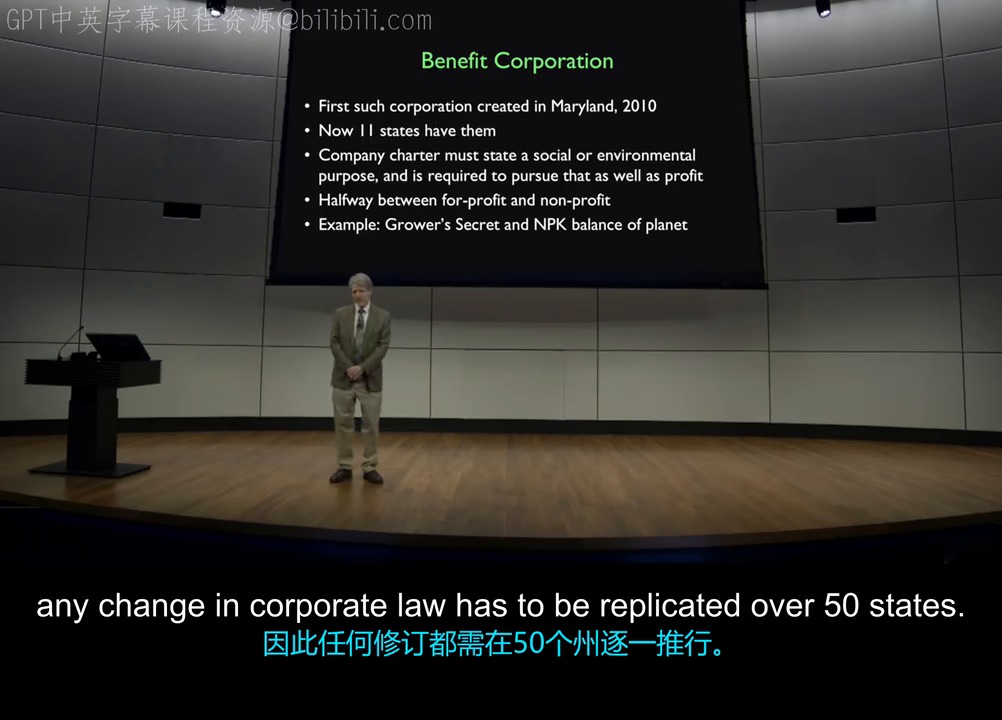
So what is a benefit corporation? It's something halfway between for-profit and non-profit. It has profits. It makes profits, but it has a dual objective. It's for-profits and for some social or environmental purpose that is stated in the company's charter. So an example is growers' secret. is a fertilizer company, and their statement of purpose is to restore the NPK balance of the planet.
Do you know what NPK? Anyone know what NPK stands for? Nitrogen, phosphorus, potassium. Right. Those are elements. on the periodic table. And the oceans of the world have had a certain balance of those three elements, but they are getting off from their old balance, and it's harming, it's a potential environmental hazard if it gets much worse. So this environmental hazard is apparently known somewhat.
One of you knows about it. it's not attracting a lot of attention, but it's attracting the attention of some people, like growers' secret, which is selling its fertilizer. See, the problem is farmers put tons of fertile fertilizer for their crops. Rains come and washes some of the fertilizer. It ends up in rivers, and then the rivers take that down to the ocean, and this fertilizer then contaminates the oceans of the world.
And it stays there for a long time. So growers' secret, has a cell fertilizer that don't cause this problem. Now, in a sense, all companies might be thought of as benefit corporations, but not quite, because they don't have a statement in their charter. In some countries, there are laws that reflect a demand that companies be kind to their communities. The U.S. is less likely to have laws like that.
But these are laws and requirements. The Benefit Corporation asks the company to come up with its own idea as to what it will do to help the world. And so it changes the atmosphere of a company. You know, I think the atmosphere, the corporate spirit, is really important. Thinking, having worked at a nonprofit all my life, almost all my life, I think that the spirit is different here.
So you do things out of, because it's the right thing to do more than you would in a for-profit company. So these are growing rapidly. It's still too soon. It's only six years now. It's still too soon to see whether they'll be a success. I'm thinking that they may well be a success. And so. I think there will be a lot more changes like this in the future. Once again, the theme of this course is that one of the themes of this course is that finance is a technology.
It thrives on invention. I think that we're making big steps forward now with a broader concept of finance than we had 20, 30 years ago. We recognize that human beings are part of society, that human beings are psychological. They are sometimes rational. They're not always rational. They have quirks of judgment. We have to try to design our financial instruments around all of these.
So I think that among, if you take account of human psychology and realities of human nature better, there will be a big future for some of these alternative forms, which in the past have had significance, like nonprofits or cooperatives or the other forms we just discussed. And these will have important new dimensions in the future.
Public, Private, and Nonprofit: No Form Is Automatically Pure
Well, there are historical attitudes that certain kinds of businesses are better run by private, some by the government. So typically countries have education in as a government run more often than they'll have steel production as government run. And there might be various reasons why governments are. more adept at handling issues that involve sensitive externalities, sensitive human issues that are politically difficult.
By the way, it's not just an issue of government versus for-profit. There's also in-between-type organizations like nonprofits. Right here, we're sitting in-between. in a nonprofit. Yale University is a nonprofit. And this building was the gift of Mr. Evans, who was the CEO of McMillan Publishing. So is this government or is this for-profit? It's neither. Ultimately, our society is made good by people, who set up institutions either governmental, for-profit or non-profit for their own aims, which are often, I don't think that it's easy to describe human motivation.
And different people find different approaches toward contributing to society. I also read your book called Efficient for Fools, and I like the idea of Efficient Equilibria. But do you think that the public companies may, like, the direct fishing equilibrium may be less extreme. For example, if the company is owned by the government, it will not try to exploit some people, like some irrationalists, people like for profit.
Like, this is not a good way. I think it takes, government-run companies have a different kind of corruption. From the government-run company, you'll have officials who are stealing money and sending it to havens in other countries so that if there's ever a revolution, they can leave and become billionaires somewhere else. Whereas private companies, when you say private, there's a distinction between public and private, even within the nonprofit.
A public company is one that is officially listed on the stock exchange and open for the general public. And a private company is one. that's held by a small number of stockholders and is not listed on a stock exchange. But I'm referring to the private sector, which is both of those. So private companies might be more important for, more likely to do tricks of the marketing form, of misrepresenting their product, of disrepresenting their product, of, jumping on, one example that Akroloff and I gave in our book, Fishing for Fools, was of patent medicine before regulation of medicines.
So regulations on drugs that could be sold to the public began in various countries around 1900. But before 1900, generally, you could sell anything. The only remedy is if you bought some medicine at the drugstore and gave it to your child and the child died right after taking it, you could sue them for that. But if it wasn't clear cut like that, they could just keep selling it indefinitely.
So most medicines were fake. They didn't test them at all. They just put something on. that they, you claim, it's fraud. But those regulations now are not very controversial. Although one of Donald Trump's appointee, one of his nominations for government said that he thought that we should not require proved effectiveness of medicines before they're marketed.
Now, that is something of a somewhat extreme libertarian view. I guess you could argue that maybe you can experiment with unproven drugs on the general public by marketing them. Maybe that would work out. I don't think so, though.