Endowments and Asset Managers
Joe McNay on Long-Horizon Venture Investing
All right, I want to tell you another story. This is a Yale story. Joe McNay was an invest, I think he was a Yale graduate. The class of 1954 was celebrating the 25th anniversary of their graduation. That would be in 1979. And somebody said, this guy, Joe McNay is a great investor. Why don't we, as a class, give money to Joe McNay and just ask him to invest it for 25 years and turn it over to Yale University as our gift.
But we don't turn it over now, because apparently they thought that the Yale portfolio was not managed well at all. And so this was before David Swenson became the head of the Yale portfolio. So Yale was investing in government bonds and safe things like that. They couldn't stomach the variation that you see in investments. But Joe McNabbard. was just this creative guy.
And they said, hey, you know, this is just our celebration for our 25th anniversary. We don't care about this 370,000. We want you to invest it for maximum returns. And you can take chances. We're in the mood. Hey, we're all having our beers together 25 years later. It isn't often that investors will tell that to an investment manager. So, right? They don't say, if you lose all of it, well, OK.
We don't care, but we think you can do it. So please try. So Joe McNay invested it in Walmart, Home Depot, and some internet stocks. So he took Walmart as this, it's like an Apple corporation, really volatile. He thought, well, they've told me I can do this. And so he gave the Yale University $90 million, quite a success. Yes.
The Household Balance Sheet: What Do Professional Asset Managers Manage?
The other part of this lecture is about professional money managers. Now this is different from investment banker or commercial banker. We're talking about people who invest other people's money by taking over the management of their portfolio. So they deal with a public. Now you could say a commercial bank is like a money manager because it's taking your money as a deposit and it's investing it in something, loans or mortgages, But we're talking more about now, we're talking about people who invest, who take your money in a different way and invests it in stocks and bonds or other normal investable assets in the open market.
Not necessarily public, they could be private. So I wanted to just first look at what it is that Americans hold. America is probably typical of advanced countries today. So this is just first look at what it is that Americans hold. the total assets of U.S. households. Now unfortunately, the Federal Reserve that compute these statistics puts non-profits in with households.
That's because they're like households. They're not owned by anybody. So what do you make of them? But almost all of this is households. So it just tells you where the money is. So the total is $101. This is in billion, so this is $101 trillion. So that's the total. assets of Americans. If you divide that by the population, I think that's about, that's on the next slide, actually. It's about 270,000 per person. So this is a rich country, I think you'd say, if the average person owns $270,000. Another way of putting it is, take a traditional family of four, okay, that's four persons. The traditional family of four, mom, dad, two kids is now a minority of the U.S. population.
But they're still there. But let's take that traditional family. That says they have over a million dollars. So the typical, if you do it this way, calculation, you divide 101 trillion by 320 million and multiply by four, you get a million dollars. So the typical household is a millionaire. A million dollars isn't what it used to be. On the other hand, we're living pretty well.
In my hand, we're living pretty well. But I have to qualify that. Remember, we have great income inequality in the United States. So that's the average household. The median household would be much lower than that. And the bottom 10 percentile would have assets of just about zero. But anyway, let's look at this average and where it is. So the Federal Reserve in Table B 101 computes totals of assets held.
So you just get in an average. idea what people own. So about a quarter of that $100 trillion is real estate. People own homes. This is the value of the homes. It's not subtracting the mortgage yet because people owe money, but we're just looking at the assets now on a balance sheet. So that's the biggest single thing, I guess, homes. People own their homes.
They also own interest in pension funds. This is a big business. It's almost as big as your house. That is, when you take your first job, they will probably tell you that we will be contributing to a pension fund for you, or promising to pay you. We're going to talk about pension funds in a minute. That amounts to about $20 trillion. Now, equity in non-corporate business, that's an estimate. Lots of people have businesses, and they're not corporate. They're not trade.
corporate, they're not traded on any stock exchange, but they've tried to value them, and they assume these businesses together are worth about over 10 trillion. And then stock, now these are stocks owned directly by the public. It's 13 trillion, it's about half of what they own in household. Now again, this would be very limited among the bottom half of the population.
There's a certain, it's wealthy people typically who own stocks. Or dilettante, people who like it, who are interested in investing. Deposits are about the same, but they're distributed to lower income people, more. Bank deposit, that's about 10 trillion. Mutual funds are coming back to that, is an indirect ownership of stocks and bonds. That's 8 trillion. Consumer Durables, this is your car, your living room, furniture.
I don't know what else. Everything you own, durable item that you own, that we don't normally value, but they've put a value on it. It's about $5 trillion. Government bonds, treasury securities, not so much. People don't generally, most people, your grandmother may have given you a saving bond as a Christmas present, but it's not worth much, right? The public is just not into buying them directly, but they're bought indirectly.
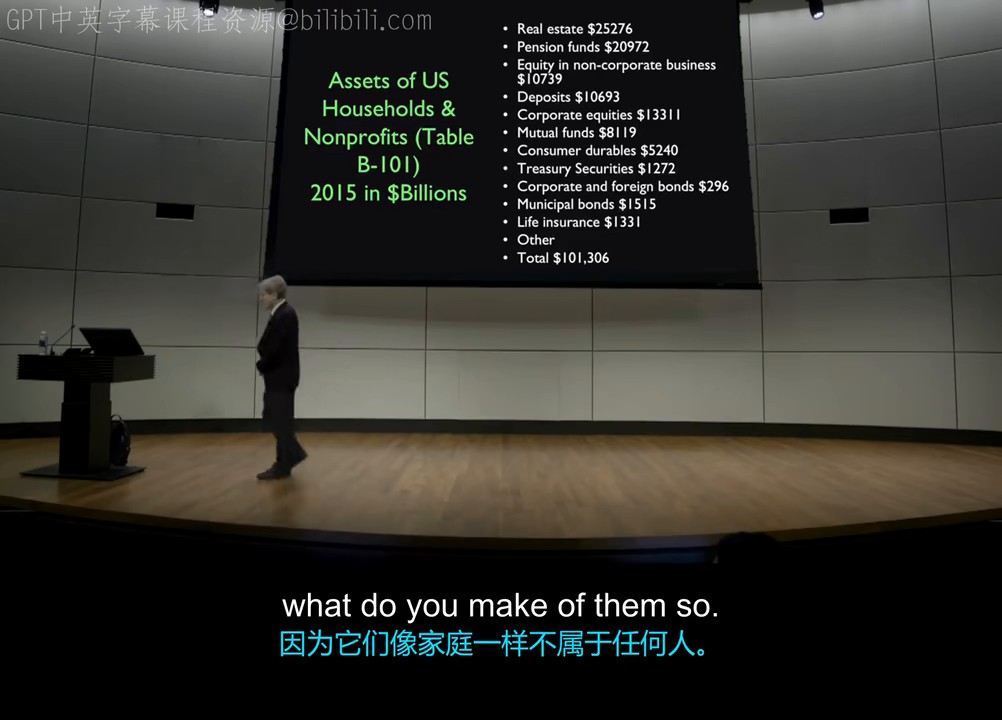
It's in there. pension funds and mutual funds. Most people just don't get into buying government bonds. Corporate bonds are even small. Look at that, it's only 296 billion. So the typical household is not owning corporate-issued bonds. They're a little bit higher on municipal bonds. They'll own them directly. Municipal bonds are bonds issued by local governments, and they have the advantages that they're tax-free.
So wealthy people, particularly who are in high tax brackets, like these, and they will own them directly. Life insurance is another $1 trillion. People have life insurance policies with cash values. And other, I didn't fill that in, but that's what people own. So anyway, today when we're talking about pension funds, mutual, funds, what else? Pension funds and mutual funds.
We're talking about something like close to $30 trillion, which is managed by institutional investors. Oh, I have to talk about liabilities. Those are the assets, but they also owe money. So this is, again, from the Federal Reserve, the same table. Home mortgages, almost $10 trillion. So that is that you have a, what do we say, $25 trillion for real estate minus $10 trillion.
So it's about $15 trillion in net worth invested in houses. Now, consumer credit is another liability. These are things that you owe on the mortgage and you owe on your credit card. Or it could also be another form of consumer credit like when you buy furniture from a store or they would give it you on installment. That's only $3.5 trillion. Loans that people take out at banks, not so big.
$1.5 trillion, not counting mortgages. Most loans are in the form of mortgages, but you can get a vacation loan or a college loan, as you may have heard, some of you. The total liabilities are $14.5 trillion. So the difference between assets and liabilities is $86 trillion. So that won't bring us up to a million dollars per household. I was doing it just assets and not considering the liability.
The Prudent-Person Rule: Defining Good Conduct for Asset Managers
The prudent man has been changed to the prudent person, but regulators have wondered, how can we define what good behavior is among investment managers? In 1974, ERISA, the Employment Retirees Income Security Act, defined a prudent man, and required that investment managers behave like a prudent man, a prudent person, and that is quoting the act, with the care, skill, prudence, and diligence under the circumstances then prevailing that a prudent man acting in like capacity and familiar with such matters would use in the conduct of an enterprise of a like character and with like aims.
It's the strangest regulatory demand. What it's telling investment managers to do is do what somebody else would do in this circumstance. Well, that's maybe overstating it a little bit. But you don't have to do exactly. what they're doing, but it has to be prudent. This prudent man rule has been a bug bear for investment managers ever since 1974. The Dodd-Frank Act doesn't ever use prudent person.
We've updated it now. We can't say man. It has to be gender neutral. But beyond that, they've dropped person out completely, and they call it prudential standards. That appears 34 times in the Dodd-Frank Act. And we're moving away from the reliance on the prudent person rule into having more concrete regulatory standards. However, there's so many details. If you move away from the prudent person standard, what do you substitute?
Now we have to be explicit. And the financial world is so complicated. A financial advisor is anyone who advises others on the value of securities or the advisor of investment or who publishes analyses. It excludes bankers, lawyers, reporters, and professors. So I am not your investment advisor. I have to not claim that I am. We're only getting general education and not tailored advice.
Financial advisors listen to your situation and give advice that's tailored to your situation. It also excludes broker-dealer. So now we're trying to get past the prudent person. We have to regulate all of these people. We have to define their different categories. A broker dealer is a company that you would go to to buy and sell securities. And when you call your broker, you could just say, I want to place a, you know, a limit order to buy this share at such and such a price.
That would be a pure broker-dealer interaction. But typically people, when they call their broker, they'll all say, I'm thinking of buying these shares. What do you think? And so the regulators decided not to tell the broker-dealer that he can't answer that question. So he is a bit, he or she is a bit like an investment advisor, but it's excluded from the category.
So financial advisors are then regulated. See, in the United States, the National Securities Markets Improvement Act of 1996 required that all advisors managing more than 30 million each must register with the SEC. Those earning, managing less than 25 million, have to register with their state securities regulator. You might wonder what, if I manage 27 million, if I'm between 25 and 30. Well, then you have a discretion.
You've got to go to one or the other. The Act does not mention prudent person, but it does, bar convicted felons from serving as an advisor. So we're trying to get good people. Now, a financial planner is someone different. That does comprehensive planning for life for you. It's not regulated. We have organizations like the Financial Planning Association, which certifies people as certified financial planner.
The Dodd-Frank Act, even though it's a thousand pages long, asked for only a study of financial planners. This is too many details for, the world is, how do we regulate them? That's a problem.
Advice Salon: Can Automation Replace Human Judgment?
If you're looking for a financial advisor, what should you look for in the traits? If this is someone who you should be calling in the middle of the night when you're having a dispute or when you're wrestling with a financial challenge in your household, how do you even qualify someone for taking on such a task? Well, that's a good question. I think one thing is you have to talk to other people who have financial advice and get referrals, references from them, because I think a lot of it is a sense that you have when dealing with someone, whether they really have your interest at heart or not.
There are also organizations that certify advisors like National Association of Personal Financial advisors. Not a perfect organization. They got into some financial scandal a couple of years ago, but I think that they're a good organization overall. And one can work through these means as well. There's been a trend of more automated advisory services. And you talk a lot about client relations and also just kind of the quirks of social behaviors. Do you, how do you see the trend evolving? And do you think that more computerized mechanisms could really replace that personal connection that financial advisors are able to carry?
See, this gets back to the same question we were just talking about, about machines replacing jobs. Now, you might think that financial advisor would be one of the last jobs that a machine would replace. But it is happening. And the machines, you know, I guess an advisor always asked similar questions, what's your risk tolerance? What are your goals in life? How old are you? Things like that. Well, a machine can answer them and give stock answers as well. This is a big trend in our society and it's replacing a lot of jobs. The question is, is financial advice high on the list of jobs that will be replaced? And I'm thinking it's actually relatively low on the list in the sense that these programs will be helpful. But I think that it's actually relatively low on the list in the sense that these programs
will be helpful. But I think that at some point in making important decisions about your future life, you do want to have a real person. It's like the same question. Well, here we are on a MOOC on Coursera. We're in a course that kind of replaces direct human contact with something recorded. But I think that still, teachers will not decline in our society precisely because of a basic human trait that you don't want to be just listening to a machine. You want to have some kind of relation with your teacher. And I think it's the same with financial advisors. They can motivate you better. They're more, they're part of your world.
And I think that's probably where we're heading. So I'm thinking that financial advice is not going to be completely mechanized. But I think it's maybe a good idea to look at some of these websites to get some insights. What do you think about some of the other things like Robo Advisors? And she hinted at algorithmic trading and dark pools and shadow banking, things that are also financial tool-based.
Where do you think that that's taking the industry in a good place? or a not so great place? Well, I think it's, I'm all for progress. And automation seems to me involve some of those things. And that one problem with financial advice is that it's expensive. The kind of people who can give good advice are also well positioned to make money doing something else.
So you have to pay them for it. So to hire a financial advisor on a fee-only basis might cost you 300. dollars an hour. And for lower income people, that sounds just impossible to pay for that. So we need, we need, another thing I've been advocating is government subsidy that operates at lower income levels for financial advice. The current tax deduction that's available for financial advice applies only to high income people who deduct or we have in the high tax brackets. But I'd like to see some payment for financial advice to lower income people.
Now, we already have some of that through philanthropy. This is where philanthropists come in. We have legal advice clinics that don't charge for low income people. But if you talk to someone who works at a legal advice clinic, you will quickly find out that they're swamped. And they can't go to bat for these people. A lot of the issues like relate to marital problems.
And there's husband and wife or disputing something. You can't go to bat for one or the other. It's just, unless you're, you can't pay for this. It's just not enough. So anyway, I think that government's support of advice services or philanthropic support is something that would be helpful in the future. The Dodd-Frank Act in the United States created things that sounded like it, but they're not really funded to, you know, we have like the consumer financial products, did I say that right?
The Consumer Financial Bureau. Protection Bureau. Yeah. You can give complaints there and you can get help sometimes, but it's not the same as having your own lawyer representing your interest. But I think, yeah, so this is something that as computers replace normal human labor, One thing that I think that we'll end up with more people in the advice business.
We'll have more psychotherapists, too. We need more of the... My wife's the psychotherapist. But lots of people would benefit from having someone to talk to regularly about their problems. Do you think, I mean, in your view, is financial advice needed for people that have below a certain amount of savings, or are they really just better off indexing? It seems like a lot of the data lately is there.
I think that the financial crisis hit people of low income, particularly hard, because they weren't getting elementary financial advice. They were hearing in the news that I should own a house, and then they would be encouraged to take out a mortgage for a home that they maybe... They left it to the bank to decide if they could afford the house. The bank should have experience in knowing who might default.
But the banks were selling mortgages off to the house. They didn't care. The investors were willing to buy these mortgages. There's a bit of a problem here. The rating agencies weren't really raising alarms. So something was amiss. I think that if one of these low income, and often they were selling adjustable rate mortgages whose rate might go up. After all, it didn't go up because we have zero interest rates now, but it could have gone up, and so these people would be in trouble.
I think that if they had gone to a financial advisor, in, say, 2005, 2006, just before this crisis. Some advisors wouldn't help them. It was a nebulous issue about whether you should buy a house. I'm sure some advisors would mess up. But I took a quick look at some advice books from around then that were published by Susie Orman and people like that. And I had the impression that they weren't gung-ho about taking out a big mortgage and buying a big house that you can barely afford.
I think it would have been better if they had had advice about something simple like that. And it's not so much that they need portfolio management and picking stocks. But they need also, I think they need, it's almost like a therapist. They need someone to coach them to save a little bit and tell them that, you know, you could lose your job or something could happen, and then where would you come up with money?
And a lot of people have never thought about that. They could tell you as an expert realistically, and not a Wall Street expert, a personal finance expert could tell you realistically. So, you know, there are private charities that have done things like this. Notably, in the United Kingdom, there's a big movement to what are called Citizens Advice Bureaus, which are staffed for low-income people, or it could be anyone.
They don't, but mostly customers are lower income. And you can ask about anything. Because often people's questions blur into different areas. Should I buy a house? I might get a divorce. Our child might be handicapped. All sorts of issues. And so the Citizens Advice Bureau brings the right expertise that you need. And for free, we actually have a few of them in the US.
It's not big here.
Mutual Funds, Closed-End Funds, and ETFs
Now mutual funds, that was $8 trillion. So what is a mutual fund? Well, in your book, Money Changes Everything. Will Getsman claims that they date back to the 1770s. This is the name of a Dutch. Of course, it's the Dutch who invented everything in finance. Well, I'm exaggerating, but I like that. They had one, I can't pronounce that. That's the name of a mutual fund from the 1700s.
There were many investment companies that developed over the centuries. Notably in the 1920s, there were many investment companies that offered to invest your money for you, but they weren't properly regulated. And a lot of them were playing tricks. Notably, they'd have different classes of shares, and the classes were designed in a tricky, deceptive way so that they, the owners of the Class A shares had much better prospects than the general public that were in class B shares.
So after 1929, when a lot of these investment companies revealed their really bad performance, it led to public antagonism against investment funds. Now, the leader in the United States was Massachusetts Investment Trust called MIT. No connection with the Institute of Technology. It had a fund. with only one class of investors. Moreover, it published the portfolio, so there was no secrets, and it redeemed on demand.
That is, you could, if you invested in MIT, you could get your money back any day with just a phone call. Now they had telephones, everyone had a phone. You could call MIT and say, I want my money out, and they would cash you out at the value. In other words, what your share of the total MIT portfolio was. And after, 1929, a lot of people looked on MIT as a model for investment management.
So investment company institute was set up, I think it's in the 1930s, and they began advocating for this kind of mutual, kind of investment company. And in 1940, the Investment Company Act further clarified. although the word mutual fund doesn't appear in that act. So do you understand, let me say, what is a mutual fund? They're very popular. What they do is a classic mutual fund, as defined by the SEC under regulation.
If you want to buy into a mutual fund, you have to contact the mutual fund, or there are these supermarkets now that will allow you to put in, but you're not buying shares on an exchange. You contact the mutual fund and you say, I'd like to invest in this fund. You give them a check for, say, $10,000. Then you will come in as an equal at 4 PM on the day you do that.
They only deal at the closing price. So then you now own a share of the overall portfolio for the mutual fund. subtracts expense expenses for managing the fund. They pay their salaries. But otherwise, you own what's in that portfolio, your share of what's in that portfolio. And when you decide to sell someday, you call them up again and say, I'd like it. Then at 4 p.m. on that day, they'll figure out what your share of the total portfolio is and give you that in cash.
That's a mutual fund. Another kind of investment fund was not invented until the 1990s. It's called an exchange, traded fund and it operates differently than a mutual fund. These are all described in Fabozi's chapter, which I assigned, which is a good background reading. But exchange traded funds are, maybe they're more pitched at people who like to trade in and out.
They don't like this 4 PM rule. And ETFs are a kind of investment company that, investment that is more liquid and tends to have lower management or expense ratios. They were promoted as for smart investors who don't need the mutual fund structure. So here's how it works. The first E.T.F was for Standard and Poor 500 stock price index. And called, the first ETAF was for Standard and Poor 500 stock price index.
The first ETAF was for standard and poor. was called a spider, SPDR, that's standard and poor depository receipts. And they were only going to invest in the S&P 500. You could actually buy the S&P 500 by buying an ETF. Okay? Mutual funds, let me step back in that. Mutual funds are called open-end funds because you can pull your money in and out. You're owning a share in a portfolio, and you can get it out at market value at 4 p.m. of every day.
There's another kind of fund, which, vote, he talks about, called a closed-end fund. is different from a mutual fund in that you buy a share in the fund on a stock exchange. That closed-end fund then is a share that you can't go back to the fund and say, I want my money back. The fund invests the money and it pays dividends out, but it doesn't redeem. It has IPO, it issues shares and drops them on the market.
but you can't go back to them and ask for it. Instead, you have to sell your shares. Now, the advantage to closed-end funds over mutual funds is that closed-end funds are trading continually all day long. So if the market is crashing in the morning, you don't have to wait until 4 p.m. to get your money out if you want to do that, you just sell on the exchange immediately.
But the disadvantage of a closed-end fund is that it doesn't track the value of the underlying assets necessarily. because it has its own market. And sometimes they sell at premiums and sometimes they sell at discounts. Now, there's no tight process enforcing that the value of the fund is equal to the value of the investments because you can't get your money out.
In other words, even it's very, well, it's very hard to get your money out. And so it could be selling a discount for years and you're tough luck, you know. You would say, why don't other investors know this? Well, maybe they don't trust the management, or something like that the management of the closed-end fund is incompetent. So, ETFs were developed as an alternative to closed-end funds and to mutual funds as an invention.
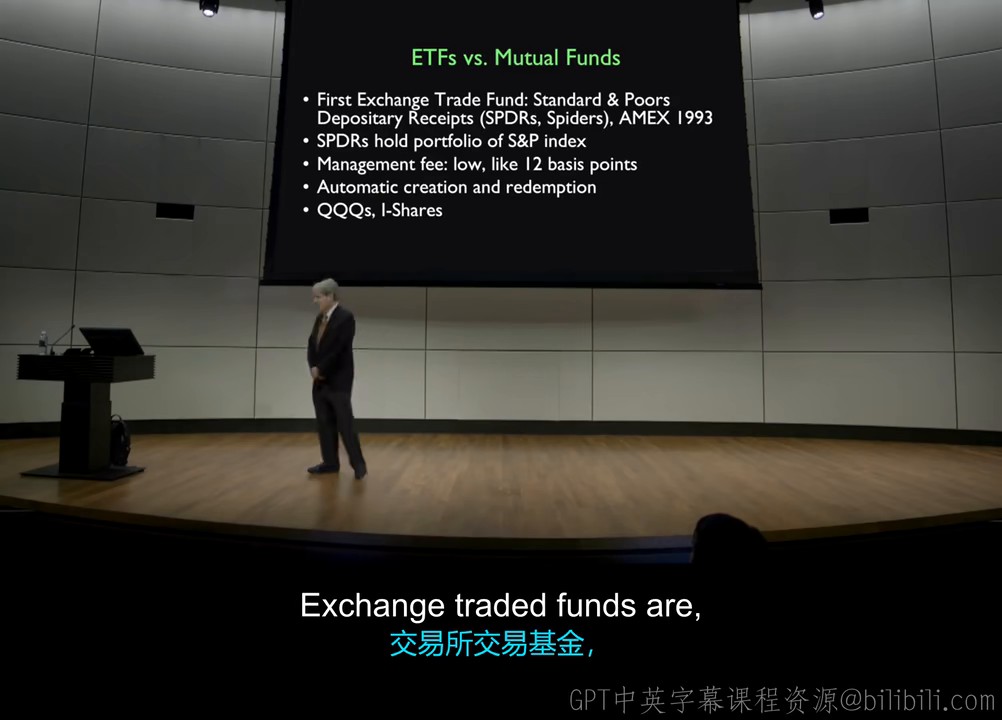
It was at the American Stock Exchange in 1993. I met the guy who invented him. What was his name? If you can't remember it at the moment, but it's not that old. He said, how can we make something like a closed-end fund that's traded on the exchange and make sure that it tracks the underlying value? And so he had the idea that we will create a fund that is not for the general public, but for arbitrage is immediately redeemable.
So if it's selling at a discount, we want to create a mechanism for, or at a premium, a mechanism. that will restore the price. So the mechanism is that they have authorized participants. When you create an ETF, like the spiders, you identify a group of Wall Street firms that we will authorize as participants in this ETF market, as opposed to just shareholders in the ETF market.
And the ETF participant, authorized participants, are authorized to either create or redeem units in large amounts, say a million dollars, that wouldn't appeal to retail investors. But we're putting in there for a purpose so that the ETF doesn't sell at a premium or a discount. So if the ETF is selling at a discount, that means you can buy it for less than the asset value, the authorized participants can redeem their, there's a process for them to redeem the shares and get the underlying shares back.
So they will do that if they will do that if they there's ever much of a discount. If they're selling at a premium, that is people are paying more for the ETF than the stocks that it holds, they can create more ETAF. But again, in big units, let's say a million dollars, it's in the contract for the ETF. So they do this. The reason we're making that happen is to keep the ETF price tracking the underlying price.
And so that's an ETF. Automatic creation and redemption. There's many ETFs now. I don't think it was shown separately on the Federal Reserve. I think it would be under stock. But a lot of people own stocks through ETFs now. But it's still not as big as mutual funds. Typically for smart investors, they don't advertise. Well, they do advertise. Spider ads, you'll see.
But I don't think it's as much. And they have a very low management. fee, typically something like 12 basis points.