Options
Options Overview: Paying a Price to Preserve a Future Choice
An option is a contract. There's both two sides to any contract. There's the buyer of the option and writer of the option. So there are two kinds of options. I've already alluded to that. A call option is a right to buy. A put option is a right to sell at your discretion. With a call option, you are buying the right to buy something, which is specified in the contract, at a predetermined price.
That means you don't have to wait to find out what the market price is of that item on the day of purchase. It's locked in in advance. But we call it an option because you don't have to purchase it. You can wait and see. It's different from a forward contract to buy something because in a forward contract you are not only having the option to buy, you are committed to buy.
You signed a contract, a forward contract to buy something in the future. It means I promise to buy it. Both sides are bound. The buying side of a forward contract is bound to buy. The selling side is bound, promised, to sell at that price. But options are, I give a choice to the buyer of the option. And at the time that the option is bought, the buyer of the option compensates the seller of the, or they call it the writer of the option.
Because the writer of the option is now subject to the choice in the future of the buyer of the option, and it has to be compensated for giving that choice to the other person. So what is the essence of options? Some people think it has something to do with free will. That is, that you can do whatever you want, and maybe you will be happier in the future if you buy it or maybe you won't. You can wait and see.
But actually in finance, it doesn't have much to do with free will or feelings generally. You will generally buy the option if it pays to do that in finance. Most people will. So you will, if it's a call option, it's an option to buy something, you will buy it. on the date specified, if the price of the option is, if the price of buying it through the option is less than the price of buying it in the open market, because you will always do that, even if you decide you don't want the object because you can then sell it in the open market and make a profit.
So options are truncated claims on asset. If it's a call option, it means that it's a call option, it means that it's a, claim on the price only if it rises above the contract option price. So that's a general idea. And so let me get a little bit more precise. The contract of the option have these terms. An exercise date or strike date, that's the date when the option expires and you either have to buy if it's a call or sell if it's a put.
And if you don't, then the option expires. option becomes worthless. And forever after, it's worthless. It's expired. It also specifies as the exercise price or strike price, which is the price at which you are in a call option case have the right to buy and in the put option case where you have the right to sell. The contract also has to specify what is the underlie, what is the object that has to be bought or sold.
And how many of that, if it's shares? Now options are not just for stocks. For example, suppose you are a builder and you're building a shopping center. You want to build a shopping center in the city, near a city. So you look around and you find, well, there's some farmland here that looks well positioned. Maybe I want to build my shopping center on this. guy's farm.
But he's a farmer, right? He doesn't know you're coming. So you walk over to him and you say, I'd like to buy an option on your farm. We haven't really finalized this deal to build a shopping center, but maybe we'll change our mind. But we want to know that we can get your farm. The farmer might first say, no way, what do you want my farm? And then you say, look, it's just an option.
If it expires unused, you just keep the money. So maybe the farmer will do that. He'll think about it and say, well, this guy's offering me money right now. Maybe nothing will come of it. So that's an example of an option. And undoubtedly has a long history. There must have been many times going back to Sumerian times, if you listen to Will Getsman, when people thought of that.
I'm thinking of buying something, but I don't know that the seller is willing to sell. so you would buy an option.
Reading Option Quotes: The Value of Waiting beyond Intrinsic Value
So, this is from one of Will Getsman's books. Not the one I assigned for you. It was one that he wrote with Roenhorst. But it was a collection of essays, and these two Dutchmen, Gelder Bloom and Yonker. Well, three of the four are Dutch. You can tell these Dutch names. Writing about the history of options. Well, the first options that are well documented come from Holland in the, maybe the 1600s, but this is an example from the year 1730.
And unfortunately, it's in Dutch. I don't know if any of you can read that, but this is an example of an option to buy shares in, I can't pronounce this right. It's like the General Royal India Company, which is a Dutch company in 1730. And so this is the options contract. Now the other thing that's kind of neat, the Dutch were the most advanced. financially people in the world in the 1600s and maybe into the 1700s.
This is a printed form. You see it's got it's nicely done. This is printed. And someone has filled in the blanks in handwriting to make it an option contract. That was an important, this might be the beginning of the information age. Printed forms was a way of sort of putting in a program, right? A standard program. Some people call it boilerplate, referring to the plates that they made the printing from.
So it says, I, the undersigned, and it's... Later, the options became much more common, and they were in newspapers. This is a clipping that I took 20 years ago or so from probably the Wall Street Journal, which used to carry options. prices in the printed edition. So that's all, but I took this off of the web yesterday. The CBOE, Chicago Board Options Exchange, has a website.
And this is, I just picked the company at random. This is Intel Corporation. It's a manufacturer of computer chips. And this is, the price of the share, last quote, I guess that's closing price. probably for last Friday. It was $31.63 per share. Notice it's about $30. That's because companies do splits whenever it gets much farther than that, because by America, this is very American.
This looks right for the price of a share. And they'll keep splitting it if it keeps going up, so it stays around there. And it's paying a dividend per share of 26 cents quarterly. That's the... underlying stock. Now, it shows, like in the newspaper column, it shows the exercise prices. Now, I think they're trying to be confusing here. INTC for Intel Corporation is the ticker for Intel.
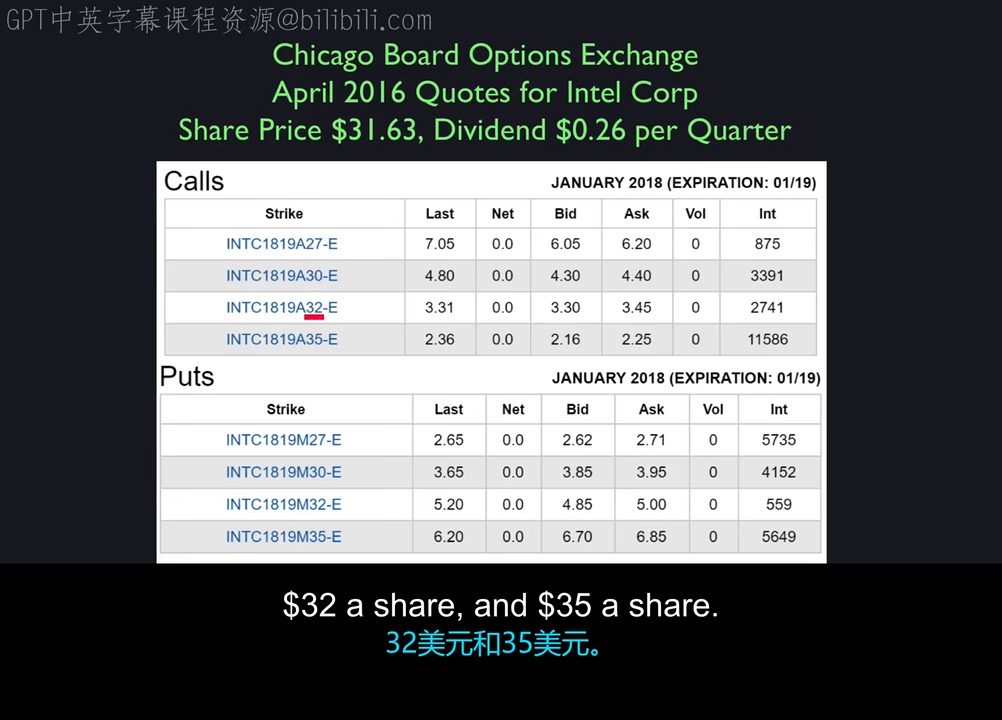
What is the ticker? It's an abbreviation for the company name, which is used in financial reporting. It's a four-letter ticker, which is a clue that it's a four-letter ticker. NASDAQ listed rather than New York Stock Exchange, which normally lists stop at three letters. And so it gives the, well, here is the strike prices. $27 a share, $30 a share, $32 a share, and $35 a share.
And now the price per share is 31. This is the right to buy it for more than it's selling for today. So it's out. of the money. So I wouldn't want, why would anyone want this option if it's a right to buy the share for more than it costs to buy it? Well, I'll tell you why someone would buy this option, because it might go up. The price might go up. And you could, well, you'd say, well, if you think it might go up, why don't you just buy the share?
Well, but if I buy the share, I'm incurring a risk that it might go down. I could lose, I have to pay $31 to get a share. I could lose. the whole thing if there was some really bad news. But here I only have, when I buy the option, I'm only paying $2.36. So I'm not risking as much, so I'll do, I mean, this looks like a reasonable price. Well, it probably is a reasonable price because it's the market price for the option.
So you'll be willing to pay $2.36 for the thought that you will, if the price of a share, goes up above $35. That's not too far from where it is now. Then I'll be able to buy it for only $35. So that's worth something. This one is in the money, because I could buy it today for $7. Well, forget the price of buying it. I could buy it today and then exercise it at $27, and then it would be immediately worth $31. That's a difference of $4.63.
So would it be smart to buy this option today and exercise it immediately? No, because you'd lose money, because you paid more for the option than you'd make as profit. You'd make the difference between $27 and $31.63, which is $4.63. But I just paid $7 for that right. So I wouldn't exercise it immediately. Generally, you don't want to exercise options early.
because they have option value. The option value is the risk, is the value that you get to the upside without so much downside. So you generally want to wait to exercise an option. That means demand that you buy the stock in the case of a call at the exercise price. But now, they also have two other prices, bid and ask. That's because this is an actual last price that a trade was made, but things have changed since then.
I was doing this on a Sunday, by the way. There are dealers, market makers, who are quoting prices that you can buy and sell that. So the bid price is what the, if you want to sell your option back, you can buy, the dealer is offering $6.5 for the $27 strike price option. Or but if you want to buy the option, the market maker is offering $6.20. There's a difference that's called a bid-ask spread.
So the dealer is asking 15 cents more per option than the dealer is willing to pay. That's how the dealer makes money. This strike price 35 seems to be the most active. So it has the most narrow bid-ask spread. It's the most competitive market.
Why Options Exist: Complete Markets and Human Psychology
So I want to go right to the question, why do we have options? Why do they matter? And there's both a theoretical approach to that, and there's a behavioral approach to that. The theoretical reason goes back to Kenneth Arrow, who is a highly esteemed mathematical economist, who talked about economic efficiency, meaning efficiency in our economic system, requiring that all risks are traded.
And the risk that a stock will go up above the strike price, or go above another strike price, are all risks that might matter to some person who needs help, and has risk that somehow focus on that risk, and would like to trade the risk in order to reduce the risk, or maybe to do some kind of business. So Arrow gave the sense that a major sense that a major of economic inefficiency is cured by options market.
And Stephen Ross, who used to be here at Yale, is still living here in New Haven, has a famous paper in 1976 called Options and Efficiency, arguing that options, if you have a complete set of options, you've, in a sense, completed the market. You've dissected the risk into all the different strike prices and exercise dates into many risks. Each stock is really many risks, not just one, and they matter differentially to different people.
That's the pure theory of justification of options, and there's much truth in that. But I want to add to that also a behavioral approach to options pricing. So behavioral finance looks at how people really think, or how they, sometimes they don't act logically. One thing we pointed out already about behavioral, is that people pay attention to salient things.
That's a cycle, maybe it's a psych term saying something that grabs your attention. And so it seems like people overreact to the news. For example, after a flood, lots of people buy flood insurance for their homes. Why didn't they buy it before that? They should have known, right, that there's a possibility of a flood. But, uh, But they don't, people are human, right?
And they forget. So they all of a sudden want flood insurance. A put option is like insurance on a stock. Suppose you're owning a stock and you think, I have big hopes for this stock, but suddenly something scares me and I think that the stock price might fall. So I would then buy a put option on the shares I own with an out-of-the-money strike price, way below the current price of the stock, and that puts a floor on my investment, because if the stock falls below that, I can always exercise the option and sell it at this option price.
Hirsch, Sheffron, and Meyer Stapman, are two behavioral finance people who describe what they call a silky a silver lining theory, a theory that find, that people in their emotions don't look only at the bottom line. They look at different aspects of their portfolio. And suppose the stock market has gone way down and you've lost a lot of money and you're feeling bad.
Why did I put all this money in the stock market? But then you look that you also put up put on some of your shares and then you feel better. You feel I'm kicking myself for having put so much in the stock market but at least I had the good sense to buy some puts on some of my shares so that I had the right to sell them and I didn't lose so much money and so you just feel better.
The theory here is that people don't focus appropriately as financial theory says on their total portfolio. They look at little details and they think, well, I lost a lot of money, but there's a silver lining. I put on my actions, I put some of it into puts, and boy, am I glad I did that. So if people think that way, that opens up the option for the option, the possibility for salespeople to kind of manipulate you and deceive you into buying options.
So Shephran and Statman in their famous paper on silver lining, quote a investment, this is a book, I'm quoting, I'm taking their quote from it, a book by Mr. Gross, who writes about how to be a stockbroker. So the title of his book is The Art of Selling Intangibles, How to Make Your Millions by investing other people's money. Now you can tell from this title of the book that Mr. Gross is not highly committed to serving his clients well. In fact, it's quite the opposite.
Mr. Gross is telling you how to make a lot of money off of ignorant people. And what we like about this book is that Mr. Gross really comes out and says it. In fact, he gives you scripts for what to do on the phone with your clients. So you're now, suppose you're a stockbroker and you deal in stocks and options, and you've recommended some stocks to somebody, and they have done badly.
So you are Joe Salesman. You have told me that you have not been, now he's on the phone with John Prospect, maybe he's a prospect for him to sell an option to. You've told me you've not been too pleased with your stock market investments. And John Prospect says, that's right. I'm satisfied, I'm dissatisfied with a return. So now Joe Salesman swings into action, trying to give him a point of view that makes him vulnerable to a sale of an option.
Starting tomorrow, how would you like to have three sources of profit every time you buy a common stock? Now this is really fishing, as Akronoff and I call it. You're supposed to be focused on the bottom line, not on three separate sources. But he wants you to think of it that way. So you'll feel better about yourself, having done it this way. So predictably, Mr. Prospect responds, three sources of profit, what are they?
And the sale, no, what he's trying to get this guy to do, who has bought a stock that's gone down, and maybe he's worried about it, but he's hoping it will still go up. So he's saying, why don't you write a call on your option? I'll arrange it. You'll write a call and sell the, with an out-of-the-money strike price. That means that a price higher than the stock is right now.
So the salesman explained. First, you could collect a lot of dollars. maybe hundreds, sometimes thousand, for simply agreeing to sell your just-bought stock at a higher price than you paid. And that's your money to keep forever. Your second source of profit would be the dividends you do as the owner of the stock. You'll still collect dividends on the stock.
They go directly. You're the owner, you still get them. The third source of profit would be the increase in the price from what you paid to the agreed selling price. All you're giving up, is the up the possibility that the price goes up even more than what the selling the strike price and then he says don't don't think about that you're it says it's a what is the you are only giving up the unknown unknowable profit profit possibility above the agreed price this these words are all carefully chosen to deceive you So he's right, there are three sources of profit, but you as a logical, rational, economic, human being should be asking, well, I don't care about the three separate sources.
I want to add them up and look if it's the profit. But he doesn't add, in fact, he doesn't even quote any numbers. Well, except three, he tells you there's three sources of profit. He doesn't tell you how big they are. So all you're doing is giving up this, the unknown, unknowable profit-profit possibility beyond the strike price, as if that's nothing. But that could be a lot.
And so it's just, this argument to sell and call option makes no sense. It can only make sense if he puts numbers on those three sources of profit, and then you add them up. You're supposed to do that. But apparently, not a lot of people don't think that way. So that's another reason why we have options.
The Ubiquity of Options: From Mortgage Default to Financial Stability
Well, options are everywhere. It's not just in stock options. I mentioned farm options. But there's option value in other things as well. Mortgages involve an option to default. Now, in the United States, we have 50 states in the United States of America. And each has its own mortgage regulator. And some states are called recourse states. and some are called non-recourse states.
So here in Connecticut, we live in a recourse state. What that means is if you buy a house and take out a mortgage to borrow, to get the house, and then you stop paying, the mortgage lender can go after you. They can garnish your paycheck, they can do legal proceedings to make you pay. In a non-recourse state, such as California, When you fail to pay on your mortgage, you default on your mortgage, the lender has only the right to evict you from the house and take the house, but cannot go after you further.
So in a non-recourse state, a mortgage is really an option of sorts. You can always just walk away from the mortgage. In fact, you can do something that's called jingle mail. You take the keys to your house, you put them in an envelope, and you mail it to the mortgage lender, and you say, I'm out of here, take the house. That's not a right in Connecticut. Options are very old, as I said, but exchanges for options are not so old.
In fact, we didn't have an options exchange until 1973 when the Chicago board options exchange separated itself from the Chicago Board of Trade and started the first options. And then they had standardized options. When I showed you that Dutch option from 1730, something was standardized, the form was standardized, but it didn't have a standardized strike price or exercise date because those were to be filled in.
The problem with those Dutch options in 1730 is that you didn't even know what the market price was. You know, they didn't even have telephone, how they could figure out a price. The broker would be trying to get you a good price by word of mouth somewhere. He would walk into the stock market and talk to people there. But now we have options exchanges. And now they're traded on stock exchanges as well, and futures exchanges.
Professor Shiller, actually on the topic of options for, like, average, like, investors. You know, there's, a lot of different financial instruments on the market, like ETFs, for example, and a lot of them incorporate options and other derivative contracts into their portfolios. And so are these kind of investments potentially dangerous on the market for retail investors who may not know they're investing in a derivative instrument when they're buying like an ETF or something else?
Yes, there are concerns. The derivatives have been called weapons of mass destruction. And because they might be subject to crashes in a crisis. That's what happened in the 2008 subprime crisis, that people had bought swaps, or engaged in swaps, that later the counterparty was about to go bankrupt. So maybe the swap didn't work. And it led into a whole quagmire of it.
of problems of interdependencies. So the Dodd-Frank Act created in Washington, the Office of Financial Research, to try to look at the macro instability. Other countries have similar acts. There's a lot more attention now. The Financial Stability Board in Switzerland is paying attention to these issues and talking about how we can make the system more stable.
The problem with derivatives is that they increased so rapidly that the data collection about them fell behind, and regulators weren't up to date on all of the issues. But on the other hand, derivatives have a useful purpose, just as insurance has a useful purpose. So, you know, when you insure your house against fire, that's a good thing to do. But you could buy a put, and now you can buy a put on not your house, but on your real estate community now at the, Chicago Mercantile Exchange.
And these kinds of things are developing, and it may lead us into a better society. And the way to put a bottom line on it is they lower inequality. People think inequality is something that only the government can deal with, but actually the biggest arsenal against economic inequality is not the government. It's the insurance industry that helps people from being hit by health problems, or fires on their house and other things that make for painful inequality.
Put–Call Parity: Identical Outcomes Must Have Identical Prices
So this shows an option on the day of expiration. The value of the option, as you call it the intrinsic value, this is a call option, against the stock price. So if it's a call option, and now it's the last day, you either exercise now or forget it. If the stock is worth less than $20, the option is worthless. You tear it up and throw it away. you would not pay $20 today, if the stock price were 15, you would not pay $20 to get something worth $15.
But if it's in the money on the last day, on the exercise date, the option is worth the difference between the option, the stock price and the option price. So if the stock price is $25, then you would definitely exercise because you pay $20 to exercise it, and you can sell the stock price. immediately. So it's $5. It's like money in the bank. Money lying on the street.
Almost everybody does that. The only people who don't exercise in the money options on the exercise date are people who are not paying attention. And I think that's actually rare. Not many people make that mistake. So the value of the option on the last day has to follow this curve. If the stock price is less than the exercise price, here 20, the option is worthless.
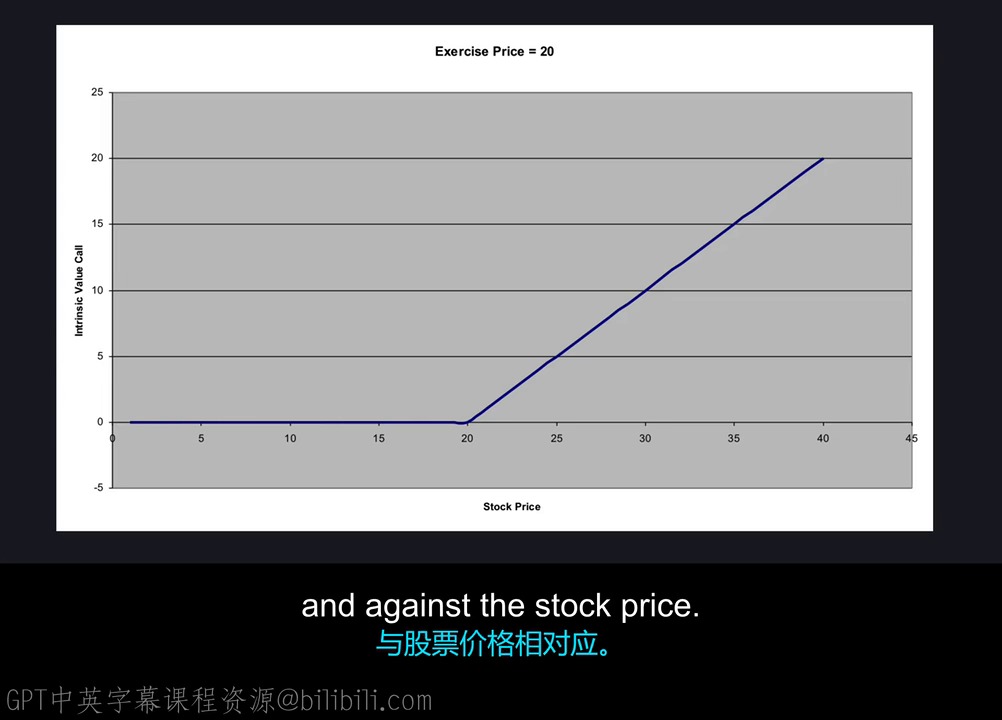
But if it's above it, it's equal. to the stock price minus the exercise price. For put options, it's different. This is the right to sell. So you will only exercise it if the option price is below the stock price. Now there's something called the put-call parity relation, which is a relationship enforced by arbitrage between a put price and a stock price that have the same underlying the same strike price and the same exercise date.
And that says that the, these two things are equivalent. I just, the first two lines are equivalent. I just, I just put the items in a different order. So the price of the stock has to equal the call price plus the present discounted value of the strike. Now this is any date up to an end, up to, and this is technically for European auctions, but it applies generally to both European and American auctions.
The price of the stock equals the call price, plus the present discounted value of the strike price, plus the present discounted value of dividends coming in between now and the exercise date, minus the put price. So it does hold up pretty well. So Intel Corp, I showed you the example from the CBOE. And so where was it back here? I'm using the first line here.
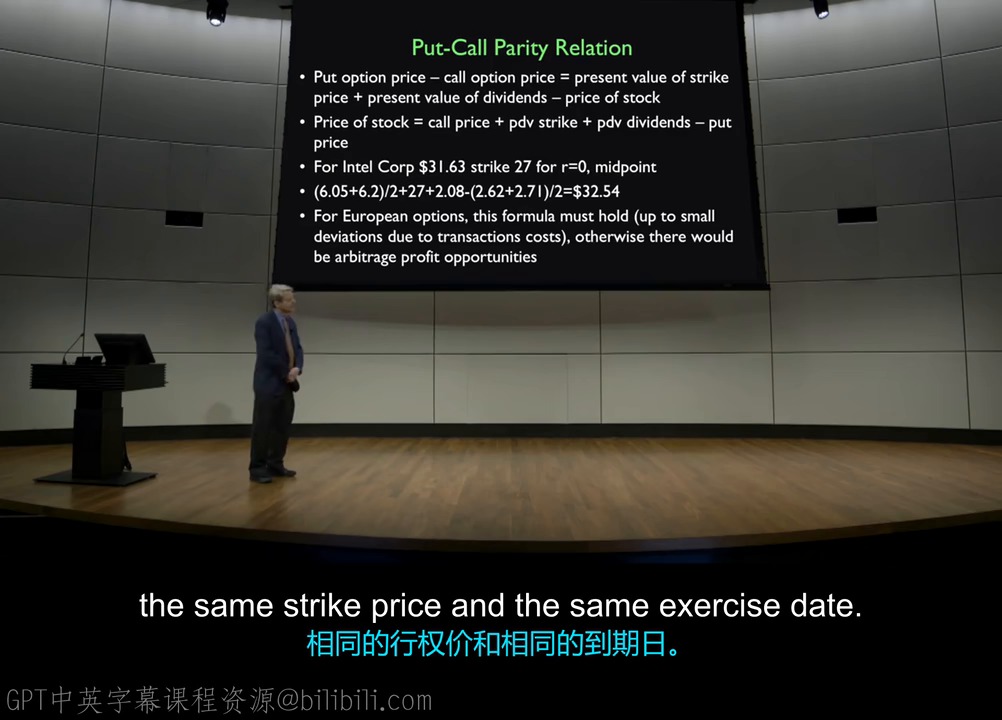
Strike price of 27. Now, this is the last price for the option, but currently the market maker has a bid-ask spread between 605 and 620. I'll take the midpoint of the bid-ask spread as an indicator of the current market price. And similarly, the same strike price is available for the same date. It's expiring on January 19th of 2018. They're both expiring on the same day.
And they, so I'll take the midpoint of bid and ask for the put. And then I'll go back to that slide here. Okay. So this is the midpoint of bid and ask for the put. What is the midpoint of the call prices? The sum of the two values divided by two. Plus the strike price. Oh, I'm assuming a zero interest rate to do this quickly in our head. So I'm not taking present values.
Well, interest rates are pretty low now. So I'm being rough when I say that. Now I have to figure out how many dividends are between now and January 19th, 2018. And I didn't carefully figure. I thought this. about eight of them. So 26 cents times eight is $2.8. And then this is the mid-point of the bid and a spread for the puts. And I add them all up and I get $32.54.
That's pretty close to the stock price of $31.63. Why isn't it exactly the same? Well, first of all, most notably, I didn't even do the interest rate calculations. So the interest rates are not exactly zero. So that would have bring down the present value. of the strike price and the present value of the dividends. But also there's just some non-synchrony here.
I'm looking at a last price, comparing that with a dealer's bid and asked. There's a little timing looseness here, so it doesn't work out exactly. But generally, it has to work out that the so-called put-call parity relation has to hold. Because it's the same thing. You're pricing apples and oranges, but it's really apples and apples. Think of it this way. The yellow line is the intrinsic value of a call.
The pink line is the intrinsic value of a put. If you add the present value of the strike price to this sum of the puts and calls line, you get the stock price again. And dividends as well have to be brought in. So put-call parity is a fundamental relation that actually holds quite well, if you do it exactly right, in the options market. And what it really means is that, in effect, you don't even need both puts and calls.
It's just for convenience, because they're related to each other through the put-call parity relation. Now, what is the price of an option on a day before the last day? On the last day it gets all set. The last day it gets all simple. The price of the option is the intrinsic value because there's no more risk. It's now. Well, there's only negligible risk over a matter of minutes that it would take you to sell.
So this is the intrinsic value, which is the value on the last day. On an earlier day, now we're talking about months or years before the exercise date. The stock option, or whatever option, it's got to be worth more than the intrinsic value. because it has option value. So consider here. Suppose this is a, we're looking at a call option now with a strike price of 20.
It says that there's value, when the stock price is 15, there's value to the option. Why would it be worth anything if it's out of the money? Well, this is obvious, because it might go up. So I'm willing to pay something for the option. Suppose the stock price goes up to 25, then my option price is going to be worth a lot on the So the option has to be worth something, even though it's out of the money.
They're never worthless. It might be very minuscule, but there's always a chance that the stock will go up above the exercise price, so it has to be worth something. Well, then you also, why is it worth more than the underlying value when it's above the exercise price? Well, it's for the same reason that if the stock price were to fall below the exercise price, you'd lose the full amount if you own the stock, but when you own the stock, the option, you've still got something.
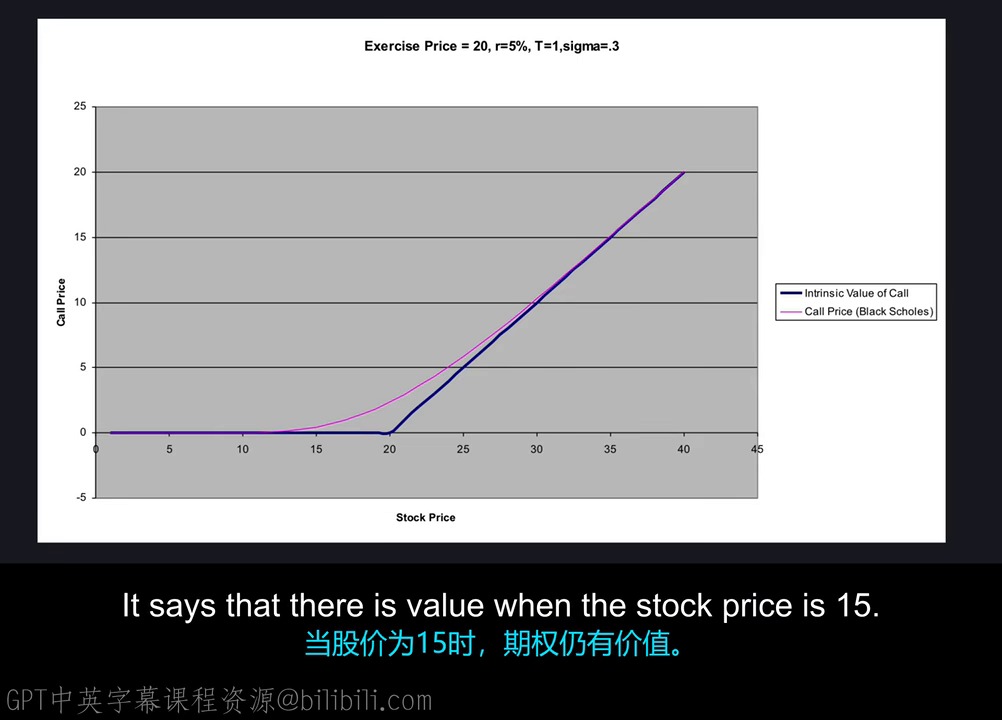
You've got the option value. The option isn't worthless if there has some time to expire, even though its intrinsic value is worthless. You understand what no arbitrage means. no sure profits. Any profit that you make has to entail risk. There's no $10, you see any $10 bills lying on the floor? No, you don't. Why not? Somebody would have picked it up. Somebody at some point must have lost.
a $10 bill in this room, but it's not there anymore. Those things are rare that you'll ever find one because the first person to see it picks it up. So similarly, we don't expect to see the put-call parity relation violated. If that were violated, I can tell you, here's a good job for you, drop out of college and invest in disparities between put-call parity.
And you make money for sure. So you might as well just push it to the limit and borrow millions. of dollars and just do it on a big scale. So it's so simple and obvious once you look at it. You can be sure that there are guys out there right now are making profits from the tiny discrepancies in put-call parity. But they eliminate the discrepancy when they do that.
Hedging with Options: Protective Puts, Stop-Loss Orders, and SKEW
What options you might say are really for is managing risks. So that, for example, someone who owns a stock, suppose you are looking at a company and you think it's very promising, so you want it to invest in it. So you want to hold shares of a company. But you also have worries that the price could fall, and you would be left with nothing, could fall a lot.
So you could buy a lot. You could buy a put option on the shares that you own. This is very common, and therefore put a floor on your losses. You can't fall below the put option. If the stock price falls below the put option, the strike price on the put option, you just exercise the option and you're out. It cancels out your losses on the stock. But here's a basic question that I want to do.
just kind of conclude mostly with this thought. And that is, there's another way to ensure yourself against losses on the stocks you own. It's something called a stop loss order. Here's what you do. You call your broker and you say, I've bought, I have 1,000 shares of Intel stock and they're worth $31.63 today. You know, I'm worried. I just can't sleep at night.
I need some help. So instead of recommending a psychiatrist, or a sleep aid, your broker says, well, why don't you just put a stop loss order? Just leave it with me. I'm your broker. I have it under instruction for you that if the price ever falls below, what do you name? Give me any price. Then you say, $20 a share. Okay, I'm ready, I'll sell the stock whenever it falls below $20 a share.
So then you can sleep easy at night. You put in a stop loss order. So what's the difference between doing that? There's the difference between doing that and buying a put. This often puzzles people. Well, you might say it's better to put a stop-loss order in because that doesn't cost anything. It's just the transaction fee. But there's no option price. You don't have to pay for an option that might end up worthless if the stock doesn't fall below this strike price.
So why would you do that? Well, I think this gets into some technical details. And I'll tell you what it is. Suppose you told your broker, to buy, to sell your shares of Intel when they fall below $20. Now, this broker is operating as a real human being in real time. It has to make some, well, probably would just fill your order. But what'll happen? The stock will be fluctuating, and it's gotten close to $20, and it dips down to $19.
The broker says, oh, oh, I better sell right now. I said I'd sell at 20. As soon as, but it probably, you're not going to be, you're not going to get 20 exactly. If you have a stop loss order, it merely says the broker starts trying to sell it at 20. So you'll probably get less than 20, so it didn't protect you fully. So suppose the stock falls to 19, and he sells your stock, and then it jumps up again to 21.
Then what do you do? Well, you can tell your broker, I guess it's not below the threshold I said anymore, so buy it back. So the broker says, okay, I'll buy it back. And then suppose the next day it falls to 19 again. You're faced with the same decision again. What do you tell your broker? Well, buy it back. So we've just gone through two days where you both lost $2 on a trade because you sold low and you bought high twice in a row.
So that's why you buy a put instead of a stop loss order. I'm not saying one is right and one is wrong, but I'm just saying that ideally you have to compare the option price with the losses you might make, as I've just described in dealing with stop loss order. Do you think like options prices have a predictive power on the stock prices? Like, for example, can we sort of foresee a stock market crash by looking at the put option prices?
Well, there's something else that the Chicago Board options exchange computes, and it's called skew. S-K-E-W, C-B-O-E-S-G-O-E-Skew. It's computed also from options prices, but instead of looking at the second moment, the variance or squared standard deviation, they look at the third moment, implied by options prices. So when put options, out-of-the-money puts are getting expensive, that suggests that the market is worried about a crash, and the prices of those puts will go up.
And then there's a tendency, ever since the 1987 crash, there's been a tendency for out-of-the-money puts that's to predict, to be expensive. If you want to protect yourself against the market crash, it's expensive. So now what you're asking is, does a high-kew index predict the next? crash. Now, my thought on that, first of all, there's a literature. There's so much finance literature. I don't know, I don't recall all of the information about, I seem to remember a paper about the C-B-B-O-E-Skew Index predicting volatility. But you're right. It sounds like it should be predicting a crash. I'm also thinking of a plot of skew. And since the SCU only goes back to 1990 that the CBOE has published. And there were a couple of periods of high skew.
One of them was in, I think, around the Russian debt crisis in 1998. And the market did take a tumble, but I'd have to get it. Remember, skew is a 30-day ahead thing. You have to be careful whether the 30 days when the market tumbled fell into the 30 days that it was forecasting. My guess is that SCU might be helpful in predicting stock market declines of a short-term nature, but not necessarily in forecasting the big events that you care about.
The really big stock market crashes didn't happen in 30 days. For example, the 1929 stock market crashes, remember it everywhere. And people remember it as October 28th, 1929. and the bottom fell out of the market. But what they forget is that the market came right back up on October 30th, 1929. And it kept bouncing around. The real decline took over almost three years.
It was until 32 that it bottomed out. So you could have been investing in puts to protect yourself against the 1929 crash. And I don't know, I'd have to go back and do complicated calculations to figure out what doing a sequence of 30-day puts, would have done. I suspect it might not have protected you. It's a complicated business. Once again, talk to your financial advisor and make sure you have a good advisor.