The Social Purpose of Finance
Critics of Modern Finance: Debt, Rent Seeking, and Getters
Well, okay, welcome to the final lecture about finding, it's about finding purpose. This is aimed at, not just at people going into finance, but actually at anybody, because we are increasingly living in a world of financial capitalism, where things are run along modern financial principles, and you can't escape it. You could become a hermit and move to a cabin.
I thought if that will work though. Pretty tough because it'll turn out to be somebody's property or government lands, and you can't do it. Ultimately, you're going to get a paycheck, and it's going to come out of some financial account. And so it may seem unmotivating or something, this system. So I wanted to talk about that. So I'm going to start this with critics of modern finance.
So Adair Turner is not a businessman. As far as I know, he was teaching at the London School of Economics. Then he was head of the Financial Services Authority, FSA in the UK that used to be the main regulator. And now he's chairman of something called the Institute for New Economic Thinking. I see him at the World Economic Forum. He's a prominent voice there.
So he is lamenting certain trends that seem obvious and important to him. One of them is the rise in debt for advanced economies. He's talking about much of the world here. So total debt, domestic credit, as a percent of GDP, was a little over 40% in 1950, and now it's up to 160%. So that means everything is leveraged. Maybe that's oversimplifying it, but why this big trend?
And then secondly, this is the share of the financial industry that's profits. and wages and salaries in finance. And here he's going back to 1850. It was only 1% of, oh, this is just for the US here, 1% of US GDP, and it's grown to something like 7%. And he's asking whether that makes sense. How much of that is contributing to a better society and how much of that is just rent seeking rent-seeking is a term coined by Anne Kruger, an economist, referring to just grabbing what I can get rather than creating anything.
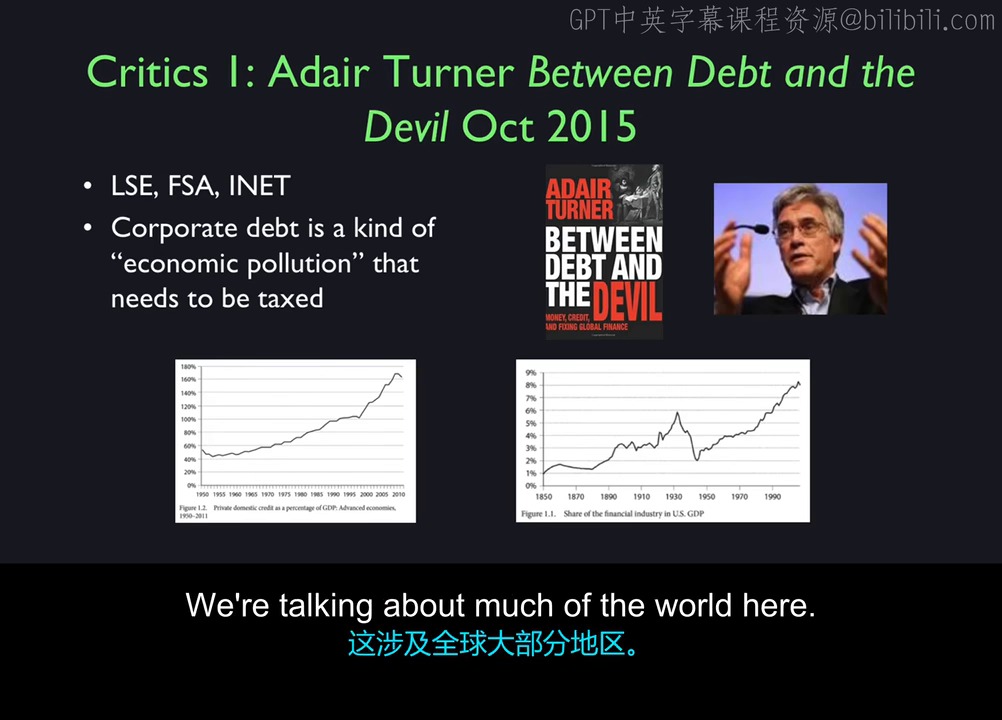
So that's the criticism. A lot of finance does seem to be, when you're trading securities back and forth, it sounds like it's a game, or it's self- It's not contributing. The other critic, again, it's a similar theme to that of Adair Turner. She starts her book out by talking about Steve Jobs, who's a hero. It's a good guy to talk about. He's many people's hero, making Apple computer at one point the most successful company in the world.
After he died, it's been five years now since he died. Apple began borrowing billions of dollars. Why do they do that? Well, apparently, they have lots of money. Under Steve Jobs, they accumulated a huge amount of money. Why do they do it? Well, it's to avoid taxes, she says. They have the money, but they don't want to spend it because they'd have to repatriate it.
They have it stashed away in foreign tax havens. and maybe they have to pay capital gains taxes on their assets, so they don't want to do that. And so that's why they're borrowing money. She kind of linked that to loss of creativity. The business world doesn't always reward the most mathematically sane person. Steve Jobs was somehow brilliant, but also a little bit off. In fact, his early death has something to do with his rejecting medical treatment for his cancer and instead wanting to rely on some kind of health.
I don't know the details, but he was quirky, so he didn't want to go after tax breaks either. Why not? You could say it's perfectly logical, but he somehow knew what to go after, though, ultimately. So she makes a similar complaint to Adair Turner that the world seems to be increasingly run by takers, as she calls it, rather than makers. So is that a fair criticism of finance?
Again, I don't think either of these people are criticizing finance. They're criticizing trends within finance.
Democratizing Finance: Helping Ordinary People Finance Goals and Manage Risk
The opposing force, which I've already mentioned in this course, is a democratization of finance. I write a lot of books. I have a book called Finance and the Good Society, and talking about how finance has been increasingly democratized over the centuries and stands to gain if it's further democratized. What I mean by democratization, again, is that it should benefit real people.
everyone, not just the rich. It shouldn't be a plot to preserve the riches of the already rich. It should be something that manages risks for everyone. Risk management should reduce inequality. So one example of what's happening these days in democratization of finance is crowdfunding. So I have a picture here of the home page of one crowdfunding company called crowdfunding.
called CrowdCube. That, if you can read their statistics, they claim to have raised 158 billion pounds in their history with 277,000 investors and 393 company. So what is CrowdCube? It's a website where people with business ideas that need funding can take their ideas directly to the public and they can raise money online. What they also have on crowdfunding websites is chat rooms where people discuss the investment.
So this is something that you could take up. Go onto a site like CrowdCube and look at what's being proposed. Like one of them was a home ultrasound kit so a woman can look at her unborn pregnant women can look at their unborn baby whenever they like. Right now they'll go into the hospital and do an ultrasound and look at a photograph. Have you seen any of these photographs?
They're kind of weird, but you can see the fetus inside and see what the baby looks like. Well, they thought, hey, women, they want to look at their baby all the time, so let's just make a home version of it. That's a neat idea. I'm not sure it's a good idea to be under ultrasound every day. I would have some health concerns, but that's a creative idea that might not be funded in the norm.
You walk into an investment bank with that idea, and they might laugh you out of it, but maybe not. I think crowdfunding, it does have the potential to tap the creativity of people in more intense ways. I know I have my own experience of raising money with my student, Alan White, my student, Alan Weiss, this was a long time ago when, well, actually he set up the company and I was a partner in it.
We went to investment bankers and tried to raise money for a company that was ultimately a success, but they didn't seem to get it. You know, I think it's just not everyone gets innovative ideas. I guess we were right after all, but, but, so the idea of crowdfunding is to involve everyone. The same way we involve everyone in the Internet. Now, you notice this is a UK company, not a U.S. company.
That's because British regulators seem to be more open to experimentation, and the U.S. regulators are more worried about abuse. So what they are worried about in the United States is that crowdfunding sites could bilk people. And of course they will build people. This is human nature. History shows that in the old days, before, you go back to the early days of telephone, there were all kinds of investment schemes that were pushed off on the public via telephone calls.
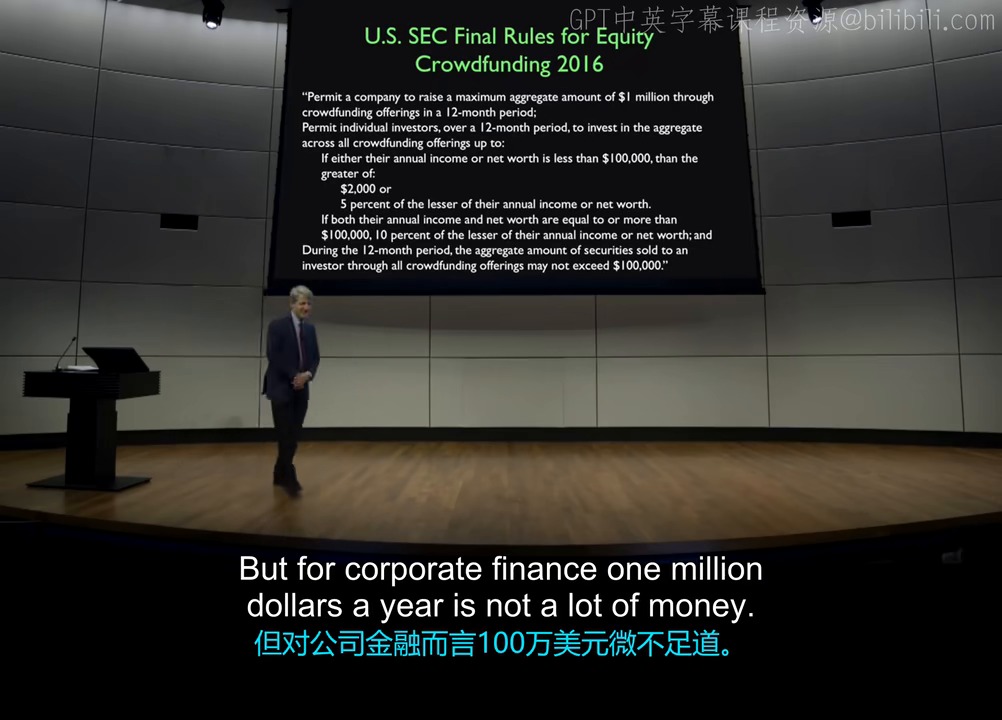
And a lot of them were just fraudulent and manipulative. People don't know how to evaluate. Most people don't know how to evaluate investments. So the United States adopted crowdfunding rules just very recently that try to allow crowdfunding to happen in the United States. but limit it so that it can't drive anyone to bankruptcy. So what they said, a company in the United States can raise money on a crowdfunding site, but only $1 million in a 12-month period.
Now, that might sound like a lot of money to you, but for corporate finance, $1 million a year is not a lot of money. It's like 5% of your CEO's salary for the year. It's not a lot of money. So they've limited it to make it. tiny. On top of that, they can't invest more than... If your annual income is less than $100,000, more than $2,000 or 5% of your annual income or net worth.
And the aggregate amount of securities sold to an investor through all crowdfunding offerings may not exceed $100,000. Well, anyway, this is nice. We're starting to experiment with something that's already going, in the rest of the world. I think the U.S. should get involved, but this is a limited involvement. So the idea, I've mentioned other ideas for, earlier in this course, for democratizing finance, like things that would help people ensure against their labor income or against their houses, which are issues that matter to individuals.
But... Crowdfunding, or democratization of finance also, I think, entails somehow dealing with issues that people really care about, that are kind of abstract issues, like broad issues of society and the environment. Despite all the criticism of the size of the financial market, it's also true that access to savings vehicles and access to financing helps people.
I mean, as far as people, the digital market. general public, it is enabled women to save money and move forward and build companies and in a way that, you know, you used to have to have your husband sign off to get your money out of a checking account. I'm kind of going off on a tangent, but isn't it, hasn't the growth of the financial industry itself actually improved the situation for the common man?
If the common man is the one looking at. We live in a better world. than before. And that involves things like pension plans, health plans, insurance. The other thing is that as it gets more and more, it always impresses me how complicated the financial world really is. So Jamila and I were talking about SEC. We need to expand that organization. because there's so much more to do in that.
I was impressed looking at the proposed rules for crowdfunding that the SEC just issued. And it was so long, there were thousands of pages. I thought, can it be that complicated? And I started trying to read it and deciding that maybe this is awfully complicated. I think it is. With everybody's different views, and again, the public really not understanding the impact of what that regulation could mean.
The pages are trying to kind of muddle through all of that and get opinions like yours and other industry players to kind of help us make the decision. I almost sent an opinion in. We need that. But I did because I thought, there's thousands of it. There are. We get sometimes millions, I mean, of opinions on things. And we appreciate them all, though, because they help drive kind of the decision making of the five commissioners.
It's a hard decision to make to introduce something like that. And usually any regulation, any change that involves progress has downsides. And the downsides are multitude. Like there's different tricks somebody can play to take advantage of it in an unfriendly way. You have to think out all those tricks that might happen. And you have to listen to thousands of people who reply to comments.
So yeah, I just think that the world may seem simple. But it's not. And the financial world is really the infrastructure for making decisions about what we'll be doing with our lives and our resources. So it's going to be a complicated thing that requires lots of people. And even more people, I think, relative to GDP in the future.
Finance Democratization Salon: Knowledge, Advice, and Defaults
So knowing what we know about behavioral finance and risk and the current state of the markets, how do we keep people invested in finance education and less fearful of the market, but more excited about how they could learn and possibly get engaged to make it better? Well, I'm trying to do that with this course. I think finance is an exciting field. It really is.
It's not about getting rich. It's about making civilization work better. And I think that it's good to have a society in which people feel a part of the action where they're not just a passive bystander, but there's someone who knows where the opportunity, who has some insights into where the opportunities are. Lots of people have insights that are specific to their field or their particular interests, and they understand it well enough to be motivated to take really, That's a fundamental thing.
You can't just have someone tell you, a scientist come in and tells you this is a good, a new idea. But you don't know. I won't be motivated to take a risk on it unless I feel that I have ownership of this, some ownership of this idea, that it's part of me to understand this kind of thinking. So I think actually there's been a lot of progress. made in the last 30 years.
If you look at both Russia and China today, for example, people in those countries are way more entrepreneurial and financially oriented than they were. I mean, it's just a total transformation in those countries, and it has brought a lot of good. It's not just in those two, I just mentioned those as prominent example. It's happening all over the world, in much of the world, that people are more business-oriented and feel part of the system and are increasingly priding themselves on some understanding of finance.
I think pretty much all the discussion now is about how finance being at elitist industry, but really finance is for everyone. So my question would be like for the future of finance, I think you mentioned a couple of times in class about the democratization of finance. And there are new technologies in the world with respect to, for example, investments. technology that are commission-free.
Some of the commission-free. And they allow you to invest, you know, with very small amount of money, so that might be more accessible to, like, common people. What do you think of those technologies and how do we really make them benefit the normal guys, not just, you know, Ivy League graduates or high networks individuals? Well, this is an important theme, the democratization of finance. If you go back, let's say, 200 years, that's a long time ago, walk into a bank and say, I'd like to open a savings account. They would look you over and say, this man will usher you out the door. They didn't have any retail. It was only for wealthy people. Then there was, starting in the United Kingdom in the early 19th century, the savings bank movement.
And this is an example now. They said that we need places. for people to put their money and earn some interest. But those were created by philanthropists. The savings banks were non-profit. Well, they were mutual or some form. So they were not profit-making enterprises. Those savings banks were well designed, and they lasted through the Great Depression. In the United States, not a single savings bank failed.
That's because they had conservative investment philosophies they were chartered to serve in the interest of these small savers. So this movement that you described towards the democratization of finance is not new. It's been around. And we can keep thinking about more ways to make it work better for low-income people. That is really the ultimate objective.
So actually, I have a question on financial literacy. So especially after the, subprime crisis, it seems that not only there is a huge information asymmetry between the Wall Street players and the Man Street. There's also a huge financial literacy or intellectual symmetry that has been building on over the last few decades. So could you share some of the thoughts on how to address the issue of financial literacy and make sure that every member of the community, the society can benefit in the long Well, I think it's a little bit analogous to medical, financial literacy and medical literacy are similar.
You need a doctor. You cannot diagnose your illness yourself. On the other hand, knowing something about health matters, you have to know when to rush someone to the emergency room and what are healthful eating patterns and things like that. So I think that we need to. both of them. I think more attention has been paid to the financial literacy than to the financial advice. This is something that strikes me as a little bit odd.
What you should really have is a trusted, you need a general practitioner, doctor, that you talk to and you say, you know, I have this ache here. What is it? I don't know, should I worry? And you need to talk to someone like that. I think it's the same thing with the with financial advice. So, and it blurs into psychological advice, you know. My husband, I think he gambles.
And he also plays the stock market. He just lost a lot of our money. What should I do? You couldn't kind of think about, well, what could you do in terms of designing savings plans that use those same kind of behavioral mechanisms where you've got that groups of, or something to Nudges. yes. What are your thoughts on going past Nudges and into, for example, mandatory W2 withholding into a pension account or some?
Well, this goes back to the theme that when you refer to Nudge, I think that term was popularized by Richard Thaler and Kass Sunstein in their book Nudge. And it was a new philosophy, which they called libertarian paternalism toward government intervention in people's lives. It's libertarian in the sense that people have free to choose. What they do, no one tells them, forces them to do anything.
But it's paternalistic in that it sets parameters so that if you do nothing or you're not responsive, you'll probably be in a reasonable situation. So, for example, if you don't sign up for retirement, plan or health insurance, you will be default optioned into participating unless you send a letter saying, I don't want to. That seems obvious in the past you would have thought, of course people, some people don't get around to doing things.
We all know that from our own experience. And, you know, that some people are not too smart. We still love them. There's all different things. of intelligence, so we have to make it work for everybody. That should seem obvious, but it wasn't obvious. You know, it seemed that history is filled with examples of people not seeing the obvious. You know, you talk about women.
They used to think that women couldn't drive cars. Now, how could you possibly think that? I don't know. I think they really didn't. If you never let them try, you won't find out.
Finance and War: Contracts Ultimately Rest on Civilized Norms
I wanted to talk about finance and war because war is a perennial feature of human history. We're always close to war and it's just life. It's something about the chimpanzees are close to war as well. By the way, they're always fighting battles with other chimpanzee groups. So it's something in our genes, I think, and unavoidable. So I wanted to just be clear what happens to finance, given that finance usually trade, long-term claims, often trades long-term claims.
But you wonder what will happen if there is a war and a fundamental change in government. So, first of all, there is no world government, and I'm supposing there never will be. And organizations that help are penuous. So you might wonder how can finance really manage if the institutions have to be defined legally by an existing government, but governments get turned over and destroyed and reformed.
So I wanted to just mention a couple of examples of wartime effects on finance. First example, World War I. Germany lost, in case you haven't heard, and in 1918, People had them at their knees, they were conquered, and people were really angry. So we had the reparations that were imposed on Germany. So how do you think, I just want to say, how do you think the reparations went?
People thought Germany should pay for the crimes they committed in World War I. How did they do that, though? Well, they could have just said, we confiscate all your stocks and land and holdings, everyone. they didn't do that. They instead demanded reparations from the government. And the government had to figure out how it would finance the reparations through taxes.
So they did tax the German people to repay the victors in the war. Actually, it turns out, however, they never did it because the victors in the war saw how hostile the victors in the war hostile the German population was becoming, feeling a great injustice in the reparations. So they canceled them by the 1920s and they never had to pay. So that means if you own stock in a German company in Germany, you go right through the war, you still own it.
In World War II, it was even better because they had learned their lesson. You don't go penalizing individuals for the sins of their government. So after World War II, They just left them all alone, except in East Germany. You know what happened in East Germany? Well, the Communists took over, and that was different, because the Communists didn't have a capitalist ideology at all, and their ideology would, could justify just grabbing things.
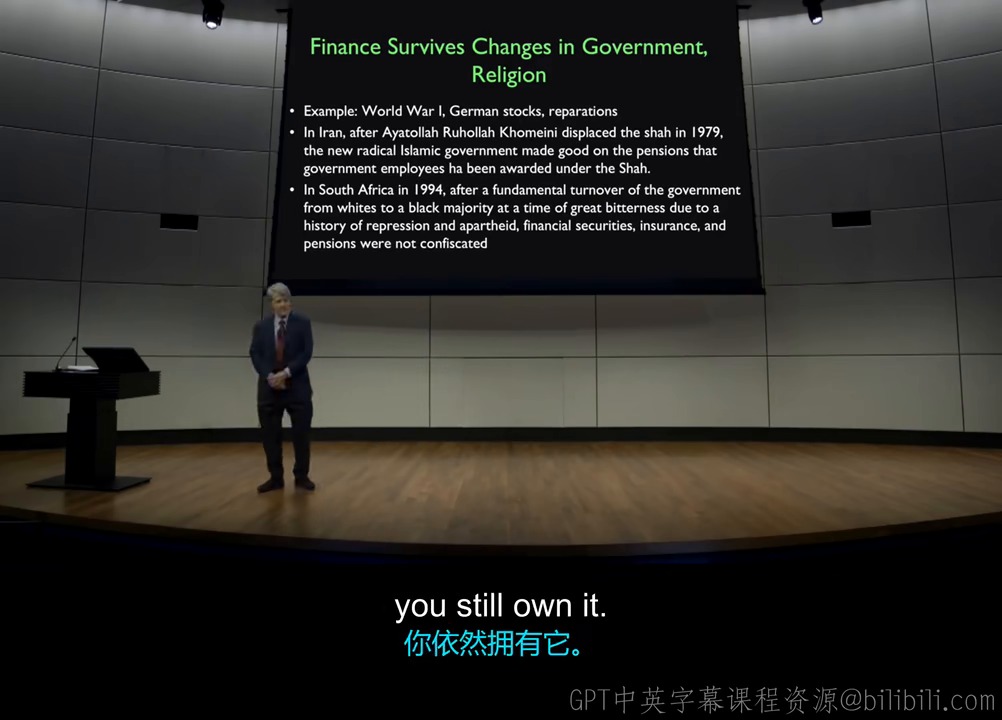
So that's what they did in East Germany after World War II. Later, after the reunification, people could sometimes reclaim their lost property. But another example is in Iran, there was the Iranian Revolution in 1979 in which the Ayatollah displaced the Shah of Iran. So what do you think that, these are fundamentalist Muslims. What do you think they did with financial holdings?
Well, notably, a lot of the government, under the Shah, employees were paid pensions and they were retired now and they were expecting to live off their pension. So what do you think the new radical Islamic government did? It left it. You know, it seems fair to them. They left it. So you could keep your pension, even though it looked like you got it under bad, under a bad to their mind government.
And then another example is South Africa in 1994. which a white majority government that had oppressed blacks for decades or centuries took over. And what do you think? Do you think they confiscated? What about people who had pensions or insurance? They left it. So why does this happen? So you have governments, turnovers of governments that are very hostile to the one that had defined the financial institutions.
So what would your expectation be? The expectation might be that they'll leave it because they want to be reasonable. It's in their interest to be reasonable and understand that we don't just abrogate contracts that were made. On the other hand, it doesn't always work out that way. So a socialist theory allowed Vladimir Lennon, Lazare Kadinas, Mao Zetong, Muhammad Mossadeh, Gamal, Abdul Nassar, Indira Gan, Indira Gandhi and others to justify major confiscations of property and nullifications of financial arrangements.
And notably after World War II, in Japan, there were the big four zaibatsu called Mitsubishi, Mitsui, Sumitomo, and Yasuda that were blamed for some of the, they were powers that They were powers behind the government in Japan, and they were blamed for some of the things that, by the victors, that some of the things that happened in World War II. Now in this case, it was the United States as a victor.
They're not a confiscating country. But what the U.S. did do is force the zaibatsu to sell their assets and put the money in nominal yen government bonds. And then they just, the Japanese government then had a massive inflation, and it destroyed the real value of those bonds, and they never got anything back. So the zaibatsu were immensely diminished after World War II.
So I think a war is kind of risky for, it ought to be very risky for financial contracts, but it isn't always the end of them. Because underlying it, there is a certain civil society that respects individuals and thinks that individuals signed contracts that acquired property by buying it, by working hard and earning money and buying it, why would you just abrogate those contracts after a war?
So I think when you think about long-term investing, you have to think about these possibilities. that the world is disruptible. And you have to think about the basic ethics of the investment you're making. If it's sound and it's not abusive or odious, then it should be all right. The word odious debt has been used many times to justify confiscating it. When the debt was raised by a government that was using it for ill purposes against the will of the people, that's odious debt.
And so ultimately the survival of your investment in government debt depends on whether it's odious or not. So you have to look at the moral underpinnings of the country that's issuing the debt and consider that a major factor because ultimately it will be civil society that will decide whether you get paid back or not.
Finance and Population: Long-Run Pessimism Does Not Excuse Present Inaction
Another thing that comes to my mind often in considering the morality of finance is the old Malthusian principle about the dismal law of economics and population growth. So Thomas Malthus wrote one of the most famous essays in the history of economics called an essay on the principle of population. I assume you've all heard of this, right? It's pretty, this is standard.
On the other hand, I think it's under-emphasized even today. But if you read his essay, the basic point was that population naturally increases and according to a geometric ratio, whereas subsistence for man increases only in an arithmetical ratio. So the population goes on doubling itself every 25 years. But the resources cannot. So this gives us the dismal law of economics that any improvement in the ability to give subsistence to man will be met with by population increases.
So men and women are historically in near starvation because there's too many of them. and if anything is done to alleviate the situation, it just means there'll be more people in starvation. So Malthus, I had a powerful argument. Unfortunately, it leads to a sort of hopelessness that we can't do anything. And what is finance able to do ultimately? So, but so anyway, the thought I have about this is we shouldn't despair though.
I think Malthus may be right in the really long run, talking centuries, but we're living here and now. And I think that we can do a lot to make the world we live in better off. And ultimately, I don't know about the future, centuries in the future. I think we have a moral obligation to use our economic principles to make people better off now.
Financial Theory Still Matters: Behavior, Law, and Mathematics Must Work Together
Another thought is, I said was the importance of financial theory. I've talked a lot about behavioral finance in this course, but I want to come back and say that mathematical finance of the traditional kind is still extremely important. And the world will never be the same again because after the development of mathematical finance, there is a theory of the allocation of scarce resources, and also of the pooling of information through markets that was not understood by most people in the early 20th century.
And that's why I read critics of finance with a certain amount of skepticism, although I'm also one of them. I think finance, I find myself admiring the financial system, the efficiency with which it feeds billions of people and provides education and innovations to them. So I think that this basic financial theory is valid. And even people who seem to be doing things that are remote from product, they look like takers, like people who trade in options, for example.
They are not necessarily takers. They're doing something for the system that makes it more efficient. And the benefits are not to society are not easily seen. On the other hand, the critics may have a point about recent trends, that things are not going absolutely optimally. So behavioral finance, which we've talked about in this course, which involves other social sciences like psychology, I think is the salvation of mathematical finance, because it's like adding friction to Newtonian mechanics.
Isaac Newton described the motions of the planets, but it wasn't. able to describe the motions of machines here on Earth, because there were other things like frictions that intervened with his laws of mechanics. So we have to add friction to those models. And similarly, adding psychological principles to mathematical finance is important. There are the hardcore mathematical people.
I've met them, mathematical finance that have a tendency to be to act as if they're threatened by behavioral finance. But I don't think that's the way they should be reacting. I mentioned law schools. You know, when I first got my PhD, I was hardly aware of law schools, it seems. Over the course of my career and trying to read and understand economics and finance, I find myself more and more reading law journals and learning what goes on in law schools.
I think this goes back to what Jillian Tet called the silo effect. It's unfortunate that we are separated from, well, we in economics are separated from professional schools. We have a separate management school too, separate law school. I guess it's maybe necessary to have these compartmentalizations and yet it seems to me that they operate together better to better together.
So law schools are as necessary as the math finance people. What I like about law schools is that they operate very much in the real world, especially in a common law environment where cases are the basis of law, so that there's individual conflicts among people that have to be resolved. Very real world, very much psychological. You can't be a... maybe there is a pure mathematical law, but mostly it's down to earth.
And it seems to me that most of the economic principal proposals that are embodied in laws are from law school people who probably read economics.
Wealth and Poverty: Inequality Also Comes from Unmanaged Risk
Now I wanted to talk about wealth and poverty because it's coming to a head these days. The concern that people feel about inequality is increasing dramatically. The current election in the United States has on both the right and the left, people who seem to, whose prominence seems to stem from some resentment about inequality. There was a recent study which was just reported in the New York Times yesterday by David Autor at MIT and his colleagues that looked at a polarization by state in politics and compared that with loss of jobs in economics.
And they find that the states where a lot of people have lost jobs to globalization or automation tend to also be states where polarization is in politics is the highest. So it's suggesting that what's happening now in politics is not independent of rising inequality. It's predictable. So I think part of the problem here is that we haven't democratized finance.
That is, we haven't dealt with the risks that people face. They talk a lot about, for example, in rural areas, there'll be a factory set up, and people buy their homes adjacent to an isolated factory. It was put there because the people there were low wage, and so there was a benefit to hiring there. But now you have a community built around a factory. Then they find that the business finds that it can get an even lower wage in some less developed country.
So they shut down the factory and leave. The people who were there, unfortunately, didn't have financial contracts to protect them against that risk. So when the factory shuts down, not only do you lose your job, but you lose your house. Well, because the house isn't worth anything anymore. People only wanted houses there because there was this factory employment there.
I may be giving an exaggerated situation. But people weren't advised about this. You shouldn't buy a house next to this factory because you're staking everything on the success of this factory. They could have just rented. So we could have democratized finance and prevented these things somewhat by just giving a subsidy to financial advisors. It's something I advocated in my books.
The government already subsidized financial advisors by giving a tax break. But if you hire a financial advisor and you pay that person for the advice, you can deduct that payment from your income taxes. However, that only buy that payment from your income taxes. However, that only by you can deduct that payment. benefits you if you're high income. Most low-income people don't even itemize.
So they would never get any break from it. So their government is subsidizing financial advice for wealthy people and not for poor people. What poor people who took that job next to a factory should have been told, very simple, don't buy rent. That means that you are not taking the risk of putting your own home value collapsing along with your weight. along with your wage. That would be common sense.
But people who don't have advisors are not aware of these risks and don't think about them. So most people don't buy financial advice because it's expensive and they feel that they can't afford it. There's also what you see is all there is effect, that Connman and Thversky. People tend to assume that they have the evidence. They talk to their neighbors. They think that it's a smart thing to buy a house next to a factory in otherwise farmland.
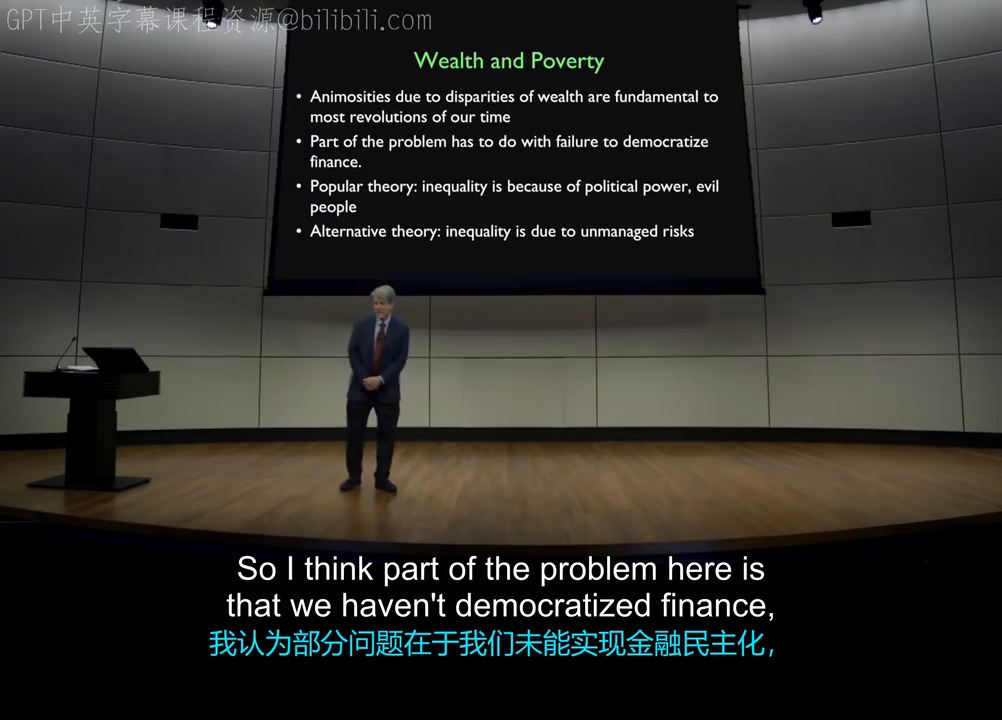
And they also have these common ideas that home prices always go up. And homes is a great investment. I know that people think that, but it's naive to think that. You have to think like a trained financial advisor to get the prospects for the value of a home. So poverty is substantially due to unmanaged risks. And one of the most important things we can do for inequality is to make the risks better.
It is to make risk management better. Wealth and monuments. We are standing right now in a monument to Mr. Zhang in China, who was educated here at Yale and donated money to build this auditorium. And I have another example of a... It's a little bit of... I think we have to thank him for doing this. And he actually did this as a young man. Usually, monuments get built at the end of one's life.
So this is a more typical example. J.P. Morgan was one of the... or maybe the richest man in America. And he built his house in Manhattan. at 36th in Madison Avenue. And he built it between the years 1906 and 1910. There it is. Nice house, right? On prime land, by the way, right in the center of Manhattan. That's the interior. That's the library. Pretty nice.
But he only lived there for three years. And what is it? It's a museum now. It's for you. can go visit it. They just did a renovation there. This is what happens that people accumulate wealth throughout their life, and it ends up being dispersed, somehow, one way or another. What do you do with this? After J.P. Morgan dies, what do you do with this house? It just seems logical it should be a museum, and there it is.
You can go and visit it. So. There is, though, something about allowing people to take risks and make money. And the result is a more lively society at the expense of a more unequal society. So the study that I'm referring to here looked at primitive societies and found that some societies are less focused on deal-making and wealth accumulation. Those that are, though, have more inequality and more wealth as well.
So it's not just modern capitalism that has this dilemma about deal-making spurs wealth, but it also makes it somewhat unequal in distribution. This unequal distribution of wealth is probably less important in an advanced society that is not close to the threshold of starvation, because you don't need all that money to live well.
Your Career and Finance: Build Capability, Then Use It for Society
So finally, your career in finance, and this will be the last section of this course, once again, I don't think that you want to necessarily be a primarily financed person, but ultimately understand what I've sought to do in this course is to help you understand finance. So some young people are very idealistic, and they might consider eschewing any connection with finance, immediately right now as they're young.
But my thought on that is if you want a perfect career morally, do you really stay out of business? You could give away 90% of your income now as a teenager and not take the course of improving your human capital, giving it all away now. But the problem with that is you won't be very contributing to society because your income. at this stage isn't very high.
So you want, instead, I think, to accumulate while you're young and give it away when you're older. This makes sense. Bill Gates is an example with the Gates Foundation. The largest transparently operated charitable foundation. That is, as far as we know, a real charitable foundation and not some religious group or government crony. It recently had an endowment of almost 40 billion.
Warren Buffett gave to them as well. Now, both Gates and Buffett have been going around with a giving pledge saying that anyone who signs the pledge would promise to give away half of their wealth before they are old. You don't want to wait until you're 90 to give it away. The whole idea of Carnegie's Gospel of wealth is that the system rewards with wealth the people who have the talent for affairs.
But that talent is limited. As you age, you'll have cognitive decline, you'll have energy decline. So you are morally obligated to use that talent to give it away constructively. Don't give it to your kids. Don't give it to your spouse. That's the idea. Here's an example of someone who you might have heard of Mohamed Yennis, who has led an exemplary financial life.
He got his PhD in economics at Vanderbilt University in 1969. He took a job as Assistant Professor of Economics at Middle Tennessee State University. But then he had the idea of founding a bank in his home country of Bangladesh. He had an idea for democratizing finance. The idea was to make small loans to individuals that could be done in such a way that it's profitable.
The problem with lending to poor people is that they're more of a nuisance than a source of profit. They want a small amount of money. We're talking about lending a small amount of money to a woman with a poor family that's living on the edge, so that she can buy a little push cart to, with a little push cart. that keeps food warm, and she can go somewhere where people are, for poor people congregate, and sell lunches.
But she doesn't have the money to get the push cart and to buy the food to start with. So he found a way of making that work. And for that, he won the Nobel Peace Prize, not the Economics Prize, the Peace Prize, the Peace Prize in 2006. Now, he has lots of critics who questioned, whether it really worked. But apparently it did. The bank grew and prospered. So there's an example of applying finance creatively.
So I think that your financial life will be concentrated in the next five or seven decades. I'll say optimistically for, and this will be a world of financial capitalism. Financial markets will be everywhere. But financial. booms and crashes will be even bigger than before. Despite all this talk of the, you know, FSB, the Dodd-Frank, etc. The FSB stands for the Financial Stability Board, which is an international body that monitors and makes recommendations about the global financial system.
Curing these problems, they won't get cured because they're endemic. When you have opportunities for people to act and form organizations and finance, them, there's going to be excesses. And we shouldn't be too afraid of them. The excesses will be offset by the greater economic growth that happens. So we'll see dramatic changes in finance in the coming decades and in our economy, particularly with the growth of information technology, and that will create opportunities and challenges.
So let me cap this with just some thoughts. I've said this already. But your outlook is really at least a century. That is, you might live another 100 years, but even if you don't, your children will, or people you care about will. And just think about the upheavals and changes in the last century. Remember, this what you see is all there is fallacy is probably affecting your thinking, and you're not thinking creatively enough about how things will be really different in 50 years or 100 years.
We have an illusion of invulnerability, but things surprise us. So this is a quote from the Bible, from Ecclesiastes 9-11, famous quote about randomness in our lives. And so the race is not to the swift, nor the battle to the strong, nor yet riches to men of understanding, but time and chance. happens to them all. I gave a talk once at Yeshiva University, which is an Orthodox Jewish University in New York.
And there were some Talmudic scholars there. And they questioned my, it wasn't my translation, the word chance. And one of them there said, in ancient Hebrew, they didn't have a word for chance. They didn't even understand that there could be something like probability affecting our life. Everything was God's will or something like that. But then another scholar stood up and said, oh, you know, it could have been correctly translated as accident.
And so then I said, well, what's the difference between chance and accident? And then, anyway, this is a lively quote. It's still being debated. But to me, it means something that it is true that our lives are driven by chance. Finance is a theory of risk management, but it's not going to control all the risks. It's the book Fooled by Randomness by Nassim Talib.
If you heard that book, I recommend that. I should have maybe put it on the reading list. But it's about life and chance. We blame ourselves too much for failures. We let our successes go to our heads. It's largely just randomness. So the question is, what do you do? Well, first of all, you want to study risk management and finance. But more importantly, you have to think about your human capital, your positioning in history.
One of the most important talents I think that some people have over others is that they're thinking about how I fit in to historical events right now, rather than thinking about where I am in my own personal life cycle. The world changes, and most people don't really anticipate the changes. And I think another really important thing for young people to do is to maintain human capital.
That is, keep thinking about how, what skills you have, will be important and needed by others under maybe different conditions. And finally, maintain humanity in an unforgiving business world. And that's my last slide. All right, so I hope you find a purpose in life and in finance. And I think that wraps up this course. Okay, thank you.
Roger Ferguson Interview: Retirement Finance, Crisis Leadership, and Empathy
So maybe we can just start is how did you get the, what got you interested in finance? Were you always interested in the field or is it something that attracted you later? No, I was interested in it from a very young age as a teenager. And that was because my father was very interested in investing. He didn't have a lot of money. He was a mid-level government bureaucrat, but he had grown up during the Depression.
And the way the depression influenced him was he became fascinating with banks and banking and money and interest, et cetera. And so while lots of folks would talk around the table about sports or other things, my father made sure at some elements of our conversation were already around interest rates and CDs and investing. And he did it without having much money at all.
So this was very practical. And the other thing that got me interested was he allowed me to start. balancing the family checkbook at a wealthy young age. It was very sort of practical hands-on financial literacy at home. Well, that's an amazing story. I don't know how many fathers will do that. Right. But maybe you got a sense of kind of a sense of beauty in the structure, right?
Absolutely. I got a sense of a couple of things. One is that, you know, finance is really interesting. Two, frankly, it really drives people's lives. You know, the ability to, you know, achieve your goals to, you know, bring your kids along, et cetera, and a modern society depends on financial well-being. And I also really had this point of view that it has something to do with everyone's life. It's not just for rich people, but, you know, moderate income people, low-income people, everybody needs to be involved in and hopefully benefit from finance. And that's one of the lessons that sort of seeped in at my household.
It seems like your career is involved with the, I would say, the human side or the social side of finance. You were vice chairman of the Federal Reserve, and that puts you in a role of stabilizer and a regulator. Right. And now you're working for a nonprofit, TIA, that is, it seems to have a strong social purpose. Right. Well, because I firmly believe that the ultimate role of finance is to, help people to achieve their dreams. And that's very social, as you point out. And, you know, the Federal Reserve was something that became interested in, again, at a young age, because Andrew Brimmer was appointed to the Fed as the first black governor when I was 14 or 15.
So that piqued my interest. You were following those things when you were 14. Well, again, back to my father and the things that he, you know, would talk about. Yeah. But to your bigger point, absolutely, there are all sorts of elements of around finance that folks don't often think about. And so creating a stable, well-regulated financial system, which is one of the things the Fed does, was very important.
Actually, the Federal Reserve also is responsible for the payment systems of the U.S., a pretty arcane activity, but pivotal to keeping the economy going. And then, as you say, I've come to TIA, and the role here at TIA is to help individuals in the not-for-profit sector. to achieve financial well-being. We say we are created to serve and built to perform. And so it's very much in the social side of finance that I found my career.
Yeah, you're both working for a nonprofit and serving nonprofit. Exactly right. We say we're serving those who serve others. And we also say we basically do finance for people who have other things to worry about. And, you know, all of these things sort of describe who we are. But the main point for TIAA is to get people. safely to and through retirement in a way that many others do not.
See, I think some of my students have the impression of finance that it's all about quick in and out trading. And don't, I won't tell you what I know because I don't want you to trade on it before me. And I don't know what you feel about. I think finance is much more than what's in the newspaper. The finance is much more than, you know, quick profits. It's much more than speculation.
So what we do here at TIAA is long-term investing. And we do it for people who are giving us their life-saving. So we have to do it with a really strong and heavy overlay of good risk management. And all of these things are an important part of finance that aren't the, you know, sort of the newspaper story around finance. Now, it's also too, true that part of finance is around, you know, trading quick profit, but that's a subset.
It's not the whole thing. And what I love about finance is that you really can use it for social purposes to help make people's lives better. Because all of us in a capitalist society live in a world in which finance is an important part of achieving overall well-being. So what do you think of millisecond trading? I'm not terribly enthused about millisecond trading.
You know, the challenge there is that's really not about developing insights into what's likely to be a good investment. It's not really understanding the income statement in the balance sheet of a company. It's really, as you say, computer-driven, algorithmic trading, looking for minor imperfections in markets. Now, as an economist, you and I both know that we try to teach our students that that, you know, markets bringing into consideration all the available information and setting prices.
So, you know, millisecond trading insofar as it maybe dries out small anomalies. Perhaps that's an important role to play, but it's not the only role to play, and it certainly is not investing. It is really, you know, computer-driven, you know, activity looking for small incremental pennies to make or less than a penny to make here and there. Another subject, on your watch at the Federal Reserve, you experienced several financial crises.
I'm thinking first the Asian financial crisis, then there was the 2000, 2001, the dot-com bubble. And then there was also 9-11, which I understand you had a very important role in managing. Well, so let me start with the backwards, if you will. So, yes, I was the only governor in Washington on 9-11. As you know, the Federal Reserve is overseen by a board of governors.
I was the vice chairman at that point. Chairman Greenspan was out of the country and out of touch for about two days, and all the other governors were out of the building. So it did fall to me to lead the initial response on 9-11. And there are two or three things that we immediately had to do. One was we issued a statement, very brief, that said the Federal Reserve is open and operating, and then in sort of technical language, it said we provide all the liquidity that was called for to keep the system running.
And then the second thing that we had to do was then that keep up with that promise. And so we provided huge amounts of backstop liquidity for banks, for checks, et cetera. And that proved to be very helpful. And then the third thing we had to do was work with the banks to keep them get them back to a state where they're operating smoothly. So it could have been a lot worse?
Oh, it could have been much worse. The U.S. economy at that point was, you know, gradually coming out of the dot-com bubble and bust that had created a slowdown in the U.S. economy. We were already at the Fed keeping interest rates relatively low to allow the economy to heal from that. And so had the shock of 9-11 really reverberated, and having not been a good shock absorber, I do fear the U.S. would have gone into a very, very deep recession.
Fortunately, that did not occur. So it ended up that the team around the Fed did the right things. And, you know, the other crises that you talked about, the Asian crisis, the dot-com bubble and bust, they all really point out the important role that central banks can play, and it's become more visible, in cushioning these blows. that occur periodically in capitalism.
And the reason you need central banks is they act as the lender of last resort. They work hard to, you know, offset cycles by using their primary tool, which is interest rates. And those, all of that came to play around those crises that you're talking about. But then, I think it was just after you left the board and came to TIA that we had the even bigger crisis.
How did that affect you? How did, what was your role in dealing with that? Well, as you say, by that point, I had left the Fed, and when the 2008 crisis hit, I had just started working here at T-I-A-A-A-A-and-my most important goal there was to make sure that people's retirement incomes, the millions of Americans, four to five million who saved with us, had a safe and secure retirement.
And so we immediately, I joined here in April, and though I won't say I foresaw the crisis, you know, things were starting to feel unbalanced. And so early on when I got here, we started to reduce costs. We reviewed our portfolio and made sure we had no material amounts of subprime in the portfolio. So we did that. And we went through 2008, basically trying to do two things simultaneously, reducing the risk in the portfolio.
But also, frankly, because there are plenty of cash, looking for new opportunities to invest, knowing that markets would eventually write themselves, and we're also trying to find, you know, sort of relatively favorably priced assets that we can purchase. So it was an interesting balance of keeping cost down, managing down the risk in the portfolio, while also looking for opportunities to invest wisely.
So some of your participants did suffer in this crisis? Absolutely, because one of the products that we all is basically a long-only equity kind of investment called Kraft, the college retirement equity fund. We also offer mutual funds. And so there's no doubt that participants who were invested in equities saw the market decline. The good news, as you well know, is that markets since that time, equity markets in particular have been rallying, have been going up in value. So those that stayed invested and didn't sell at the low point, have ended up doing, you know, quite well.
They've more than made up for the losses. And so that's a real message about a long-term perspective and avoiding panic. Right. And everyone else is panicking. So TIA offers help to investors and gets that message. Absolutely. So we offer help in the form of our website. TIA has bone centers, as do many others. And importantly, we have well over-aithers. thousand individuals out on campuses giving advice to everyone. And one of the big messages that we were trying to deliver during the most recent crisis consists of all the messages we deliver, is taking a long-term perspective, not panicking, and certainly don't sell into declining markets unless you really need the money. Now, easier said than done, but
counseling and cautioning people to think about their longer-term. term goals is a really important service that we offer here at TIAA. So do you think the structure of our retirement funding industry is set and final? Or what about people who are thinking of careers, what will it look like in 10 or 20 years? Will it be different? I think the structure of at least the U.S. retirement system, but more broadly, has, will have to evolve.
And the reason is that, you know, the private sector, pensions that many of our parents knew growing up are really a thing of the past for most people. We also are discovering, as we sit here in 2016, that public sector pensions in the U.S., but in other countries are under stress as well. And so I think what we're going to see is for a variety reasons, retirement decisions, are going to be pushed more and more to individuals. And that challenge for is that many individuals, not just in the U.S., but around the world, are not very financially literate.
And so those of us who are in the retirement space are going to have to continue to invest in financial literacy and advice for individuals, but also knowing that we have a broad obligation to manage their retirement money prudently over long periods of time. And I hope that, you know, the private sector really steps up to the challenge and does it the way that we here a TIA do it.
Of course, not everyone is capable of understanding these subtle financial, and we care about everybody. There used to be a defined benefit pension that used to be more prominent. Exactly. Do you see any advantages in that or in some kind of? Well, I think there's some advantages in the defined benefit world, but I think it's a world that's a world that's behind us.
The advantages were very much that, you know, the individuals didn't really have much to do with the decision making around their retirement. So what we need now is what TIA does, which is a combination of defined benefit and defined contribution retirement, in which every individual contributes, hopefully the employer matches the contribution. We invest wisely in a well-diversified portfolio, and then we create light- lifetime income for individuals through our annuity products.
And so I think you need all three. You need everyone participating and contributing with a match. You need good, solid, long-term investment performance with the diversified portfolio. And then you need the benefit component to be, you know, a salary for life or lifetime income. And we offer all three of those things. But there seems to be some public resistance, some psychological barrier toward even understanding annuities.
Right. And the reason that there is, here in the U.S., a psychological barrier to understanding annuities, as you point out, is that some annuity products, not ours, but others, are maybe too expensive. But I think there's a broader question, which is, you need to, we, the industry needs to create products that respond to people's concerns. So one of the things that people are concerned about here in the U.S. around these annuities is that You know, what happens if I invest my money with you, give it to you, and you promise to give it back to me over life, but I had an unexpectedly early death?
So, or what happens if I'm really interested in leaving a request for other people, leaving something? And so we have developed a number of annuity products that speak to these concerns because we want more and more people anuritize. We want them to understand what the annuity offering is and to have an annuity. anewity that speaks to the psychological needs that people have.
And so I'm cautiously optimistic that we will continue to see good developments in the annuity space that responds to the psychological needs. So in some recent interviews of you, you have expressed skepticism about the secular stagnation theory. That seems to be a fundamentally important issue for the kind of business you do. Right. So secular stagnation is the idea that we're going to have zero interest rates, high, maybe high unemployment, maybe low growth, for decades.
Right. What do you think? Well, I am skeptical in part because the history of the idea of secular stagnation started, not at Yale, but at Harvard with Alvin Hanson, as you know. Right. And he proposed that idea shortly after the end of the end of the state. the Second World War, well, it turned out to not be accurate. And so one of the things that, one of the reasons I am always skeptical about this theory is I think it underweights the ability of societies to grow, to evolve, etc.
So as we sit here today, the U.S. economy and global economies are dealing with slow growth, low interest rates, but at least here in the U.S., we're finding sort of rising employment. So I think what we're actually dealing with is not secular stagnation, but what will be perhaps a long adjustment from the industrial world to a world that's more driven by technology and other things.
And if you think about economic history in the U.S., we've gone through this before. We went from an agriculture economy to an industrial economy. It took a generation to sort of sort that out, and I think we're basically in a process of going back to higher productivity, higher growth, but requires some adjustment. So I think that's really what's going on here.
Now, it may take some time with low interest rates to make all that work, to be fair. As a CEO of a fiduciary, you can't let your independent opinions dominate, right? Correct. And there are people who express different views about secular stagnation. Absolutely. true. People will express different views. So my job is to think about how do I set the company up in case that is true?
Right. Versus other things. And so the way we've been thinking about this is to broaden the alternative investments that we have. So fixed income investments in a world of so-called secular stagnation are likely to have very low interest rates for a long time. So what we've been doing is also investing in the world of so-called secular stagnation are likely to have very low interest rates for a long time.
So what we've been doing is also investing in. different kinds of asset classes that might do well in different environments. We call that alternatives. So agriculture and timber and real estate and so-called infrastructure, different kinds of loans, for example. And all of these diversifying investments are meant to create incremental returns for our retirement participants over the returns that they would get if they only had fixed income.
investment. So while I may be skeptical about the theorist secular stagnation, knowing that low interest rates may be with us for a variety of reasons for some time, it's important for us that are well-diversified portfolio that has some opportunities for higher return as well as the fixed income investments that are normally associated with the retirement activity.
Now what you're saying ties into some themes of my course in financial markets about diversification. in particular, and there is a mathematics of diversification. Now, you have a PhD in economics. That is true, but I'm not an esteemed economist like you. I have a person with a PhD in economics. That's true. So what you are doing at TIA, which I think I applaud, is generating opportunity for real and important diversification.
That is absolutely right. And what I like about it is this is true not just for the senior faculty at a great place like Yale, etc. But also for the buildings and grounds people, and we make the same alternative investment diversified portfolio available to everybody. So one of the things I really like about what we do here is we are serving millions of people, some at the very upper end of the university hierarchy, and frankly some who are doing more manual kinds of labor, but we give them both access to, directly or indirectly, to this well-diversified portfolio, which we think is part of the secret of getting people safely to and through retirement.
Well, I have one final question, which is, recently it's in the news that you've joined the board of directors of Alphabet, which is the parent of Google. Yes. And I wonder if you could just tell us a little bit about your, what you think you Google is an amazing company. Yes, it is. And you're not a computer person. Right. But I can imagine that you have important contributions.
Maybe you could talk about that. I certainly hope I have important contributions. I think it's going to be a two-way street. So here in my company, we're very interested in digitization and using technology to help people to, you know, their retirements, et cetera. So I am very excited about being exposed to Silicon Valley and that kind of thinking and bringing some of that back to TIA.
I see your motivation is... You have a social motivation. You're thinking of... I'm looking for synergies. now, but it's got to be mutual. So what I think I bring to them is a worldview that's quite different from theirs. So people in Silicon Valley are deep experts. on technology. They're deep experts in thinking about how to change what we do. They call it disruptors. That's all fine. But, you know, their experience is limited to the world of technology.
So I come from a world of regulation, of finance, which are things that they need to understand a bit more about. So high-tech companies are finding themselves more and more in the world of regulation. You know, questions around, you know, the so-called net neutrality, for example, or privacy, or the so-called right to be forgotten. These are all places where technology and government regulation are intersecting, maybe even colliding.
So I know a lot, from my experience, about how to think about regulations, how to adjust your company to deal with them. So I think I can bring some of that. The other thing is that Google may be able to be. It takes billions of dollars a year that it has to invest in new ideas. And so, you know, capital allocation, holding businesses accountable, all of those things are business concepts that I hope I bring to them with my background and finance.
And so, you know, I think it's going to be a nice mutual learning where I'll learn a lot about Silicon Valley and technology and they'll learn from someone who's got a different worldview. It's a version of diversification. So that's right. So it seems like in your examples, there's some lessons for young people or for people anticipating a career change that you do something like serve on a board at Alphabet for broader reasons, for connected with your feelings for people in various places and appreciating the kinds of different understandings that we all can do.
Oh, absolutely. I mean, I think, frankly, all the business I think are the better parts of business are the people sides, both sides. So there's the building your own human capital, as the economists would say, you know, learning more and more and continuing to learn and be a continuous learner as you go through your career. The other side is really understanding what others are going through and figure out how you can be helpful to them.
I describe that as empathy. And I think a good career has a nice mix of. both, where you're building your own human capital. Good for society and for yourself. And good for others. And so I think that's, and that's, you know, back to where we started, one of the great things about finance is you can be good for society and good for yourself. And that's an important lesson in our careers in general. So I'm very excited about both the opportunity of the Alphabet Board, but more importantly, the opportunity to lead TIAA. It's been spectacular because it's had the society benefits.
we're also being things that I'm really fascinated with. Okay, I want to thank you very much again. This was wonderful discussion. Well, thank you very much. I had a great time doing it. Thank you.
Zhang Lei Interview: Be an Actor, Hold for the Long Term, and Invest in Education
So you started out in business, I understand selling magazines as a teenager. Right. What's different about you? Why did you do that? Well, I guess I was just curious. I mean, I mean, I would say two sets of a coin. On one side, I was very curious about how to make some money and had to see the financial freedom, as a teenager financial freedom. I would interest in that.
On the other hand, I saw, oh, okay. It was not that difficult, you know, it's really trying to organize things. So later you founded Hill House Capital Management yourself. Right. Alone, right? Uh-huh. How did you get the courage to do that? Why did you do that? Well, I think a couple of things. One, I wanted to do something I'm passionate about. I think having sort of apply what I learned in an environment, that fits where I want to go.
It's very hard to go for work somebody. So why don't I just, you know, start a company and focusing on what I believe in back then was to investing in China's emerging technology companies and the businesses. So I thought that was my passion. I wanted to do that, and the opportunity opens up. I got a one investor. I just think most young people today wouldn't think of starting, they can't imagine they could do that.
Right. They, if you, you never know until you try. Yeah. So it was a, you regarded it as a big gamble then, and you didn't know that you could do it. Oh, I always kind of had the interest and confidence starting something. I tried actually a few other things before this. Some of them failed, some of them succeeded a bit. But in the end, I truly believe you have to be a doer.
You can't just be a thinker. You have to get started something. Well, I'm just, academics are thinkers. Yeah, well, you are doing by teaching. That's a different door system. Yeah. So you made it into a huge financial advisory company. And you have investors, are they from China exclusively? Are they from other countries as well? Yeah. Around the world. Yeah.
And so what is your philosophy? Do you follow a formula? Or do you use personal judgment? Very simple. You want to learn the philosophy, come here to school of management and also learn from a cross-street idea endowment. That's where you learn the basics. My students have started by taking my course online. Right, right. That's the first step. To listen to your class is a good idea.
But really it's about, I think at the end of day, It's about spotting those opportunities, applying common sense. Sometimes, you know, common sense is hard to get by. Now, a lot of people have the impression that markets are efficient. Right. And that it's so competitive that you can't win at this game. But somehow you had confidence otherwise. What gave you...
Why didn't you believe this efficient market story? Right. Oh. That was at when I was at school here and was taught, market efficiency theory, but at the same time, it's a dynamic concept. There were so many conditions and assumptions of that market efficiency. And I think, you know, the opportunity I spotted back then about China's investment opportunities was so big, was such a transitional economy that, you know, that over time actually I developed my theory.
Initially, I think, you know, I would say I thought myself as a value investing has a conventional sense of value investing which is more about discovering value. What other value? Maybe that discovery value started from kind of cigarette bet sort of us, you know, deep value investing. Over time I changed, I would say, I'm more sort of not only about discovering value, but also about adding value and also about like investing value not as a static concept, but a dynamic growth concept.
So that's sort of my thinking value. my twist, if you will, on the sort of value investing philosophy. But is your twists related to your personal ability to judge people and business ideas? Right, yeah. I've just more, I think about myself, not so much an investor in a way. So I think about I'm a kind of entrepreneur who happened to be an investor. Well, you've been on the other side.
Right. So I was thinking, you know, so that's really, every time when I make a judgment, I'm not like going to the fat forces and, you know, there's a static business school case. Instead, I was like, you know, think about me starting that business. What's the essence of that business? What's the nature of the people behind the business? What are the drivers of his sort of ambition?
What's, you know, trying to understand better of the first principles, not necessarily from a formula. That's how I started. But what's still, how did you get started? In a sense, you have to find, in the sense, you have to find, who wish, who believe in you from the beginning. Yeah. How did you do that? I was lucky enough. I got convinced David Swenson. Well, you were now, that's an interesting story, because you were a, of his interns.
Right, that's right. And in fact, you translated his book into Chinese. That's right. His book was setting for $30 in the U.S. After my translation sells for $5 in China. That was a lot of value I did. So you were telling the world how you were going to do it, and you had, right? So you are following something like the Swenson approach? Yes, absolutely. I think in the end about that thinking about long-term orientation, you know, they focus on equity, focus on the residual free cash flow of the nature of the business, and focusing on risk just returns.
So that what I learned from David. I mean, those are philosophes still very much the same core philosophy of what do we do. But then, I would. say we combine that with actually a lot of Chinese philosophy. One thing I always talk about the Chinese Buddhism, you know, we're talking about, you know, how do you do when thousands of drops of water, you only need one bottle.
So how do you think about that focus? How you think about there's sort of, how do you win a conventional markets union and conventional thinking? That's toism thinking. There's also the thinking about, you know, how do you be focused and also have peace of mind, don't get bothered by the market movement. A lot of those philosophies, I would say, combined with what I learned here at school management and with David Swenson, I would say, those are from the foundation of my investing philosophy.
You've been through some big market movements in China. Right. How did that make you feel? Like the market was going crazy. It must have seemed that way. Right. Absolutely, I think that's exactly the opportunity, right? So the, when there's people chasing up and downs, when the, you know, the volatility drive so much opportunity for long-term investors. So if you're a long-term orientation, you just have an inherent advantage over other people.
When I was asked actually to speak with a Chinese fan manager association, they were talking about, you know, they're like, Lay, we love what you do about long-term investing. But, you know, how? do you make money, you know, despite being a long-term investor? Yeah. But that's the whole point, right? It's like, you want to be long-term because that's actually how you think you can make money.
But did you sell at the top in 2007? I wouldn't necessarily know exactly, you know, like a whole portfolio because we're not a market timer. But we look at everything on bottom-up basis. We look at every, some of them get overvalue. over a value that you would sell, some of them. Actually, you know, you hold on to them over a long period time. You look at our top holdings on the public equity portfolio.
We have been there for, I would say, you know, 60, 70% of the name that we owned in the first couple years. And after 10, 11 years, we still own them. But you said unconventional. Yeah. How do you make sure that you're unconventional? How do you know? Right. I think, well, a conventional thinking in China is that first you have to do market timing well, you have to do sector rotation.
So you always follow the trend because China changed so fast. You can be a long-term orientation. Because, you know, it's just because the market changed so fast. Unconventional seeing that, you know what? Actually, we could be a long-term orientation and hold on to very few names, do a concentrated book, instead of a very diversified investment portfolio. Those are unconventional.
Well, you aren't as diverse. as diversified. No, I was not at all. I was, you know, probably we own, you know, 10, 20 as a core name. Those are, those make the vast majority. And some of them, like was it JD? Well, JD was a private equity portfolio, turned into a public equity portfolio. And, you know, some of companies like Greya and Media, the air conditioner company we own from the beginning.
We own now 11 years, and they are still our top five holdings. Anyway, I wanted to ask you about philanthropy. Yes. You are a philanthropist. Yale is very grateful for your gift. Thank you. What do you think, is that something that's important to you in your lives? And are you different from other people in your emphasis? Is it part of your philosophy that, does it combine well with other things you do?
I think it's the learning process for me. I think that's really, you know, obviously to me, education changed my life. And it's kind of something. such a strong touch on what I do on every day. So my wife and I, when we reflect on that, I say, oh, how can other people benefit from our appearances? And so that's why we set up, you know, school in China for underprivileged kids of vocational schools.
That's why we give scholarship inside China. Now we actually give actually the set up the smaller libraries for schools in Southeast Asia and India. And we, you know, that's what I do. why we did what we did at Yale. So I think the way to make a connection to the people who have similar situations. And at the same time, I think China is in a critical crossroad.
Hopefully, there's a lot of first-generation entrepreneurs who made the money. Hopefully, by being an example in doing this, China could change to be, you know, European-style kind of a dynastic culture to be much more about this. open culture so that I hope with social mobility and help give people more chances. I think China is right now in this critical crossroad.
That's great to hear. You were giving the idea of evolving Chinese culture and that somehow philanthropy was different in older China. There was philanthropy all along. Yeah, there were a lot of philanthropy in different ways and throughout the culture, so other, you know, the Chinese. civilization. But maybe it had it qualitatively different? Like more emphasizing to one's family or to one's caste?
Yeah, to one's communities and also obviously to be connected to the sort of the communities and always being in that Chinese culture, the Confucius is always the belief of giving. But I think the recent decades obviously had been very hard for the Chinese because of the economic difficulties. Now, really the first generation entrepreneurs are shaping the Chinese culture.
I think that by being a role model for people, a lot of people who you sort of make the money and to say, oh, okay, there's a better way of yielding that money and to help the society. And I think that was a very rewarding experience. So you say it was important for you to visit the United States here at Yale for some years? Is that enriching experience? Oh, absolutely.
I enjoyed it so much. I learned, I learned, I mean, not only about the knowledge and instruments of financial instruments, but also the philosophy, the thinking. I mean, if you combine that with sort of the Chinese philosophy, I think that makes perfect sense for me to form my investing philosophy as well in my life. We're trying to, with Coursera. we're trying to give an opportunity for people to see other.
Many of our students are from other countries. What do you think about where the social media, the online experience is changing the world? Yeah, yeah, absolutely. I think that, you know, actually in emerging markets, this could have even deeper sort of implications because essentially you have the opportunity to defrock the traditional classroom and the value added you could have to have world-class faculty and world-class teaching transcending the current system and I think that giving and given that most of the younger people in the emerging markets also you know many of them now have smartphones that they have access to all those information if somehow we can empower them.
Doesn't matter where they live in, you know, suburb of Indonesia or India or China or Brazil, people can benefit from that knowledge dissemination and they really empower them to really try something much better for themselves. This would help with social mobility, help giving people the chance to succeed. So it sounds like you are talking about diversification into human capital.
Right. A lot of people have, maybe you'll tell me whether you agree, a lot of people have traditional views about how to invest. And they think of, say, real estate as a sure bet. And they think of taking a finance course as something kind of secondary. But it's, yeah, what do you think? There's nothing better than investing in yourself, investing in education.
And education investment. over a long run, always produce the best compounding results that you can never imagine. I think that, you know, that's for sure the best investment you could ever make on yourself, on your friends, and your relatives, on the society. I have a deep belief in that. I think there's, you know, the people, we haven't even talked about externalities, right, then when you have a, you know, better educated society and that interact with each other can produce even more profound impact.
I think the, so we're just, at the beginning of the sort of the error that we can see how human capital can be harnished better, I think there are two things going on. One is about we have to be, there are two things that we should be mindful of. One is about technology change, artificial intelligence, would that replace human capital or not. Secondly, about the sort of the knowledge, the knowledge, gap or digital gap between different classes, socioeconomic classes of people, especially in places like emerging market, where they don't have the same access for the people in, you know, suburb of Jakarta may not have the same access for the people in, you know, New Haven. So how do you bridge that gap? Because that actually, the digital gap actually
get widened. So how do you bridge that gap? And also, how do you think about technology, not only you know, not as a sort of disfranchising factor, and actually as a equal ladder, as an equal ladder to help bring people together. Those are things are very interested.
Georgia Levenson Keohane: Innovative Finance for the Public Good
Okay, well, I'm very happy today to have George Levinson Cohane as speaker for our financial markets class. Thank you for coming. This course I've always thought is different from many other finance courses in that it emphasizes social purpose. Often finance is described as a way to make money. But it doesn't have to be for yourself, or it can be for a broader purpose.
In fact, normal humans are not exclusively selfish. So we have here someone whose life exemplifies what I'm trying to get across. Georgia is executive director of the Pershing Square Foundation, which is a family foundation in New York City. that has purposes other than of maximization of anyone's fortune. She's also connected with the Columbia University program in social enterprise.
But what brings her here most directly is her recent book, Capital and the Common Good, which is all about innovative technology in finance. So what is finance about? It's about incentivizing people. It's about managing scarce resources that they're used effectively. It's about conveying information and making information credible and universal. All those things are a technology.
And I think her book is a wonderful example, or a wonderful treatise on how that is done. So I'm going to leave it now to Georgia. And then at the end, we'll have questions. Leave for about, what, 15 minutes at the end. Okay. All right. Thank you. It's always a treat to come back to Yale and to New Haven. I was an undergraduate. I graduated in 1994 and did a second tour at Yale and New Haven when my husband was on the faculty here at SOM, so both my kids were born here.
So lots of neat connections, and I love to come back. Particularly thank you, Professor Shiller, for having me and for inviting me to be part of this financial markets course. I was thinking, as I came up, this morning on the train of a conversation we had, I brought the book actually, last November. So just over a year ago when the book came out, and Professor Shiller very kindly agreed to do sort of a fireside chat with me about the book to say, what do you mean by capital and the common good?
What do you mean about innovative finance? And how can we use finance to tackle the world's most urgent problems? And we had scheduled the conversation and it actually took place, they think about November 8th or November 9th, so it was right after the election. And I think it was, we were all little dazed and confused, and we did it pretty, good job staying on track on that evening, but indeed, I think it's been in some ways a dazed and confused and a little bit of a bewildering year since then for all of us.
And I think therefore all the more reason to think about creatively about how we solve and address some of these tackling problems. I'll say a few weeks after our fireside chat, Bob Shiller very kindly referenced the book in one of his opinion pieces in the New York Times where sort of an open letter to Donald Trump and the new or the incoming administration sort of that we imagine, be a business-friendly and a markets-friendly administration to say, here are some interesting policy ideas that reference finance and reference markets for public good.
And I think even the dismal science and the dismal scientists in those days were hopeful. I think we all remain hopeful. But again, it's been an interesting year. And I guess as I came back to campus today, all I could think was how fortunate really all of you are to be spending this year and these years, I think, here at Yale, where you have the chance, I hope, in a very safe and welcoming and open environment to soak in the knowledge, to soak in the training, to soak in the skills, but I think also really buttressed by faculty and friends and mentors like Bob Shiller, who encourage you to take that learning and that knowledge and really think about how it's applied in the public sphere.
And I think that that's exactly what we're going to discuss today, how finance and what sometimes are really sort of some plain vanilla tools, you know, debt, equity, insurance, et cetera. how we can really think about harnessing these for public purpose. Before we get into too many of the case studies, and I hope the case studies you find interesting, and again, we will save some time at the end for Q&A, but before we really get into some of the definitions, and the case studies, I'd like to do a little bit of a thought experiment.
So I'm going to ask all of you to think about how you got here this morning and how you got here today. And I don't mean literally, I sort of came back through campus, and I guess my route here would have been from old campus, or from Granford through Commons and grabbed a muffin or something. I saw that Commons, which I guess is no longer called, Commons was closed.
But I guess some of you from the newer colleges also may have had less of a climb or less of a journey. So I don't mean literally today. I mean, what it took for you to get here, what it took for your families, what it took for your communities, to send you here. And all of you today really represent in many different ways an investment in our future, and a bet in our future, and it's a bet your family's made, it's a bet your parents have made.
It's a bet your communities have made. It's a bet your high school has made. It's a bet that the federal government has made. And the reason I mention that is because you might not think about this, but there are actually a number of very interesting, innovative financial instruments that have helped people make that bet on your future. So what do I mean by that?
Well, some of you, your parents or your families may have used 529 accounts to help them and to help you save for college. Now they may have been putting money into 529s instead of their own 401ks, their own savings for the future. They may have had other savings instruments. They may or may not, depending on where you lived and where you grew up. Some of you may have lived with extended families.
Some of your families may have rented. Many of your families actually paid for their homes with mortgages. And what those mortgages really represent our contracts with your future family selves. So mortgages essentially say we are borrowing from our own future to secure an asset. For many of our families, it's the most valuable asset we have. And we can't really pay for the whole thing up front, but we can't pay for the whole thing up front, and small bits over time.
When you arrived at Yale, you arrived probably pretty healthy. That doesn't just happen. That's because of a lot of pretty inventive health insurance, either that a school provides or your family provides. And when you got here, many of you received financial assistance from this school. For many of you, for most of you, that was sort of very generous grants that no one has to repay.
And let's be clear, all students who are at a place like Yale are receiving some kind of financial subsidy because Yale charges tuition still below cost. But for many of you also, it meant publicly subsidized loans, or your families had to go to the private markets for loans. And again, that student aid is you borrowing from your own future and your ability to repay in the future for an investment in your human capital today.
So your bets on the future, finances help, no pressure. But I ask all of you as we talk today, and sort of even as you leave this classroom, to say, okay, I'm going to broaden that aperture a bit. And I'm not just going to think about myself, and I'm not just going to think about my family and my family and my immediate community, but are there other ways that I can start to think about some of these financial instruments that, you know, we don't actually think about, but they didn't just appear. They were designed by policy specialists, they were designed by financial engineers.
Are there ways that we can really think about those to really harness them in ways that help us grapple with some pretty, pretty onerous and pretty challenging conditions out there, climate change, health, economic inclusion, and maybe even issues of social justice? So can we think about finance in a ways that helped us really sort of work towards a much broader shared prosperity.
So briefly, as Professor Joseph said, I come today with a few different hats. So I did leave my Y-94 hat at home. But one of my other hats are theory and practice. So practice, I've spent most of my career since my Yale undergraduate days in the world of social change and community and economic development pretty broadly defined, sometimes in the private sector, sometimes in the social sector, Currently, I'm the Executive Director of the Pershing Square Foundation, which is a foundation that uses both grants and impact investments to address issues of health, education, economic, development, social justice.
Very happy to save some time at the end to talk to you about both our grant making and our impact investing strategies. But I also teach in the Social Enterprise Program at Columbia Business School and have written a couple of books. One on social entrepreneurship and one, this one on innovative finance. I came to the idea of innovative finance and of thinking about using financial tools and financial instruments, broadly speaking, to address issues of public good and public purpose, as I was just finishing the previous book, the first book on social entrepreneurship.
And this was about fall 2002. I was in New York City, and that first book on social entrepreneurship was really much more about iconic change makers, people like Wendy Kopp, who had founded Teach for America, or Mohamed Yudis, who had won the Nobel in economics, for his work in microfinance, or Bill Drayton, who had founded Ashoka. But it was really more about those sort of people we think about think of these larger-than-life change makers.
And I was in New York. It was during Sandy, big hurricane, shut down the city. And I'm lifelong New York, or born and bred, and it was really one of the first time in my lives that I'd seen the city actually come to a complete halt. So the city was really paralyzed, in part because the subways and the buses, the mass transportation system, which is really the artery and the lifeblood of the city, was actually shut down.
It's extremely rare occurrence. What was more remarkable actually was how quickly the MTA got the subways and buses running. And what I subsequently learned was that some of the unsung heroes of Sandy in that natural disaster were actually not these larger-than-life Wendy Copp's folks that you sort of read about and you hear from at conferences, but were really the risk analysts in the bowels of the MTA who discovered that with $5 billion in damage because of the storm to the tracks of the subway, so the subway was flooded, you know, 100-year-old wiring was completely corroded.
With that degree of damage, the MTA found it, uninsurable in the traditional insurance markets. And without insurance, it meant that they couldn't get the subways and buses up and running. And what the folks there did was extremely creative and extremely entrepreneurial and extremely innovative. And they said, you know what, we need to be a little bit untraditional about how we think about insurance.
And they went to something called the catastrophe bond markets, which is typically used to reinsure insurance companies, had typically been used really to protect and ensure private property, not public infrastructure. They went to catastrophe bond markets and pulled like a municipal finance first. I thought this was very creative and innovative and led me to think, wow, you know, maybe there are other people who are thinking really out of the box about ways to take really sort of age-old and traditional financial instruments and apply them to new circumstances.
So I started to look at things like vaccine bonds and green bonds, which aren't always all that green and social impact bonds, which aren't even bonds and a whole range of financial instruments. And as this started to become a book, people became more excited and in some ways it took on greater urgency. because at the time, global leaders were beginning to meet at the UN to articulate what would become the sustainable development goals.
These sort of 17, very bold, very audacious goals in health, economic development, inclusion, infrastructure, etc. And the more that countries began to speak and sort of announce and commit to these goals, the more they realize that actually all the public assistance, all the sort of public spending and development assistance and all the philanthropy in the world would still leave us a couple trillion dollars short of the money in the investments we needed to achieve these goals, and therefore we needed to go to the capital markets and try to crowd in more private sector dollars with things like green bonds, with things like cat bonds.
But the more I looked and the more I really thought about it, and the more I analyzed, and I can give, well, these are the examples that would get to, the more I realize that actually innovative finance is much more about better money and smarter money than it is just about more money. So it's not just about crowding in more capital, it's smarter capital. And what I mean by that is what Professor Shiller alluded, to was can we really think about innovative finance as a way to give people the security, the motivation, the incentives they need to take risks or to make longer-term decisions, to have long views and long horizons to invest in prevention for institutions and governments
to invest in really evidence-based policy? And maybe really that that's what innovative finance is all about. So a quick word on definitions before I get to some of the examples. I do think, and I sort of want to address head on, the difference between what I would call innovative finance and financial innovation. So if you're taking this class, it signals to me already that you're interested in finance and you already actually know a fair amount about finance.
But as you're also well aware, sort of beyond, you know, within the academy, but also beyond academia, finances is a very political and complicated term in industry and concept. And as I wrote the book, I sort of encountered really two camps. There's one camp that sort of really tends to fetishize finance. And as I talked to friends and colleagues who work in financial services, they said, well, what are you talking about?
Isn't all finance for good? I mean, isn't that what finance is? And on the other end of the spectrum, at the other extreme, there are folks who I think who really have come to be very wary and very skeptical, usually justifiably, but sometimes even have a more demonizing view, a humanizing view of finance and say, you know what, we're really concerned about the financialization of the economy.
And I think what that means is that people are legitimately concerned about privatizing everything, which is different than finance. But they also were very concerned about sort of financial innovation and financial engineering unchecked. So in 2008, in the wake of the financial crisis, for example, Paul Volcker, the former Fed chief, very famously said, you know, the only really useful innovation in finance has been the ATM After that, we're done.
And you can see really what he means by this is that credit default swaps, subprime mortgages, a lot of the fancy engineering that we saw in the lead up to the financial crisis really can sort of get out of control and cause dramatic instability in a system and bring down a system. And so again, for the purposes of this discussion, and when you write the book, you get to define the terms, financial innovation I tend to think of as sort of engineering that's really strictly designed to improve market efficiency and to increase profits.
And that could be things like speed trading or subprime mortgages, you know, maybe even payday lending. I mean, those are all, those are really engineering for engineering's sake. Whereas I consider innovative finance, type of finance that's deliberately intended to solve political and market failures and problems to help serve the poor and help meet the needs of the underserved.
So we'll see today that's things like microinsurance and agriculture, or pay as you. go financing for solar electricity or ways to make public transportation more affordable. So again, it's a little bit of tautological definitions. I sort of wrote the book, so define innovative finance as something for good, but I actually think that that's how I refer to the term.
Okay. So now, finally, my kids are a little bit addicted to HQ. So they say, let's get down to the nitty-gritty and get the show on the road. And so we're going to get down. We're going to do that with some examples. And again, I'm going to sort of plow through these, and then, keep some time at the end and happy to sort of talk about these examples, other examples, the work at Pershing, et cetera.
So I asked all of you to think about how you got here this morning. I'm going to start with an example that relates a little bit to how I started my morning and how I got here this morning. And my morning started, before I got a Metro North, I had to hop in the subway. And no, this is not all to talk about the city subway, although it could be. I happen at the subway and I swipe my metro card.
And as we know, every swipe of the metro card costs $2.75. So if you're a daily commuter, and you're taking two of those trips every day, so perhaps up to 500 times a year, $2.75 can add up very quickly. It's very expensive. Fortunately, for me and for others, my children have free metro cards because they're subsidized by the schools and sort of the seats.
sort of the seniors have also free or very discounted metro cards. And I have a monthly metro card, which means that an aggregate I'm paying a lot less than the equivalent of 275. Right. The problem, and that's good news. The bad news, the not so good news, is that that monthly metro card costs me $121 up front every month. And it turns out that that $121 up front every month is cost prohibitive for many New Yorkers, millions of New Yorkers in fact.
So that means that the 75,000 students in the CUNY system, for example, using higher education, the city university. More than half of them live at the poverty line. And because of the way, sort of poverty and low-income populations in places like New York are now distributed, most people are not living in the inner city. They're living spread out, which means that there's a commute.
That commute becomes very expensive when you can't afford the discounted metro card. The same thing is true clearly for millions of low-income New Yorkers who need to commute. So it's estimated that in aggregate New Yorkers are overpaying $500,000 a day because they can't afford the upfront cost. Now, this seems like some of the income that's quite easy to fix and maybe the MTA should address it.
They haven't. So interestingly, there are fintech startups that are sort of social enterprise type startups that have started to address things like this. So one of them, led by a guy named Avi Carnarney, it's called Alice Financial. And Avi's insight was that given mobile technology and a small float, he is a for-profit, he could basically charge people a little bit more to pay him weekly amounts.
So probably about $30 a week. rather than the full upfront cost and his float that he charges, which is very small, allows him essentially recirculates and allows him to serve more people. Now, this is not just a problem in New York, this is a problem in London, this is a problem in most major cities. And Alice Financial, of course, is a workaround, but it's really solving a major problem with essentially layaway financing, right?
Not new something that we're all familiar with, but he's actually intentionally designing it for good. I came to the Alice Financial example. and I came to this, not because I ride the subways a lot and every day, but because when I was writing a book about innovative finance, I could not skip over the M-Pesa revolution in Kenya. So that's a story that if you're writing about the intersection of technology and finance, you start with.
And I think most of us know that story, so 2007 or so, SafariCom, the telecom company, comes to Kenya, where maybe 75% of the population doesn't have a phone in a certain, unbanked. Fast forward 10 years, now about 80% of the population in Kenya has a mobile phone. And using the M-Pesa platform, Pesa is Swahili for money. People are also now effectively banked.
They have access to the digital payment platform, and they, by some estimates, 40%, 50% of the Kenyan GDP is flowing through the M-Pesa platform. Kenya's and M-Pesa have clearly led the way. Other companies have followed, other countries have followed. We're a little bit of a laggard in the U.S., but we're catching up. What's interesting to me about the M-PASA story is that, while 80% of Kenyans are effectively now banked in some capacity because of the end-paced technology, about that many are also still living off the electrical grid in Kenya.
And 2 billion people, by the way, globally, are not on the formal electrical grid. So what does this mean? This means that they are relying on other sources of energy that are often very expensive and noxious, and in some cases, taxis. and in some cases, toxic. So, for example, people are using single-use lead batteries, or they're using candles, or they're using lanterns, or they're using diesel generators.
Often what they're using is kerosene. is very expensive, but you can buy it in small quantities to make it a little bit less expensive for use. But over time, it's a huge expenditure. It burns, it poisons, it's a major contributor to global warming through CO2. So all around, kerosene is a really bad source of energy. And of course, if you're a Kenyan household, you're spending more than $200 a year, which most are, on kerosene, you know it makes perfect economic sense to install a solar panel that only costs $199.
Again, right, it's the Alice Financial problem. It's the MetroCard problem. Most of those families do not have $199 up front to make the investment. So people know it makes sense. It's not that people are making bad decisions. They just do not have the upfront cash require. Again, enter into the Kenyan market, and now we're seeing a proliferation of these companies, like, M-Kopa, Kopa means borrow in Swahili.
As you will see, Swahili is effectively the language, the lingua franca of innovative finance. And what M-Kopa does is that not only installs a solar panel in your home, but it installs an electronic payment and tracker so that you can make essentially layaway, pay-as-you-go payments for the solar panel in small increments over time. Again, lay-away is not new, pay-as-you-go is not new.
What's new and what's innovative is the application to alternative and ultimately more affordable energy sources for families who wouldn't otherwise be able to make them. Now, M. Kopa has sort of led, but there are many other companies and countries that are following suit. At Pershing Square, we are invested in a company called in Gaza. We're invested through a fund called the Social Entrepreneurs Fund that makes these kind of investments on our behalf.
And because of companies like MKopa and Gaza, adoption rates, for solar are estimated to be probably, have accelerated maybe four times faster than they would have otherwise. And you can imagine, once you start thinking with this lens about sort of pay as you go, that it doesn't just have to be solar. This could be, and we are seeing, for water, for health services.
There are books that schools are downloading and paying per chapter. You could really, it's sort of, you begin to explode your mind a little bit about all the goods and services that are now suddenly available when they wouldn't be otherwise, because the upfront cost was too high. What I only really sort of recently started to understand is that, in some ways, to me, the most exciting, the most interesting part is that through companies like in Gaza, families for the first time are not only sort of moving out of energy poverty, so they're finding better sources of energy, for the first time they're actually able to establish credit histories because there's documentation of their payment and repayment schedules that shows that
they're extremely consistent and shows they're credit worthy. So suddenly, they can begin to move up the credit ladder and not just be eligible to finance things like solar. They can, these families don't necessarily own, in fact, they typically don't own their homes. So this credit history, in some ways, is the most valuable asset that they could possibly own.
And you move up the credit letter, and suddenly you are eligible for financing for all types of things, a home, your child's education, etc., etc. So, again, I think this intersection of technology and sort of new forms of finance that it ushers in is very interesting and has, in some ways, huge and exciting potential. I know the next question is, or at least the question in my mind, when I, is, you know, this is a very sort of techno-optimistic and kind of techno-utopian view of the world, and aren't these really just about technology and not necessarily about finance, right?
I mean, why is this a book, why isn't it called, you know, innovative technology? And I think that that's a fair question. And as I started to probe further, and as we really think through, I think at the intersection of technology and finance, we propose. pretty quickly run into some limitations. And in some ways I think, as we think about both the power of finance, but also the bad experience, either the lack of experience or the challenging experiences people, particularly vulnerable people have had with finance, with financial services, you know, your experience might have just been that you're with predatory lenders, et cetera, the human interaction and the human component, Professor Shiller and I were talking about this earlier, sort of the need to actually
have face-to-face communication with people that you trust. In some ways, we really quickly bump up against the limitations of what technology and finance alone can do. So I call these cases sort of a good fit where you have finance, innovation, technology, and trust. So what do I mean by that exactly? What's a good example of a good fit? Thinking about finance and thinking about the underserved by definition means that you need to revisit, visit and revisit microfinance. And where are we now today with microfinance?
So as I alluded to earlier, as I described earlier, Mohammed Yunus, sort of a pioneer of microfinance and microlending in particular, showed in the 1970s and others that you could make very small loans to poor people who, in the absence of collateral, but under the right circumstances, often through joint liability, were able to repay those loans. That was a huge breakthrough in showing credit viability, and in launching what would become a commercialized and multi-billion dollar industry, which is the microfinance industry. In the years since then, we have developed, people have continued to push the needle in microfinance, what we might call microfinance 2.0, in some ways because there have been real concerns about commercialization and what happens
when you introduce for-profit companies into the microfinance space. But in some cases, there have been very legitimate questions and inquiry into how effective microfinance, and microlending, so these small loans, have been, and actually raising people out of poverty. So many development economists, including some really excellent ones here at Yale and elsewhere, have used very rigorous studies to sort of say, you know what, are those microloans enough?
And the empirical record actually is a little bit mixed on this. But I think if you look at some of the meta studies, what we can observe is that lending may be necessary, but not sufficient to raise people out of poverty. And in fact, what people really need are broader access to savings products, to insurance products, to pensions, to some of these payment technologies, that credit alone is not enough.
So as I began to explore sort of who are some of the leaders, who are some of the pioneers in this microfinance 2.0, who are some of the organizations globally that have been really successful in developing this broader suite of financial products and services. consistently people said to me, you need to go see IFMR Trust in India. They are lenders to, or they're microfinanceeers to the rural poor.
They've really done an exceptional job of creating a broad array of products and services, and they're also really thoughtful about technology. So go and talk to IFMR Trust and find out what they're doing. So I went and I spoke with the leaders of IFMR Trust, parenthetically, most of them are women, and I'll come back to some of the issues related to finance and gender.
But I went and spoke to the folks at IFMR Trust, and I said, I understand that you have this incredible array of services. I understand that people can save. I understand that they can use electronic payments. I understand that people get insurance for their cattle or get insurance for their crops. That's really fantastic. How did you get here? And they said, well, we want to tell you how we got here because it's important and it wasn't inevitable.
They said, we want to tell you a story about a client of ours, and we want to tell you what we learned. So they said, we had a client. She was an agricultural worker. She worked in the fields, and she used to come to us regularly for gold loans. So what that means is that she would take her jewelry, very common practice, use it as collateral, and borrow against her.
Very consistent repair. So she was sort of a terrific type of point. And a few years in, unfortunately also quite common, she's walking to work one day near the field, and she's hit by an oncoming truck and she's killed. And IFMR Trust discovers that she has left behind five dependents. So her husband had left her, and she has two children that she's supporting her parents and a sibling.
What they realize, of course, is that what's even more tragic is that what she didn't need were gold loans. What she needed was life insurance. That would have benefited her family and really kept them afloat after she was killed. And IFMR Trust had life insurance on their books, so they could have offered this to her if they sort of had had a better understanding and insight into who she was and the financial needs of her family.
Fast forward number of years, IFMR trust offerings now include all of the great products and services I described. Financial counselor, essentially a financial health community worker who goes household to household with a tablet. Enders a home, takes in a huge amount of basic financial data, basic household information. There's an algorithm in the tablet, so no one really has to make any sophisticated decisions in the algorithm, and we can get to later, the problems with some of these algorithms.
But the algorithm will then spit out what would be the best products and services for this person. What makes it all work and sort of the way the alchemy works is that you have the technology, you have the broader range of products and services, but you also have this trusted member of the community who's going to people's homes and helping them understand and trust, that these are the right products and services for them.
Again, that's sort of this sort of fit finance, innovation, technology, and trust seems to make it all work. When I came back to Columbia and I came back to New York and was sort of excitingly, excitedly telling some of my colleagues about the IFMA story, they said, oh, right, of course. Well, you must know Justine Zinken uptown at Neighborhood Trust. And I didn't know Justine.
If I sort of played along, I said, yeah, of course, I know Justine Zinken. And again, hopped in the same thing. subway and went uptown to a little bit further uptown to Washington Heights, where Neighborhood Trust is, and Neighborhood Trust turns out to be, it started life really as a credit union and is now one of the most sort of innovative finance institutions serving the poor, certainly in the New York area and even nationally.
And the reason Justine has been very successful, at least what I was told on the front end, was that she has really been a wizard in helping get technology companies to develop terrific technologies that serve, that are sort of fintech for the underserved. So they use smartphone technologies to let people do, to let some of their very low-income clients do banking. They have a whole range of savings acts on those phones so that people can try to save. They have socially responsible credit cards that allow people to start to pay down their household debt. And they even are working with employers, we were discussing these type of fintech companies earlier. They're even working with employers to think about payroll technology.
So they work with employers to develop essentially software that allows people to get paid when they need the money rather than having to wait a two-week pay period. So what that means is that if your rent is due in three days, you've worked three days, you've accrued enough money that you should be able to get it now rather than have to wait. So I said, Justine, that's really terrific.
Which of these have been the most successful? Where are you seeing the most uptake? What are people most adopting? Sort of what makes this work? And Justin looked at me, and she sort of, she didn't hesitate, she said, Marisol. And of course, you know, I used to work at McKinsey and I teach you at a business school, so I assume Marisol is an acronym. I'm thinking, you know, metrics and accountability and record. And she said, no, no, no. She said, Marisol is a lady. Marisol's a woman who lives in Upper Manhattan and is convincing clients not to put their money under the mattress, that if they actually start to use some of these apps or they open accounts with us, they're not going to necessarily get deported, right?
that there's a huge concern and fear. And that all of this technology and all of these products and services go unused unless there's a trusted individual. Again, IFMR, same thing as neighborhood trust. There's a reason that these sort of age, these financial institutions have the word trust in their names. And that's because it's really critical to the process and sort of makes it all work.
And we can come back to, you know, it's what I'm often asked, where do I think some of the most promising areas are for further work in innovative finance for sort of products and service and things about opportunities to better serve the poor. And I think this area of financial services, especially in places like the U.S., where we have like $138 billion in sort of dark products and services.
So payday lending, auto loans, check cashing, it's not, but the poor in the U.S. are unbanked. They're just using really pernicious and expensive banking services. And so I think somewhere between, you know, nonprofit and predatory. There's actually a lot of room to work with. You know, you can make some margins and make some money and be self-sustaining, but you don't necessarily really need to exploit people. And I'm happy to come back to some of those that we've been exploring at Pershing because that's been a highlight of my time, of my time there. I think, let me jump into maybe a third category. I think a little bit we had this sort of technology and then the overlay of technology
and human interaction. I think there are sort of many ways to slice and dice these in many categories. What I think in some ways is some of the most interesting are finance and financial instruments, and these are mostly going to be types of public-private partnerships and financing facilities that have to do with prevention. So basic investments in prevention.
And the adage that an ounce of prevention is worth a pound of cure. And if we really think about what that ROI means, I think there's a whole category if we start to use that lens of interesting and innovative ways to think about finance. And I'm going to give an example from insurance, which I promise will be pretty cool, even though we don't always think of insurance that way, one that has to do with debt and lending, and then I think maybe close with some related to pay for success and social impact bonds, which have gotten a lot of coverage in sort of the press, and people don't necessarily know what they are, and they're certainly not bonds.
What I'd like about these investments and prevention examples is they harken back to what we discussed at the outset about the mortgage or some of your student loans. In other words, they are really less about what you're financing than when and when you're making the investments. And this has to do with what economists like to call sort of intertemporal transfer.
So thinking about resources in the future and trying to front load them and use them today. So again, we talked at sort of the outset. about all the investments everyone is making in all of you and the investments in this human capital because we think those investments now will really pay off in the future as you all sort of fulfill and realize your potential.
And you know that if you move into those investments even further down the sort of early stage spectrum, so to speak, the investments can pay off even more. So, for example, we know that investments in early childhood education, particularly for poor kids and underserved kids. Those that ROI, investments in early child education, because they're here, can have like a seven to one return.
So really terrific. The same is also true, by the way, in prevention, in stopping bad things. So you can realize really good things if you do it early. You can also stop really bad things if you do it early. And that's particularly true with crises. That's particularly true with catastrophes. In some ways, we spend 40 times responding to crises and responding to catastrophes than we do preventing them.
So, for example, we know that investing in a vaccine is a whole lot cheaper than trying to grapple with the cost of a full-blown disease. Even when we get a full-blown disease, we know that containing a full-blown disease here is a lot cheaper and much more cost-effective than when it really kind of metastasizes to a pandemic. and trying to contain a pandemic.
Responding to drought easier than when it becomes famine. Job training certainly beats mass incarceration. And even when it comes, or maybe especially when it comes to climate change, for example. So abating climate change or investing in, for example, low-carbon technologies, as expensive as those are, they're a heck of a lot cheaper than dealing with the catastrophic and very long-term effects of climate change.
For really a host of us, political reasons, for economic reasons, we don't make those upfront investments. And I think I want to walk through a few examples that I think allow us, again, give institutions, the incentives, the security to make some of those investments that we know are really cost-effective. And again, I have a colleague who refers to some of these catastrophes and these crises as sort of, you know, loan shark.
They're loan shark in that they become more expensive. and they're also a serial killer because they get a lot worse. So they sort of extort more and more money, and the problems get a lot worse. So let's consider, let's make this a little bit more tangible. So recall, you guys were young, but think back to 2014 in the Ebola crisis in West Africa. So in 2014, in March, MSF, Doctors Without Borders, sounds the alarm.
They see a handful of cases of what start to look like Ebola. Nasal bleeding, rectal bleeding, starts to look like Ebola. They sound the alarm. This is an alarm. March. The World Health Organization doesn't declare an international emergency until August, and donor countries and the World Bank don't really start to release funds. They don't flow in earnest until November, so eight months later. We know that this delay essentially cost approximately 10,000 lives in Sierra Leone, Guinea, Liberia, billions of dollars in GDP loss. And again, those numbers are a little bit antiseptic. They clearly do not fully capture or describe the, the, that they, massive human toll.
It just, we can't possibly begin to estimate, but those are just put some figures on it. Now, in finance and in Wall Street, in the business world, we think about those hockey stick curves and everyone gets very excited, and hockey sticks are a good thing because we say, wow, this business, you know, this business, this company is going to grow, it's going to go like that, and we love hockey sticks.
Well, we don't love hockey sticks when it's a, when it's a pandemic. I, again, because the disease itself grows so rapidly, exponentially, and the cause, and the cost of abating it, or the cost of containing it also do the same thing. So by the World Health Organization's own estimates, the cost to contain Ebola would have been 5 million or so in April by July, 100 million by August, a billion dollars. The World Bank is now trying to design and is putting a place under Jim Kim, essentially a pandemic financing facility to try to think through how we can use insurance to respond much sooner once there's an outbreak. So the whole notion that You start to see a crisis that countries go to the UN, whether it's the World Food Program
or the World Health Organization, they issue an appeal. That appeal then goes to donor countries. The approach is called too little, too late, whether something like insurance can short circuit that process. And this isn't just in someone's imagination or fantasy. There are plenty of examples that exist for what an insurance facility might look like. And one of them comes from drought.
It doesn't actually come from. pandemics. The Africa risk capacity, which is sort of a funny name, ARC is a better, the acronym is a little easier to refer to. Africa risk capacity is an insurance entity that was created in 2015 by the African Union and essentially it was designed to respond to drought. So drought, like Ebola, same thing. Drought becomes famine very quickly.
Famine leads to food insecurity. You know, food insecurity. which is basically a euphemistic word for starvation. is not only devastating to the immediate communities, but very destabilizing because people migrate and can be extremely challenging for an entire region. Again, the typical response, too little, too late. There's insufficient rainfall. Countries typically then appeal to the UN, there's lots of sort of protracted political discussion, and the money comes both too little and too late.
And a number of countries in terms. the African Union finally got together. There have been at least three major droughts in the Sahel and sub-Saharan Africa in the last 10 years that have really been devastating. And they said, what if we essentially, turns out, by the way, that drought among a number of these countries is uncorrelated to the risk of drought.
I wouldn't have assumed, but the region is large enough, and the topography and the geography varied enough, that their risk of drought is uncorrelated, which meant that it lent itself very naturally to an insurance pool for them to pool their risk. And in the first year in 2015, Martina, Niger, Senegal, and Kenya, all paid in premiums of about $1 million to $9 million, depending for up to $60 million in drought coverage, and that first year $26 million was paid out as soon as there was any detection of insufficient rainfall.
The way this works, among others, is that it relies not only on countries paying in a premium, but also, relies on weather stations on the ground and satellite technology in the air. So as soon as there's any indication of insufficient rainfall, there are payouts immediately made. So those payouts being made very quickly shave months off the response time. And months off the response time when it comes to drought is not sort of you and me waiting for, you know, our auto insurance to repay after an accident.
I mean, this is the difference between life and death. So the shaving months out of the response time is huge. Today there's about $500 million, $500 million. in coverage for 10 countries. The ARC is aiming for 30 countries and $1.5 billion in coverage by 2020, which should cover about 150 million people. There are a number of interesting lessons, I think, from the ARC example, not just that it lends itself to pandemics and potentially other natural or even man-made disasters, but there's a lot related to good governance.
So for example, countries can't even pay in premium. They can't even join in. the pool unless they have demonstrated preparedness plans. So what this means is that it's not just that you get the money sooner, but the idea is to try to ensure that once you get the money sooner, it's going to be spent well. There's no value in getting the money sooner if it's not going to be spent well.
It's also really worth noting, and we'll talk about this at the end, in terms of sort of not only the locus of innovation, where it happens, but sort of who is in charge and who controls this. It's very important that this is an African Union-owned entity. There are huge issues, as all of you know, in the history of development about where the money comes from, who's designing the system, and who owns it.
And in this case, it is an African-owned entity, which just has a huge implications in terms of sense of sovereignty and solidarity between the countries. That's the insurance example. I want to talk briefly about something called IFAM, which is the international financing facility for immunizations, which is a financing facility that really is about debt and borrowing and has to do with funding vaccines.
Again, we talked about mortgages, we talked about student loans. This is really a case about borrowing from future aid and future commitments for needs today. So Ifam came about, the ideas for IFOM started brewing in about 2000. We talked about the sustainable development goals that countries articulated last year, now two years ago, in 2000, the precursors to the SDGs, the Sustainable Development Goals were the Millennium Development Goals in 2000.
Most of those were focused on global health, so AIDS, malaria, tuberculosis. And again, countries came together with very good intentions. The UK was among them, the U.S., many countries. They made these bold pledges, these bold commitments. But again, it turned out there was a spectacular funding shortfall, not surprisingly. that even the largest commitments of ODA assistance, even philanthropy wasn't going to cover it.
So some bankers at Goldman Sachs in London who were really very expertise and structured finance. So they did a lot of even then mortgage-backed securities. That's what they knew how to securitize mortgages, they knew how to bundle them, and they knew how to securitize them. They got together with the Treasury in the UK, the Exchequer. The UK government came to them and said, look, we really want to attack these health goals, but we just don't have enough money.
Help us think about our future aid commitments and how we can use them now. And it turns out that the UK had made, overseas development assistance had made aid commitments out 20 years. And the US had done the same, and there were maybe 20 countries that had these very, very significant aid commitments out 20 years. And they said that's terrific, but we don't really want the money in 20 years.
We kind of want the money now. So these folks who were very good at structured finance at Goldman said, okay, maybe we can securitize all these future aid commitments. Maybe we can essentially bundle them together and front load them and issue bonds against them and try to sort of harness that money today. And that's what became if I'm, and in the years since, it didn't actually get off the ground and running until about 2005, but from 2005-2015 or so, they've raised almost $5 billion.
And what they call vaccine bonds, the reason they call them vaccine bonds is they just raised the money, they issued the bonds. You could have used the bonds for anything. You could have used this funding once you had it, whatever you wanted to. But they decided to give it to the Gavi Alliance, which is a global health organization, focused on vaccines because vaccines had very high our return on investment, maybe 18% on the types of vaccines that they were focused on, focused on preventive diseases.
But as a guy named Christopher Edgerton, Warburton, the Brit, who helped design IFOM, said to me, we really could have used the money for anything. And so what they're doing now is trying to imagine a financing facility based on the IFM model that might help with refugee resettlement in places like Jordan. And one was announced about a year and a half ago focused on child maternal health.
Again, these are, these are, very complicated to structure. The transaction costs are very high. They sometimes take years. But it was a creative way of saying, you know, we have these future commitments. We need them today. Last example, and then maybe we'll open it up to some questions, have to do, again, investments in prevention. I want to talk a little bit about social impact bonds, and pay for success financing, which is a relatively new concept, and in some ways has gotten disparate.
some ways has gotten disproportionate, I think, coverage and treatment and discussion in the world of innovative finance. We've now passed sort of the 100-deal mark, and in terms of number of social impact bonds issued and contracts executed in about $400 million. But again, you can see order of magnitude. We were just talking about IFM, which is $5 billion.
Social impact bonds are maybe at the $400 million mark. Each deal is about $5 million. So relatively. small and bespoke, but I want to talk about what they are and why I think that they are significant. Social impact bonds, not bonds. They're basically public-private partnerships that exist as contracts between governments, typically local government, social service provider, and an investor.
And what they do focused on prevention in some ways. What they essentially do is allow the investor, which is often not a commercial investor. But in my experience in the last several years has typically been a foundation. loans money, loans working capital effectively to a nonprofit to provide some preventive service. If that preventive service works, so these contracts usually are only over a relatively short time period, maybe a year, two, three, if the intervention works, then the government repays the investor.
If it doesn't work, the taxpayers, the government, are off the hook for the investment. And the investors lose their investment. So let me make this a little less abstract. first social impact bond was executed in Peterborough in the United Kingdom in 2010. And the intention was to reduce recidivism. So Peterborough is a, you know, mid-sized UK city, you know, with a bunch of pubs, a cathedral and a very large prison.
And the recidivism rates of people coming out of prison at Peterborough were above 50%, maybe 60%, so that means within a year of their release, people were reoffending. and were being reincarcerated. And that rate of reincarceration was cost, the taxpayers about 30 to 40,000 UK pound sterling per year. Rates of recidivism, as we know in the U.S. are similar or comparable.
So the second Sib, social impact bond that was transacted actually took place, or the first one in the U.S., the second major one globally, was in New York City, also focused on recidivism at Rikers Island and involved Mike Bloomberg, who wanted to do the first U.S. Sib, and actually, Goldman Sachs was the significant underwriter. And I'll get to that. The idea was, if you could reduce recidivism, you didn't have to reduce it by 100%, so you didn't have to have recidivism rates that went from 60% or 50% to 0, but you wanted to get them down maybe at least 10% or 15%.
The idea being that the cost savings to government and the taxpayers would be so substantial that if you could somehow give people coming out of prison whatever services that they needed, whether they were related to housing or substance abuse or employment, if you could somehow, you could bring that recidivism rate down a little bit, there'd be huge social savings.
And you could repay the savings to the investor who had given the nonprofit the money to do the deal to begin with. Very complicated, and this has been a critique of Sibbs, is that, you know, in some ways, the government should just be spending the money directly in the first place of not having to pay a premium for the investor to pay the nonprofit. But often government's just, again, because the budget shortfalls, because no one really wants to do a whole lot for prisoners, because the outcomes accrue after someone is like after someone has left office for a whole bunch of political and market failure reasons, everyone's aren't making those investments up front.
Peterborough was the first Sib, Rikers, and Mike Bloomberg and Goldman Sachs was the first U.S. Sib focused on recidivism. Today, there are about 100, as I said, about 100 deals. They have unlocked about 400 million, mostly from philanthropy. But what's interesting about the social impact bond case, and my mind has been the evolution. So even since 2010, we aren't seeing so many in recidivism, anymore. It turns out that they're very complicated.
The Goldman, New York City, Rikers one didn't work. There have been a couple of others. There was a New York State one that we're actually invested in through Pershing. Also, it's proving to be a bit challenging. But there have been many more that have started to move down the prevention spectrum. So we had a number that focused on substance abuse, a number that focused on homelessness because you're treating homelessness essentially through Medicaid in emergency.
rooms, extremely expensive. If they're a way to prevent that, there'd be huge cost savings. But increasingly, in some of the most recent ones, have been in early child education, and in some cases, in maternal infant health. So really, really early interventions. What's interesting about Sibs? In some ways, Sibs are really, in my mind, most interesting, not because they're unlocking huge amounts of private sector capital.
I think the hope was at some point you'd actually have commercial investors. As I said, for the most part, they've been philanthropies or they've been commercial investors backstop by fully That was the case of the Rikert's example with Goldman Sachs. It was backstop by Bloomberg Philanthropies. They're really, in some ways, about evidence-based policymaking.
What that means is that the only way that you can demonstrate whether or not the Sib has worked is to run something like a randomized control trial. So you have a set of formerly incarcerated, two sets of formerly incarcerated, one who's getting the treatment and one not, and you can see if there's a reduction in services. So they're really all about measurement and evidence-based policy making.
And then, government only pays if it worked. So that's sort of the standard, which, believe it or not, is not always the standard in government-funded social service interventions. That's sort of one. The second is, it also tends to be a little bit depoliticized. So that doesn't just mean that there's bipartisan support for these, which there are, and it's true, but it means that someone might be in office and put together the Sib deal. So this was true of Mike Bloomberg in New York. This was true of Deval Patrick in Massachusetts. Massachusetts at the state level has none of the number of Sibs. They leave office, but the state is still contracted to this deal for any number of years, right? So it exceeds essentially the, it expands beyond the politics
of our particular administration. And I sort of hope that I, deals have become a little bit bigger. They are also now moving, for example, the D.C. municipal government has done one on waterworks, and so we're seeing kind of the first green social impact bond, which looks a little bit more like a green bond. I'm happy to answer questions about green bonds and what this are. And that's much more of like a $25 or $30 million deal, so it's a little bit bigger.
But in some ways, I think that the lasting legacy of these Sibs is going to be as much about evidence at the core of public-private partnerships as it really is going to be about large amounts of private sector capital. So a few concluding remarks. That was a lot thrown at you. But I think I hope that you have some questions. I want to point out. that we started with some examples that were really much about consumer finance.
So we were talking about Alice Financial, or M. Pesa and COPA and sort of household level financial services, and even IFMR Trust and Neighborhood Trust were really, again, about working with individuals and households and communities, whereas the second category, the prevention examples were much more about public-private partnerships at the sovereign or country or state or local level.
So I think that it behooves all of us to think about ways that we can work at the local level, but also think about these as public-private partnerships, which in some ways goes back to where I opened with the great and hopeful piece that Professor Shiller wrote to the Trump administration that said, you know, how do we think about finance and innovative finance and finance for good vis-a-vis public policy, right?
That these don't just exist in a vacuum, and policy does matter. The Obama administration was very good on thinking about these type of public-private partnerships. There was a White House office on social innovation that brokered some of the USAID. It was very thoughtful. Not clear entirely where this administration is going with some of this. You know, certainly, you know, killing or defanging that, you know, consumer finance protection Bureau, for starters, you know, if that's an indication, doesn't leave us to be terrifically hopeful that we can look to federal policymaking that, said, you know, there have been some wins even recently in Congress. So just last week, CIPRA, which is these social impact partnerships
to pay for results act, which is essentially been bills that have been sitting for years now in the House and the Senate finally passed. They're hoping to unlock about $100 million in federal aid for social impact bonds for pay for success at the state and local level. You know, and there's clearly a lot of activity globally, sort of beyond the U.S., in places, especially, on climate. And we're seeing leadership from places, countries that we didn't necessarily see it before on things like climate, but also in the U.S. that this is as much about state and much more local innovation and activity, I think, than it is necessarily about federal.
I think what the examples also show us is that it's sort of an all-hands-on-deck activity. And in some ways, that can be a little bit daunting, but some ways that should be a terrific opportunity for all of us. So what that means is that you can be training. in finance, and you can even spend some time, God forbid, on Wall Street making money, but also thinking about how you can take some of the tools or the products or the services or the approaches that you're working on and really put them to public purpose.
I would encourage all of you, in closing then, to think about the fact that this is all hands-on-deck. This was certainly my experience, and I didn't think about this at the time when I was at Yale, but I would really look around at the folks in this room and in your other classes, and you're in your dorms, and your colleges and your faculty allies, because as I do this work now, whether it's at Pershing or in other hats, so many of my allies and my work and my career have really came from my Yale experience in ways that I probably couldn't have anticipated, but I draw on very heavily now.
So I think, again, as we think about all of our sort of paths to social change, the opportunities that you have here, they may not fully reveal themselves, may very well lie within these classrooms and within the campus. So I will pause there. That was a lot. Open it up for questions. Happy to talk about some of the innovative finance. Happy to talk about Pershing Square Foundation.
Happy to talk about whatever he goes on. At Pershing Square Foundation, we actually have not invested in them. So my knowledge about Greenbonds is a little bit more from the perspective of sort of a researcher and someone who has watched the evolution, the really explosion of the green bond field. We are not invested in Greenbonds, although many larger institutions are, for a number of reasons.
I think the problem or the challenge of Greenbrens is exactly what you described. So the reason people are interested in fixed income products, like bonds in general, and then, you know, green bonds in particular, is because again, I alluded to the fact social impact bonds, we're talking about, which aren't bonds, by the way, they're clearly more of an equity structure, but they're for sort of $400 million.
And when we think about fixed income, we're thinking about, you know, billions and in some cases trillion dollar markets. So if you want to really think about bringing private capital to bear, that's sort of where the action is. The problem or the trick is you described is there aren't really standards. So, you know, what makes a green bond? A green bond is a little bit in the eye of the beholder.
So there's no dark green and light green and greenish bonds, you know, that they could have said they're essentially self-descriptions for bond issuances that, you know, are for environmental purpose, but that environmental purpose could be almost anything at the moment. And the initial green bond movement was led by development. finance institutions like the World Bank, or the IMF and the IFC.
And a few years ago, issuances of green bonds, which by the way, I think this year passed like $150 billion. I mean, it was a record. 2017 was record issuances for green bonds. It's now corporates and municipal cities and states that are issuing green bonds much larger than the development finance institutions. But what does that mean? So that means, if Toyota issues a green bond, Hoaida might issue a green bond to help people buy Priuses.
The World Bank is grappling with hydro. Big hydro, it's not a green. It's not green. It's not green. Little hydro is green. So there aren't necessarily these definitions. And every financial institution and every investor is on the one hand saying, we really want to understand what these are really doing. And are they really, the yields aren't different, the returns aren't different than typical bonds. So how are they different? And is there really sort of greenwashing going on here. You know, for example, one of the UMass, you know, campuses issued a green bond to build a parking lot that, like, in theory, was going to mean that students drove fewer cars to the university.
Like, it wasn't entirely clear how green it was. The trade with better definitions and tighter definitions comes with liquidity. So the more restrictions and definitions you have, the fewer issuances you're going to have that count as green. So that's a little bit of the tension that you have a number of councils and groups that are really pushing, I think, rightly so, to say, what does this really mean? And how are we defining green? And is it a free-for-all on our people greenwashing?
But, you know, that then gets at what I sort of said at the outset, which is people want to think people want scale, right? That's sort of the buzzword in this field. Everyone wants scale. And the more you restrict and define and actually put parameters, the less scale you got. So it was a trade-off. So it is a great question. So the investors, the way they're currently structured for the most part, the investors, not the government, the investors bear all their risks. So what that means is, so you're absolutely right. The social service provider is doing the work. And if the intervention works, so if you've reduced homelessness or if you've improved job outcomes, outcomes, replacement,
etc., right? That's a good thing. And government replays the employers. And if they don't, the government representing the taxpayers does not have to repay. So you're right, the investor bears all of the risk. The nonprofits do not have skin in the game in the sense that, you know, that their performance, they are not remun. They get the money. either way. You know, over time, right, there's a sort of notion that, like, if a nonprofit underperforms consistently, they're not going to necessarily get a renewed contract, but there are new, so I didn't talk, the evolution in Sibs has not only been across sectors and it's not only been over time. People are now looking at ways. So the Rockefeller Foundation has pioneered a few
of these. They're actually, I think they've gotten them off the ground where the nonprofit also has a little bit of skin in the game. So actually, but they don't necessarily lose money. but they are essentially paid a bump. They're paid a bonus if they perform. So try to build in precisely, as you described, sort of, again, continue to tinker with the incentives so that they can get it right. And if they get it really right, they essentially get paid more.
They don't want to penalize them for getting it wrong. It's complicated because you don't necessarily want Goldman Sachs peering over at the social service provider and saying, you know, like how many beds did you actually fill? Right? I mean, everyone has to stay in their lane for the integrity of the process. But people have been concerned that the nonprofit social service provider also needs to have some incentive for performance beyond sort of reputational, et cetera.
Most of the work that I did outside of the U.S. was in Indian, Latin America. I think I was going to say, you know, I think the largest area that comes to mind is sort of in the area of climate. Well, climate and infrastructure, very broadly speaking, where, you know, China for better or worse because either there's a vacuum and or because people can't breathe, China has actually taken a real leadership role on thinking about, you know, things like cap and trade to reduce carbon emissions, you know, and in sort of like stampeding forward on infrastructure. Now, I think, you know, in places like Africa, et cetera, you know, that is not necessarily innovative. I mean, they're playing from sort of the old playbook when it comes
to infrastructure in terms of, you know, essentially making. investments to extract resources that then are essentially repatriated back to China. But I do think that they have understood that these are, I mean, public-private partnership in a country like China looks quite different than it does in the U.S. I also think, I mean, I get in, so anyway, I think those two categories, China is playing much more of a leadership role than it had previously.
I also think that, you know, as we start to think about, I didn't, I didn't touch on, and typically it has to about sort of crypto and Bitcoin and how we think about virtual currencies. I think clearly China has more than caught up on mobile and on trading platforms. And I think that, you know, again, for better or worse, because it's not the regular, it's not going to be regulated. But I do think that as the hope is that once you start to think about some of these virtual currencies and the intersection of technology and finance, that it's going to be for good. I think with crypto and some of the virtual currencies, we haven't, where sort of people are hoping that, you know, there are million-on conferences about how you think about blockchain
for good. I don't, you know, you have to sort of hope that China will lead there. I don't know. But I think that that's an obvious area where they could. I think that that's it. All right. Thank you.