Public Finance and Social Insurance
Government Participation in Enterprise: Limited Liability and the Ultimate Risk Bearer
Okay, next thing is government involvement in the corporate sector. Okay, so capitalism is supposed to separate the government. does not get involved in business. So you might imagine that the United States, which is the most capitalist country by reputation in the world, would not have any government involvement in business. But actually, you would be wrong.
First of all, the government regulates business, and secondly, the government can own shares in business. The United States government is the least likely to own shares in business. Other countries like China have the government with major shares in their business. That's a difference. But even so, non-government business know that they may be nationalized in the future.
There's always a threat. So there's an implicit claim. even in the United States on businesses that might be nationalized. But as you know, there was a tsunami that overwhelmed the east coast of Japan. And the electric power company on the coast in Fukushima was overwhelmed by the tidal wave. And it spilled radioactive materials. and cost immense dollars to the Japanese economy.
So here this company had done tremendous damage through not having proper preparation for this kind of event, which seismologists could have told you was a possibility. They took risk. They were betting that it won't happen. Well, it was an unlikely event, I guess. But ex post, who bears the cost now? Well, it turns out it's the Japanese government. because of limited liability.
They can't impose all the costs of the nuclear disaster on TEPCO. Well, it would just drive them out of business. They can't do it. And since we can't go, Japanese government can't go after the shareholders, which include your parents, maybe you. Effectively, you don't know it, but many of you are shareholders in TEPCO because your parents have a bequest for you planned and the bequest will include some international equity fund which owns some so your parents don't even know that. You can ask them, do you own shares in TEPCO?
And they'll never have heard about it, but they do own shares in TEPCO. So could the Japanese government go after your parents, or let's make it even more personal, go after you for owning shares in this company that imposed this huge disaster on Japan? Well, it's just unrealistic. You can't do that. It's not the law. So they had to deal with TEPCO. And the Japanese government had to decide on what to do.
Should we drive them to zero? Well, it ends up that the government owned, as of July 2012, 50% of the new TEPCO, and it has preferred shares. I'm sorry, it has debt that it can convert to a pre- debt that it can convert to preferred shares. So the Japanese government owned the 88.69% of the company. So your ownership share, which you don't know or you have, but you do have likely an ownership share, has gone down to a low level.
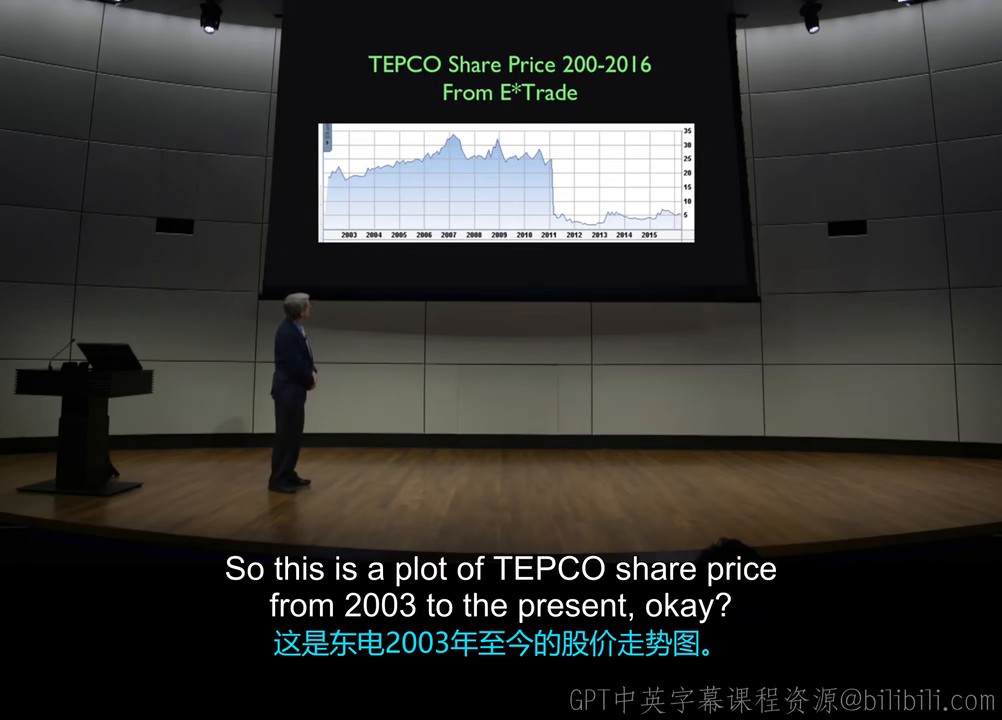
The other thing that's happened is the share price dropped. So this is a plot of TEPCO share price from 2003 to the present. Okay? And can anyone guess when the... win the earthquake hit by looking at this chart. So the other thing that governments do that make the government a shareholder in business is bankruptcy. So if you are a company that can't pay its debts, all right, because you're in trouble. The company, business isn't doing well. You've just had an earthquake or something and you can't pay that back. What you are invited to do by bankruptcy law is to file for bankruptcy. Now you do this because you're in trouble and you can't pay the debt.
So legally, in order to avoid a prison sentence or something really bad, your lawyers tell you, take your pick. You might not be able to take your pick. The bankruptcy court may not allow you. But Chapter 7 is for companies that are so bad off that it's best just to shut them down and sell everything else. And then they're done. And if there's anything left over after you've paid off all of your debts.
the shareholders in the company can get a liquidation amount. But typically there's not even anything left over, so the shareholders are wiped out. The debt holders get pennies on the dollar. All the assets are sold and they end the company. But Chapter 11 bankruptcy is used for companies that still have some enterprise value that you can argue shouldn't be shut down because we're doing something and people value.
So let's reorganize. the company. So you might wipe out the shareholders, or you might maybe keep them alive with hoping that they'll get reimbursed. So General Motors is an example of that. But you see what's happening is that the government is accepting some of the losses of the company in trying to deal with the bankruptcy. Personal bankruptcy is similar to a, of corporate bankruptcy because it allows you to take risks and have your negative consequences borne by the government.
As long as you're not criminal. Of course, even if it is criminal, all they can do is put you in jail. And they still end up taking the loss. So the government is like a shareholder, inevitably, even when it tries not to be. So I think it was an apt title. David Moss, who we've mentioned before, wrote a book called Government as Risk Manager of Last Resort.
Municipal Finance: Why Cities Borrow for Infrastructure
Now I want to go to municipal finance. That is, now incidentally, we have to distinguish in the United States between state governments and local governments like cities. Because state governments are sovereign. They are like separate countries. Remember, the United States began like the European Union. There were 13 colonies. They were separate countries. And they came together and formed a union.
But there are still separate countries in the law. So the federal government is not going to make laws about bankruptcy of state governments. But they do make laws about bankruptcies of municipal governments, cities. So the basic motivation. Now, cities borrow money. Why do they do that? It's the most elementary thought that I want to get clear. I would say, you could say city government shouldn't borrow money.
They can raise taxes and they should pay it. they shouldn't go into debt. Why does a city go into debt, you might say? People do say that. Why don't you just finance everything by taxes? But there's a really important reason why they don't finance purely by taxes. And that is, there's a problem of population inflow and outflow. Suppose you are a young city, newly established, and you have a reasonable prospect of expecting to grow.
So there will be a huge city. population in the future it would be reasonable it wouldn't it for the government of this new town to set out roads and sewers and other basic infrastructure do it all at once do it right bring in a consulting for expensive consulting firm lay out of grid of streets and then put the whole sewer system in now I mean rather than do it piecemeal it's it's it's more efficient to do it but how are you going to pay for it now because the people who are and there aren't many people who've come yet.
You'd have to put enormous taxes on them. That obviously is unrealistic. So the city government will borrow money to put into these infrastructure investments. And then they have the right to tax future people who come in, to pay off the debt. So they're making a gamble that people will come in. It may be a very reasonable gamble, but they have to convince the lenders, the borrowers of the municipal bonds, that it's a reasonable prospect that you will get repaid.
So you have to agree, isn't it obvious? Or schools, right? You know that people are coming into your city. Let's get a lead on it. Let's not have them come in and then there won't be any classrooms. Let's have an extra amount of classrooms now. You want to finance that by debt. But now, have you heard that this that in the United States, almost all state governments have prohibitions against deficit spending, against the state governments for borrowing money and spending instead of raising taxes.
Let me give you an example. I'll just pick our own state as an example. The state of Connecticut initiated an income tax, it now stands that I think it's 6.7 or is it 6.8? Somewhere in that, I should know, I pay it, but it's only a tenth of a percent I might be off. So they, and I'm talking about the top bracket. So they, Governor Lowell Weicker was an independent.
He campaigned, he put his personal reputation on the line saying, Connecticut was, which is then short of money needs an income tax because the income tax is a fairer way to raise money. It taxes people with more income, more, rather than sales taxes, which tax everyone the same. So it's progressive. It's hard to sell that, though, because your influential people tend to have higher incomes.
So how did Lowell Weicker do that? Well, he's very proud of it that he did that. It was the right thing. do. They had to have a constitutional amendment to get it by. And then he was not reelected. He's out for a policy. This is an example of a profile and courage where he did the right thing and it got him into personal trouble. But in order to get it passed, the Connecticut voters wanted something in exchange. So they put in a balanced budget amendment for the state of Connecticut.
that it cannot do deficit spending. But then if you look, no, wait a minute, you say there's Connecticut government bonds. How can it be? If we're not allowed to do deficit spending, why do we have debt? Then you have to understand the way it works. The prohibition against deficit spending is on the current account. The government, state and local governments have both a current account and a capital account.
On the current account, it's their expenditures, inflows and outflows for current things like salaries, taxes come in, salaries go out, that's the current account. But if we borrow money to build a school, that doesn't even go on to our current account, because that's capital. We're not waste, it's nothing irresponsible. Building a school, is that irresponsible?
So we are allowed to do that. So states, can borrow if they can justify it as for making a capital expenditure. There's also a state and local governments issue bonds that look a lot like GDP-linked debt, in a sense. It's not GDP, but they're linked, they're more like equity. They're called revenue bonds. So if a city issues debt, for a particular project, like building a toll road, or a toll bridge, which has money coming in to the state from something other than taxes, then they can issue bonds which promise to repay the debt out of the toll revenue in this case.
So it's like a business that the government is engaging in. It could be a private business. We could have a private company building a bridge. This used to happen. I don't know, it's not very common anymore. But a private company could build a bridge and plan to make money by trying to make money charging tolls on people who cross the bridge. But typically that's done by, that kind of thing is done by state and local government.
And it does it with revenue bonds. So revenue bonds are like equity in a government project. So it's good to know about revenue bonds if you are a public-spirited person and you want to see something happening that looks like it's a business prospect, but it isn't happening for maybe some subtle reasons in the private sector. You give up your idea of starting a new company.
You might think, I want to form a bridge company. We need another bridge over the Quinnipiac River here. You could start a company and build a bridge, but you might have problems. Maybe legal problems in enforcing toll. I'm not sure. But anyway, you decide it's not going to work for me. But it's still a good idea. So what do you do? You go to the mayor or the governor of the state.
and you say, I have an idea that can be financed by revenue bonds. Now, governors like this better. When you come and say, it's an idea for something you can do, and you don't have to raise taxes. You can issue revenue bonds. It sounds more saleable. So remember, revenue bonds. That's an alternative to your budding dreams of becoming an entrepreneur. You can participate in local government, in an entrepreneurial-like activity, There's nothing new here about this.
There's a special bankruptcy law. I mentioned Chapter 7 and Chapter 11. Chapter 9 is a special bankruptcy law for municipalities in the United States Code. And also, this slide, the title might be inappropriate. There's a lot of talk about balanced budget amendments, and it continues today. not just in the U.S. but in other countries. But I think it's maybe, I don't support a balanced budget amendment because I think we need deficit spending as an economic stimulus.
But it's not as bad as it might seem. If you reflect that, these Scholdenbremsa, for example, doesn't, I think, doesn't prohibit governments from doing, local governments from doing deficit spending for capital account.
Government Social Insurance: Embedding Risk Management in Public Institutions
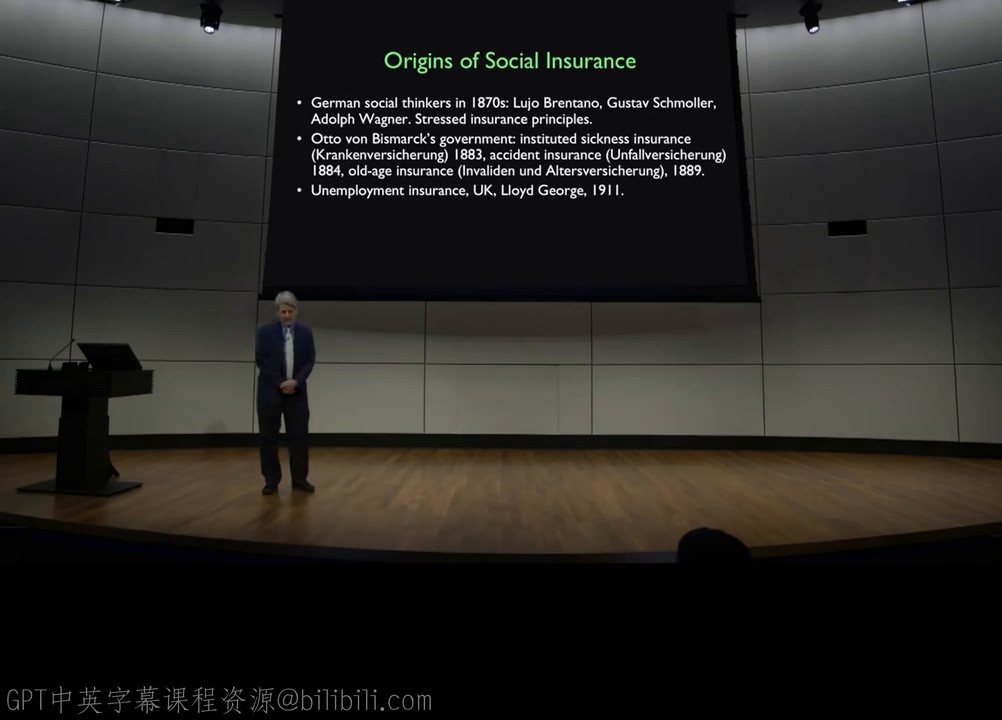
Government social insurance, well, the government gets involved in insurance. The first major government involvement in insurance, which ought to be a private, you might think ought to be a private business, started out as a private business, occurred in Germany. In the 1870s, there was a lot of, Germany was the most advanced country for forward economic thinking at that time. A lot of Americans went to get their PhDs.
in Germany. People like Liu Brentano, Gustav Schmuller, Adolf Wagner, said that the government should use insurance principles. Otto von Bismarck was not an economist. He was the head of the German government. What do they call him, consular? And he wasn't really very involved in this, but his government did this. It created Kanken-Vizikurung, that's, sickness insurance, in 18, 1883. Unfal for Zichurung, accident insurance, 1884, and invaliden and altars for Zichurung, old age insurance in 1889.
In his memoirs, Otto von Bismarck wrote his autobiography, he forgot all about this and doesn't mention it. I don't think it came from him. It came from these economists. It wasn't until 19, the Germans did not invent unemployment insurance. in the United Kingdom with the impetus of Lloyd George in 1911. Now, these are all insurance things that you might think could be handled privately.
Well, we do have examples of private sickness insurance, accident insurance, and old age insurance. We've got them all. So, and not unemployment insurance. Except maybe there is some example, a minor example, of unemployment insurance. I know it's been proposed. I think it might happen soon, by the way. People call me up with their ideas. Maybe in the next five years it will be privately offered add-on to government unemployment insurance.
That's a major force. So why does the government get involved with these things? Well, I think it has to do with the private sector can manage certain things well, but not everything. And it's hard to sell some of these to the public. They're mistrustful. Do I have a slide? Yeah. This is Gustav Schmuller, in around the early, beginning of the 20th century, he wrote his memoirs.
He wrote that it was the triumph of insurance in every imaginable area was one of the century. He's talking about the 19th century, great advances. It was an entirely logical development, replacing the older charitable relief funds. It used to be religion which dominated our lives more. And religion did provide insurance. Maybe I should have mentioned that.
The church provided insurance. The earliest insurance contracts seemed to be religious documents. So there's other kinds of insurance. Aid to Families with Dependent Children created in 1935 was to support people who couldn't feed their children. It was abolished in 1996 in reaction to what was perceived under President Clinton as an accelerating moral hazard problem.
People thought that we're developing a class of people who've lived all their lives with AFDC and have no plans ever to work. And that struck them as wrong. So we have modified that, although still we are still feeding. They changed the food stamp program's name to snap, to disguise it. Supplement supplemental nutrition assistance program. But we still have them. We still have something analogous.
to AFDC. So there's so many other things. Progressive taxes are a risk management device because if your income falls very low, your taxes go down. And in fact, we have negative taxes for very low incomes in the U.S. and other countries because of the earned income tax credit and its analogs. We have free public education. That's an incredible transfer to the unsuccessful people.
who are unsuccessful in terms of earning income so that their children will still be supported with decent public education. Social Security. OASD stands for old age survivors and disability insurance. And we have government health insurance, notably Obamacare, which I didn't put on the slide yet. Workers' compensation was a movement. Before the federal government began really in providing much insurance.
Workers' compensation was a movement that went across the U.S. states, and now I think every state has it. And it spread across the whole world. I could give a whole lecture on this. It's an interesting story. To protect people against job-related hazards. The theory was developed by economists. I think in Germany, the first, that spread to the United States.
The idea, that's Arbites for Zikering. It's Arbites for Zicorum. It is Germany. So what is Arbites for Zichorum? It's insurance that the employer must buy for the employees of the company against accidents at the workplace. And since they're forced to buy it, it helps employers improve the safety in the workplace. It provides an incentive. That was the argument.
It internalizes the cost. It used to be, when Lloyd George went to Germany, for a visit in the 1890s or early 20th. One thing struck him, there are no triples begging on the streets. He said, why not? In London, they're all over the place. Well, this is what you had to do. You would be injured at work and you lose your legs, and now what do you do? Well, the first thing you do is you try to sue the employer for having an unsafe work.
You could do that. But it's very hard to win a suit like that. Because how do you prove that it was the employer who did it and not your own negligence? They could call the other employees to testify, but they're not going to testify against their own employer. So you couldn't get it. You ended up on the street begging. So, Lord George said, this is, we have to do this too.
And it spread all over the world. And we still have it. On an airplane, I sat down next to someone, I occasionally conversed with people next to me on an airplane. And she worked for the state of Connecticut workers' compensation law. And I said, well, that's fascinating. Tell me about it. And she said, you're the first person to say that's fascinating. It's not glamorous, it's not talked about it.
It's just there in the background. You don't even know you have it. But when you take a job, you've got this insurance policy. In the United States, we tried to create an income tax. during the Civil War between the states. And it was a low tax rate. But the problem was that they couldn't measure people's income. Only 10% of eligible taxpayers actually paid by one estimate.
Fraud was too easy back then. One problem was, how do you know what someone's income is? They didn't have documents. You know, your employer would be able to be. pay you in cash. And so how does anyone know? And your employer wouldn't keep records deliberately because there's an income tax. So they rescinded the income tax in 1872. We had a much more corrupt government than we do now.
So some economic historians say that economic development tends to have a slow process occurring over decades against corruption. Eventually, if it works out well, advanced countries are much less corrupt than the lower countries. And it's partly because they have regulators and they have law enforcement that creates a standard that eventually is accepted. You don't bribe the police officer, right?
If you're pulled over for speeding, does any of you, I can ask you this. Do you say, hey, look, I'll give you $100. I don't want a ticket on my record. You might do that in some other country, but it's just not done here. Unless I'm naive, I don't think it's done. I don't think any of you have tried doing this. that. Also, another important invention in history is the withholding of income taxes, that they don't expect you to pay up at the end of the year. Because that would mean that you'd be expecting people to save money to the end of the year to pay their taxes. Well, they're not going to be able to do that. Maybe they can, but what do you do with someone? There's a family that
looks like it's starving and they come into the, you're not paying your taxes. What are we going to do? Put the father in jail? What's that going to do? So it's better to create a tax system that withholds. It's an invention like any other. I think it's a behavioral finance invention. I mentioned survivor insurance. The amazing thing to me is that when they created it in 1939, that the insurance industry didn't vigorously oppose it because it was competing with what private insurance companies were offering. One thing they did in order to confuse the issue is to rename it, survivor's insurance. I mean, this is well, this is fishing, but it's well-meaning. The government thought, we won't even call it
insurance, life insurance. We'll call it survivor's insurance. It sounds completely different, but it isn't. With life insurance, you insure someone against the death of a named party, and then there's a beneficiary named in the contract who gets it, usually the child, or sometimes the wife, or it could be the other way around, could be the husband. So, but if you rename it survivor's insurance, insurance companies don't have to mention when they're selling insurance that you already have life insurance. If they called it life insurance, they'd have to mention it. So let me just say that public repeat, that public finance shares many aspects of private finance and insurance, but they are different traditions and they have different
vocabulary, a different culture. And once again, progress in innovation is slow. It's always about the same general themes. It's about incentivization of good actions in a risky world. People have fears and purposes, and they like to have some choice of alternative financing methods, but they often miss the choices, so we have to give them something automatically.