Real Estate Markets and Bubbles
Recessions: Psychology, Expectations, and Elusive Turning Points
You mentioned trying to stop recessions. How do you do that? I mean, it seems like everything's cyclical. Well, I have a lot of thoughts on that. I wrote a book with George Akulov called Animal Spirits, and it's about the psychology of market and recessions. We concluded that, and this isn't totally new, but it's our reaffirmation, that recessions are substantially psychological.
So it's difficult for anybody, a central bank, a central government, to deal with them. They're just, it's just like if you get depressed and go to a psychiatrist, don't expect to be cured overnight. Yeah. I had a question about inverted yield curves. So how do they occur and what do they mean about the state of the economy? Well, an inverted yield curve is a situation in which short-term interest rates, like overnight rates or three-month rates, are above long-term interest rates.
That's not the usual situation because long-term, well, obviously, long-term bonds are riskier because the payout is coming much later. So people generally demand a higher, and the market will give them a higher interest rate. But sometimes it's in the market. It's been shown statistically that that's a leading indicator of a recession. That historically, inverted yield curves tend to be followed by recessions.
Right now, we do not have an inverted yield curve, but we're still talking about recession. So it can, still can happen. But why is an inverted yield curve predicting a recession? Well, one thought is that recessions occur when people get pessimistic. And they might get pessimistic about 10 years into the future. So we were just saying that government bond yields in Japan reached a negative number at the 10-year horizon. It's done that similarly in Germany and other European countries. So what does that mean? Well, one thought is it's just a long-term pessimism. We've been in this financial crisis, It's worse in Europe than in the United States.
We've been in it in Europe for, it's getting close to a decade. And people are starting to think, this isn't going to end. You know, we just don't have prosperity. And they don't want to invest in new projects. So there's just no demand for these... So the interest rate equilibrates at a very low level. The other thing, though, historically is that often central banks started recessions deliberately at times when inflation was getting out of control.
That's not now. But in history, there would be times when inflation was just going through the roof and someone said, you know, you've got to take tough medicine, shoot the short rate up really high, which is what banks can start a recession, and that will bring the inflation rate down. And out of desperation, they actually did that. So if that's the story of inverted yield curve, it's not so promising and explaining the current situation when inflation is not a big factor generally.
So are there better gauges of recession in the bond market, like say the LIBOR OIS spread or other basis swap rates? Like, what are the good ones, would you say? Well, I don't like to, I mean, the stock market is the famous one. This is the most famous leading indicator. And I tracked it back to the early, 1920s, that's when people thought, started to really talk a lot about the stock market as a leading indicator.
And I think it became a sort of self-fulfilling prophecy afterwards. In 1929, now people had been talking about stock market as leading indicator. In 1929, we had the biggest one day crash. I think it was the biggest in history, or very close to that. And so people thought that's a leading indicator. They started to worry about the depression. And that encouraged it to actually happen.
People stopped spending and stopped new investment projects. So that's the most famous leading example of it predicting correctly. So we have seen drops in the stock market after 2000, and it led to a recession. After 2007, and it led to a recession. And now in 2016, we see some little drops, you know, close to 10% in the stock market. It's going to get people worried that this leading indicator is suggesting another recession.
And it's not just the U.S. It's all over the world. Stock markets have been dropping. But it's still not clear yet because it hasn't dropped really a lot. It might correct upwards. It's very fuzzy. And it's always. fuzzy about recessions. Until they're really happening. Once the unemployment rate starts shooting up, then we pretty much know there's going to be a recession.
But it's that period before there's any clear indicators that it's just hard to predict recessions. There's some kind of turning point that happens when people suddenly think, this is it, you know, it's a recession. I better batten the hatches and retreat and protect myself. And then business plans. are canceled, people are laid off, hiring is shut down. You can see that when it's happening, and you can predict it's going to get worse for a while.
But at this moment, we're not there. So how do you see that in the bond market specifically? Well, okay, so the bond market isn't known as much as a leading indicator as the stock market. And if I looked at what was happening in the long-term bond market in 1929 for a 1929, for example, not as dramatic. Or in the housing market then. The stock market is the one that is most famous for predicting.
But you know, it's a fundamental fact, though, that recessions are just hard to forecast. Not for you. Well, I think it's a little bit like predicting the success of a movie. If I were to show you a screening, a private screening of the next movie about to be launched, could you predict whether it would be a hit or not? You know, I think you might think you can, but nobody really well can.
You know, these things are, even some of the most famous operas, for example, they flopped on their first performance, and people thought they were terrible. but somehow public opinion has its own livelihood. So in our book, Animal Spirits, Akhalov and I emphasized how it's really a kind of contagion of emotion that takes place. About a movie, for example, or a song, that's human nature.
And so you can sometimes predict, but not reliably.
The History of Mortgages: Clear Title before Broad Credit
All right, so I want to talk about real estate. So let me start with mortgage lending. Morton means death in Latin, and so they called it mortuous Vadium, dead pledge in ancient times. It's an old idea. The idea of collateral is very old. That is, I'll lend you some money, but you have to sign a contract saying, I can get to sell your land or something if you don't pay me back.
and take the money out of that. Otherwise, lending couldn't happen. So that's an old idea. We have it as a verb to mortgage something. To mortgage your house means to offer it as collateral for a loan. So when you get a mortgage on your house, the bank, typically it is to buy the house. The bank lends you the money to buy the house. And then, but if you stop paying on the mortgage, they can, reclaim the house.
Maybe not all of it, they'll sell it, and they'll take what's owed to them out of it, and plus maybe some charges, and then you'll have the remainder. That's the idea. And mortgage lending is very important because they can lend to anybody, as long as they can value the house. They don't have to really be able to value your trustworthiness to pay the money back.
You could drop dead and they don't care. You're gone. You're not going to pay anything. The house is theirs. at least the component of the house value that they can use to pay off what you owed them. So the history of mortgage lending goes back, at least to the Tang Dynasty in China. A little different back then in the Tang Dynasty. They could impose fines on your relatives as well.
We don't allow that now in modern times. It's only you and your spouse who would both sign. Or sometimes they'll ask your parents to coach That makes it easier to get a mortgage. But they can't go to relatives who don't co-sign anymore. The word mortgage became common in the English language in the late 18th century. And property law wasn't very well developed then.
Because it wasn't even clear who owned property. Because there wasn't a system that was well established. So if you look in newspapers, from the 18th century, you'll see a lot of ads, personal ads, placed there, claiming ownership of property. So this is what you do. When you bought a house in 1750, you first would go through all the newspapers and see if there's any ad placed that says, I own that house, this guy is cheating me.
And then I have papers to prove it, which would be documents drawn up by a lawyer. So you stay away. it was a mess, though. They didn't have, who owns this house? Well, in Germany, in the late 19th century, they had the idea of having a centralized and authoritative book called the Grunbuch book that would list for the whole country, who owns what? And when you bought and sold the property, you would have to send papers to the holders of the Grunbuk and they would change the ownership.
That made it so much. better that property now is clear, the title property is clear, although it's still not completely clear, even in modern countries. So, because not everything, not all claims on the property get reported, but at least it's getting clearer.
Commercial Real Estate Vehicles: Partnerships and REITs
So, commercial real estate. partnership is an example of a direct participation program. In order to buy in to a real estate partnership, you have to be an accredited investor, which is defined by the Securities and Exchange Commission in Washington, D.C. as in terms of your wealth and your income. Now it used to be you had to have more than a million dollars of investable wealth in your name, excluding your house, or an income of $200,000 a year or more.
That's what a definition. How many of you are accredited investors? I won't ask for a show of hands. You might have to achieve a certain age, too, to be an accredited investor. But the idea is we will protect the small investors against fraud and being cheated because they don't have lawyers, they can't afford lawyers and advisors, and they're so vulnerable.
But if you're rich, the government says, all right, you know, you have your advisors, we'll let you invest more generally. Other countries have similar divisions, so it's not just the... U.S. It makes sense, right? You have to protect ignorant people, and not everyone is smart. We can't let the crazy schemes prey on them. Okay, so a real estate partnership is for accredited investors.
And a limited partnership means you have limited liability, at least the limited partners have limited liability. Direct participation are flow-through vehicles. They escape corporate profits tax, but their profits become your income. IRS has various requirements. One of them is that a DPP can't be perpetual. It has to have a limited life. Corporations derive a lot of their value from the fact that they go on forever.
Once a company establishes a reputation, it has value that will last maybe hundreds of years. if not that long, at least many decades, but a DPP is supposed to be for a particular life. That means, for example, you would buy an apartment building, a typical DPP, you'd get a small number of partners, rich people who buy into your partnership, and then you say that in 20 years we'll sell the building, and then we close down.
So you've satisfied the IRS requirements for a pass-through vehicle, and you don't have to pay corporate profits tax, which is a big advantage. The general partner runs the business and does not have limited liability. Must own at least 1%. Limited partners are passive investors, just rich people typically, and they can replace the general partner. And they sell units to investors.
and give performance-based compensation to the general partner who's taking the risks. Now, there were complaints about these limited, they were trying to protect small investors, but when that left small investors unable to invest in real estate. In 1960, the U.S. Congress created something called a REIT, real estate investment trust. And I believe the U.S.
was the first country. But I shouldn't say that I know that. There's so many things that happen. Often the U.S. is not the first to do something, but it becomes a leader in finance, a leader toward a movement, so something will happen. But it was new, definitely in the U.S., in 1960. So the complaint was, I, a little guy, just can't invest in all these buildings that have been making so much money for rich people.
It's unfair. So the U.S. government created a new kind of investment vehicle called a REIT that would be available to small investors, and they'd be regulated to be safe. But it wouldn't necessarily be safe because they're investing in a real estate, and if the real estate goes bad, but at least they won't be taken advantage of. And they also get the tax break.
You could have set up a corporation before this that owned real estate, but they would be paying corporate profits tax. So now REITs are getting much bigger. They've been over half a century now, and they're now in many countries. But U.S. is still the biggest source of REITs. So the law restricts REITs. They're not going to pay the corporate profits tax, so they don't want to let corporations call themselves a REIT.
call themselves a REIT. You know, our company could say, well, we own real estate, we own the factory. And so we're a REIT. No way. You can't call yourself a REIT to escape taxes. They had to define it. So they've defined it that 75% of the assets must be in real estate or cash. And 75% of the income must come from real estate. And 90% of their income must be from real estate.
dividend, interest, and capital gains. And 95% has to be paid out. Now here's where the dividend earnings ratio is set by law. They've got to pay out their earnings. And also, they wanted to discourage no more than 30% of the income from sale of properties held for less than four years. They wanted it to be long-term investing, not turning over rapidly. So starting in 1960, there was a REIT boom.
And that was followed by a recession and drop in property prices into the early 70s. There was a second boom after the tax reform of 1986, eliminated many of the advantages of partnerships. It used to be that DPPs could do fancy arithmetic on the pass-through taxes that you got, which would make them very advantageous. Notably, you could depreciate very favorable rules that reduced your taxes, even if the depreciation wasn't real.
So they made it less profitable in 1986 to invest in a DPP. And then there was a third boom starting in 1992, when many, companies. This is also a time when a lot of specialized REITs developed to appeal to investor interest. So you can buy a golf course REIT. Remember, real estate is both structures and property. So golf courses apparently satisfy the investment, the idea of investing in property, and you can do a golf course REIT or many different kinds of REITs.
You describe how human psychology explains a lot of the price in housing and real estate. But if we don't consider those, if we absent any psychological factors, what would the long-term housing price index would like? I never actually went through that exercise. If you look in my book, I have a plot of home prices since 1890 and construction costs since 1890.
So maybe it would look more like construction costs. So remarkably, if you correct for CPI inflation, construction costs haven't gone up a lot in 100 years. In fact, for the last few decades, they've been sagging. Why is that? Well, I think it's because there's technical progress. We mass-produce things now. They used to plaster by hand on lab. Now they put drywall up.
It's cheaper and quicker. things are pre-made. You just stick them in place. Mass-produced. So that limits the rate of growth of construction costs. And I think prices, if that were the only factor, then prices would look like construction costs. That's what people often have said. Economists have often said that prices are just driven by construction costs, but those economists wrote before the recent bubble and home prices.
I think they're getting more, they're more psychological. There's more attention. The psychology of the housing market has changed. If you went back to the 19th century, it's hard to find many real estate bubbles. But you do find them, for example, in the 19th century, in Manhattan and Los Angeles. And few other places as well. But what did Manhattan and Los Angeles have in common?
They were glamorous places. They were glamorous back then. Beautiful weather in Los Angeles. And also a shortage of space to build, at least especially in Manhattan. So in those places, they had housing bubbles, but not everywhere. So something happened. in the late 20th century that got people, and not just in the U.S., in many places, got many people thinking that real estate was really going to be scarce.
I think it had something to do with the free market revolution that started in Britain with Margaret Thatcher and in the United States with Ronald Reagan, and then in China with Deng Xiaoping. There was a move over much of the world toward free markets. market, which I think on the whole was a good thing. But it also had its consequences that it led people to think, you know, we used to be a society where we appreciated the working man or woman and we would protect them.
Now everyone's got to watch out for themselves. And they started to have a fear that housing would just get beyond affordability. And that kind of is still with us that homes prices are just going to go way up, and you better buy now. you don't see that so much. I look through old newspapers for ideas like that. Maybe in Manhattan. If you want a house in Manhattan, I remember reading from the 1880s, someone saying, you know, it's hard to find a building that's less than six stories tall that's going up now.
You can't just buy a house in Manhattan anymore. And it's still true, and it's still expensive there.
Mortgages I: Underwater Homes, the Great Depression, and the FHA
Mortgages. Now, mortgages owned by households was recently $13.2 trillion. And recently there were $48 million, in the United States, 48 million mortgaged homes, but that's one for every six or seven people. A lot of people still rent and live in apartments, but there's 48 million mortgaged homes. Now, there are also problems in the mortgage industry because in 2012, right after the financial crisis, when the housing market bottomed, there were almost 11 million homes that were, quote, underwater, which means the value of the home was less than the value of the mortgage.
That's quite a startling number, so it was one in five homes. What would benefit people who lived in those homes would be to abandon the house. It's called jingle mail. You put your keys in an envelope and you sign a short letter to the lending bank. I'm out of here. Take my house and you go and you rent. Now that only works legally in what are called non-recourse states.
So some states are recourse they can go after you and try to get your money anyway, even beyond. to the house, but many of our states are non-recourse. And even if they are recourse states, they won't actually often go after you because it's too expensive, and you don't have anything else typically. So why bother? They just write it off as a loss. But most people don't.
Most people keep paying. They live in the house. Maybe they have some ethical concerns. I promise to pay this, I'll pay it. But it left our economies in chambles. because these people typically knew they were underwater. So they knew that they had negative savings. The typical homeowner, especially younger homeowners, have nothing more, virtually nothing more than their house.
And if it goes underwater, that means their personal net worth is negative. So we have, you know, like 10 million families with negative, something like that, negative saving. And that's what killed the economy. They didn't want to spend money when they don't have anything, less than nothing. So they just sat in their house and they continued to pay the mortgage and they didn't spend.
So the whole economy went down. In the 1920s and before, there weren't as many mortgages. The industry wasn't as developed. But the mortgages that you got were typically five-year term loan or less. You might get a two-year loan or a three-year loan to buy a house. Now, of course, you're going to live in it more than two-year. or three years, often would anyway.
But how do you deal with it? We have to just come back and refinance. The bank says, no problem. We're giving you a two-year mortgage to buy a house. In two years, come back, and we'll give you a new loan at the then prevailing interest rate. The problem was, in the 1930s, we had the Great Depression. And it involved a crash in home because everyone was poor.
They couldn't pay as much to buy a house anymore. And secondly, it produced 25% unemployment. So now, two years of pay. You bought a house in 1929. It's now 1931. You're underwater. You go back to the bank and say, I'd like to renew my mortgage. And the bank would say, no way, you don't have a job. Your house isn't worth as much as the mortgage. So they would just foreclose on you.
So millions of houses. were foreclosed in the early 1930s. That led to the Roosevelt administration. They created the Federal Housing Administration in 1934 that would insure mortgages. That is ensure the bank against your default. So the government was taking on the risk that had formerly been on homeowners. That's because the whole thing was a total mess.
Houses were working. worth much less. Nobody could buy them. They were crashing. And that made banks fearful of lending to anybody. So Roosevelt took a big gamble. He said, we're going to just insure them. We, the government, and if there's further defaults and further crashes, well, we're going to take it out of taxpayers and we're going to, we'll pay you off. So the bank started lending again and it brought the housing market back up. The other thing that Roosevelt did in 1934 was to require 15-year loans.
Any FHA loans had to be 15 years till maturity or longer. This whole idea of giving you a two-year mortgage seemed like a bad idea in 1934. That's established a trend toward long-term mortgages. As time went on, it became standard in the United States to have long-term mortgages. And now typically it's 30 years, at least if you're a year. younger person, you typically get a 30-year mortgage. By the way, FHA has been in trouble recently, and it may still be in trouble, but it hasn't defaulted yet. So there have been a lot of mortgages that had to be paid out by the FHA that defaulted.
And so they've raised their insurance premium from a half percent a year to one point five percent a year, which has been hurting real estate. Since the 2007 housing bubble, markets seem to be concerned overwhelmingly with irrational overvaluation of aggregate housing prices. My question is, should we rather be concerned about irrational undervaluation of housing prices?
That's a question especially for certain cities like Detroit or Baltimore, or Baltimore, which where prices have, well, I don't know if they've fallen much in Baltimore, maybe in certain pockets. But Detroit has had prices fall so much that the city has been tearing them down. They hit zero and they're abandoned and then they've become a hazard. So I guess it's like anything else.
You have to judge whether they're being devalued for a good reason. or not. Detroit is coming back now. So it might have been a smart move to go in and buy them recently, and you could get them really cheaply. And then maybe they will come back. It's like anything else. Value investing has to judge. You can do value investing with housing, but you have to judge whether there's a prospect of them coming here.
back. I'm sure there's a good, there's a strategy for doing that. Maybe I'll buy some property in Baltimore. Let me know. You said you're from Baltimore. I am. Yeah, so the thing about mean reversion, when something gets really cheap, it has a better chance of coming back, but not necessarily. It's a somewhat risky investment. But yeah, Holmes, Holmes, there are a number of places where some people argue price has fallen well below construction costs, and so there won't be any new construction if the houses are selling for less than it costs to build them. So those might be good investments in the longer run if the city gets rediscovered. New jobs start coming into the city and then
suddenly those properties would take off and they're protected against new construction. See, if homes are selling well above construction costs, there's a kind of a cap on their appreciation. I don't know if a lot of people realize this. They can't appreciate too much because builders will come in and build more of them and dump new supply on the market. So there are people who look at these and invest in housing, trying to find houses below, construction costs in areas that are coming back and that might be a good investment.
Mortgages II: Interest Rates, Maturities, and Contract Design
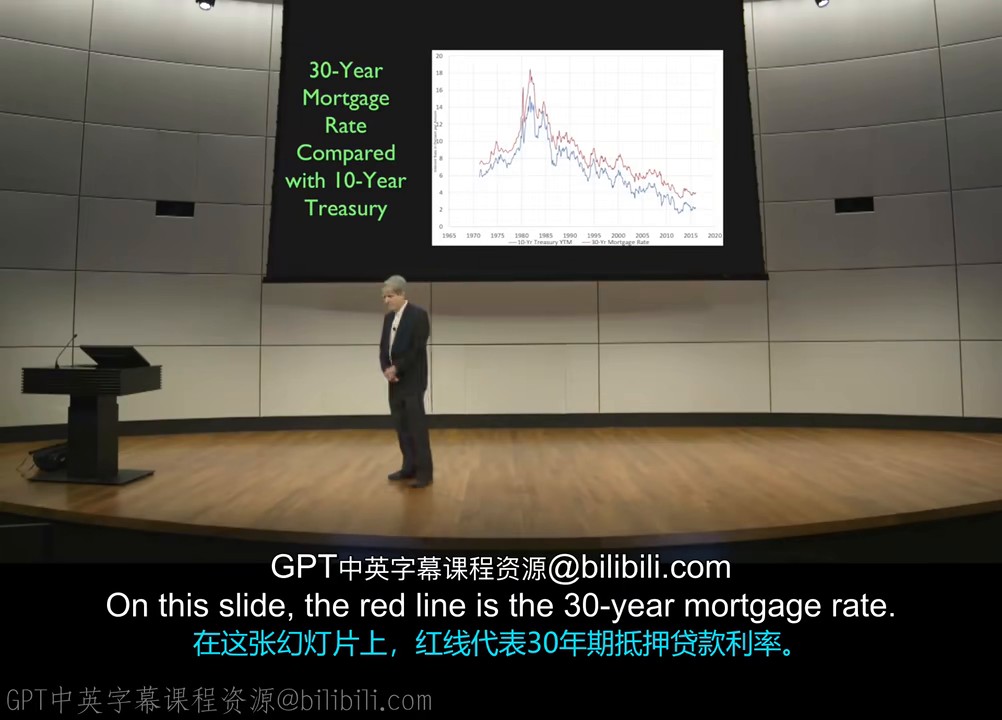
On this slide, the red line is the 30-year mortgage rate. It's the rate of interest on the 30-year mortgage. And the blue line is the yield to maturity of a 10-year U.S. government, federal government, Treasury bond. I put the two together on this chart to illustrate an important fact that the 30-year mortgage rate tracks the 10-year government bond yield. It's a pretty good relationship, isn't it?
Well, the reason that there's a good relationship is that there should be one interest rate. Right? Now, let me clarify one thing. 30-year mortgage, that looks very different from 10-year. But most mortgages are paid off in less than 30 years. In fact, this is the way it works. The typical homeowner, that's you coming up, the typical homeowner buys a first home, which we call a starter home when they're in their 20s, maybe.
And then their jobs tend to be unstable at that. They're moving from one job to another, and they might move several times in the space of 10 years. And then typically the normal life cycle in an advanced country is by the time you're reach 40 or thereabouts. You've now settled down in a job that will keep you for 30 years. Not always, but typically, this is a typical life story.
And then you buy a house which is your final house, which you live in for 30, 40 years. And then you end up moving to some kind of retirement community. And then you move to a nursing home. And then you move to the cemetery. That's the life. cycle. But look at the housing purchases there. There's a lot of short purchases, and then there's a long one. But we don't, we give these people 30-year mortgages often, even if they're buying a starter home.
They never know it's a starter home. They don't like to bring that up. You're buying a home. You're excited. We hope you've got a house now. And they know that you're going to probably sell it. So anyway, the average time that a mortgage actually is outstanding is something like 10 years. even though it's a 30-year mortgage. So they like to track, they're doing this deliberately.
They're tracking the 10-year mortgage rate. Now, why is there a spread, though? The mortgage, I said, they're tracking the 10-year government bond yield. Now, why is there a spread? See, the bank is charging more than the 10-year rate. Home mortgages are slightly riskier. Yeah, you can see it's. Now, incidentally, there is, there is a, Some of them are FHA insured, so, and there's other mortgage insurance.
But they have to pay for that insurance, so it's not, we just said it's up to one and a half percent. The spread between the two is getting wider now than it was back then. And I think that reflects the costs of, and also, a mortgage has to be serviced. You have to send out letters, you have to maintain a system. When people don't pay, you have to call a credit bureau that will nudge them to pay.
So all those are costs. But I find it amazing. The 30-year mortgage rate in 1982 got up to almost 19%. Okay, that's the interest rate on the mortgage. This is the mortgage rate. But your mortgage payment would be more than 18. If you borrowed, let's just to make it simple, you borrowed all of the money to buy a house. Let's say you bought a $300,000 house. And let's say the total, mortgage payment is 20%.
So what's 20%? That's 60,000 a year. That's a lot of money, isn't it? How did people do that? A 300,000, of course, back in 1982, 300,000 would be an expensive house. We can still do that. That's a lot of money to be paying out every year. You know how they did it? Well, A, they didn't do it. The home prices fell because nobody could afford to buy a house. Some of them did it, and they got their mom and dad's money to buy a house.
And I was there, I did that. Yeah, I bought a house in, what was it, in 1982? We weren't paying that, of course not. That would be a huge sum. Yes, these are nominal. Yeah, and there was a lot of inflation. You see, the problem, it doesn't matter where there's a lot of inflation or not. Yeah, you're being paid back because ideally your property is appreciating with the inflation rate, but that's not cash that I have.
to pay this mortgage. So, yeah, high inflation and high nominal rate periods bring in a high mortgage rate. It makes it difficult to buy a house. But there are other kinds of mortgages. What is prompted by your question is just so called Price Level Adjusted Mortgage, or Plam, which tried to make the amortization, they made the amortization actually negative.
Amortization means paying off the principal. Your payment comes in two parts. One of them is interest, one of them is amortization. So they had negative amortization mortgages in the first year, so you didn't have to pay 20% of the value of your house every, how can anyone afford that? So Plam started to come in in this really high inflation period. The inflation rate was double digit in 1982.
So then there's all these different. Adjustable rate mortgage is a mortgage that you get it for 30 years maybe, but they don't fix the interest rate. They tell you that your interest rate would equal some short rate, like the one-year treasury, each year plus something. So it's it. fluctuates with interest rates. Dual rate mortgages, I don't know if they even exist anymore.
Plams, as far as I know, don't exist. There might be something. You might, if you're asked around, be able to get one now. But inflation is virtually zero now. And so people completely lose interest. They shouldn't, by the way, because we're going to have a lot of inflation in the future probably, sometime. And the people get kind of unconcerned. The banks are unconcerned.
If there's a lot of inflation and you own a house, you're happy because now the real value of your mortgage goes down if it's a fixed rate mortgage. But the bank won't be happy. Then there are shared appreciation mortgages. These are mortgages where you pay out some of the appreciation and value of your house in lieu of interest. These were popular in the United Kingdom just before the financial crisis, or just before the 2000s.
But they dropped out of favor because home prices went up so fast in the UK. And people were promising to pay that. And they didn't like it. And they got angry. And the whole thing kind of fizzled. So we're still back mostly in the United States with conventional fixed rate mortgages. A home equity loan is a loan on the value of your house that you might take on later as a way of getting So for example, for home improvements, or you might just take out a second mortgage.
And they're often marketed separately. And they were part of what got us into a great amount of debt just prior to the financial crisis. Because people were, first of all, borrowing at a conventional fixed rate mortgage, and then they'd get an ad saying, want a vacation, we'll lend you against the value of your house. So people started borrowing more and more against their house.
We had fewer people who had paid off their houses and more and more debtors. And then the financial crisis came. Would you consider inflation being one of the major causes of, you know, the depression of housing values? Well, when you bring that up, it brings to my mind, the episode just as Paul Volcker became chairman of the Fed, in 1979. There was double digit inflation, like 12% in the US at that time.
And so interest rates were very high. You know, some people were paying 18% a year on their mortgage. It became very difficult for people to afford that interest. And so home prices reached real, extreme lows at that time. But they came back. So it's plausibly due to inflation and to the absence of plans, price level adjusted mortgages that might have made it easier for people to borrow, to buy a house.
Private Mortgage Insurance, CMOs, and CDOs
I remember I said that in 1934, the United States government decided to insure mortgages of a certain kind through the FHA, Federal Housing Administration, and later through the Veterans Administration for veterans. The government would merely tell the mortgage lender that if this guy defaults, we'll pay up, so don't worry. So these people, they wanted to make sure that people who fought in the war and came home wouldn't be.
handicapped by their being out of the business world. That makes sense, right? Veterans should get some special reference. But that led to private companies that also did insurance on mortgages. And then you pay for it. So when you get your first house, you'll have a mortgage payment that subsumes the PMI, private mortgage insurance. And that ensures the lender, but you have to pay for the insurance. You, the homeowner, pay for it if the down payment is less than 20% of the value of the home. And it usually is. Now there is a controversy.
This is more manipulation and deception. It's not really deception. It's failure to notify you. would think that the mortgage lender or the mortgage insurance company would notify you when the value of your house is probably over 20, you know, you know, you know, you know, the mortgage insurance value of your house went up, so now the down payment is, your mortgage balance is less than 80% of the home value and tell you to cancel, but they don't.
So many people continue to pay for PMI long after it was necessary. That's capitalism. They have no incentive to notify you. They also didn't necessarily hold enough reserves. So in the financial. crisis, at least one of them, PMI Group Inc. declared bankruptcy. So insurance companies are not necessarily reliable. So the CMO is a, I think I was studying on this last time, it's a, when a bank issues a mortgage, it's a loan, so it's a piece of paper with a certain value. They can sell the mortgage to somebody else and typically continue as the servicer of the mortgage, namely you send your mortgage check to them. And if you don't pay you get a call from them or from someone they subcontract to call you. But the owner
of the mortgage is different. Now it's an investor. A CMO is a collateralized mortgage obligation that is a pool of mortgages that is sold to investors, like you, you could invest in one of these. But they also divide them up into tranches. I think I alluded to this. They, the senior tranche gets paid first. If there are defaults, it affects the senior tranche only if all the other tranches have been wiped out.

So they might have a triple a tranche, then a double a tranche, and so on that are not rated as highly. And it helps them sell these securities because many investors are required by their charter or their sense of obligation to invest only in triple A things. So CMOs, an ordinary securitized mortgage would not have a AAA rating because the homeowners might default.
But if you divide them up into tranches like that, you can get AAA securities out of them. The last tranche, the worst one, is called toxic waste. And these are the ones, it's probably not worth anything or very likely not worth anything. And hedge fund investors might buy those at a price, really low price. So they take all the risk. but presumably they understand it better than you the investor.
So what is a CDO? It's something like that. It does the same thing. It divides up into tranches. You might think of CDO is just a more general category. They don't have to buy just home mortgages. They can buy auto loans or any kind of debt. There's also some technical legal definition that I won't get into because this isn't the Yale Law School. These, by both CMOs or and CDOs went into default.
They reached into the higher tranches during the financial crisis. And that was of two, I said 2007. It's 2007, 8, 9, maybe 10, 11, maybe even now, we could still say we're in it. I don't have a good name for it. But what we do know is that these CDOs and CMOs dropped in price. Actually, they dropped in price too much. The AAA tranches shouldn't have been rated AAA, but they weren't as bad as all that either.
People panic because of the crisis. So it was a good investment in 2009 or around them to buy low-priced CDOs and CMOs. You have to be smart. Once again, I don't believe the efficient markets hypothesis that everything's priced right, especially at a time of crisis when everything seems up in the air. And this is a time when deep knowledge of institutions and people help you, that you have to kind of be in a swim of things.
Know what's going on in Wall Street. Know in 2007 that those ratings that the rating agencies give are bunk. So you don't buy them. After they're beaten down, then you go in and buy them because you know it's not that bad. So that's how the smart money outperforms.
Mortgage Regulation after the Crisis: Making Originators Care about Quality
Now, after the financial crisis, the people were really angry that the mortgage, the CMO and CDO people had repackaged mortgages and sold them to the general public, and that the banks who sold the mortgages didn't really care whether they were good or not, because they weren't going to own them. If you're in the mortgage origination business, you're a banker that makes mortgage loans, and you know you're going to resell it to some ignorant investor, then you say, what's the point?
I'll just give, I'll approve everybody, make maximum amount of money. So this was the period, among other things, the liar's loan appeared. That's a nickname, that's not what it was officially called. But a liar's loan was a mortgage issued to a person who did not show evidence of having a job or having a good record. They just took the guy on faith. Maybe they faked it and said that they did have evidence.
This is a crime to do that, right, to take out a mortgage that you think is highly likely to default, to get a credit rating which is not careful at all, and to sell the securitized mortgage to ignorant people all over the world thinking that they're investing in a sound enterprise. So in Europe, the European Parliament passed a rule that a mortgage originator must hold 5% of the mortgages that it initiates.
So if you're a bank and you issue mortgages, you can't sell the last 5%. That gives you an incentive to stay above level and not to give liars loans, for example. Here's an example of the US copying Europe in 2010, the Dodd-Frank Act copied this idea. But it said that we won't require that, if the mortgages are qualified residential mortgages. So the term qualified residential mortgage was defined by the Dodd-Frank Act.
Actually, it didn't fully define it. The Dodd-Frank Act said the appropriate regulators will have to come up with a definition of a qualified residential mortgage, which is a mortgage that is, where all the right things have been done by the originator, the lender, to assure that it won't default. They also, this is funny, Dodd-Frank Act is very difficult to read, and I have to admit, I haven't read all of it, but it's almost a thousand pages long.
And it's not written to be readable. Have you ever tried to read legislation? They'll say something like, in the Something Act, the Credit Act of 1940 something, line such and such is hereby stricken, and the word are replaced with. So in order to read the stupid thing, you've got to go back and forth between all the other legislation to figure out what the other one said.
So it's complicated. And it leaves all these open ends. So Dodd-Frank Act said that you have to, you as a mortgage originator, have to hold 5% of the mortgages you issue or more, unless it's a qualified residential mortgage, as will be defined in due course. So they left it to the regulators to say, you have to define what is a qualified residential mortgage.
And that means a mortgage that has been done properly so that we can be reasonably assured that the homeowner won't default. So they brought this up to the, right, now it turns out there's multiple regulators of mortgages and they couldn't get their act together. They started to do. started issuing proposed rules. That's what they do. Before issuing a definition of qualified residential mortgage, they put up on their website, we're thinking of this definition.
So what do you think happens? Every banker in the country gets onto it and writes a complaining letter. So it's such a mess. You can get onto the website and see. I think for the QRM definition, they got over 10,000 comments. They call them comments. Often angry complaints. You can't do this. I can't stay in business if you put that definition on. So it took them four years to come up with the definition.
Originally, they had a 20% down payment requirement. They've dropped it. So I tried to read the rule. I tried to read it. I discovered it was taking me a long time. So I went to the end and it had 689 pages to define a qualified residential mortgage. That's a lot of pages. Well, you get lawyers, you know, and get them going, and you get all these bankers arguing about it, and all their lawyers, it gets very complicated.
At least they did it. And so here, this is not reading the 689 pages. This is a summary from a mortgage website. So this is, now, incidentally, you don't have to adhere to these rules, but you can't sell all of the mortgages if you don't. And so bankers pretty much are all going to follow these rules because they don't want to be stuck with something that can't be sold.
Bankers have to sell the mortgages to get money to make new mortgages. They're in the mortgage origination business. And mortgages are inherently not held by banks, somewhat by banks, but often not. So they just generally want to qualify. So that means that you have to have equal payments or substantially, you can't have no payments at the beginning. and then payments later, because that would be attracting borrowers who don't have the money, right?
Or it would be confusing borrower. They might think that the low payment is forever. No negative amortization. That means, remember we talked about amortization and that price-level adjusted mortgages that were tried in the 80s had negative amortization at first in nominal terms because the interest rate was so high that nobody could pay that. You know, in a high inflation environment, you have a fixed nominal payment for 30 years, but inflation is going up at 10% a year.
Prices are going up at 10% a year. That means the real payment is going down. So the real payment is declining through time, but the nominal payment has to be constant now. So you can't have negative amortization and qualify anymore. And balloon features, a balloon payment. is a payment at the end. You can't have a payment at the end. It's got to be an annuity.
You can't go over 30 years. You can't have points, which are fees of a sort, that exceed 3% of the total loan amount. Also, interest rate is sometimes adjustable. You have to use the maximum interest rate that may apply during the first five years to define debt to income ratio. You have to verify the consumer's income and assets and current debt obligations and ask whether the borrower has alimony or child support payments to make.
And finally, they did not put a loan to value ratio test. In other countries they'll do. They say you can't loan more than 90% of the value of the house. QRM rules don't have that. Instead, they have a debt to income ratio. So that is you cannot have a debt which is more than 43% of the borrower's income. So that's QRM. And I'll end with that. These rules are kind of obscure, and I went over them though, because you're going to be buying a house.
How many years before you start buying houses? Won't be long. And you want to know these things. This is what you're going to get. a no negative amortization, 30-year mortgage with a debt-to-income ratio less than 43%. And you know what question. they're going to ask. So this shows how regulated our economy. It's a nice tie into our next lecture on regulation.
Real Estate Bubbles I: Counterintuitive Evidence from a Century of Home Prices
But I wanted to talk about the real estate bubble, which is a favorite topic of my... I should say it's a depressing topic, but it's interesting, like a disease, it's a disease of the economy. And I don't like the bubble itself, but I like to study things like this. So I think I told you before that when I wrote the second edition to my book Irrational Exuberance, I wanted to find a long-term, say, 100 years.
year price series for homes, and I discovered there was none in any country. So I constructed one for the United States, and it attempts, it's not the average price of a home or median price of a home, which would be misleading, because homes have gotten a lot bigger and better. It's the resale, it's a repeat sale index that looks at repeat sales of individual houses to measure price changes.
This is the index that I produced with Carl Case at Wellesley College. And then my student, Alan Weiss, here at Yale, wanted to start a company. So we started Case Shiller Weiss to publish these indexes. So the blue line here is the home price index from 1890 to the present. I published it in 2005 when we were right here. And in my 2005 edition, I said, something is really going on right now, which is unprecedented in U.S. history.
Except, well, the only precedent is this one here. The baby boom, yeah. So after World War II, the war was over, and the U.S. wasn't damaged in the war. The soldiers came home, and what did they want to do? Well, they had baitment. But by the way, during the war, they couldn't build any houses. By law, except military housing, or housing for factory workers.
You had to get the war production board to approve any house. And you know what they approved? A tiny bungalow with one bedroom, and that was it. So there were no house. You wanted two bedrooms. You have a baby now. Or you're hoping to have a baby. So there was a shortage of houses and they bid prices up. But that was a totally different boom. That was understandable.
right? World War II. Also, right around the peak, people started into a buying frenzy because of World War III, as they called it. The Korean War broke out in 1950. And I think, I might have mentioned this before. People panicked thinking that they're going to shut down home building again, so I need my home now. But the funny thing is home prices didn't really fall after that, not very much.
It wasn't the same thing. It was all about war and government restrictions on housing. This one was different. Something was going on that was unprecedented. And I'll tell you what it was. Partly, it was fraudulent mortgage lending. It was also not fraudulent mortgage lending, but it was over-optimistic mortgage lending. Somehow people thought that prices would go up forever.
And just a boom, just a bubble. You wonder, why did it happen when it did. Well, it sort of happened on two prior occasions. This one here was a bubble in the 80s, and then it crashed with the savings and loan crisis. There was some fraud and manipulation in this bubble as well. This one that wasn't everywhere. It was in Texas at first, and then it was in California, in some East Coast cities.
So it didn't really catch on as big. And then this was another bubble that peaked in 1990. But then it really shot up. So like these were practice runs, trial runs. The idea spread everywhere in the United States. Not just in the United States, though, I might say this was happening in lots of countries around the world, and it wasn't driven by building costs, population, or interest rates, which weren't doing anything.
So I think it was a speculative bubble that preceded and led to the financial crisis. Then home prices really crashed. These are real home prices, by the way, corrected for inflation, until 2012, and then they started going up again. So now, this series, I may have said this before, showed no increase from 1890, or virtually no increase, from 1890 until sometime in the 1990s.
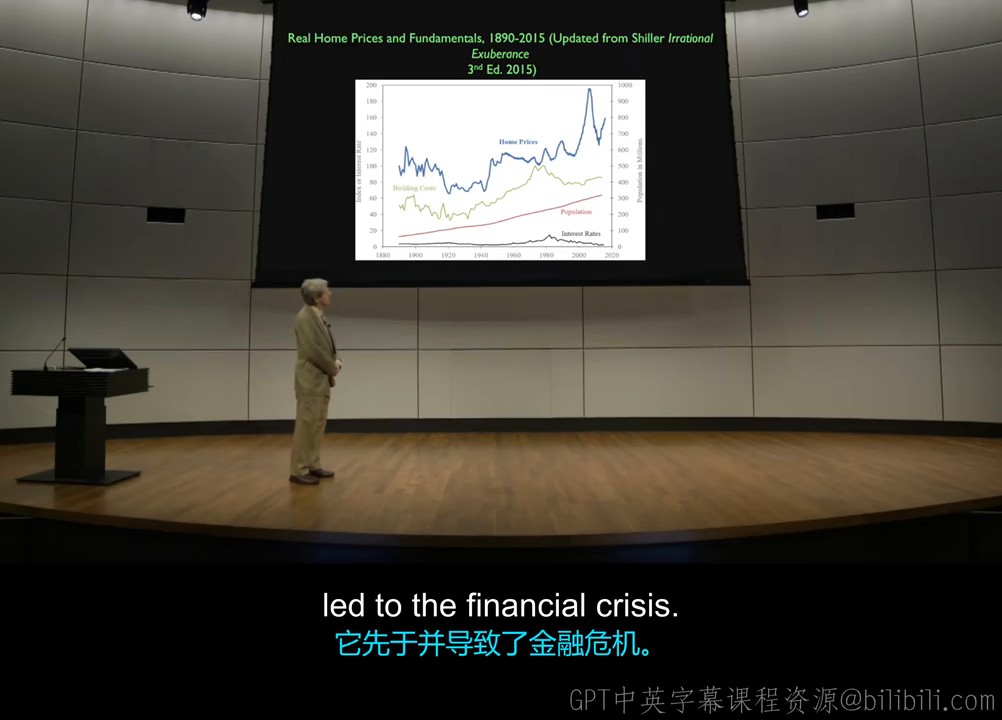
This is around 1997 when it's. started going up. So we had 100 years of no home price increase. This is important to understand because it's contrary to most people's intuition. Most people would think as the population grows and the economy grows, homes would just keep going up in price. Well, there is some truth to that. I mean, we have limited land, and people especially like to live in cities, established cities where they have jobs. So there's some truth to that. But offsetting that is that our technology for building homes is getting better. And so we can mass produce things more.
We can build them more efficiently. So we don't need, we don't need to do all the expensive things to maintain a home. You can see that building costs have not been going up, in fact, falling for the last half century. And the building costs might be. go up because of labor costs, but labor is only part of building. So it's kind of building costs are kind of stable.
They've gone up a little bit in a hundred some years, but not a lot. So if you can build them, there's no problem. And the price of land is actually a rather small component of home prices, at least if you get outside of major cities. So you're building a structure, and structures depreciate and wear out, and they go out of fashion. So people don't want them anymore.
In fact, they'll tear these houses. it's down sometimes when they buy them and put up a completely new house. So it doesn't, home prices don't tend to go up. But somehow in this period in the 1990s and early 2000s, home prices were just seen of as autumn, always going up, it had something to do, I don't know, with the culture, with the story about the emerging world, about the rich Chinese or rich Russians or whatever.
they are, coming in and buying our properties, they just got exaggerated. And so it led to a bubble.
Real Estate Bubbles II: Prices and Beliefs Reinforce One Another
So this is a figure from the book you have, Irrational Exuberance, Third Edition, that I came out with in 2015. And what it shows is, well, first of all, that's just the same Home Price Series, but just since 2003, the same Home Price Series you just saw. It doesn't look as dramatic since it's a short clip of the longer series. But you can see the home prices peaked in 2006, and they started falling after that.
But the other thing shown is the percent of new homebuyers who agreed with the following statement. Real estate is the best investment for long-term holders who can buy and sell through the ups and downs of the market. That's a cliche. It's usually done with stocks, but I thought, why don't I ask the same thing of real estate? Now, these people just bought a home, so they're likely, it's called wishful thinking bias.
They're likely to think that their home was a great investment since they just made it. would be cognitive dissonance if they answered otherwise. But you can see how these were always new home buyers in every year that I did this survey. And you can see that it kind of moves with home prices. When home prices have been going up, so has their agreement. with this. And when home prices start going down, they start losing their agreement.
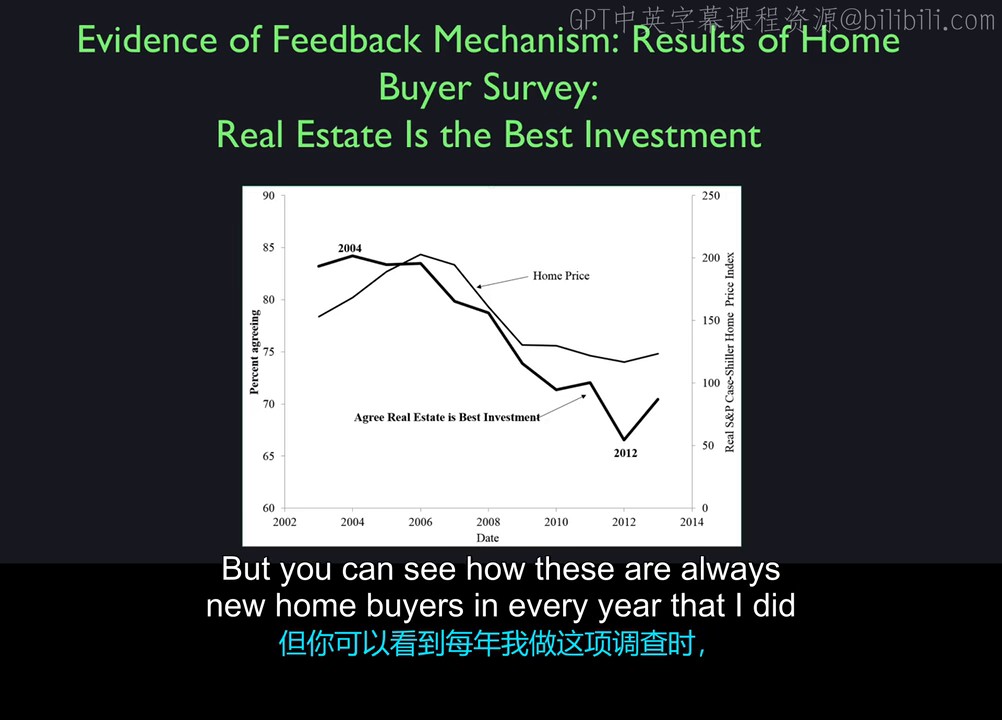
So this is evidence of a bubble, okay? We had initial price increases on homes in the 1970s. They were doing really well as investments. People just don't look far back. And the reason, part of the reason they don't look far back is nobody shows the data. They don't show a, no, I kind of absolutely flooring to think that nobody had ever constructed a 100-year price series.
The newspapers don't publish 100-year-long time series. They're not interested. It's not what people seem to think they want. So you only see, you know, a few years, and you see it's just going up like crazy. And so you make the mistake of thinking it always will. That's how we... Now, the housing sector has a big impact on the economy through residential investment.
in the GDP accounts consists of building of new houses, new apartment buildings, and improvements, like additions to new houses and apartment buildings. So the red line is housing starts in thousands of units. It's a monthly series. S-A-A-A-R means seasonally adjusted annual rates. So you can see how variable it is through time. Also shown on this chart is the Real Home Price Series, which is the K Shiller, S&P K-Shiller series, starting in 19, And for the region before that, it's an old Bureau of Labor Statistic, home price series that they've discontinued.
But I've got it for that period. So I have a home price series. And you can see that the housing starts are very variable, and they have something to do with home prices. Not surprisingly, when home prices are high, you're a builder, right? You want to know, what can I sell this house for? When home prices are high, my profit margins are high. So I'm going to dump houses.
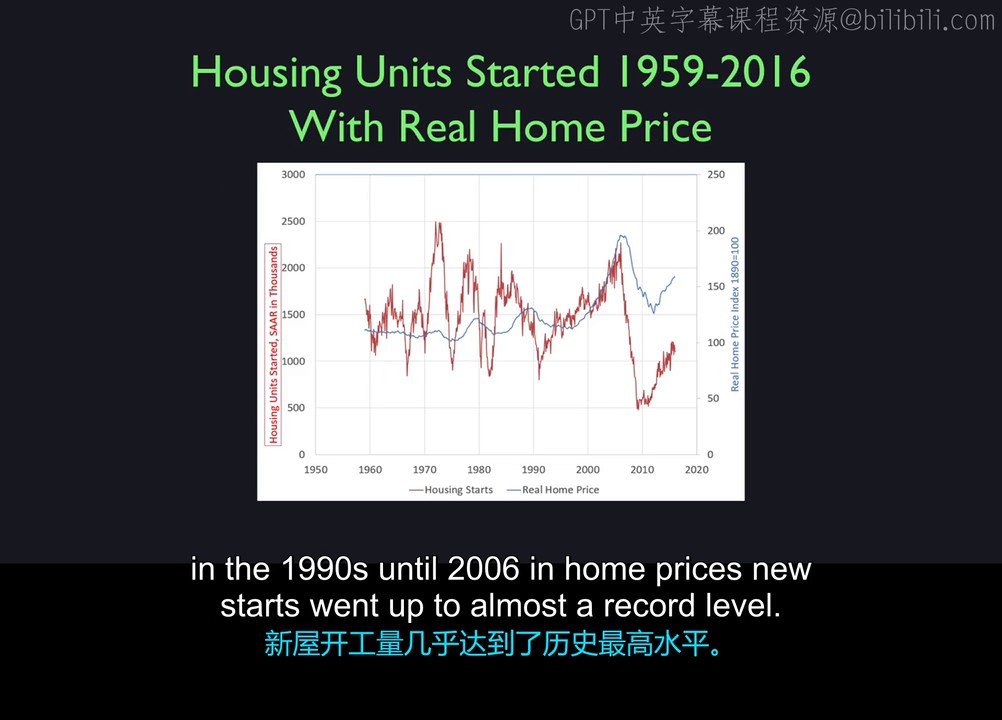
on the market when home prices are high. And I'll stop doing it when they fall. Well, it doesn't explain housing starts that well, but somewhat well, right? You can see there was a big housing boom in the early 70s, and there was a price increase as well. These are prices of existing houses, not new houses, so it's not necessarily the exact best price series.
But most dramatically, the biggest boom ever is this one in the 1990s and 2006 in home prices. New starts went up to a record, almost a record level. And then suddenly the home prices collapsed dramatically. And look what happened to housing starts. Housing starts went down by 80%. And then they recovered dramatically. And so did home prices. So there's something, what, this is animal spirits driving the economy.
I'm calling it animal spirits. It's some idea that people got that home prices always go up. How would you decide whether a housing market in a particular area or the country or continent is rational or not rational? Yeah, that's difficult. It's judging people. And it's very hard to predict turning points when will a bubble burst. So a lot of people would like to give up and not try to do that at all.
But I think that's a mistake too. It's about humans. make big mistakes. If you look at history, there are horrible mistakes that people have made, often unmasked, where millions of people are all thinking the same thing. And it turns out, how can millions of people be wrong? Well, history shows they've done a lot. They've done it again and again.
Real Estate Bubbles III: Leverage, Media, and the 2005 Shift in Beliefs
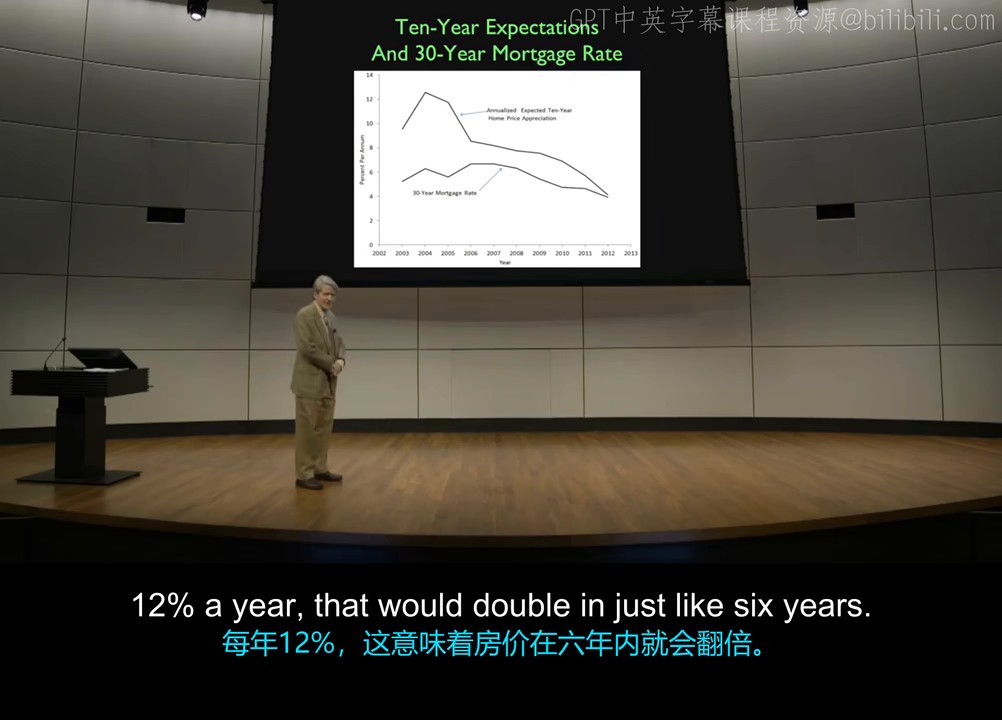
Now, one thing that happened, just to try to put it in your mind clearly, why we had a housing bubble, I also ask on my questionnaire your expected 10-year home price appreciation. What do you think houses in your area will do, on average, in terms of price increase per year for the next 10 years? And so we found that the average, this is actually a trimmed mean.
Essentially, the average response was 12% a year. for the next 10 years in 2004. That's what people expected in the United States. That's a pretty high appreciation, given also that they were at almost record high levels in 2004. So what did people think? 12% a year, that would double in just like six years. But they were already high. Did they really think that?
I don't know if they knew what they were saying. But let's just take it. They thought 12% a year. What's just take it? What could you borrow on a mortgage for it? Well, the 30-year mortgage rate was 6%. So does this look like a good deal? You buy a house. You invest, you only put down 5% of the money or less, and you're leveraged 20 to 1, and you have a 6 percentage point spread between the interest rate you pay and the appreciation you get.
Also, the interest is tax deductible, and the appreciation is the capital gains. and you have deferred taxes on that or maybe never have to pay taxes on it. Pretty good deal, right? There's a 6% percentage point spread. Roughly speaking, your leverage 20 to 1, what rate am I getting per year? Sounds like 120%. I didn't do that carefully, but it was a, you'd be stupid not to buy a house.
Everybody thought that. You've got to get into this market. And there weren't enough. people saying, hey, wait a minute, maybe this is a bubble. Nobody used the word bubble yet. The term housing bubble, I searched for it in n-grams or newspaper, was used rarely, not common. The word bubble was something you were trained not to use in college when you took your financial markets course.
You were told markets are efficient. Maybe they were starting to doubt it after the stock market correction of 2000, but still hadn't reached most people. So that spread looked pretty good. So what happened? My data back then end, I guess, in 2012. The spread is gone. People don't expect to make more than they're paying on their money. Even though the Fed has cut interest rates and mortgage rates have gone down, they haven't gone down as fast as expectations have.
So lots of people are thinking, you know, I don't need to own a house. You know, I'll live in an apartment, that's fine. It's carefree. I don't have to mow the lawn or worry about anything. And young people. are more urban oriented. You live in a city where apartment living is more acceptable. Anyway, the big, why did this turning point happen? Why did everyone seem to believe this?
And then suddenly not. Well, actually, we usually date the financial crisis as showing its first fault signs in 2007. But I would date it back to 2005. And it seemed that I could see something in the air in 2005, not in the air, in the media, that public attitudes were changing. So the economist magazine, which is British, but the similar things were happening in Britain, wrote a cover story in June 16, 2005, which showed houses, house prices falling like a brick.
And nowhere were they actually falling. This was how the economists getting out ahead of the economy. getting out ahead of the game. They're to be congratulated for writing this story because they, in a sense, predicted the crisis. And this is a line from that story. Perhaps the best evidence that America's house prices have reached dangerous levels is the fact that house buying mania has been plastered on the front of virtually every American newspaper and magazine over the past month.
They notice, they read all the newspapers, and they noticed, suddenly everyone's talking about crazed homebuyers. Suddenly, it began to look embarrassing. It used to be, it's obvious. You can get this huge advantage by buying a house because home prices always go up. But now there's all these stories saying, I'm stupid to have bought the house. It suddenly clarifies people's thinking, it wasn't just the economy. Here's Time magazine. This was three days apart. They came out with a cover story, Home Sweet Home, Why We're going Gaga over real estate. Will your house make you rich? Super hot markets. Is it time to buy or sell?
The case for renting. Wow. And this is, this was a major magazine. They're practically telling you right on the cover that it's crazy. And then I have one more slide. I was interviewed by Barron's magazine. I think this was a cover story. I'm not sure that I remember right. I was interviewed by Barron's. Because they knew that I'd just come out with my second edition for a rational exuberant.
John Lang interviewed me. That's me standing out in my own neighborhood here in New Haven by a home next door. And what it says at the top, economist Robert Shiller, whose book predicting his stock market rout arrived just before the NASDAQ began its sickening slide in 2000, sees another bubble ready to burst. Home prices he contended could fall as much as 50.
adjusted for inflation. So I remember the line called me up and he said, I'm going to quote you that you think home prices would fall 50%. Are you sure you want to say that? He caught me late at night. And I was thinking, oh my God, am I going to make a prediction like that? So I had like 60 seconds to think about it. And I said, yeah, go with it. Actually, I was wrong.
They only fell something in the 40s percent. It wasn't quite 50%. But it really gave me a sense of the turmoil that was developed. The public tends to be kind of fattish, and they take on ideas that spread by word of mouth. The idea that it's a terrific thing to do to buy a house. It's been happening more recently in other countries like China, where people think, wow, you know, I should buy a house, even though home prices in China at some points reach very high levels.
It's just human nature. It's the same in every country. There's the same vulnerability everywhere. Do you think there will be a new bubble after 2007 crash in the housing markets, especially in some emerging markets like China? I noticed that the real asset markets has a recent booming in China, especially in the metropolitan cities like Beijing, Shanghai, Shenzhen, and the housing market, the housing values in Shenzhen, has a, has grown 10% compared to the compared to last year and it amounted to $659 per square foot compared to the Manhattan's 1,1495.
Yeah. I think the average salary is not the half of the Manhattan's. Right, right. What do you think about? Is there a new bubble? Yeah, well, China, there are various measures of valuation of real estate and China. So one is price to income. This has been remarked by many Chinese that they say, how does anyone afford this real estate? Because, you know, the average, look at the average salary of someone working in one of these major cities. It's just the ratio of price to that is just beyond belief. So how do they afford it? Well, their parents are helping out. They're borrowing what they can.
And they think that it's all going to be worth it because they're going to keep going up. So there are other measures, you know, just the rate of appreciation has been high in China. The total value of land in China is high relative to their GDP. So there's a lot, a lot, and price to rent is high. When you move to Shanghai or Shenzhen, don't buy rent and invest your money somewhere else, maybe.
I shouldn't speak with utter confidence about China because I'm not an expert on, I have never lived there. But it does seem that China is a special case regarding real estate. One of them is that it's still difficult for Chinese people to invest abroad. There are limits on how much they can put abroad. And so they're stuck in China. Secondly, there's a fear of corruption in China, a fear of being taken advantage of.
And I know Xi Jinping is trying to combat corruption, but I think there's still a public perception. So they might tend to prefer investments in a house that they can see. And there's also, people have pointed out in China to the relative shortage of females, relative to males, And many parents want their son desperately to get married. So they save all their money and buy a house for the son, so that he can impress a young woman that he has a house. These are all kind of peculiarly Chinese factors that has been driving home prices up there. Now the question is, will they stay up there? That's an interesting question. Always the long term comes in. So will these factors continue? Well,
they might continue in the short run. But my bet is that China is going to be on the path toward liberalizing so that Chinese people can invest abroad more. I'm guessing, I'm not an expert on this. And things will change. Now the other thing about China, it's an interesting thing. Its economic growth rate has been so high. that you might think it's not going to be very long before Shenzhen, Beijing ought to be the highest-priced cities in the world.
But then that brings in question. There's a slowdown in China now. Maybe people won't feel quite so optimistic that that's right around the corner. So there might be a slowdown now in Chinese real estate prices. But you know, these things are hard to every day.
Bubble Salon: Living with Bubbles, Short-Sale Constraints, and Epidemics
Well, let's say that someone even could recognize that there's these social quirks that we have in terms of the behaviors of maybe the word of mouth behaviors that we're hearing in terms of whether you should sell or whether you should buy. For instance, I'm thinking about the housing crisis. Now, let's say even you could know as a homeowner before you buy your second home to then rent it out.
to someone that you suspect we're in a quote bubble. I did that by the way. And nonetheless, even if you know if the market is still going, shouldn't you take advantage of that bubble? Now here's another issue, yes. When a market is going up rapidly and you think it's because of psychology, you might want to short the market, the benefit, own a negative quantity.
You can't short houses. Sure. So a lot of people during the housing bubble, it's a little bit hard to get out of that market. But a lot of people, I'm sure, did because they think it was going crazy. But the problem is you don't know when it's going to turn. And there's a folklore that it usually takes several years longer than you ever imagined for it to finally turn.
And then it finally does, but if you were a short seller, you might go bankrupt before that time is reached. Or if you are a financial advisor, advising clients to stay out of the market, you will have lost all of your clients before the turning point come. This is part of the tension that makes it hard to deal with these phenomena. Like stock price and value, when bubbles exist in the market, for example in 2000, the dot-com bubble, how does that affect the ability of stock price to reflect or indicate value?
The term bubble was coined in 1720 at the time of a stock market crash in France. And it's kind of stuck as a colloquial term. It's spread to other countries from France. And it was a colloquial term that stays with us. But academics have always had a little trouble with it. What it refers to in my mind is a... There's an up swing and then there's the bursting.
The upswing of the bubble is when stock prices or real estate prices or some other speculative asset goes up as a sort of part of a social epidemic. The price goes up and people start talking. They remind themselves of good news. They forget about bad news. And it goes up again. More people start thinking I should be in there shopping. I should be buying this.
And then the price gets really high. Doubters start to appear saying this is crazy. First of all, nobody believes them. But then the market starts going down. And then they're thinking, maybe the doubters are right. And so then they start to bring it further down. Now this, you might call it a theory. It's a theory that people in the news media said was obvious when they were writing reports out. They could see.
in the 1720 bubble, you could go out on the street in Paris and you would find mobs of people all shouting and excited when the market was crashing, or even before when it was going up. It looked crazy. Economists though, who are more academic or more professional, don't naturally take such explanation. So I think the word bubble has had limited impact, except for what they call a rapid.
call a rational bubble, which I won't get into. There is a theory about possibly rational bubble. But so economists, just by their nature, they're not psychologists usually. They don't get it. So in fact, though, the 2007 to nine, world financial crisis was a time when the word bubble came into more broad use, even among academics. It used to be not in the textbooks of finance, They put it in after that.
And now you can actually say bubble without feeling embarrassed. It's kind of interesting how, like, the term, bubble, it seems like, assumed that it's, at some point it has to burst and then everything has to come back down to, I guess, the truer core of what it's supposed to be. I guess, sort of related to that. Do you think that there's something about the 2008 crisis that was different that made bubble a more appropriate term than had been for these previous crashes?
Yeah. Well, I don't like, is... Your metaphor point is right. The word bubble, coined by somebody 300-some years ago, suggests that it grows, like when you're blowing a bubble, with a bubble blower, it's getting bigger and bigger, and as you watch it, you think, it's gonna pop, it's gonna pop, and then poof, it's totally gone, unless you blow up another one.
But I don't think bubbles are quite like that because they don't crash completely. And then you never know they can come right back up. So it's, I think I would have preferred if I were back in 1720 naming it, I would call it an epidemic. Because epidemics don't just disappear. You know, they grow for a while and then they recede and then they recede and then they come back I like the idea of epidemic too because it sort of suggested it's contagious.
Right? Now I think, I like epidemiology, which is a course in the medical school because it also suggests why it is that bubbles appear so mysteriously. It's the same way that, let's say, an influenza epidemic appears. Suddenly hospitals are reporting, there's lots of new cases. Do they know why? Well, they'll say maybe the virus mutated and suddenly it's more infectious.
It's the same way with stock market bubbles. So suddenly the market goes up. It wouldn't be a virus. We'll call it a story or a theory. And the theories mutate the same way viruses do. Like there's some new news thing or some politician says something and suddenly it's more contagious, a better story that people will tell to influence each other. I use the word bubble because I think I know what people mean by it, but I think it's really epidemic, the word we want to use.
And the 2007, was that different. Another thing that was really unique about 2007 was that we had the biggest real estate boom ever in major countries. Like, notably, the boom was really big in United States, China, UK, Spain, Italy, and it was also in other places, but Iceland, Ireland. It was really big, reflecting something that, what, why did it get? so big?
You know what? I think part of the reason is the efficient markets theory itself. Because before then, there would be public leaders who would come out and say, this is crazy. But now they didn't want to because they didn't want to appear unscientific. So science shows that these markets are right, uncannily right. So I'm not going to criticize it. And if nobody criticizes it, it can just go wild.
During the efficient markets era of the second half of the 20th century, it was as if there's this smart money out there evaluating the level of the market. But you know what? I never meet this smart money. I only meet people who are trying to predict where it's going in another year, not thinking about these big issues. Maybe there are some, but are they really dominating the market?
That's the kind of doubts that came forward after 2007. Do you think it's irrational for an investor during a bubble to invest in the market, even though you might think it's a bubble, but prices are going up? Right. Oh, yes. So is it really irrational to invest in a bubble? Right. Could you say rational bubble again? Right. If you can predict when it will burst, then you would want to go in and ride with it.
Now, there are some theorists who've argued that that that helped, that that in fact, gives a rational, I've mentioned rational bubbles, or there's quasi-rational bubbles where some people are rational and that their behavior exacerbates the bubble. So I think that maybe you do want to ride a bubble. But I think it's a tough business. Maybe also when you're in a bubble, you might know, like bubbles, you know that it's a bubble when they burst, right?
Maybe in hindsight you can tell it's a bubble, but while you're in the... See, one thing people have to realize, after the fact, there's a tendency toward what they call historical determinism. Reading back on history, you imagine you could have seen it all coming, it was obvious. So in the 1930s, for example, didn't people know World War II was coming? It wasn't that obvious?
Well, it seems that way to us, but it wasn't at all obvious then. And it's the same true for any of these events. Just to follow up, how does short-selling effect, like, the development of short-selling effect, the, I guess, rise and fall, these bubbles. Right. So, in the 1970s, Edward Miller, as a finance professor, wrote a famous article about short-selling, saying, you know what?
I think this was a major article. It seems so obvious after you read it, but before, Edward Miller said, you know what, this is a major article, You know what, this efficient markets hypothesis just can't be right. Because there's nothing to stop some group of zealot. We know that some people have crazy beliefs, right? Well, there's nothing to stop them from going in and bidding up the price of some stock to some crazy level, and everybody else knows it's crazy.
Unless you can short-sell, that means borrow shares and sell them, enough so you can offset all of these. But what if all of these? people buy up all the shares and they don't they hold them personally so that they're not available for shorting, maybe you can't short sell. So what's to stop it? That was his question. You know, the finance profession was embarrassed by this because they didn't have an answer. The answer is if short selling is hard to do, and in some countries, like China, for example, it's been very difficult to short sell, if you can't short sell, there is nothing to stop crazy people from bidding up the price.
They, you know, it's free, markets are free and open. Somebody gets a screwy idea that this stock should be worth a million times earnings. They, if they want to bid it up to that, it's their business, they can do it. That's one reason why. Now, now in terms of housing market, traditionally the housing market, you can't short a house, you can't say, can I borrow your house and I'll sell it, and then I'll pay.
you back with a house like it? That doesn't happen. Now I worked with my colleagues to create a futures market for single family homes so that there would be an options market, so there would be a possibility of shorty. You could buy a put option on a house. And we have that market. The problem with it is that it's not very liquid. I'm hoping that it will eventually, but this is at the Chicago Mercantile Exchange. We have 10 cities traded and the United States as a whole. And there are also, there are other like the IPD in London, which does commercial properties, there are ways of shorting real estate or property, but not, they're not huge. I think that short selling has
its own inherent problems. It has to be facilitated by regulators, and it has problems of itself that being a short seller is a risky business. You might go bankrupt. up trying it. And so it's just limited. And that's an important reason to doubt market efficiency.