Financial History and Financial Innovation
Why Good Ideas Take So Long
Why does it take so long for ideas to develop? I mentioned insurance. It goes back to ancient Rome. Why is it that we didn't have any real insurance, I mean in the sense of an insurance company with actuarial tables and the like, until the 1600s? And why did fire insurance on homes become important? They didn't even become, most people didn't own fire insurance until after the reformations in the, Great Depression.
So the funny thing about invention to me is that ideas that seem simple and natural somehow don't get established. I'll give you some examples. These are from my book, New Financial Order. Wheeled toys, okay? Well, archaeologists in Mexico find that there were children's toys that had wheels on them, like a little toy cars, and you could roll them along the floor.
All right? So they knew about wheels. But you know what? Nowhere in the Americas did they've ever find a wheeled wagon or anything used, a wheelbarrow. Nothing. They only had toys. Strange. Now this brings up another example of wheeled suitcases. And so I wrote this book in 2003, 13 years ago, and you believe you have a suitcase with wheels on it, right? Does anyone not have wheels on their suitcase?
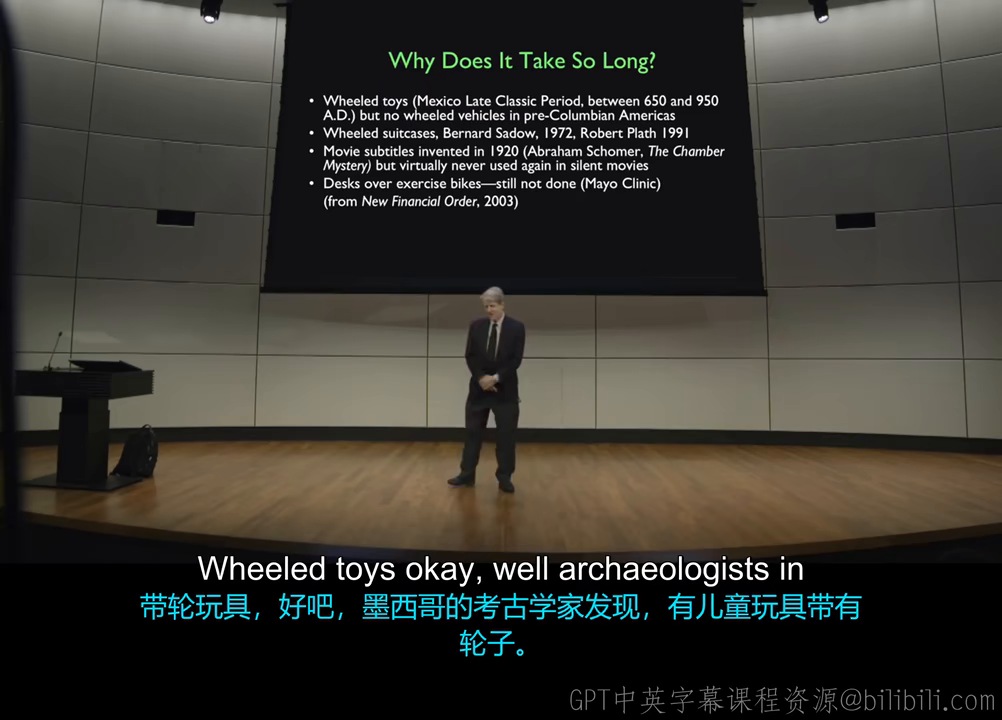
Well, it seems like this is so obvious. Suitcases should have wheels. But, you know, they didn't until 1972? That's not long ago. And in fact, I was doing research for my book, and I had an undergraduate research assistant. And I was intrigued by these wheeled suitcases. So I asked my student, go find the inventor. See, is he still alive? So he's still alive?
He tracked him down. It was Bernard Seidau in 1972, and called him up on the phone. Again, inventors don't tend to be famous. You didn't know this name, right? It's changed your life. You don't know what it's like carrying a heavy suitcase when there are no wheels on it. So my student asked him, what was it like inventing the wheeled suitcase? And he said, you know, I had a lot of resistance.
I showed my wheeled suitcases. I went to the department. stores, remember department stores? They used to have those instead of online shopping. And I told them, this is a great idea. And they said, no, it isn't. Nobody's going to buy that. It looks ridiculous. Wheels on suitcases. They said, look, if you want help with your luggage, every train station, every hotel has porters who will be ready to help you.
don't need these things. That's what they told them. But he did get some of them to sell. The problem with his wheeled suit. with his wheeled suitcase, however. He didn't, now he didn't get it right either. He had a suitcase, a big suitcase like this, and there were four little tiny wheels on the bottom, and there was a strap, right? So you would pull on the strap, like a leather strap, and it would trail behind you.
The problem, have you ever seen, you might still have one in your parents' attic. They flop over, that's the problem. You start pulling and it falls over sideways. But you can do it. You can figure out eventually how to pull it. wasn't until Robert Plath in 1991 invented something he called the rollerboard, which you now have, right? And actually, it improved again.
But in 1991, he had a suitcase with just two wheels on the bottom and a rigid handle, not this leather strap. And the handle collapsed into the suitcase, right? You could pull it out. And then it would tilt and it would go behind, but it'd be very stable. That was 1991. And that just completely took over. He called it a rollerboard because he was an airline pilot, and he thought he made it narrow enough that you could roll the suitcase down the aisle of the airplane, and it wouldn't bump into anyone.
It was under control. You know what the latest thing is? It's like a rollerboard. I'm going on too long about this. The latest thing is now they have four. wheels again and you can either do it like a roller board or you can stand it up and people like that so that's but it took every one of these inventions took ten years and they seem you'd think Robert Bernard Seda would have figured the whole thing out in 91 but that's not the way it works oh and movie subtitles were invented in 1920 but never really used in silent movie I think this is amazing they had this whole silent movie era. They'd already invented subtitles and they didn't put them on movies. They had these intertitles. You remember silent movies? They would stop the whole movie and
they'd show you this intertitle. But it's so much better. I'm really used to it now. You can watch a movie with some. It doesn't matter what language it's in anymore. So obvious. Oh and desks over exercise bikes. I have this in my basement. I put a desk over my exercise bike and I'm preparing my lecture. The Mayo Clinic is selling them now, but it's a slow thing.
Eventually you ought to get one so that you can exercise and do scholarly work at the same time. I think that we're moving ahead. It's, so another way I'm putting it is financial theory and practice are good areas for young people to go into because I think it has been transforming and will continue to be transforming. And I think that it has been transforming and will continue to be transforming.
And I think that the nature of our financial markets in 10, 20, 30, 50 years, which matters for young people today, will be amazingly different and better. And you have to join the financial community to make that happen. You don't have to, I understand. Do you have in your mind an ideal of what that future looks like? See, there are people who proposed, like Karl Marx, for example.
Robert Owen, who's the guy who coined the term socialism, they had ideals which they sold on the public as simple and obvious. But I think it's not quite so simple and obvious. The human species is the product of evolution that gave us a number of different mental quirks that served us well as cavemen, but now they don't really. fit into the modern world and we're just seeing new opportunities.
So we might be excessively fearful or unwilling to change. We might be too focused on our own personal lives and we have to invent something different. And it won't be a perfect world, just like it's never been a perfect world. But it's exciting and it's getting better.
Financial Innovation as a Pillar of Civilization
What do you think has been important about the innovation of people's ability to insure against risk in the marketplace, whether it's through just something as simple as, you know, an insurance contract or by other means? Well, the history of risk management goes back thousands of years. I would say that the history of risk management is, the technology that we have has been very slow to develop over the centuries.
And that encourages me to think that it has a lot more to develop yet, a lot more to develop yet. I think that there's an inherent conservatism and mistrust of new financial arrangements. sense that I'm not coming to this party unless the in people are coming to it also. And so things are very slow to develop. I know if I'm answering your question. It is a belief of mine that financial innovation is a pillar of our civilization.
That it's not just shifting papers around and getting people to sign documents that trick them into signing away something. They, it's a sequence of inventions that incentivize people, provide capital for enterprises, create organizations that last through time, that separate themselves from the objectives of the individuals who comprise the corporation, and get people focused on some common good that will be produced.
Do you think it's safe to say that historically, financial innovation has occurred on the, you know, kind of the upside, looking to capture new markets and new ways of earning returns versus on the kind of the downside risk management side of the side of the ledger. Well, when we say risk management, it implies a focus on the, seems to imply a focus on the downside, but it's on the upside as well because people accept.
the downside risk because there's something on the plus side that is enticing and is exciting. So people seem to, this is an interesting point, people seem to like gambles that involve a small amount of money lost with high probability and a large money gained with low probability. So if that's what people like, we have to try to turn the natural risks which might be balanced equally into loss and gain, into something more appealing.
So that's one thing that limited liability did. People like lottery tickets. I pay $2 today, and I have the chance of winning $10 million. For some reason, the chance is minuscule. It's virtually zero. But somehow people like that. So that's a discovery about human nature. Why they like that is a puzzle, but we just know that people like that. It's because people savor the small probability.
They think, I have this lottery ticket I bought this morning. I could be worth $10 million at the end of the day when they announced the number. That just makes your day bright. Then when you don't win, you still feel, well, it was just $2. So what? limited liability does is it creates that for corporate invests. Same sense for investing in stock. You just put in, you know, you bought 100 shares.
So maybe that's $3,000. That's a little bit more than a lottery ticket. But hey, I could be a multi-millionaire if I bought the right company. It's like a lottery ticket. So people flock to these things. And they're actually, they're disappointed, almost always. But they're not. I'm not disappointed because we end up with a more vital business sector where things are created.
So we have to try to reframe things. That's what part of financial innovation is. Reframe risks so that they're appealing. And we want it also, for good social purpose, to be risks that need to be taken so that they benefit the economy.
Limited Liability: Capping the Worst Outcome at the Amount Invested
So I wanted to give some examples, both from the past and from the things that I've talked about now. So the first example I like is limited liability. I'm going to credit New York State with inventing the full dimension of this idea in 1811. However, it precedes, the idea of limited liability precedes 1811. and I don't know what country could be given credit for discovering it.
But here is the idea, well actually it goes back in a way to Bottomery, which I talked about. The idea is that investors, in order to be encouraged to invest in businesses, should have protection against liability for what the managers of the business do. They should have limited liability. So the example we gave before is if you're in ancient Rome, and you are considering investing in a trade, a trip where they're going to send out a ship to trade goods.
If the ship sinks, you are not liable. You don't have to pay the loan back. That's an example. But it was never enunciated as clearly as in 1811. So New York State passed a new law then that said, investors in stocks can never be pursued for the mistakes of the company invested in. So what we're going to do is allow it, well, already they had shares. You could buy shares in businesses.
But you only are liable for what you put in, initially, and no more worries. So, but it, but before, this law, there was doubt about that. Apparently the idea of going after shareholders for the sins of a company was rare, but people had to worry about it. So this is what could happen before 1811 in New York. You could buy shares in some company, and then the company commits a crime.
And then they come after you to pay up for the crimes of the managers. And you say, I didn't know. You know, I didn't know. I just bought some share. I didn't know who these guys were. And they would say, what? Tough luck. Pay up or go to debtor's prison. That's what they would potentially do. And they had debtors prison. There was a different idea then about.
The idea is, if you invested in this company, you are responsible. And we're not going to forgive you. So when New York State passed the law, there was a lot of controversy. And a lot of people. in other states said, this is crazy. People are not responsible for what they invest in and what happens. This is going to lead to wild transgression of our laws and our Massachusetts passed a law similarly around the same time, reaffirming that shareholders are responsible for what they invest in.
You are a party to the crime. So what happened? Well, almost all the business went to New York, and New York became a mecca for business. And eventually, gradually, state by state, they all did it. They all passed limited liability laws. There were a few failed spectacular failures, corrupt businesses, but so many good businesses started this way. So I think this was an invention, and it was an experiment in human nature.
The idea that the problem is that people, if you are responsible for everything you get involved in, then you won't do it. You won't supply capital to some business. David Moss was a graduate, I mentioned him before, a graduate student here at Yale who wrote his dissertation and then a book called When All Else Fails, the role of government in risk management.
He describes the controversy in 1811. The real genius of limited liability is that it makes it possible for you to make an investment in some enterprise, and then it's just fun thereafter. No more work, or you could lose what you put in, but you know exactly what you put in. So what Moss said in his book is that it's really behavioral. No, this is human factors engineering.
Nobody knew when they tried limited liability what would happen. It might encourage corruption. It might not affect the supply of capital. But we discovered that investors' psychology favors limited liability. That's because investors tend to, if they're not limited liability, they overestimate the minuscule probability of loss. just as when they buy lottery tickets, they overestimate the minimal probability of winning.
So he thought that what the limited liability did is created a sort of lottery effect. People are basically, you know, you're driven toward fun things and you don't like things that make you worry. So let's make it. Buying a share in some startup company is like buying a lottery ticket. And now you probably won't. get rich. Almost certainly you won't get rich.
But hey, it's fun. And so just like lotteries, I don't know why people, when I go to the train station, I have to stand in line at the little store there behind people buying lottery tickets. I can't imagine to me, why anyone would buy those because your chance of winning is so low. But people do buy them. They just, it makes their day. I guess they have fun.
You buy a lottery ticket in the morning, And then, what do you, you turn on television? I don't know. There's some television clip that shows you them drawing the ball, and you're all excited, and you're having fun, and you lose. You'd think they keep losing that they would stop, but they don't. There's something, you wouldn't know this, but that's human nature.
The other thing about limited liability is that it created the whole idea of holding a diversified portfolio. If you don't have limited liability, absolutely not. You should. not hold a diversified portfolio. Especially if you have some wealth, they'll go after you. One of those companies is going to go down, and they'll go after you. So don't hold the diversified portfolio.
Once they discovered that, once they did limited liability, then you could start enjoying your investment and diversify over many things. And we know that there's risk management power and diversification.
Inflation-Indexed Debt: Promising Purchasing Power, Not Currency Units
So I'll give you another example of practical financial innovation. So it's here inflation index debt. So we have always traditionally borrowed money in debt contracts and promised to pay them back in the currency. But there are so many examples where the currency is unstable, especially if the government prints it. They make big mistakes. So the idea is why don't we have a price index?
and have a debt contract that pays back indexed to inflation, then it's fixed in real terms. What could be more obvious? But the history of it is very shows it was very slow to get going. I've tried to find who was the first person to define debt in terms of a consumer price. Index. There were earlier examples. For example, in Japan, they had rice bonds. And maybe other places too.
So a rice bond was a debt instrument that was payable in rice. Yes, the grain instead of currency. And you're safer with that than in currency if the government might print money and debase the currency. But the idea that I'm referring to is something broad. The problem with rice bonds is the price of rice isn't stable relative to other prices. So you really want an index of prices. You want to tie the contract to an index.
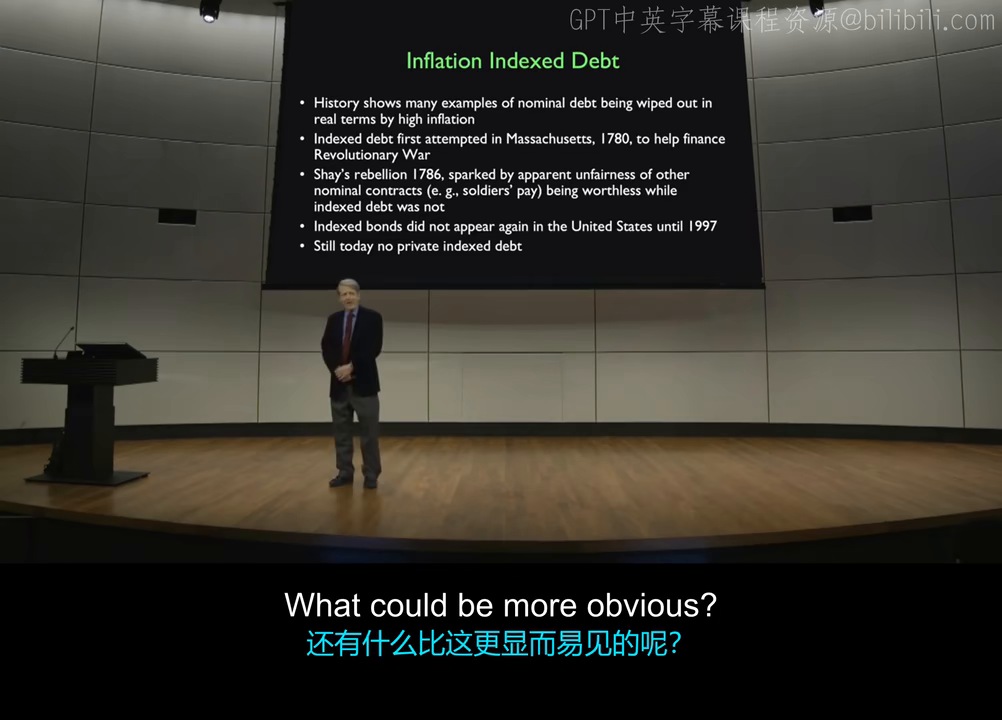
So as far as I've been able to tell, I wrote a paper about this, the first index debt was invented here in the United States in 1780, and it occurred because of inflation. The U.S. government was giving debt to the soldiers this was during the Revolutionary War, denominated in currency that was issued then by state governments. And they debased the currency because of the war.
There was rapid inflation. And the soldiers were really unhappy because they didn't, what they got was already worthless before they got it. And in order to keep the soldiers happy, this was necessity. As Plato said, necessity is the mother of the mother of the is the mother of invention. He was quoting someone else, I believe, but that's where it appears. So they decided to define a consumer price index.
They didn't call it that. They just defined it. And they bond had to pay out in inflation index terms. And what a wonderful idea. Simple. You should promise them in real terms, not in money terms, There was inflation. But there was a lot of other people were paid in nominal debts, and there was an actual rebellion called Shea's Rebellion about the unfairness of this debt.
So somehow the U.S. government didn't issue them again. Well, the index bonds in 1780 were issued by Massachusetts, but no state issued index bonds again until 1997. I can't believe that. It took so long. I was there advocating. This is one thing I advocated before it happened. Not that that necessarily made a difference, but I just wonder about it. It seemed impossible.
I called Treasury like in 1996 and I said, I want to talk to someone here. Why not, why don't you do index debt, inflation index debt? And I got a guy on the phone and he said, oh, you know, we've thought of that. We have a joke here at Treasury, and that is that if we ever do issue inflation index debt in the United States, we should send the prospectuses to the members of the American Economic Association, because they're the only ones who would be interested.
I said, how can that be? I mean, are people are getting their real value of their debt wiped out by inflation? Don't they care? I mean, it still puzzles me that it isn't more important. People just don't get it. They make the same mistake again and again. They think, well, inflation is only 2%. But they don't know that history shows that governments mess up all the time. Now, of course, this is America. We don't mess up here. I guess you could say it's patriotic feeling. You don't want to raise the possibility that we would mess up and have a lot of inflation. But maybe even if it isn't a lot, maybe, you know, how about 4% a year inflation?
And you lose half your money in 20-some years. That's within the realm of possibility. People don't even think about it. But we do have inflation index debt in the United States. And it has spread around the world. The U.S. was not the beginning of inflation index debt in 1997. It was in 1780, I believe.
Unidad de Fomento: Separating the Functions of Money
So here's an invention that I've been extolling now for 25 years. So far, I shouldn't say no success. I've gotten attention for it. But I think, you know, it won't happen in my lifetime, but we'll do the Unidad de Fomento eventually. It's coming. So let me tell you, the invention. In 1967, Chile was going through a hyperinflation. I mean, prices were just going up.
I don't know what it was, 1,000% a year or something like that. And people were distressed by it. When you got your paycheck, you know what you did. You got your paycheck. Of course you cash it immediately, and you run to the store and you spend the whole thing. Because by the end of the month, it won't be worth anything. So this is crazy. And so, now, the idea that Chile invented then, was to create a new unit of account.
And in Spanish, Unidad de Fomento, which means unit of development. I don't know why they called it that, but I can think of a better name, but that's what they called it. In 1967. And what it is, now money has several functions. It's a store of value and a unit of account. You can, and a means of transactions. You can separate out those functions. You can have a separate unit of account that is not money.
So they invented something called the UF, Unidad de Fomento, and they allowed its value to be tied to the consumer price index. Back then, they would publish in Chilean newspapers every day the exchange rate between the Escudo, which was the Eskudo, which was the currency they had then, and the peso, which is the, I'm sorry, and the U.S., I'm sorry, and the UF.
So I looked it up today on, now it's a website, it used to be in the newspaper. Well, maybe it's still in the newspapers, but there's a website, valour uf.c.c.l. I looked it up this morning, and one UF is 25,655.55.5 pesos. Now, you might wonder, why did they pick such a big number? They didn't. They picked some small, maybe it was one to one in, I don't know exactly, in 1967, but they've had so much inflation in their peso, that it's up to 25,000 pesos per one UF.
And that is worth at the current exchange rate between peso and dollar, $35.95.92 cents. So there's been a huge increase in, even though Chile has got to, gotten its inflation more under control. The price level has still increased 50-fold, over 50-fold, since 1977. So, but you know, it's not, the U.S. is not the haven of price stability either. Would you believe it, prices in the U.S. have gone up 24-fold since 1913?
That's not exactly a zero inflation environment. And if you're saving for your retirement, for example, your grandmother buys you a saving bond that matures in 2050, you should be worried, right? What is that going to be worth? So Chile had the escudo currency, and between 1960 and 1975, they had so much inflation that they had to replace it with one escudo to a thousand pesos.
But then, the peso then eroded away, and they had to define a new peso, which was 1,000 So we have something like a 50 million-fold increase in prices in Chile. So why would anybody still quote prices in pesos? I don't know. There's something about human psychology. But at least let's give credit. The Chileans are the most advanced country in the world in terms of dealing with inflation.
When I was in Chile, I was giving a talk at the Central Bank, and I said, whose idea was this? This is amazing. to be following Chile. And then you know what? Nobody knew whose idea it was. Nobody, they think it's a national embarrassment because it reveals how much inflation they've had. I said, no, you are the world's leader. The world ought to copy you. Eventually they will.
Home Prices and Human Capital: Major Risks Still Left Unmanaged
Finally, real estate risk management devices. Values of homes go up and down a lot. And people are not protected against these fluctuations. And this is bizarre to me. We have home insurance, casualty insurance, that protects you against accidents in your home, you get protection against fires, but why not protection against the big risk, which is the change in value of your home?
Are people who do things like short the financial markets, good people or bad people? Shorting, is it evil to short a market? Well, if you're shorting a market for homes in your own city, you're just trying to protect yourself against the collapse. It's not so evil. If you're doing it to make billions of dollars, it's a little bit of, ambiguous your moral stance.
But anyway, it's legal. You can short markets. And I thought it would be a good thing if people could short the housing market. It would help stop bubbles and it would help people protect themselves against them. They could also be a source of risk management for equity-protected mortgages. You should have a mortgage that tells you, when you buy a house, if your home price falls below the amount you owe, will correct you.
your debt downward. Isn't that sensible? But that's not what we did, not what we are doing. If you buy a house for $500,000, you borrow $450,000, the price of the house falls to $400,000, you are now $50,000 underwater. You go into your mortgage lender and you say, I'm underwater, what do we do? And the mortgage lender will typically say, tough luck. We'll sue you, we'll go after you if you don't pay.
Why do we leave it like that? Well, it's because progress is slow. So you talk a lot about financial innovations. Is there anything of recent that is really exciting for you or that you think is kind of the next frontier of finance? There are many innovations. I don't know where to begin. But let me put it this way, that most of our risks are still not managed well.
For example, your home price risk. That is born by you, the homeowner. And I actually worked with the Chicago Mercantile Exchange, and we do have a futures market for single, and an options market for a single family homes, so that you could buy a put option on your house to protect you against the big fall. That is up and running. I want to see it grow and get more.
active. But it is, it does exist. Another risk which is even bigger is the risk of your human capital that you are investing in now as a student. And now, you were an MBA student. So you have chosen a very fungible form of human capital management. That has to be a very versatile skill that, right? At least that sounds like it to me. That won't be replaced by a computer.
Now, it might be partly replaced by computers. In fact, it already has partly been replaced, I think. But I think that's, but the question is, what if you pick a human capital that is more focused, like nuclear engineering? Now, you could, how can you protect yourself against that risk to your human capital? Well, I have an idea how you could do it. You could short the stock of a nuclear power company, assume that it's going to correlate negatively with your risk.
So you can sort of do it. But I think there are other things that might be more appropriate for most people. I think that's kind of requires some sophistication to pick a company and short it. to protect yourself, your own human capital. President Obama, in his State of the Union address for 2016, proposed wage insurance that when people lose their job and switch to a permanent job with a lower wage, there should be some payout that would insurance payout for the loss of livelihood.
I've advocated things like that too in my writings. I call it livelihood insurance. But I can keep coming up with, there's so many innovations. We don't know which one. What we do know is that risk is not well managed worldwide. And we also know that enterprises are not functioning well everywhere. That there are many places in the world where free enterprise and entrepreneurship seems limited.
So there's a lot of things to be innovated.
Student Loans: Can Education Finance Shift from Debt to Income Sharing?
So for education right now, when student wants to pursue higher education, he takes out a student loan. So we can consider that to be a sort of, say, bond that the student sort of issues. Yeah. So is it possible that, you know, we could switch to an equity model? Right. Right. This is something I've been behind for a long time. But it's not new with me, the idea of having student loans that are responsive to, income so that protects you against the outcome that you might not get a great job, even though you incurred this expensive education.
That goes back many decades. Even here at Yale in the 1970s, we created, I wasn't here then, but they created, with Professor Tobin, they created a income contingent student loan. And so now we have such things. President Obama is behind this too. But it's also happening in other countries. So student loans should be ideally contingent on the income of the borrower.
As long as you can verify that. Now there's a moral hazard problem. We have to deal with that. We have to limit the, in fact, with the Yale experience, people were surprised when they made a lot of money and they saw their tuition debt go up. One thing that was a problem, they hadn't thought of, what if you marry someone who makes a lot of money? Well, they didn't think about that, but the contract said, it was the income on your tax form that goes into the formula.
So the bad luck of marrying a rich person would cause Yale to get a lot of the pie. So these are problems, but they have to be worked out. Do you think there's a student loan bubble for me? Oh, now in the United States. Maybe elsewhere too, but the kind of bubble I think that has been happening. I think it's partially driven by all this talk about robots and artificial intelligence and an anxiety that drives young people today.
Where am I in this world? Every time I look around, there's some new thing replacing a job. So I think that there's an atmosphere of I've got to be connected. I've got to be somehow the elite. The way we define elite, especially in America, since there's no aristocracy, there's no lords or dukes or barons, you get status here by having an education. So people are willing to spend a lot for that.
At the same time, after the financial crisis in two, governments are very wary of spending money. So the US does have some support for college education, less so than in other countries, but they're pulling back on that so that you kind of have to buy your own college education. Even the state universities are getting expensive because they're not being given enough money by the state governments.
So it's getting expensive, and so people are borrowing to finance a quality higher education. But in some sense it's a bubble because it's getting expensive to go to college. And also it might be a bubble in the sense that if a lot of people go to college, it might not be as lucrative as it used to be. Yeah. And then you have to pay it back. And you can't declare bankruptcy to get out of a student loan.
That's a special law in the United States. in the United. Did you, I hope you weren't thinking to do that. That's because it would be too easy. You would graduate and you'd say, Hey, I don't have a job. Interesting. I remember for the MBA students, they offer an international loan for the international students. I think they allow for the bankruptcy. I didn't know that.
Please don't do.