Exchanges and Market Trading
Brokers and Dealers: Commissions, Spreads, and Excessive Trading
Now I want to talk about exchanges, notably stock exchange, and brokers, dealers, and clearing houses. So let's just go to some really basics. A broker. I have this, I've written down B-O-A-C. The definition of a broker is someone who acts on behalf of others, that's the O, as an agent for which they earn a commission. So a stock broker, what he does, he or she does, is brings people together so that they are, if someone who wants to buy a stock, he finds someone who wants to sell that, puts the two together, charges a commission for finding the other side.
That's a broker. A dealer is different. A dealer always acts for himself, or the H is a problem, or her. They both start with age. A dealer always acts for herself. In other words, as a principle in the transaction for which she makes a markup. So that's a fundamental difference. So if you're buying from a dealer, the dealer owns some of the shares that you're buying, and the dealer sells it to you at a price.
There's no commission, but the price is higher because you're buying. If you want to sell to the dealer, the dealer will buy from you, and they'll buy from you at a lower price. The difference between the two prices is called the bid-ask spread. A broker-hyphen dealer is a, it could be an individual or a company, it's typically a company that involves both, potentially involves both brokers and dealers.
So a dealer posts prices, bid and asked, and stands. ready to buy. They may be required by the exchange to execute a small number, at least a small amount, at the posted price. But if you want to buy a million shares, the dealer is not expected to stay with the posted bid and asked. They're analogous to an antique dealer. If you go to an antique store, the dealer has bought the antiques.
And there won't be any sales commission. They'll just sell you the product. Bid-ask spreads on antique dealers are much wider than stockbrokers. Why is that? Well, I think it's because they have more costs of dealing. Antiques are unique items, hard to sell. They have to put them on a showroom floor. They have to answer. questions, so they have to make more money per transaction percentage-wise.
So they typically have very wide bid-ask spreads. But in a dealer market, where the dealers are competing with each other, and they're all posting their bids and asked, then it gets competed down to a very narrow margin. And so the costs of trading. The bid-ask spread is like a cost of trading, even though it's not booked as that. An inter-dealer broker is a broker that facilitates exchange between dealers.
That happens. So a broker-dealer is usually a firm doing business. A person can never be both a broker and a dealer on the same transaction. You have to choose one or the other. You can't both make a commission and a markup on the same trade. Now here's an interesting question. When you buy or sell a house, you will probably deal with a real estate broker, also called real estate agent, and also, well, there's a trademark, realtor.
The realtor is a trademark of the National Association of Realtors in the United States. But these are all brokers. What about dealers? If stocks are traded both by brokers and dealers, why not real estate? So, you know, when you sell your house, I shouldn't say that there are no dealers, but you don't hear about them very much. When you sell your house, do you find that a dealer comes to you and buys it and hopes then to market it and sell it?
I've been asking people why we have so few dealers. One answer has something to do with taxes that the dealers would have to pay ordinary income on capital gains. So it just doesn't work out as well. But we do have immobillion mapler in Germany. So as far as I know, the dealer market is alive and well in Germany. I still haven't completely figured out. But it's still a minority, I think, of sales that go through immobilian mackler.
So what is good and bad broker behavior? One problem, here's some example of bad behavior. churning, all right. Now, a broker charges a commission, remember. So every time they make a sale, they charge a commission. So brokers with the advent of the telephone have developed the habit of calling people up regularly and saying, I have this hot new investment prospect.
And I encourage you to sell what you just bought last week, maybe not that quickly, and buy something else. And then you get another phone call in another week. And the broker is such a friendly guy. You can call him up any, call me any time. He has all, he's bubbling with ideas. But every idea involves a trade. So he doesn't care about you. He's only trying to make commissions for himself or herself.
So they decided, the SEC decided that this is a crime, that, You could get barred from securities trading for the rest of your life, as happened to Robert Magnum in 1999. He had clients with an annual turnover rate of 11. That means they were trading about once a month. Their whole portfolio, and they pointed that the transactions costs were so heavy that they would have to earn 50% on their investments in order to pay the transactions costs.
So, you know, anyone, who has any serious knowledge of finance knows that you can't be trading all the time, especially with a broker that's charging a high. He wasn't a discount broker, so he wasn't charging low commissions. So you don't want, so churning is bad. So let's recap what churning means. Say you have given your broker discretionary authority over your trading account.
If your broker is unethical, he or she may engage in churning by executing excessive trades simply to generate commissions for him or herself, although this is not always easy to detect. Churning is an illegal and unethical practice that violates SEC rules and securities laws. One way to avoid this risk is to always maintain full control over your own trading account.
It's one of those tricks that anyone in the industry knows it when they see it. That's why it's enough. Magnin could have argued, I'm sure he did. Oh, all these were good trades. I have so many good ideas. They just turned out badly in history. But they should have really were. I was sincere. I wanted them to make money. But he, well, you know, maybe he was sincere.
I don't know, but probably everyone in the business knows that that kind of broker behavior is bad.
Securities Exchanges: From Pink Sheets to Electronic Markets
So in the United States, the first stock exchange was the New York Stock Exchange, NYSE, which was created in 1792, not the first stock exchange in the world. The first stock exchange may have been in Antwerp or I would say Amsterdam, but New York Stock Exchange was the beginning in the United States. And there's a tendency for people to revere the first mover.
So New York Stock Exchange has some sort of prestige. That's the first market, traditionally. In 1971, the NASDAQ market was created. It was a computerized market. Believe it or not, in 1971, it was at least partly computerized. We had computers back, but they created a market. So National Association of Securities Dealers' Automated Quotation System, replacing the pink sheets.
So here's what used to be. The New York Stockians. exchange was the prestige place. Now, I should have added, they have, exchanges have listing requirements so that the firms that are traded on the New York Stock Exchange have to have been around for a certain amount of time. They've had to have some earnings. They can't be fly-by-night organization. The New York Stock Exchange didn't investigate their complete investment potential, but basics, which would require listing.
Then, but lots of firms didn't get on. the New York Stock Exchange. So the National Association of Securities Dealers was an organization of dealers in these typically small stocks that were not so reputable. They were the disreputable stock market. And they had what they called pink sheets. This was before the internet. The pink sheets were on pink paper, I guess, and they would mail them to you, and it would list bid and asked quotes on unlisted corporations.
The third market is NASDAQ small cap. Even NASDAQ made distinction. So these were the low market capitalization stock. They're really, the guy next door types. And then the fourth market, large institutions sometimes trade amongst themselves stocks or other assets without the use of any exchange. You don't have to go through an exchange. So exchanges provide standards and codes of ethics.
So there's certain amount of prestige associated with the New York Stock Exchange, but it's fading. As I said before, NASDAQ has often been where all the action is. It's those adventurous and corporations that don't look obviously good to the people who give listings on the New York Stock Exchange. So there's also something called the National Best Offer, Best Bid Best Offer, Intermarket Trading System, which was created by an active Congress.
There are regional exchanges, and stocks can get delisted if they do something wrong that no longer warrants the confidence of the exchange. In stock exchanges didn't flourish until the late 19th century. or sometime in the 19th century, when information technology, we were entering the information age by the mid-19th century with the invention of cheap paper, the paper machine, paper pulp paper, typewriters, carbon paper, filing cabinets.
All these things were information technology that made more things possible. Now there used to be other exchanges besides exchanges to buy and sell shares. They used to have lending exchanges. So it used to be from 1926 to 1933, the stock exchange floor at the New York Stock Exchange, where the trading took place, and again, it was all done in person back then, people talking to each other in trading.
There was a buy-sell crowd on one part of the floor, and there was a loan crowd on the other part of the floor, where you would borrow stocks. This would be for short selling. You would borrow stocks, and you would pay a loan rate on shares that you borrowed. But after 1929, the public turned against the lending market because they thought that they brought on the stock market crash of 1929, that short sellers were somehow responsible.
You can choose which they could. which stock exchange to list on, does it matter? Ning Zhu, who is a student here at Yale School of Management, and is now at Shanghai, Advanced Institute for Finance, finds that, they did a study and they find that Chinese investors tend to trade in stocks that are locally listed, and that stocks that share a lister, a share of stock exchange, tend to move together.
The people tend to invest in local stocks, not because they have an information advantage. You might imagine that people who live in Connecticut, let's say, know what's going on in Connecticut and can predict. That might be true for bankers who are serious about it, but it's not true for ordinary investors. It's a familiarity bias. So if you live in Shanghai, you want to buy stocks from a company.
headquartered in Shanghai. Just because you hear about them and you see them and you meet people, it's like family, I guess. You feel better about it. That's not just in China.
The Limit Order Book: How Bids and Asks Form a Queue
This is an old screenshot from an electronic communications network called Island that shows a bid and asked for not just dealers, but for everyone who trades on the exchange. The Securities and Exchange Commission wanted to encourage innovation. And so this is like from 20 years ago, I think, and they wanted to see electronic trading going. ECNs to be kept as a separate category.
So this is one example. It was exciting because you could get onto to buy and sell stocks and you could actually see the book. Now here, you don't have to be a dealer. You can place a bid that I'd like to buy shares, so many shares at such and such a price. Or you can put an ask. Did I say, bid is when I want to buy? Ask is when I want to sell. So these. you can see the number of shares is small in each case.
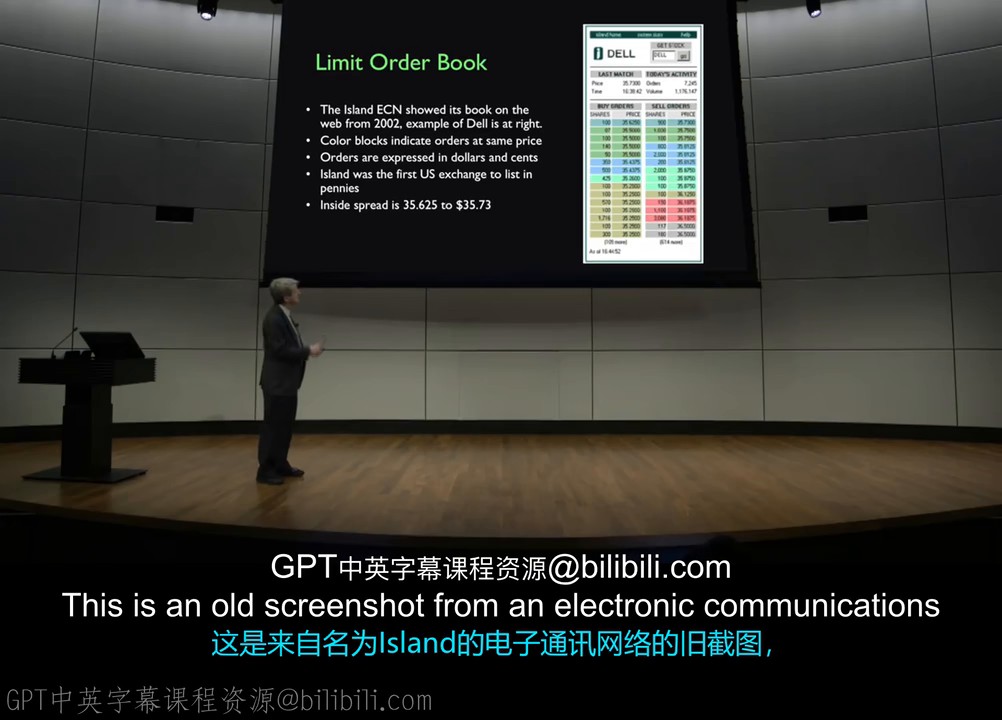
These are ordinary investors. I mean, there might be some professional dealers trading in it, but mostly it was kind of an amateur market. So you could buy 100 shares at $35. I can't quite read that. And 62.5 cents per share. And then someone else is offering, does that say two shares? The biggest one on here is 500 shares. So these are not big-time trades.
So what happens if you wanted to get on to island, you would open up an account and then you could place a bit and ask. You could do it on your own, but you have to fill in one of these blanks. So you would get on the computer and you'd see this thing. And then you type, I want to buy 20 shares at, but now I've got to beat these other prices. You know that they're decreasing as you go down.
The computer has automatically sorted them. So if I want immediate execution, I'd better put something, I'll say $35.63. So I type that in, it goes on. And then for a split second, you'll see, hey, there's my buy order, and then bang, it's gone. It lasted only like one second. Because there was somebody else with his finger on the cell order. He hit, I'll take it.
If you put your order right here at the top, But here's a share, if you want to sell, you see that the price goes up. So if you'd stay near the top, you'll probably get executed immediately. So then it becomes a fun game to play. Then you think, well, you know, that went awfully fast. Maybe I should put it down here somewhere, so it's not. Then I won't get executed until someone wants to make a big trade, like say wants to buy a thousand shares.
And if you watch this thing on the screen, it would be constantly disappearing and appearing. in the buys and sells. But the same thing is, what you saw on Island, is the same thing that you see on NASDAQ. The NASDAQ now offers different levels. But this is a screenshot from what dealers see. It's the same game they're playing on NASDAQ. The only problem is that NASDAQ makes it expensive for you to subscribe to their service, because they want it to be for professional dealers.
And so, but it's the same. Do you see what this is? These are the bids and these are the asks. And it would be the same thing. But you notice that the number of shares is larger. And this is the name of the brokerage company, I mean the dealer company that's offering, like ARCAX. This is the game that dealers play. So the inside spread is the spread between the bid and the ask.
This is slated to disappear in a millionth of a second.
High-Frequency Trading: How Much Social Value Is There in Milliseconds?
High-frequency trading is something that has been gradually coming on because of computers. So instead of sitting there with your finger to push the button when a bit or ask comes up that you want, you can program a computer to do that, and the computer program can trade algorithmically. So that the execution, some of those things may never, you may never even see them, an offer to buy or sell would appear and disappear within such a tiny fraction of a second that you couldn't even see it.
So what you can also do is trade, you can also enter on your computer a trade that flashes up for just a millisecond, and so only computers will respond. So that could be a strategy that you would use. You only want to trade with computers. Well, there's no formal way to do that, but you just, cancel your order after a millisecond. And you can be sure that no humans will be able to trade that.
So speed of transmission matters in this market. So you have to start thinking about the speed of light. Electricity flows at approximately the speed of light, and fiber optic cables also at the speed of light. So if you are on the west coast of the United States, that's 3,000 miles from New York. and you're dealing with a New York exchange, 3,000 miles at the speed of light, 50th of a second or 20 milliseconds, that's too, that's not going to go.
You can't let it take 20 milliseconds, so they have to move close to the exchange. Some people are alarmed by high-frequency trading. They think all these high-frequency traders can out, they can play. much faster than I am, and I'm going to be destined to be a loser. But I don't think it's that worrisome if you don't trade too much. They can somehow tax trades a little bit in effect.
This battle to have the fastest connection between cities is adding value to the market? Yeah, I don't think that high-frequency trading is particularly adding value to the market. And in fact, it's siphoning money out. And recent estimates show that it's a substantial suck on money from, it's not really socially viable. So one recent proposal was that we should change the way orders are executed. Instead of executing them instantly as they're placed, to group them up, instead of every millisecond trade being executed as soon as it's received, you have them wait maybe a full second, okay, or maybe even 10 seconds.
And so it's like having separate auctions every 10 seconds. And all the trades that come in in that 10-second interval are grouped together and all reach, all are executed to the best buyer or seller for that longer interval. We could eliminate. a millisecond trading. This has been proposed. It's not my idea. And it sounds like it's something that may actually happen in the not too distant future.
Because there's just nothing gained by. People are installing fiber optic cable so that they can be a millisecond ahead of someone. In other words, there's already a fiber optic cable leading between two cities. But somebody says, yeah, but it's not the straightest rate. And if I cut it off a little bit straighter, I can get a whole millisecond. That's a gold mine to me.
Well, it's not contributing to society. But that's the kind of thing that could be changed by changing trading rules. Do you think there isn't any incentive by the public to actually push for a regulation that would... I think so. I think millisecond trading doesn't have any particular advantage of So I think the history of Western civilization is that we do these sorts of things.
We're capable of making changes in rules. Now, there's going to be someone who really opposes it. Someone who just installed a fiber optic cable that's straighter than the other one. Does it have to be done by the government for like Arizona? Oh, it doesn't have to be done by the government. It can be done by the exchanges. make their own rules. The members vote.
So if you were a member, most members on the exchange don't benefit from millisecond trading. And they could vote to change the rules. Do you think high frequency trading contributes to efficient markets or has nothing to do with efficient markets? Well, it makes them millisecond efficient. But only computers can see it. Yeah, I don't consider this one of the top issues facing the world today, because it's only measured in billions of dollars per year that's sucked off of investors by no second traders.
It doesn't compare with other issues facing the world today.
Payment for Order Flow and Three Common Order Types
So one thing I wanted to talk about concerning exchanges is a peculiar practice called Payment for Order Flow. So here's what happens. When you decide that you want to buy and sell stocks, you get a brokerage account. So it could be with an individual broker who works for a local brokerage firm that deals with you, the public. guy you can call up and talk to. Or it could be a discount brokerage firm where you're working online. But when you place an order, you tell your broker I want to buy or sell shares, how does he or she make that happen? Well, normally your broker could transfer the order to a stock exchange. Then that person at that group could execute the order. In other words, find a counterparty who will, if you want to buy, who
will sell. But often they don't just hand it to someone. There's someone who will pay them to get your order. And of course, that who is ultimately suffering from that? It's you because that payment costs money. And so people thought that was suspicious. Why doesn't the brokers give my order? Isn't it his or her obligation to give my order to the best executor? Maybe I'm not getting the best price. And so in the year 2000, the Securities and Exchange Commission investigated this practice of payment for order flow and wrote up a big report, which you can find on the web. They were thinking of outlawing it. It sounds like it's something that should be outlawed, right? When I go to my broker,
why would my broker be collecting money by sending my order to someone who might do a bad job of getting me a good price? But the SEC decided not to outlaw it. And it practice continues till today. Controversial still. So the practice, the reason they didn't is complicated. These people are all playing games, one sort or another. And it would just change the nature of the game.
And it's puzzling to figure out what will happen. One thing is that they often send your order to a millisecond trader, someone who does really rapid trades and wants to see the order first. It goes to this guy first. And that can have an advantage. So, but the SEC decided it's, the other thing, one thing is they were thinking, I believe, that if you are outlawed payment for order flow, it might contribute to monopoly power on exchanges.
And they wanted to see competition among exchanges. Or they thought it might affect the kind of bids and ask that dealers are posting. When they know that there's payment of order flow and it's affecting millisecond trading, they might post less narrow bid asperas. So they decided it was just too complex to figure out the consequences. of outlawing it. And so they decided that payment for order flow has to be disclosed.
So your broker has to put somewhere on the brokerage, the BD website that they're doing this. And they must report statistics on what they're paying and on the order execution quality. This is something that most people don't think about, but do they really get you the best price? You see, a broker has to do a lot of things, and someone who's... trading on the exchange on your behalf has to do a lot of things.
For example, if it's a big order, they should break it up into little orders, right? And not affect the price by dumping it all on at once. Or they might want to deal with upstairs traders at the exchange. The so-called upstairs traders are not on the floor, but they're big deal. They make big deals and negotiate. So it's a difficult thing to regulate. Anyway, it still exists. We have payment for order flow, despite controversy.
I think I've mentioned before, but let me say, there are different kinds of orders. Most people place, especially retail clients, place market orders. So you just call your broker or you go to your online brokerage and say, I want to buy 100 shares. That's it. That's all you say. Then they go in and they fill that at, we hope, the best possible price. The nice thing about a market order is you know that it will be completed.
But you can also place a limit order to buy or sell. And the limit order is an offer, let's say it's a buy. I want to buy the stock, but the price has to be below some number, which I'll give. Or I want to sell the stock, and the price has to be above some number, which I'll give. So why would I do that? Well, I'm worried that the price might rapidly change on the market.
I can see what it is now by looking online sources, but I don't know that it will be that when I actually execute. Sometimes the market has a big glitch, or you might come in at a time when somebody else is selling a lot. And in order to get a price for you right now, it might be a really low price. So we had something called the Flash Crash a few years. ago when the stock market in the United States dropped tremendously in a matter of minutes.
And a lot of people who placed market orders said, I'll never do that again. It'll only be limit orders. A stop loss order is the same thing as a limit order except, and it involves you naming a price as well as offering to buy or sell. But it's different. With a limit order, you say I want to sell at any price at or above the price given. But with a stop loss order, I will sell at any price at or below the price I've quote.
So why do I do that? Well, I quote a price, let me see, what is it, I'm talking about buy or sell. Usually a stop loss order, I think, is in order to sell. And you want to say, I want the broker to sell if the stock price falls below a certain amount. Presumably, I own the stock. I don't want to lose too much. It's like we're having a put option that we talked about before.
I want it to get out if the price falls below a certain point.