Stock Markets and Corporate Finance
Market Capitalization across Countries: The Stock Market Is Not the Nation
Now, we did not invent stocks in the United States of America, but I just started out, I wanted to show market capitalization. Remember, we defined, the market capitalization is the price per share multiplied by the number of shares. And this is common stock. I'll define that in a minute. I just took some kind of the latest year I could get data, shows the market cap in trillions of U.S. dollars by country, just for a random selection of countries that I picked.
And here is the market cap as a percent of annual GDP. So the United States leads the pack. For now, I say the United States did not invent corporate stock, although it was here in the United States that a general limited liability law was invented. And that may be a head start that this country got to impetus toward a huge stock market valuation. But as of 2014, the market capitalization of the U.S. stock market was $26 trillion.
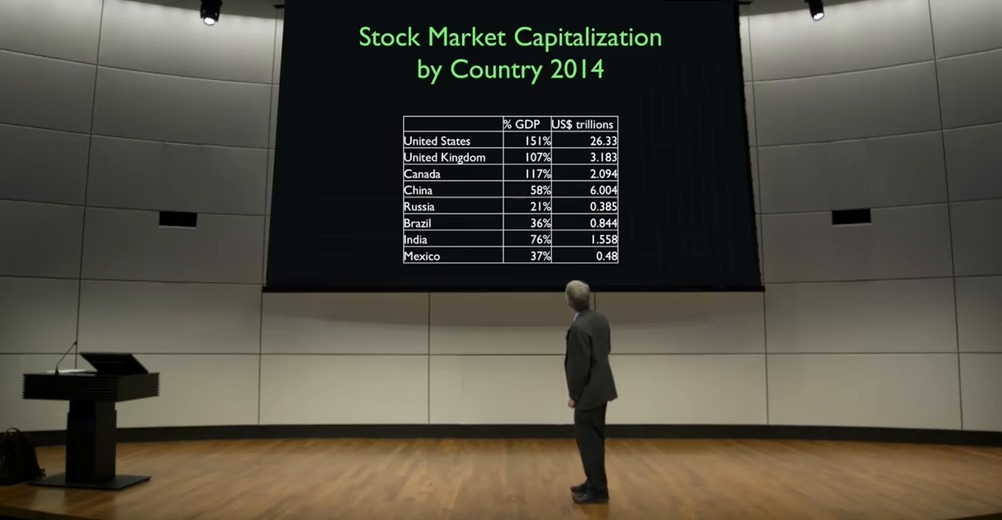
Actually, it hasn't changed a whole lot since then because 2014 was a peak. 2015 was flat. 2016 is down so far. So it's something like that now. at 151% of GDP. No other country comes close. But I think if you put the EU together, I didn't do that, the European Union, it comes somewhat close. But I think here's one EU country. The stock market as a percent of GDP is lower than the US, but they have a very large GDP.
Canada is a little bit less capitalist. See, we're really capitalists in this country. We have a big stock market. It's all traded. A lot of this isn't owned by Americans, by the way. The Chinese love the U.S. stock market and they would invest in it more if there weren't regulations in China making that difficult. But America is for sale. But I should add, the U.S. stock market is not America.
It's a particular thing. It's a particular contract. It's a claim on earnings of the corporate sector. And there's much more to this country, and to any country, than the stock market. So I don't want to overplay it. Okay, just to give another perspective, this is now about the United States. The Federal Reserve Board of Governors has a balance sheet for households and nonprofits.
They lump in nonprofits with households, which I think is unfortunate. But they're small. It's basically households. So what do, what do, what do, what do, What's the total wealth, tangible? We're eliminating, we're not including human capital. You could compute a present value of your lifetime income. For each of you, that would be in the many millions, I'm hoping.
Not for each of you. Some of you won't do that. Most of you, because you live a long time and earn money for a long time. But what is the tangible assets that we can quantify? and value through markets. According to the Federal Reserve, as of 2014, these assets were worth 98 trillion US dollars. Ask people to add up everything they own, their house, their stocks, their bonds, everything.
Add that number for every household, and you get almost $100 trillion. But people don't own it free and clear. They have liabilities. For example, typically they borrowed money to buy the house, so they have debt. So we want to subtract off those liabilities. The total value of those liabilities in 2014 was $14 trillion. So that leaves the total net worth of households in the United States at $84 trillion.
That's quite a bit more than the stock market. Now, corporate equities own directly, not. Now, equity is that's the same as stock, a common stock. Households own directly $13.9 trillion. That's less than half of the stock market. They tended to own it in other forms, like mutual funds, which as of 2014 were almost $8 trillion. What are mutual funds? They are collections of investments made by an investment company.
who then sells shares to the public. Now this includes, I believe, not just corporate stocks, but also, definitely includes bonds and other investments that mutual funds might make, but it's mostly stocks. And pension funds, 20.6 trillion. Those are investment companies that save for your retirement. Your employer typically gives you one. This is not social security.
is a government pension fund, but companies also, as a compensation to their employees, give them pension funds, and the pension funds invest and typically buy stocks. Now, you'll note that these numbers add up to more than $26 trillion, which is my market cap for the stock market. But that's because pension funds also invest in bonds and other things. And then the balance sheet for the table B-101 also includes the value of real estate owned directly by households.
That's mostly single-family homes. It also includes vacation homes. Some households have investment properties. So the total value of real estate owned by household, and I have to say in parentheses, and nonprofits, is 23.7 trillion. Bigger than the stock market. No, not quite. Bigger than the, direct holdings on the stock market, about close to twice as big.
So even in America, most people are not that into stock market investing. I think it might be very smart policy not to buy a home, to rent a home, and invest in a broadly diversified portfolio, which would be less risky. But most people don't do that. And maybe they have good reasons.
The Corporation: An Organization Shaped into a Person by Law
So what is a stock? Well, we first have to think about the corporation. So the word corporation comes from the Latin word corpus, meaning body. And what it is is an organization that is incorporated. That means it's made as if it has a body, as if it's a person. In fact, the word person in law typically includes corporations. If you wanted to say an individual, you could say a natural person.
A corporation is an artificial person. The idea is to create something that legally has a lot of the rights that individuals do. And traditionally, it would be created by a royal charter, prescription, or active legislature. More recently, it's done according to procedures that are widely available. In ancient Rome, they had corporations. They were called publicani.
But they were limited. And they had a stock market. This is what you can read in the Getsman book. The stock market of ancient Rome was outdoors on the street in front of one of the temples in the Roman forum. And you could go and buy shares in company. There isn't much data left. about stock prices then. Most of the companies, at least later in ancient Rome, were of a certain kind.
They were tax collectors. The Roman government paid private companies to collect taxes for them. Why not, right? It's not the way we normally do things today. But rather than go out after everyone, the government just hired a company to do it. And those were traded on the stock exchange. But they didn't develop much. And I don't know the reason. They didn't have any insurance companies or shipping companies.
Those kinds of activities were done without incorporation. Now, let's talk about a modern corporation. The modern corporation in the United States, let's talk about a for-profit company, like those that are on the New York Stock Exchange. It's governed by a board of directors that is elected by the shareholders. So it's called shareholder democracy. Typically, one share, one vote.
So it sounds like a sensible thing. It's a little bit like the electoral college in a U.S. Constitution for the government. You vote for electors, and then the electors vote for the president. Similarly, you as a shareholder vote your shares, one share, one vote in the company. It sounds sensible to elect the board of directors, and then the board of directors votes on who will be the president.
The CEO or president, well, we now tend to say CEO, chief executive officer, and companies will also have a president. But the CEO is generally the top. person. So the CEO is hired by the board, served as an employee and has to report to the board of directors. Even non-profits are somewhat likely, they do have a board of directors. And then they hire the president.
There are other structures. In Germany, notably, they have, a company will have two boards. An al-zikhrat and a four-stahn. The office-zik-hrat is a station. supervisory board, which stands on top of the whole operation. The forestand does the details, manages, well, it doesn't actually do. It hires people to manage the company, but it's in charge of the day-to-day activities.
But it's the same basic idea. They just divide it into two parts. Now I've been talking about for-profit corporations. We also have nonprofit corporations. A for-profit corporations. A for-profit corporation is owned by the shareholders, and the shareholders have one vote each. The shareholders have the claim on the earnings of the company and have to pay a corporate profits tax.
The company has to pay a tax to the government on its earnings. Non-profit corporations, for example Yale University, are not owned by anyone. Now you might ask, how can that be? How can it not be owned by anyone? Well, they have a board of directors called the Yale Corporation, and they have a provision where alumni can elect them. Other non-profits would just be self-perpetuating. That is, the directors appoint their own successors. It sounds a little wild because what if the directors get crazy, then the whole thing could go down and crazy.
But that's the way we leave it. Generally, it works. Generally, the board appoints other people who have normally some idealistic commitment to the purposes of the nonprofit. So it exists. The for-profit exists for shareholders. The nonprofit exists for whatever the charter of the nonprofit said to promote some cause. Four profits have a price per share. Nonprofits are not traded.
And so they don't have a price. No price for them. You mentioned nonprofit organizations in your lecture. So can you talk about that nonprofit status means that their revenues should never exceed their costs to maintain nonprofit status? Yeah. Non-profit, maybe it's misleading. It doesn't mean that they don't make profits. It means that they don't distribute.
profits to shareholders. The purpose is not to distribute profits. But they do have a purpose. In a for-profit company, the objectives that are focused on are the shareholders. They take the money and they do what they want with it. But in a nonprofit, the nonprofit can make as much profits as it wants, but it keeps them in the company and spends them on some purpose.
A nonprofit has to be defined with a purpose. It has, because it doesn't go any. Otherwise, they would just sit on the money forever. And in fact, that kind of thing has happened, where nonprofits accumulate huge amounts of money. And people wonder, where is it going to go? Where is it going to be? spent. Sometimes nonprofits are developed that have a goal that gets lost later.
One famous example is the Shaker Church. That was a Christian church in the 19th century. And they created a foundation and they accumulated money. But there aren't hardly any shakers left. There might be two left in the world. And so the foundation is being run by people who have to think, well, what would I do? if I were a shaker. That is a potential problem with non-profits, but usually they're defined with a purpose that will endure and will continue to motivate their use of the profits.
Shares and Dividends: Proportions Matter More Than Share Counts
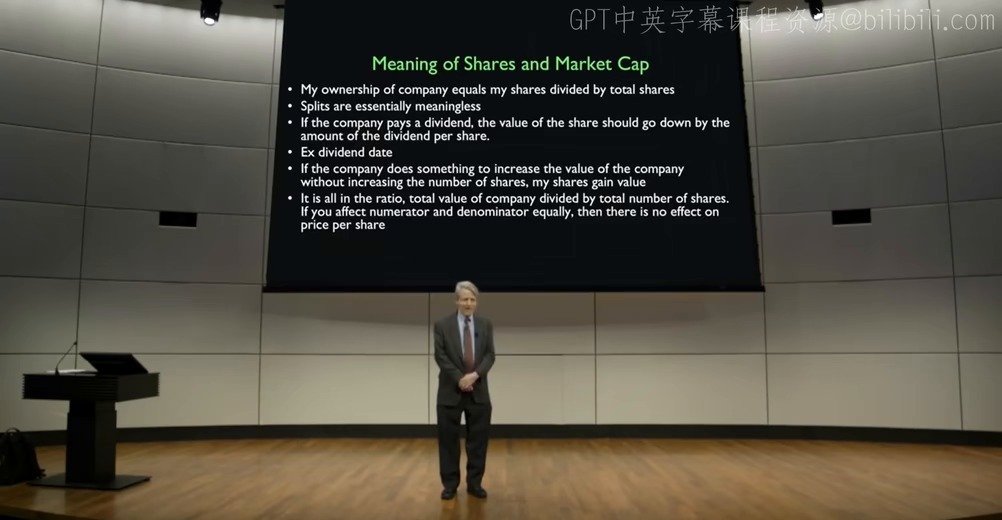
Now, I wanted to make a very basic point about corporations and shares. If I give you a thousand shares in a company and you wonder, well, what does that mean that I own a thousand shares? You have to ask another question, which is, how many shares are there outstanding? So we talked about this before. I'm not up to date on these, but my share of the company is equal to the total number of shares I own divided by the total number of shares outstanding for the company.
So it's my number relative to the total. If I own half of the shares outstanding, then I own half of the company. Companies do things called splits where they will break a share in two and call one share another 1.5 shares or two shares or whatever. They do that periodically. Why do they do that? It seems that companies think that there's an optimal price per share that encourages investors, looks right, feels right, and so they will change the number of shares from time to time to try to hit a target for the price per share.
In the United States, by tradition, The target price per share is something like $30 a share. So suppose your company has done very well, and the price per share, which was originally $30, is now up to $60. Your board of directors may then, someone might bring it up at the board meeting. We should do a two-for-one split to get our share price back down to the magic $30 a share.
So then you would then send out a letter to all. of your shareholders and saying we're doubling the number of shares. And by the way, here's your, you now have twice whatever you did before. Well, I put down on my slides, this is essentially meaningless. All they're doing is changing the unit of measurement. It's like going between metric and ever-de-poix. It means nothing.
So by the way, why do they even do it? Well, why not, you know? One reason they do it is they just think, if the share price gets too high, you can't buy a fraction of a share. It gets too expensive. And people like to buy in round lots because the brokers encourage that of a hundred shares. So if it's $30 a share, you can buy an investment round lot for $3,000.
But it gets expensive if you don't split. Now one company that doesn't split is Berkshire Hathaway, that's Warren Buffett's. company and it's been selling for thousands of dollars per share. So you can't even buy a round lot unless you're a substantially wealthy person. Warren Buffett does that out of some principle. He can do it. Well, I should say his board does that.
They can do it because it's all meaningless, but not totally meaningless, just that it gets hard to buy small amounts of share. You can't, you can buy one share, but you can't buy half a share. So, now the company is defined, as I said, in basic terms, by a board of directors. It's in the company has a constitution called the corporate charter, and the corporate charter defines how things are done.
But the general principle is guided by state laws. It's state governments that manage, you have to incorporate in a state, which means you choose, which means you choose a state to make your headquarters in, and that state then restricts what you can put into the corporate charter. Delaware is the most popular state for incorporating. Because, well, it's the smallest state in the United States, and small states have an incentive to be very generous to corporations, and then they'll all move to you.
your state and you'll end up making money. Big states wouldn't do that because they already have corporations who need to be there. So the corporate law in a state defines the rights and responsibilities of shareholders and the board of directors. But it doesn't say, well, it might say something about dividends, but it doesn't tell the company what to pay out. Now, you've This is something that's often forgotten.
You buy shares in a company to get dividends. A dividend is a distribution of money from the company's earnings to its shareholders. That's why, in America at least, especially, where we make it very clear. Why would you buy share in a company? Hey, they pay dividends. It's like interest except it's variable and tends to grow through time, whereas debt contracts, it doesn't grow, it's just fixed.
So you're doing it for the dividends. Some people, remember we had the return on a corporation has two components. The capital gains, which is the appreciation in the price per share and the dividends. So people tend to talk so much about the capital gains, the movement of the market. They forget about dividends and some people don't even know there are dividends.
But it's actually the whole reason for being for the stock market, ideally anyway. You buy shares together. get dividends. And in fact, if you look at history, most, even up to recent times, most of the returns you get on the stock market are in the dividends. People think, well, no, isn't it just that the market has soared? Well, historically, over 100 years, dividends are more important. The stock market goes up and down, creates capital gains and capital losses, but dividends are what it's all about. So companies don't have to pay.
a dividend, but typically young companies don't. Once they're mature, they like to start paying dividends, and it signals to the world that they're really making money. If you invest in a company that never pays a dividend, you start to wonder, you know, is this real or is this a fraud? I never get a penny from them. So once they're into making money, they think it impresses investors to get dividend checks.
I remember my own company, we incorporated in Delaware, my first company, we incorporated in Delaware, company, K. Shiller Weis Incorporated. And we didn't have to pay a dividend. I remember we had a board meeting where we talked about exactly this. And, you know, we've never paid a dividend. We gave shares to a lot of our employees as incentive, but they don't even, someone said, they don't even believe in it. You know, nothing has ever happened.
So we should pay a dividend, but we didn't. We held on. The employees eventually did well when we sold the company. They found out that their shares really worth something. But we should have started paying dividends and make it clearer. We didn't. So when a company pays a dividend, what happens to the share price? Well, very simple. It drops. Because the company used to have the money, and now it doesn't.
It paid it out. The share price pretty much has to drop. I don't suppose it always does because funny things happen. But the basic idea. is that a share drops in value when a dividend is paid. But I have to qualify that. It doesn't drop in value when you get the check in the mail for your dividend. That would be variable anyway, right? They don't necessarily pay them out at any exact moment.
So a company has to define what they call an X dividend date. That means they will pay out the dividend, this dividend, that typically, quarterly dividends every three months. They'll pay out this dividend to shareholders of record on this date. So company values drop routinely on the ex-dividend date. That doesn't mean bad news about the company at all. So I had a question about companies in different dividend payment systems.
So some companies like to boast about they always pay dividends, they never miss it. And why would they want to emphasize this? And then what would happen if they have to cut back on their dividends or they don't miss their dividends they don't miss the dividends in a period? Well, I think this is an essentially behavioral human question. So the reason they don't want to miss a dividend is because they think that will harm the investor support.
And they don't want to see their stock price fall. If the investors lose confidence in the company, the stock price can fall, and then the management starts to worry that they'll be taken over. If the price gets too low, takeover people will think, I'll buy it and I'll shut it down and sell off all their assets, maybe, if it gets low enough. So it's a big fear.
They don't want investors to have a bad attitude. So then why would you as an investor be disturbed if a company didn't pay a dividend? Well, I think it's a sort of fundamental human mistrust. You don't know that these guys are on the level, you know, maybe they're crooks or maybe they're not. It's like missing a payment on your credit card. You know, you have a credit rating that depends on you're actually making these monthly payments.
And you could take the attitude, well, I miss it once and not. I'll pay it up, you know, I'll pay the fine, what difference does it make? But your credit rating will go down if you do that. So most people personally think, I'm going to pay every month. This is something I'm really going to do. And they kind of imagine that it's like that. dividends that the company, if they miss a dividend, it means they're kind of unreliable or untrustworthy. Now, they didn't have to think that, but that apparently is how a lot of people think. So that's why lots of companies don't ever want to miss paying a dividend.
Couldn't that, couldn't missing a dividend also be a real indication of financial trouble though? And maybe that's why investors have a, why a red flag is raised? Yeah. No, the thing is that. A dividend is not promised. The corporate law says that they can pay a dividend at the discretion of the board, whether they want to or not. And many companies go years without paying dividends.
But the public might have some preconceived notions and think it's like my credit card bill. And if they're not paying, yeah, there's something wrong here. Now they could stop paying a dividend for perfectly good reasons, like they want to do something with it, the more productive. But the investors might not understand it. By the way, I don't mean that firms never miss paying a dividend.
I'm just saying that some firms pride themselves on never having missed a dividend.
Common and Preferred Stock: Priority Is Still Not Debt
I've already suggested, but I didn't really state it clearly. The difference between common and preferred stock. We've been talking about common stock. Now common doesn't mean plain and not pretty. It means held in common. It's the word equity refers to common stock as well. I'll come back to that. What's the difference? Preferred stock has a specified dividend, which does not grow through time.
And like common stock, it doesn't have to be paid. Now, again, there might be slight differences in state law. We have 50 different states in the United States. And other countries have similar institutions. There's a complicated law. But typically, the deal is this. The company is supposed to pay out a fixed dividend to the preferred stockholders, but it doesn't have to.
But it cannot pay a common stock dividend until it's paid. up on its preferred stock dividends. So if they don't pay them, then they have to, if they haven't paid their preferred dividend, they've got to make it up eventually. But in contrast, corporate bonds have a contractual obligation to pay a dividend. So that is that if the company gets in trouble and it doesn't, I say dividend a coupon on the bond.
If the company gets in trouble and doesn't pay out its coupon, the shareholders can come back and see sue, forced the company into bankruptcy. Preferred stockholders can't do that. Otherwise, they're kind of like corporate bonds. During the financial crisis, 2000, 2008, 2009, 2000, well, the US government bought, got a lot of preferred shares in companies for bailing them out.
The US government didn't want to get common shares, it wanted to get paid back, it didn't want to push them into bankruptcy by creating a new form of debt. So the US government got preferred stock in the company. Why didn't they get common stock? Hey, this is America. The US government, if it were to be buying common stock, this would be socialism. The government would be owning parts of companies.
They didn't want to do that. So they bought preferred stock. So for example, the US government had, and the Canadian government, and I think had a lot of preferred shares in General Motors.
Corporate Charters and Shareholder Democracy: Why One Share, One Vote Can Fail
Now, the basic corporate charter emphasizes that all common shareholders are treated equally. They don't have to pay out dividends to them, but if they do pay out dividends, it has to be every share gets the same. And that's where the word equity comes in. It's equality of shareholders. Does not have to pay dividends, the board decides, doesn't ever have to pay dividends.
But you trust that the board will pay dividends because the other shareholders want the money. They can't get at it without paying you too. The firm can also repurchase shares instead of paying a dividend. No law saying that they have to. They can both issue new shares and they can repurchase shares. The board decides. There's also other kinds of corporate liabilities, warrants which are a form of option.
convertible debt, they can do whatever they want. But the fundamental thing that ties it down is that all shareholders have one vote, and they elect the board. Now, there are critics of shareholder democracy. Notably, Burley and Means wrote a book in 1933 that was very influential, arguing that was very influential, arguing that, well, you've described a system of corporate governance that sounds plausible and probably does work for little companies, but it might not work for big companies.
Well, I know when I set up my own little company, Kay Shiller Weiss, there were three of us and we got some more, well, we had one more major shareholder. We got together and it was very clear that we voted and things happened because we were involved. So the democracy, it just seemed perfectly natural and functional. But Burley in Means thought that it doesn't work so well for big companies.
The same reason may be why voting for, when there are millions of people voting, doesn't work so well. So I don't know what you think, whether do you vote? I mean, as you go to the voting booth in an election, Does it ever occur to you? That my vote doesn't matter unless the rest of the people are equally tied, right? If exactly half vote for one candidate and exactly half vote for the other candidate, then it's tied, and my vote would decide.
Otherwise, my vote doesn't do anything. So what's the probability that my vote is the deciding vote? Well, if there's millions of people, the probability must be, you know, minuscule. So if you're really the probability, you know, rational you wouldn't vote. But people still vote in elections, and this must be out of some sort of patriotic feeling or a sense of obligation.
But when it comes to corporations, those senses aren't so, you don't feel patriotic for a corporation. So, and a corporation has an election, why do I even bother? We're holding diversified portfolios, aren't we? So I've got a hundred different stocks. I can't keep up with how they're all being managed and would go to an election and the vote, my share. I'm only a tiny, tiny fraction.
So why should I do that? So Burley and Means said that while in practice we have shareholder democracy, in practice, the democracy is imperfect. It's really self-perpetuating boards of directors. So that led, their book was an extremely important historically. And what it led to is new regulation that tried to allow for takeovers of companies. What Burley Amin said is a lot of companies were ill managed and managed for the interests of the board of directors because they just effectively owned the corporate.
They can't pay themselves big amounts of money. They can put fairly generous salaries. They can hire their friends and give them nice jobs. they're sort of ripping off the company. The shareholders, some of them might hear about this and get upset, but it's hopeless. You can't influence the votes of so many people. So they made it easier. In 1935, the Securities and Exchange Commission, under authority of the act that had just created it in 1934, established rules for proxy contests so that people who wanted to change the governance of the company could reach the shareholders, and asked them to sign a contract to let you vote on my behalf.
You would give them the right to be a proxy for you at the shareholders meeting. And they made it, companies didn't want to help outsiders reach their shareholders. They wouldn't publish the list of shareholders. So there was no way that a proxy contest could have been done prior to 1935. But not that. They made it a real, because they began to think, we have to make shareholder democracy work.
This is Roosevelt era, which was very left-wing. But the really wonderful thing about the Roosevelt New Deal was that it wasn't socialist. It was maybe motivated by social harmony and concern about poor people, but it left intact the corporation. So this doesn't sound like Franklin Delano Roosevelt at all. But it is. It's trying to make democracy work, and they wanted shareholder democracy to work.
So that there have to be election contests in corporations like we see in politics. In 1956, amendments made proxy contests difficult. But then people later, as we moved to a more free market governance relaxed the 1956 amendment so that proxy contests came back. Now, some companies have classes of shares as permitted by state law. So you can have both voting and non-voting shares.
Berkshire Hathaway, which is the company of Warren Buffett, who has both Class A shares that have voting rights, and Class B. shares do not. I don't know if that, I have to update this, what the Class A shares sell for now. It was recently $200,000 a share. Showing, again, the fact that only means, that doesn't mean this is a big company. It only means they don't split.
And it would be $30 a share if they split like other countries. And it wouldn't make the company any less valuable. Maybe I'm overstressing that. The New York Times has a share both Class A shares than Class B. Class A has less voting rights than Class B, which allows the descendant of the original Adolf Oakes family still to control the company. Why do they do that? Well, they think that the New York Times serves a higher purpose.
That is, it's not out for profits. It has, some profits, but not entirely. So they gave the original New York Times family more voting rights than the other shareholders. This has been under criticism recently, but still is maintained. Facebook, Mark Zuckerberg, recently, I don't know what the percent is right now, but had 28% of its shares, but 57% of its voting shares, which means basically, Mark does whatever he wants.
He has a majority of votes in the, but that's because of the classes of shares.
Corporate Finance: Retained Earnings, Debt, and Stock Issuance
So now, how do companies raise money? You're in a company and you're trying to make a profit. You need money, say, to build a new factory, or to launch a new ad campaign. So you need the money now and you get profits later. How do you get the money? Well, there's two major resources, ways to do it. Well, I should, maybe three. One of them is retained earnings.
I'll list that first. You can wait until you've made enough money. You save it up. and then you can build your new factory. That's one way. But it's slow because you have to wait until you've got the retained earnings to do that. Often young companies don't have much earnings because they're putting everything into the future. Another thing you can do is borrow money.
Either through banks, you can go to a bank and say I'd like a loan for my company, or you can issue debt and sell that through a broker. You would issue a corporate bond which brings in money. And you can issue shares, new shares. So suppose there are a million shares outstanding, you can issue another million shares. Now the shareholders of the company, when you do that, are going to look at that and say, wait a minute, what are we doing here?
I used to own like 10% of the company, and now I own only 5%. So I'm not so sure I'm happy about that. But then you on the board would say, but don't worry, we brought in millions of dollars and you own a share of that. So the company has more now. So it's not bad for you. We need the money because we need to invest. And I think people understand that. So this is called dilution.
When they issue more shares, your share in the company goes down, defined as the total of shares you have divided by total shares. And so do you feel happy or not? Well, you have to understand that it's diluted you. no longer have the same vote that you used to have. You've given up some voting power in order to get money to expand the company. You might come to a shareholder's meeting and complain, but they'll say, but look, this is the way it works.
We can't expand without money. And this will make you writ, you'll be treated equally to these other guys that came in and bought new shares. So you might well back down. I guess that's the way, you know, all these big companies did that. So if you're an initial shareholder, you once own a big fraction of the company. It keeps going down, but the company keeps going up in value.
But here's why they call it equity. because all common shareholders are equal. Now, so what about issuing shares to get money? Well, some people said that issuing shares isn't very important anymore. That companies, when they need money, they borrow money, or they use retained earnings. Carl Marx thought that. He said, all this trade in stocks is trading mostly existing shares.
It doesn't bring money into the company. There's all this transaction. It's just gambling. That's what Mark said. All these people playing a game. It's only when the company issues shares that share price matters economically. And Mark's thought they don't do that very much. Stuart Myers, who is a professor of finance at MIT, wrote an article in 1984. arguing that, well, you know, I don't think you put it this way.
Marx was right. I'm sure he didn't say Marx was right, but he was effectively saying that, because he looked at the data and he said, firms don't issue, when they first start, they issue a lot of shares, but after that, they're not issuing very much. So he proposed what he called the pecking order theory of corporate finance. How do corporations, this sounds like behavioral economists.
Now he must. He might shudder if I identify him as a behavioral economist, but this is what this sounds like to me. The best way to raise money for corporate actions, according to what he said boards think, is retained earnings. You feel most comfortable. You go to a board meeting and say, we need to build a new factory, but we've been making a lot of money, and we've got all this cash lying around.
We'll use our retained earnings to build a new company. That feels really good going to really good going into the board. They'll say, well, why not? They'll go for that. But then if you say, let's go to the bank and borrow money, then they get a little nervous, because bankers sometimes ask for the money back, and then you can be in trouble, so they're not quite so willing.
So that's lower on the pecking order. But then the other thing, you can say, all right, let's issue new shares. Now they get really creepy. Now they're thinking, oh, my votes going down. I don't like that. There's often shareholder. as they're on the board. They're thinking, now I'm going to be giving up power to other people. And if our profits don't go up, then we're going to be dividing them up among more people.
So they don't like that. Stuart Meyer's article was very influential, because it sounded right. This sounds like the way I could imagine myself behaving as a board member. And he showed statistics, emphasizing that. Now, as of 1984. In 1984, most firms had not done a single equity offering in the last 20 years. And when asked, are you thinking of issuing new shares, did not even contemplate doing it.
And from the years of 1973 to 1982, 62 percent of capital expenditures came from retained earning. That is what companies were doing at that time. And only six percent from issuing. 6% from issuance of new shares. So if they never issue new shares, then what difference does the share price mean anyway to corporate activities? So this was a Marx was right conclusion.
But they were criticized, notably Eugene Fama and Ken French. This is the Eugene Fama that we keep talking about, the efficient markets guy. But I think they were right here. Stuart Myers' choice of 1973 to 82. was atypical. The stock market crashed in 1973, and it was still low. So you didn't get much money for the new shares you issued. Of course nobody issued new shares.
But even so, there was some forms of equity issuance, even in that period. And, for example, they issued corporate shares. to employees as a compensation, or they had warrants on the stock that were given to employees. So there was some issuance, even then. But the amount of equity issuance increased right after, well, they give, 86% of firms issued some equity between 1993 and 2002.
So it's really not true. Marx wasn't really right about this. really right about the price of a share in the public market matters for the amount of money that a company can raise. So if the market price goes up, the company can get more money by issuing shares. And that encourages them to do that and make more investments. When the stock market goes down, the company starts looking at it.
Typically, the board members are still optimistic about the company. And you say, we're down to $3 a share. You might be talking about doing a reverse split to try to bring it up. But you're thinking, are we selling these shares for only $3? I had my life's dreams. We're going to be diluted down for just $3? I don't believe that. Wouldn't do that.
Stock Dividends: More Shares Do Not Create More Wealth
Sometimes companies will issue a dividend in shares. It's called a stock dividend. So you might get a letter from your broker saying, congratulations, the company has now paid a stock dividend of 5%. So you had 100 shares, you now have 105 shares. And a price per share is $30. So you've got five new shares. It's like getting a dividend of $150. Well, that's what most people think.
But then you, what is the next question you ask your broker? Let me get this straight. The company has issued new shares so that I can be paid a dividend in shares, and I now have 105 shares. Is that the same as getting $150 in cash? I think about it, the question you would ask your broker, do you see where I'm going with this? The question you'd ask your broker is, wait a minute, every shareholder is getting these share dividends.
It's equity. They can't pay me a stock dividend without paying the other. So the total number of shares went up by 5%. So I'm calculating what fraction of the company I own. It's the same. So then you would go to the company and say, what is this non-sense? sense. You're paying a dividend and shares? I figured out that means nothing. The company would be kind of embarrassed.
If you ask that question, they would say, what would they say? They might say, if you could get them on the phone, say, yes, you are deluded. You did get shares and you were diluted down by the same amount. But we think this price per share will hold, and it's going to be good for you. try to talk their way out of it. Typically, they issue stock dividends as just, it's kind of a trick.
This is fishing for fools. But they could be well motivated in doing it. They have to keep your morale up. Maybe they weren't going to pay a cash dividend. So let's do a stock dividend. Let's make a public statement that the company is doing really well. And if anyone brings up dilution, you say, well, but no, we're doing so well. We don't think you're, we don't think you're, we wouldn't issue a stock dividend if we thought that it would make price per share fall.
So people might say, okay, I can do that. Now, there was a time once when the Internal Revenue Service proposed taxing stock dividends. Well, why not? You just got a dividend. You should declare it on your taxes. So some companies went running to the IRS, and now they explained it with perfect clarity to the tax claim. No, no, no, you got to understand. This isn't really a dividend.
This is just paper something. You can't possibly tax them on this because they didn't get anything. So the IRS backed down and it doesn't tax stock dividends. You just briefly alluded to how some firms never pay dividends or go many years without paying them. Why do these firms think it's optimal to do so when these other firms boast about always paying dividends?
Well, typically the firms that never pay a dividend are young firms in a rent. rapidly growing business, where they tell investors, it's a different kind of investor. The one that buys stocks that have never missed paying a dividend, that's grandma, okay, and grandpa. They don't want to, they have old fashioned ideas. But young people are more likely to buy a stock that doesn't pay a dividend.
It's also especially popular in the last 20 or 30 years. That's a long time for you, I know, but... When the internet started building up Steam in the 1990s, they were setting up companies like Amazon and was Google. I'm not sure about the years, but around that time, a lot of young companies were set up. And people said, you know, this is an opportunity. Right now, there's this revolution in the internet.
You've got to jump on. it because this is going to, it's going to go to the first mover. And to a significant sense, that's true. So the kind of people who would invest in some startup internet company back then would say, don't pay me a dividend, I want you to move, otherwise you'll be a loser. So in fact, it almost became reversed that companies prided themselves on never paying a dividend.
It used to be that the New York Stock Exchange, wouldn't list a company that never paid a dividend. And so, and it was prestigious to be listed on the New York Stock Exchange. But there was this other young exchange called NASDAQ that would list you whether you've paid a dividend or not. So Microsoft went on NASDAQ, not on the New York Stock Exchange. Then years later, when Microsoft became big and important, the New York Stock Exchange said, in its dignity, it said, we have now decided.
that Microsoft is okay for listing on the New York Stock Exchange. But you know what Bill Gates did? He said, no way, I don't care about your prestige. NASDAQ is better because it's the go for it, companies. So you're right, there's different subcultures, some which appreciate a dividend and some which think it's a sign that you're old school. But, you know, firms have clientele, investors that invests in their firm.
and so you appeal to your clientele. The old utility companies are never going to get the young hotshot investors anyway.
Share Repurchases: Like Dividends, but with Different Tax and Behavioral Effects
Now, share repurchase is another thing that happens. That instead of issuing new shares to raise money, the company can repurchase shares outstanding. Go out on the market like you, and the company buys back its own shares. That's the reverse of dilution, because the number of shares goes down. And if you didn't tender your shares, if you didn't pay, if you didn't sell your shares at the time of the share repurchase, you own the same number of shares.
That means your share repurchase pushes up the amount that you own of the company. So share repurchase, in a sense, is like paying a dividend. It's an alternative way of paying a dividend. So let's think of it hypothetically. Imagine that the company is about to pay its dividend. It's been paying $2 a quarter regularly per share. and they're about to pay it.
Then someone says, why don't we send out a different letter this time? Instead of saying this is a dividend, let's send a letter that says this $2 is repurchasing 1% of your shares. Because everyone gets the same letter. So if you get this in the minute, you'd say, what's this? I got my $2 dividend check, and I also get a letter saying this is share repurchased.
Now you might be confused, well, what does this mean? Well, I tell you, one thing it means is it's not taxed, because, well, not taxed the same. But forget about taxes for the minute. What does it mean whether I get a letter saying this is a share re-purchase or this is a dividend? It's $2. And the share repurchase, if it's everyone equal, it doesn't affect the fraction of the company that I own.
So the letter is nonsense. It's just. the same thing is paying a dividend. So they do a lot of share repurchases, especially recently. It's been a big thing in America since the financial crisis. Now some people say that's because the stock market, it was during the financial crisis, the stock market was low, and so companies were buying back their shares at a low price.
That's what was said. But now prices. are way back up again and companies are still repurchasing their share. So what's going on here? There's a lot of share repurchases lately. Why do they do this? It's been 2% of shares per year, which is comparable to the dividend rate, the rate of dividends on the aggregate U.S. stock market has been something like 2%. So how do they get that? Well, the important thing is, I would say, the important thing is there's a tax break.
If they do share repurchase instead of dividends, it's the same thing technically, but you see the tax, you can fool the IRS. Suppose the company pays out a $2 dividend, then I would get $2 in dividends, and I would have to pay income taxes on those. It used to be you had to pay them at your marginal tax rate. Now it's 15% on, or it's capped at 15% of the dividends paid.
But if they do share repurchase, now if I would still have $2 more, if I didn't buy, if I didn't participate in selling my shares to the company, then my value of my shares goes up by something like $2. But I don't have to pay taxes on it because I don't have to pay taxes until I sell. So I can postpone them, maybe indefinite, maybe I'll never pay taxes on them.
So I like that. I like share repurchases. Now, incidentally, right now, in the United States, the capital gains tax for small capital gains is capped at 15% also. But for higher amounts, it's 20%. The real thing, though, that's different, is that capital gains taxes don't have to be, that's for long-term capital gains. taxes do not have to be paid until you sell the shares.
So it allows you to postpone maybe for the rest of your life, you know, the tax on the amount paid out. So there's a tax incentive for share repurchase rather than dividends. I think that is a substantial part of the reason why companies are relying more on share repurchase. Those other issues though, these are behavioral, One thing is that people just don't get it.
Most people, most people have not taken financial markets, and they don't understand what's going on. So if you were to say, we're not paying dividends anymore, and we're going to do share repurchase instead, first of all, you get the IRS. If you do it every quarter, if you do share repurchase every quarter, and you make this big announcement, the IRS will then say, maybe this is a dividend, even though you're calling it.
You got to be devious of it. about it. You can't do it every quarter. But suppose you did that. The people would react immediately to the loss of dividend. I'm talking about grandma and grandpa who are retired and don't know anything about Fania. They got a letter saying, we're canceling your dividend. They would panic. They say, well, we have a rule that we only live off of interest and dividends.
We can't, they'll be upset. And some companies boast that they have always paid a dividend. This is very effective for grandma and grandpa. They, who often have a rule that I never dip into the principle. I only live off income. And I need that to buy food every quarter. So I need those dividends. I mean, you could tell them, no, you don't. You can sell your shares.
Anytime you need to sell some of your shares. They're going up in value because of the repurchase. But they won't get it. There's also other thing about a price power. about a price pop after repurchase that might encourage share repurchase.
The Present Value of Expected Dividends: What Is the Stock Market Pricing?
What does the stock market value? What is, you know, now, as I said last time, a lot of people think the stock market, you buy into the stock market so that it goes up and you can sell at a higher price. But what is it? What are you pricing? Well, some people have never thought about that. They just want to know whether it goes up. So what I was saying last period, I repeat it, that most of the return people have gotten historically from stocks is in dividends, not in capital gains.
And in fact, it's correct to think that efficient markets implies that what you're really pricing in the stock market is a claim on dividend. That's why you, if a company were to, suppose a company were to say, we will never pay a dividend again, and we're going to put it into our charter, that we will never pay a dividend. All of our profits go to charity, let's say.
Well, you can do that, but what's the value of a share? Well, there are no shares, but if there were, they'd be meaningless, so they'd be worth nothing. So it's all about dividends. There's two important ratios. There's the price earnings ratio, price per share divided by earnings per share, and there's the price dividend ratio, typically dividend price ratio, where it's dividends per share divided by price per share. Now, let's simplify things and not worry about that distinction.
Suppose a company is paying out all of its earnings as dividends. Then the two are the same. So let's just talk about the price earnings ratio. What does that mean? It's different for different companies. Some have a high price earnings ratio. You know, it could be as high as a hundred. That's very unusual. Which would mean that you'd have to wait a hundred years to get your money back based on dividends.
If you bought it, that's a long time away. More typically, the price earnings ratio is something like 15. So you'd buy a share, and in 15 years, if you're getting all the earnings as dividends, you'd have your money back. So the price earnings ratio should be something like that, like 15, right? 10, 15, 20, not 100. You wouldn't buy into an investment that takes 100 years to pay out.
So what determines that? the price earnings ratio? Well, I refer to the idea that efficient markets idea is that the price of a share is the present discounted value of its expected future dividends. And then I can apply the Gordon rule, which I mentioned recently, which says the price should be equal to earnings divided by r minus g, where r is the interest rate or discount rate and G is the growth rate of earnings.
So the price earnings ratio is 1 over r minus g. Now that's, this is a very important model because it gives you a theory, it's an efficient markets theory, why some firms have high price earnings ratio and other firms have low price earnings ratio. It all has to do with R and G. is the only thing that go into this formula. So if a company has a low price earnings ratio, according to efficient markets, according to this most, I should say, efficient markets is not precisely defined.
There are many different efficient markets models. But I'm taking the sort of basic canonical present value model of efficient markets. And it would say, if a company has low PE, that means either R is high for that company, or G is low for that company, or both, or a combination of both. Now, why would R be high for a company? Well, if you believe the standard theory, which has been taught for 50 years in finance courses, we have the security markets line.
Remember, the expected return on a stock is equal, is a function of its covariance with the market. So that would mean that companies whose return covaries with the market should tend to have, via this R thing, should have low price earnings ratios. In simple terms, they're riskier in the correct sense that CAPM provide. They're riskier in that they co-vary with the market.
Okay. The other thing, though, is G, some companies, have very high growth prospects. Everyone knows that they have some patent, say, or some good technology, nobody can compete with them. They're just starting out. Of course you expect their earnings to grow. But in efficient markets, that's not a reason to invest in them because the price will reflect the growth in earnings already.
So it will already be discounted into the present value. So anyway, high growth companies, should tend to have high PE. A low PE would be a low growth company. There are often good reasons for a low price earnings ratio. One is that the business is very risky, and so people don't want to put a lot of money into it. And another one is that the business might have a poor earnings growth outlook.
That earnings is likely to fall. The classic example of that is railroads. You know, that was the in thing in the 19th century. By the early 20th century, it was looking a little bit old-fashioned. And we've gone another 100 years. So they're really not the most rapidly growing investment. So they get beaten down. The price gets beaten down. But you know what? Railroads are here to stay, and there's always a price that makes them a good investment.
So when were railroads a good investment? Well, I was thinking around 2000, when the market was at a peak, what I call the millennium peak, and it was all this internet.com stuff. You shouldn't have been buying dot com then usually. You should have been buying railroads because they were just forgotten at the time. The question is, does it work? Does the efficient markets model work?
Well, I've been always saying efficient markets is a half-truth and it sort of half works especially with G there you know as I say railroads are not high PE stocks but there's it there's another approach to investing which goes back many years called value investing okay notably Benjamin Graham and David Dodd who were teaching finance at Colon University in the 1930s, they wrote a textbook called Securities Analysis.
And in that textbook, they outlined their thought that, you know, PE varies for other reasons than just this technical reason that we talked about. Because companies go in and out of fashion. And when they're hot, people bid them up too high. And then when they're ignored, they just ignore them and forget about them and they get low P.E. So value investing as outlined in 1934 by Graham and Dobb is still with us.
And it's still worked. Although it hasn't worked in the last five years. It comes and goes, but generally it has worked. This is going to apply also to real estate, but let me just move on to. This is a figure from the third edition, Irrational Exuberance, that you have. And it gives some sense of value investing. The thin black line is the stock price. It's the S&P 500 index, corrected for inflation, back to 1996. And the solid black line is a tabulation of a questionnaire item I've had on, I've been doing since 1996. So I started doing surveys, actually I started in the 1980s, doing surveys of investors. These are individual investors.
High income, I mean income like 200,000. I figure those are more representative of the stock market. I didn't want to, I like low-income people, but I don't survey them when asking about the stock market. So the question was, do you agree with the following statement? Stocks are the best investment for long-term holders who can buy and hold through the ups and downs of the market.
I'd heard that phrase said so many times in 1996 that I thought, you know, I better start tabulating. Do people believe that? Now, this theory is not what we say in this course. emphasizes diversification and not looking for the best investment. But I just want to know what people think. To my amazement, almost everybody thought that's right. Stocks are the best investment.
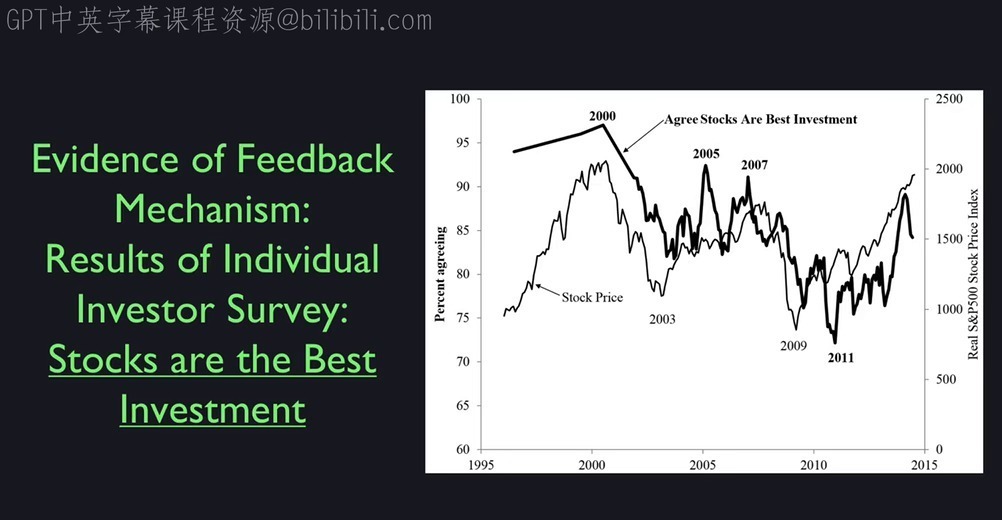
So you can see in the year two, which I have marked up here, something like 95% of these people thought stocks are the best investment. Now there could be a little of a buy. These are people who agreed to fill out my questionnaire. They must have found it interesting, so it may not be completely accurate. But it's certainly an awfully high proportion. I almost don't believe results like this.
It was really into the culture that smart people invest in the stock market. You notice the stock market had been rising for years prior to that. And this is the peak of what I call in the book, the Millennium bubble. This is the new millennium. And then we celebrated the new millennium. It was great. Do you remember it? Probably not very well. And look what the stock market did right after it.
And then look what happened to opinions about stocks are the best investment right after it. came down with it. The stock market bottomed out. So did their... agreement with that. Now, it's not a perfect fit, but I see a strong parallel. This inclines me to value investing. This question didn't ask about, do you think the stock market will go up next year or the next two years?
It's about stocks are the best investment. It's like timeless. So why should opinions about something so timeless be so variable through time, and why are they so influenced by the recent behavior of the market? Well, I think that's human psychology and behavioral economics.
The Gordon Growth Model: Asset Value Comes from Future Cash Flows
So, Professor, hopefully we can go through the idea of the Gordon growth model and kind of how that relates to what we've learned in CAPM. Myron Gordon, a half century ago, merely told what gave a formula for the present value of a growing quantity. Suppose we have an asset, let's call it land, that is, producing revenue for you every year, and the revenue is growing in value.
So it produces X the first year, then it produces X times one plus a growth rate the next year, and then it produces X times one plus the growth rate squared the next year, and then it does that forever. So this is a year. Now it's time zero, and then we have time one, time two, times three, time four, it would be at one plus G cubed, etc. I say this might be land, because land, assuming that it's managed properly and doesn't get depleted, will yield the crop every year.
And as time goes on, the crop will be worth more, partly because demand for, it probably goes up in a growing economy, and partly because of technical progress. And we're going to assume this land goes on growing like this forever. So the question is, what do you pay for this land at times zero? Okay, what is, so Myron Gordon, he's famous for this formula, principally, is that the present value equals x all over r minus g, where r is the rate of discount.
What he's saying is that it equal, the present value is x all over 1 plus r. That's this first term here, plus x times 1 plus g all over 1 plus r squared, plus x times 1 plus g squared over 1 plus r cubed okay and if you calculate, you can show that this infinite sum reduces to this simple formula as long as g is less than r. See if g is less than r, then each term is smaller than the one before it.
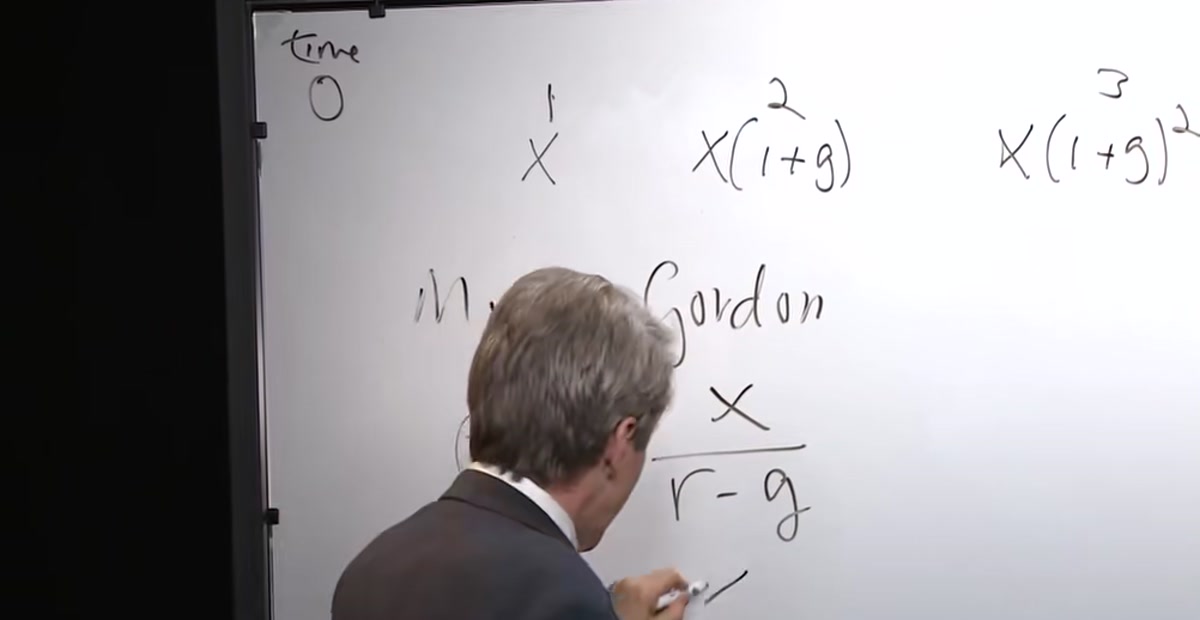
and it sums to a finite number. If g equals r, then every term here is x over 1 plus r, and they're all the same. And so the sum would be infinite. So as long as g is less than r, this is a formula for pricing the value of an asset that actually yields an infinite amount, but in the future. And even not, it's actually growing forever. Actually, G can be negative.
also. It doesn't matter whether it's positive or negative. So that would be like you're losing a some proportion every decay or something? It could be that the land is being depleted. And so the growth rate of the value is negative. So then this becomes r plus something because G is negative. You still have a present value. And this is an important thing to recognize.
that even assets whose payments are running down to zero, there still is a price for them today. That's really important to recognize. So some people think that businesses that are growing are the only ones I should invest in. That's bad investing. You can make a fortune investing in businesses that are declining. You can fill up your portfolio with declining industries. Doesn't matter. It's a question, can you buy them for less than the present value?
And if you're buying them for the less than the present value, it's a good investment. I see. And so here, you know, we, just to clarify, G is given? Yeah, I'm taking that as given. Okay. The growth rate. It might be like 2% a year. Right. And the interest, R might be 5% a year. So the value. So the value, the value, the value. would be x divided by 5% minus 2%, or x divided by 0.03.
And this is a very useful formula because a lot of possible investments have a growth rate. In fact, they usually do. Usually you don't expect the earnings of a company, for example, to stay exactly where they are today. Some companies are expected to grow through time, and some are expected to decline through time. So you end up using this formula. all the time to judge, you look at their earnings today and you think, well, what are the, what is it worth? What is this stream of future earnings worth? And you can plug it into this formula. And so, and are, is that also given or is that that? Oh, now, okay.
Now, I haven't talked about risk in this equation. I was saying the land is going to do that. We just know this for certain. But we don't, in fact, often, we don't know the future with certainty. So there's amount of risk. So if this growth rate is more uncertain than you thought, that should lower the price. Right? So if the asset is riskless, if there's no risk, if we actually know all the future payouts from the asset, R would be the riskless interest rate. But if it's greater, if there is risk, and that would be measured by beta in the capital asset pricing model, then R would be increased reflecting that risk. You still use the same Gordon formula, but you have a higher R. R is no longer
the riskless rate. Okay. And so I also found that to be a very fascinating statement you made that, that even if most people, I think, typically think that if there's an industry that's declining, you know, I don't want to have that in my portfolio. Right. But in this case, we're kind of bringing out the idea that even the stocks of declining industries, those should be in your portfolio if you kind of follow the standard traditional finance.
So I like to bring up the example of railroads. When the first railroads came out, well, it was in the 1830s, but by the 1840s, there was a big bubble in railroad stocks. Lots of people thought, wow, railroads are growing. They were right. Railroads were growing. But people paid too much. Even though they're growing, you can pay more than the present value. So lots of famous people, in the very beginning of the railroad era, lost fortune, even including Charles Darwin, the great biologist. He couldn't figure out present value. He was a smart guy, but he couldn't figure out what the real value of these railroad stocks were.
So, but then as time went on, railroads stopped being glamorous and exciting, and they became old hat. And then we got airplanes and, well, trucks and cars and all these other alternatives to railroads. So railroad stocks then became underpriced relative to this formula. So one of the best investments to make in 1929 was railroads. Already, people were thinking about Charles Lindbergh flew across the Atlantic Ocean.
Everything is moving fast for airlines, and they just got overpriced. The same thing happened in the year 2000. In 2000, that was the peak of the dot-com bubble. Everybody was investing in computer or software or social media style. and because they saw the growth rate but they made a mistake. You have to use this formula. They made a mistake in thinking that they're worth more than they really were and the whole dot-com bubble collapsed. The good thing to invest in, if you could go back in a time machine to 2000, was railroads.
Everyone was ignoring them, but they're still chugging along doing all this work and may not be a declining industry. It wasn't living up to expectations initially in terms of earnings growth, but they made good investments sometimes, and not every time, depending on how the price compares to the present value of their earnings.
Why Companies Pay Dividends: Self-Control, Signaling, and Smoothing
Now this comes back to the funny question that we discussed previously that last period. Almost all the value of the stock inherently is due to the dividends. But firms don't even have to pay dividends and they often go through years and years without paying dividends. The other thing is, and we have to be clear about this, firms can get money to their shareholders in another way besides paying dividends.
You can buy back shares. And firms do that. It's the same thing. We talked about that, right? The dividends are, you could send a letter with your dividend check and say, well, we're really buying back shares. And it wouldn't make any different, except to the IRS who might decide something different about taxation. But there are other reasons why firms pay dividends and Hirsch Sheffern and Meyer Statman described it what they called a self-control theory of dividend.
Now this sounds funny, but there's a lot of people who invest in stocks and have a personal rule of thumb that I will never dip into principle. The modal investor in the stock market in the United States is an 80-year-old woman. Oh, I'm exaggerating, not quite 80 years old, a widow. And sometimes they are following the instructions of their late husband, who said, never dip into principle.
That's for the grandchildren. Never touch it. But if dividends go to zero, she's in trouble. She doesn't have any income. This sounds really silly, but it actually applies even to such institutions as Yale University, who a half century to a century ago, I think was influenced by the same thinking. So we wanted dividend paying stocks, and we didn't want to touch the principle.
That all changed when we got David Swenson to take over and became a more sophisticated investment manager. Another theory why firms, some of the influences their thinking about dividend by Badachara Hackinson and Ross, is that they use dividends to prove to the public that they're really worth something. It's called a signaling theory is a theory that you do something, not for its intrinsic value, but because it proves something about you.
So Michael Spence, who used to be dean at Yale at Harvard College, surprisingly wrote a famous article saying, college educations are largely signaling. This sounds awfully cynical from the dean, but he did say that, that why do you go to college? You want to prove two things. You're smart and you're not mentally ill. And you can actually slog through all this nonsense that you get in college and you make it out four years later.
And so I think there's some truth to this. I hope that's not the only reason you go to college. But you actually have to do, why go through all four, why don't you do a Bill Gates and drop out? You already prove that you could get into Harvard. Why don't you just drop out? Well, you might, if you're an entrepreneur, just drop out because you don't have to prove anything to anyone.
But you want to stay the whole four years because that separates you from the people who are unstable who can't hack the work. So you're proving your work ethic. Well, that's, I'm not saying that's right. That's a signaling theory. Well, it's the same idea that Badacharya, Hackinson, and Ross have that firms are signaling. Life is filled with signaling. You're trying to prove one thing or another by doing something.
And so firms pay dividends just to show there's real money here. We really got it. And if we were on the verge of bankruptcy, we wouldn't do this, obviously, because we would be risking going under. So it's a proof that we're there. We've made it. And I'm sure there's some truth to that. But this kind of signaling does impose taxes. Remember, dividends are subject to immediately.
to immediate income taxes, whereas repurchase of shares will not involve any tax until you sell the thing again, sell the shares again. John Lintner was a professor at Harvard Business School who said that he interviewed a lot of firms about dividends and how they decide. This is unusual in the Efficient Markets era when he was writing. Usually, you never interview anyone.
Just trust to markets, and so no one can tell you why they do things. But he interviewed people who set dividend policy for firms and asked them how they did it. And he found that they set all sorts of things. But he said, you know, in the bottom line is they just gradually adjust dividends toward earnings per share. So they have some target payout ratio. I was assuming above it was.
one. They were paying out all their earnings. But in fact, it's less than one, typically. And so they changed the dividends only slightly, each quarter, reflecting an adjustment towards the target dividend price ratio. So you can see that the tau, the target ratio times EPS, is the dividends they would have with today's earnings per share. And if it's above their previous dividends, they'll raise dividends, but not enough to put it there.
That's because earnings jump around. And another thing they told Lintner, we don't like to cut dividends. We never want to cut them. That's embarrassing. People start calling this up and said, last month, last quarter you sent me a check for this and this. I need the money. Why are you cutting it? And you'd have to tell some story. Well, you know, our earnings weren't as good as we thought.
You don't want to tell a story like that. So when earnings jumped, up, you don't raise your dividends right away, you just lag behind. And that's what the Lintner model says. Just to give you some idea, though, that back in 1968, general public utilities court, which was a utilities company, proposed to substitute stock dividends for cash dividends, and offered to sell the stock dividend to the, stockholder for minimal costs.
and wrote a letter to the shareholder saying this would save them $4 million a year in taxes. He's saying, instead of paying a dividend, we decided to buy back some of your shares. So you now have less shares, but you get the same check. And you're going to get the same checks in the future because everybody's shares went down. He explained all this and they didn't get it.
He was just trying to save them on taxes. But you know what happened? He got death threats. People, you know, they're emotional. Investors are emotional, and somehow they didn't like the sound of this. It sounded immoral. Cash in on principle, you're selling our shares. We don't want to sell our share. We just want the money. And it just lost on them. You know, people don't think about taxes.
Even high-income people who might own shares, which goes to show why I don't really believe in efficient markets. It's somewhat true, but there's a lot of people out there who don't think very much about investing. and it's such a complicated thing to imagine that the market gets it right. Now, on the other hand, efficient markets is still valuable because there's still a lot of smart money.
They just don't completely dominate. There is a lot of smart money that will take advantage of mispricing. But they do it at some risk and it's not a sure thing. And so they hold back a little bit and there's there are mispricing. There are mispricings all over.