Interest Rates, Debt, Banking, and Monetary Policy
A 1982 Savings Account: The Interest-Rate Environment Has Changed
I wanted to start though with just a little bit about the current situation, or the situation in the aftermath of the financial crisis of 2008-2009. And that is, that's not what I'm showing you. This ad here, I found it from 1982. What I'm commenting here is that the current economic situation is rather different from 1982. And one sign of that is you don't see these ads anymore.
I was just thinking, where are the ads for savings accounts? There used to be all the time in newspapers and magazines and TV. So I couldn't remember what they looked like, so I looked it up. I found this ad. This is one of you'd love to see today, but you won't see today. So this is offering a passbook plus account with a 7-5. with a 7.4 per annum interest rate.
Now, so do you even know what a passbook savings account is? They used to, actually I have my passport here, I think. No, I don't. It looks like a passport. You used to walk into banks. Everything has changed so much. You used to walk in and there would be a teller and you would present your passbook and you'd either deposit or withdraw, and they would enter your...
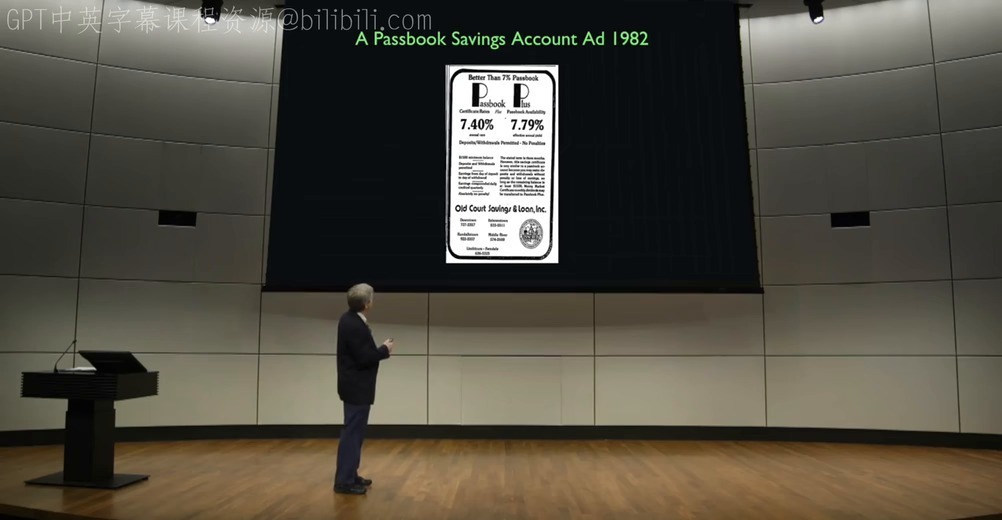
new balance in your passbook. It's like a save, whenever you need money, you go right to the bank and you pull it out. Meanwhile, you're earning 7.4% a year interest on it. So this actually is an ad for somebody's passbook plus savings account, which has a term, it says this in the fine print. Stated term is three months. That means you technically, they might not let you, they might make you wait three, months to get your money out.
However, this is very similar to a passbook account because you make deposits and withdrawals without penalty or loss of earnings. So in this case, though, you have to keep your remaining balance at least $1,500. So here you are. You can go in and out of this account whenever you like. So it's basically an overnight account. You can take it out any day, any hour.
It pays a nice interest rate, and it's a nice interest rate, and it's, insured by the government, so there's absolutely no risk. So this is what you want, right? Well, you're not going to get it because it doesn't exist anymore. Now, the secret is if you want something like this, you're going to have to pay a negative interest rate because it just doesn't pay.
This business just doesn't pay because interest rates at the short end have gotten very low. I'm going to come back to this. We're talking about the term structure. The term of any contract is the time you have to keep your money in it and can't get it out. So this one is technically a three-month term, but they're saying, trust us, you can get it out any time.
So it's basically overnight. Absolutely no penalty for withdrawing, he says. So we are in a situation in which at the short-term interest rates are virtually zero. It's a historic event. And so when I'm going to talk about interest rate, we might wonder why these things are happening.
The Federal Funds Rate: Why Short-Term Rates Can Approach Zero
So this is the federal funds rate. Now, I'm mentioning term. is the time that you have to leave your money in and cannot get it out, at least without a penalty. So this is the shortest-term interest rate in the United States. It's called the federal funds rate, and it's an overnight rate. Now, most of the people who deal in this maturity of one day are banks, because individuals normally don't borrow money overnight.
It's too short an interval. Only people who are very sharp pencils and very professional would borrow money for one day. But it's a lively market largely among bankers. So this is the interest rate on federal funds in the United States from 1954 to the present. So the ad that I showed you was from somewhere around here. I picked a high interest rate time looking for an ad.
Those were different times. Look where we are now. Okay? This is amazing. It's right at zero. And it's been at zero ever since the crisis. Now, it's going to pick up. In fact, it's already picking up. Do you see this little uptick at the end? That was the decision of the government, the U.S. Federal, well, the Federal Reserve, under Janet Yellen, to raise interest rates.
And it got a lot of attention. But I'll have to say, I'm not very impressed by this raise of interest rates because it's virtually zero still. So something funny is going on here, wouldn't you say? If you looked at this whole, if your job was to predict interest rates and you were standing here in, say, 2004, would you have predicted this? Well, absolutely.
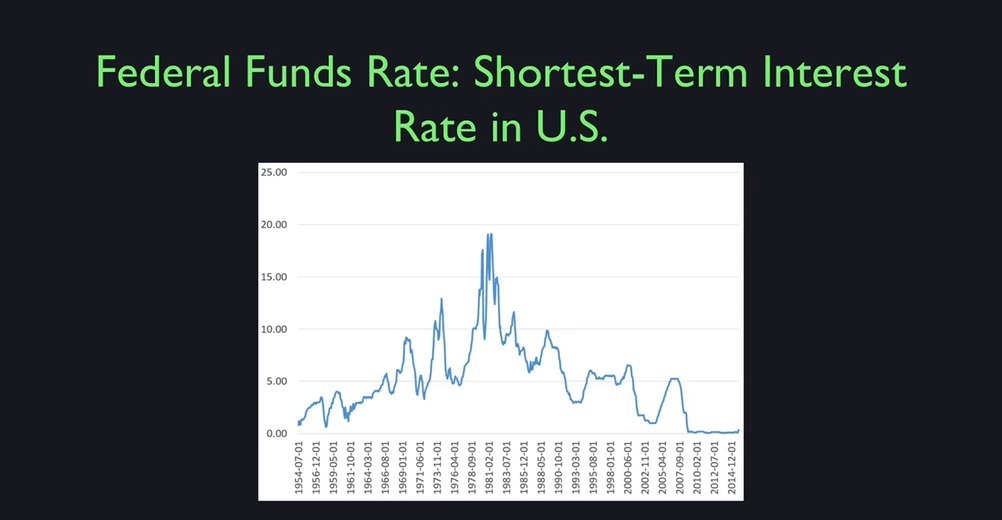
I shouldn't say. There might have been someone who predicted this, but as far as I know, no one saw this coming. So something very strange is happening. It'd be nice to understand this interest rate market. Now, you might first of all say that, well, this is a targeted interest rate. The Federal Reserve announces a federal funds rate target, and they do everything they can't, and they've decided to put it at virtually zero. So you have to understand the Fed. But Maybe you don't have to understand Janet Yellen or Ben Bernanke, because these are the chairs of the Federal Reserve, because anyone would do the same thing.
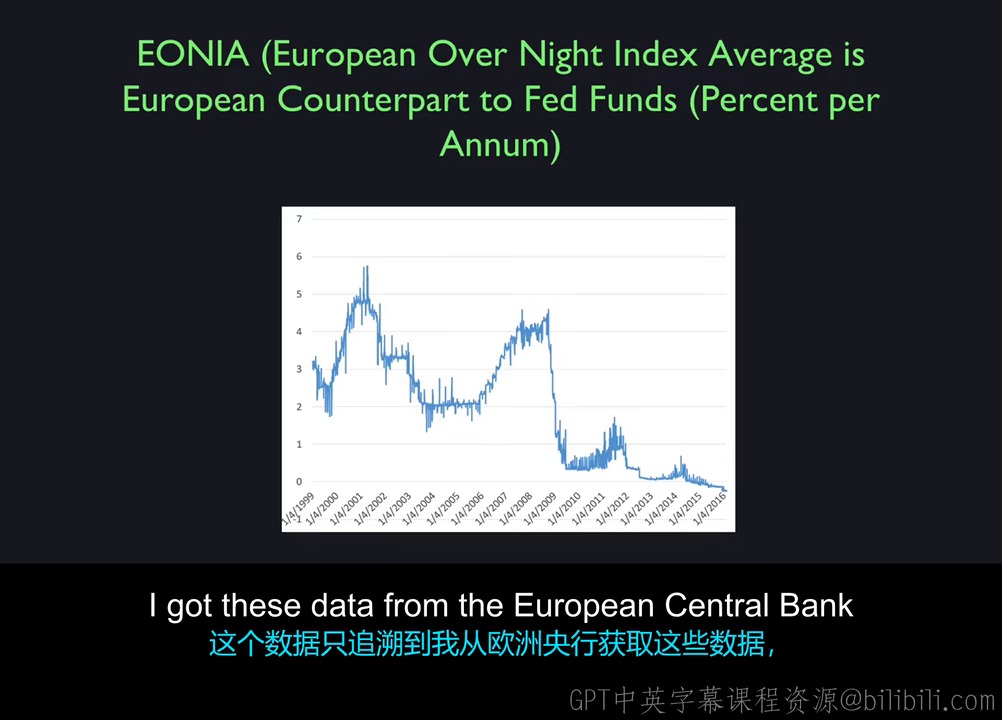
It's an economic crisis that's brought equilibrium, short-term interest rates down to zero. And to give you an idea that it is an economic crisis and it's not the personality of Janet Yellen that accounts for this behavior. Let's look at Europe. So this is the European counterpart to the federal funds rate. It's called EONIA, European overnight index average.
So it's the same thing. Banks in Europe lend to each other overnight. And this is the interest rate. Now this only goes, I got these data from the European Central Bank, and so that's why it only goes back to 1999. But you can see that it has the same downward path since 2000, right? Now it's even more interesting because in the U.S., it's stopped at zero. But hey, it somehow knows no zero bound.
In fact, it's been negative for over a year. And it just seems to be trending down. Is this going to, now, if I asked you to forecast where it will be in 10 years, where will Ionia be in 10 years? would be in 10 years? Well, you might be inclined to forecast, oh, I don't know, minus 3%. Does anyone believe that? Anyone offering a forecast? What do you think it will be?
It can't go too far negative because the banks have the option of just holding on to care. Why should you lend money at a negative interest rate? Well, that's an interesting question. You can blame Mario Draghi. who's head of the European Central Bank, who he and the others at the bank, have lowered the interest rate that they offer to European banks on deposits at the European Central Bank to a negative number.
So you could say it was the decision of the central bank. But still, it seems, why does a bank ever invest money at a negative rate? When they can just pull the money out and hold cash, cash by definition, I mean real cash, paper money, those Euro notes that you have in your pocket, they pay exactly zero interest. So why would a bank lend to another bank at negative?
Does anyone have an idea? Why would they, they are doing that, right? We know they're doing it. Why are they lending to another bank at a negative rate? It's cost. costly to store cash. First of all, if it becomes known that you have large amounts of cash in your vault, thieves might come and steal it. So you'd have to buy insurance against that. And then the insurance company will impose costs on you.
Plus, you have to hire those trucks to drive it. You know, it's not set up. Banks don't hold huge amounts of cash in their vaults. So, yeah, so you've got to hire trucks and armed guards and It sounds, I think also it's just irregular. We don't do this. We don't have billions in our vault. We have to get a bigger vault, maybe. Because they don't, what's the biggest euro note?
It's probably like a hundred, do anyone know? 500. Oh, is it 500? In the United States, it's only $100. So to store a billion dollars, you need a big vault. So you have to buy a new vault. things like that that allow negative interest rates. I think that as they learn, that it's going to be harder to have a negative. So right now it looks like in this latest data shown here, it looks like about minus 30 basis point.
A basis point is a hundredth of a percentage point. So it's minus a third of a percent. So they can get it lower than that for a while anyway. But anyway, it's just trying to understand why did it get so low. So this brings up. to causes of interest rates. There was a famous book written by Orgen von Böhm Bauerwerk in 1884, Capital and Interest, which said interest rates tend to be small positive numbers, like 3% or 5%, because of technical progress, time preferences, and advantages to roundaboutness.
I think he said, he wrote in German, so how do you say roundabout in German. It's not exactly an English word either. I'll let you think about that. It's probably a translation of some long German word. But he said, where did these numbers 3% come from? Why is it 3% or 5%? Well, he said, it's because the rate of progress is something like 3%. Also, so that sounds plausible, right?
The economy is moving forward. So money, one dollar today is really, if you take into account what will happen to the economy, it's really like a dollar, $1.03 in a year. The other thing is time preferences, he said people are just naturally impatient. It's built into our, well, I don't think he said built into our neural structure, but maybe he meant that.
So we just want more to just more So if you're, if a dollar and three cents in a year is equivalent to a dollar today, because I wouldn't, I prefer it now. And so I'll take a cut in what I have to get it now rather than later. And finally, advantages to roundaboutness, that is advantages to more delayed and complicated production process. So, for example, I can talk to, I'll just give you a very homely example.
I can talk to an apple orchard and say, how many apples can you give me today? And so the guy quotes so many bushels of apples. And then you come back and say, that's not enough. I want more apples. And he'll say, hey, you know, our trees only produce so much. But you say, I want more. And then he said, well, okay, what I'll do, instead of giving you a instead of giving you apples now, I will sell my apples, buy fertilizer, and I'll get stronger and bigger trees next year, and I'll have more for you.
But you have, it's more roundabout, right? I'm converting apples into fertilizer, and I'm making the trees bigger. I can get you more next year. That's a roundabout production process. And so there's an advantage to that. So all three of those were causes of interest. Do you think that? low interest rates are contributing to inequality? There's definitely some connection because a lot of elderly people retire on fixed incomes.
And if they have a rule that they will only consume the interest, and the interest is zero, they're in big trouble. And that is unfortunately the situation. It's unfortunate that our efforts that policy can't help everybody. So monetary policy is a very blunt tool. You may feel that you have to cut interest rates to help the economy move ahead, but it doesn't affect everyone the same.
And that, anytime it doesn't, that has a potential to raise inequality.
Compound Interest: Interest Earns Interest
Now I wanted to give you a lesson, which I somehow have the impression you learned in high school. Did you learn a compound interest? It's supposed to be such a basic math point, but let me just reiterate it. Suppose there's an annual rate of interest are, and suppose that you're putting your money in a savings account in a bank that promises to compound once per year.
What does that mean? That means that your interest is applied to the account once a year and you start earning interest on your interest at the end of the year. So if I put $100 into an account paying 3%, compounding once a year, and I go to the bank after six months and I say, I'd like to cash out of my account, what's it worth? They would say $100 because we haven't credited your annual interest yet. So then you go, if you wait a full year, you can come back to the bank and now you get $103.
Now your account is marked up for compounding. If you go back to the bank in 18 months since you deposited it and you ask for your money, they'd say, well, now you have $103 because we haven't credited your new interest for this year. You have to wait two years. And after two years, how much do you have? $1.03 times $1.03. It's a little over $1.6 if you have annual compounding.
Now the banks often compound more often than once a year. So suppose they compound twice per year. You put in $100 in a 3% account compounding twice per year. You would get, if you would, if you would, if you would, went to get your money out in the first six months, you would still just get $100 back. After six months, you'd get $101.50. If you went back after nine months, you'd get $101.50.
You'd have to wait two years. No, one full year. Did I say that right? Yeah. You have to wait a full year, and then you would get 1.015 squared times $100. You see where we're going on this. If it's compounded twice per year, the balance is 1 plus r over 2 times 2t after T years, where t is any number, which is either an integer or an integer plus a half. In between, it's a step function.
And if it's compounded n times the year, the balance is 1 plus r over n to the nt period. Now if you take the limit of this expression, as n goes to infinity, you get what's called continuous compounding, and then the balance is E to the RT, where E is the natural number. So if they continuously compound, it improves your interest payments a little bit more.
But unless R is really big, it's not, or T is really, It's not a huge difference.
Discount Bonds: Converting Future Money into Present Money
Now I want to define a discount bond. Bonds typically pay coupons. This is an old word, but they still say coupons. It used to be that if you invested in a corporate bond or a government bond, it would be on a piece of paper they would give you. This is like for hundreds of years. And around the exterior of the pieces of paper were little coupons that you would clip every six months typically.
And you would clip your coupons every six months and take them to a bank, and the bank would then give you the money. So each coupon would be so much money. And then at the end of the maturity of the bond, you could take the whole thing back, and you get your amount back. So a typical bond back then would say sell for, back then, I mean in 1900 and 1800, and 1700, going way back, if you bought a $100 bond and it was issued for $100 and had, say, a $3 coupon, then you would pay $100, you'd wait $100, you'd wait six months, you'd clip a coupon, and it would say, pay to the bear $1.50, you'd go to the bank and get your $1.50.
And you can see some of these bonds. they're framed and on display, ones that defaulted. Otherwise, the coupons would be already clipped and gone. You can see them, I think they're on display up on the fourth floor of this building. But a discount bond is a bond that carries no coupon. Now, why would you buy a bond that carries no coupon? Because how do you get interest from it?
This is also a bond. time immemorial, people have traded discount bonds for a long time, and the answer is, because you buy it for less than $100, you buy it at a discount. So there tend to be two different kinds of bonds. The coupon bonds, which are more common, tend to be sold at par. You buy it initially for $100, and you sell it for $100, you get it back at the end when it mature, after so many predefined years.
With a discount bond, there are no coupons, but a of course you buy it at a discount. There'd be no other reason to buy it unless it was, well, maybe today they're selling not at a discount with our negative interest rates, but normally they're sold at a discount. We still call them discount bonds even if there's a negative interest rate, then they're selling for more than $100 initially.
So if we look at the price of the discount bond, we can infer the yield to maturity from that bond. So if someone says, I have a bond that will pay, well, let's say $1 in T years, then I'm in, and it's compounding once a year, then I would say, and the price I want is P, I can compute using this formula what the yield to maturity is. So I would basically take one over P, solving this, equation. I take 1 over P to the 1 over T power, and that's the yield to maturity.
It's in a sense paying an interest rate of R every year, compounding once a year, if I call it that. But typically bonds pay interest rate every six months. That's the tradition. So you might use this formula instead, which has the bond compounding twice a year. If T is the number of years to maturity and P is the price, then we will take P as the present value of the principle, which I have as $1 here, divided by 1 plus R over 2 to the 2T.
So this is called, the price today of the bond is called the present value, if it's a $1 principle of $1 at time capital T. And as a general rule, P is going to be less than one. I say as a general rule, because it might be not hold right now, which is a little puzzling. But over most of history, it's a discount. P is less than one. So is that clear? Any questions about that?
You have to specify the compounding interval. But normally, for pedagogical purposes, it's convenient to take the compounding as once a year. And we just use this formula. By the way, you could do it continuously, too. You could say, what is this? the continuously compounded yield to maturity. And that you would have p equals E to the minus r times capital T.
Okay. Now we can define the present discounted value of any cash flow, not just a coupon flow, which would be the case for a coupon bond, or the principle after T years for a discount bond. Because we know that implicit in market prices for discount bonds, we can calculate the present discounted value of a dollar in any number of years. So what is a dollar one year today?
What is the present discounted value of that? It's 1 over 1 plus R, where R is the yield to maturity on a one year discount bond. And what is the present discounted value of a dollar in n years? It's 1 over 1 plus r to the nth power. Now this is obvious to a banker who always thinks, when you talk money with a banker and you talk about money in future years, there's a little calculator going in his head.
He has memorized the prices of all these discount bonds going out and he's translating it into present value. or present discounted value PDV. Amateurs mess this up and so they become vulnerable to fishes. Lots of people make mistakes. Maybe you should develop the habit of always computing the present discounted value. On the other hand, you live at a very good time for ignoring this because right now interest rates are virtually zero.
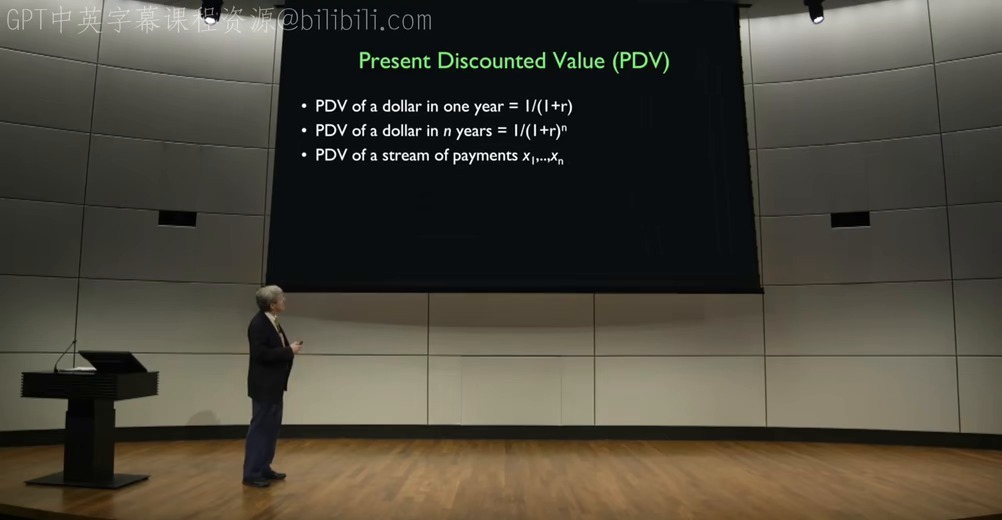
So, but it will come back. I think, Nick, you are right. We're going to have two points. and higher interest rates at some date in the future. I just don't know when. If you have a cash flow, x sub t, so x sub 1 is the money coming in in one year, x sub 2 is the money coming in in two years, and let's assume that the discount rate is the same for all these different maturities, this is a simplification, then the present discounted value of the cash flow is the summation t equals 1 to capital T.
of the cash flow, x of t, divided by 1 plus r to the t. That's one of the most famous formulas in finance. So now let's look at a conventional coupon varying bond, which is issued at par. Now, how do they issue them at par, by the way? It's tradition to issue at par because you're getting your interest in the form of coupons. What they have to do is judge the market.
What coupon is the market, if I want to issue at par, what coupon is the market demanding on $100? And once I know that, I'll just pick that coupon and I can be pretty sure that my bond will be picked up for $100 because I've got the market coupon. So I'm going to use C for the amount of coupon. Now this is measured in currency. If we're dealing in dollars, C is so many dollars, and the price is in so many dollars.
And what it is now, I have two versions. This is compounded annually, and this is the more realistic compounded every six months. Where T measures years. So what you get in this simple case, when you buy a coupon bond, is you get after one year, this is the annual compounding, after one year, So one year I can clip a coupon for R, dollars, not R, for C dollars.
And then I have to wait another year, and then I can clip a coupon for C dollars again, and clip another coupon in three years for C dollars. What's the present value of, and then at the end, I get my last coupon of C dollars plus the principal, which is a hundred. So I get a hundred plus C. dollars at the end. What is the present value of that if it's discounted at rate R?
It turns out that's the formula for the present value. Now it's interesting to take the limit of this as T goes to infinity. If T goes to infinity, this term goes to zero, right? And this term goes to zero. So we're left with C times 1 over R. So that's the console. I think I have another slide for that. This is the more complicated formula for six-month compounding.
This formula was sufficiently difficult that in the old days, and people didn't have calculators, bankers would carry around a table, a bond yield table. Also, you can't solve this back. If you want to, if you want to, if, I'm told the price of a bond, I want to compute the yield to maturity R, I've got to solve this equation for R. And you can't. It's not algebraically possible, unless T is very small.
So you need a book. But now it's probably already on your mobile phone. I think it is. I know it is. You can get this on your, go to Wolf from Alpha on your mobile phone. There must be other places. There must be hundreds of places. that will solve this equation for you. Because it's standard, so many people think in terms of present values, and they want to know what the yield to maturity, what's the interest rate on a bond given its price.
Consols, Growing Perpetuities, and Ordinary Annuities
So I already mentioned a console is one that pays the quantity. Well, I was saying C or whatever, X forever. And the console present discounted value is X over, or coupon over R. So it's kind of obvious in the case of a, oh, why do we call them consoles, by the way? Because in Britain, in the 1700s, the government of the United Kingdom issued bonds with no maturity date.
they promised to pay this coupon forever. And the only way they could get out of it was by buying them back. And those bonds, well, there were some adjustments made in the 1880s, they're still paying the coupon. The British government hasn't defaulted in all that time. And so it's not forever, but it's close to forever. I mean, several hundred years. It's a long time to be paying a coupon.
Now, it's simple to understand the console present that says the price of the console, is equal to C over R. You can just return that, turn it around, and it says the yield to maturity on a council is C over P. And that's kind of obvious, right? What interest, if the council is paying a three-pound coupon and it's selling for $200, pounds, I say, what is the yield to maturity on it?
Well, it's 3 pounds divided by 200 pounds. In that case, it would be, if it was 3% yield to maturity, I'm sorry, if it was a 3% coupon at issue, it's now paying 1.5% yield to maturity because the price has gone up. And this is an important point with bonds. The coupon is fixed at the time the bond is issued, but the market price of the bond changes through time.
So if the British government issued a 3-pound console for 100 pounds, and that console is selling for 200 pounds today, the yield to maturity is down to 1.5% instead of 3%. But this is no fault of the British government. They're true to their word. They're paying the console as promised. It's the market that does it. So bonds are risky. They have market risk, even if there's no default risk.
If you buy a console, you know you won't live forever. The British government may live forever, but you won't. So you're going to want to sell the coupon at some point. The British government does not guarantee the rate that you will get, the price you'll get for selling your console. So there's market risk for a console, and for any debt instrument, long-term debt instrument.
By the way, if a bank or a company or a government were to issue a Usually companies don't issue consoles because nobody believes they'll last forever. Patriots in Britain might believe that the British government will last forever, although I can tell you it won't. Not forever. Nothing is forever. But they imagine it's forever, so they're willing to buy British consoles.
But what if the British government did something even more dramatic? They say, we're going to have the coupon on the console growing at a constant rate. So it's going to start out at three pounds, and then it's going to grow at a rate G per year, G is a percent of growth per year, forever. Well, what is the present value of an amount X if the rate is the yield to maturity or interest rate is R, and the X is going to grow at rate Well, it turns out the growing console present this kind of value is X over R minus G.
So by the way, what happens if G is greater than R? Or G equals R? Any idea on that? Well, I think you probably can figure this out. If G equals R, it's X divided by zero, it's infinite. That's because it's the series that you're summing is not convergent. If you're getting an amount that's growing at the rate of interest, the present value is infinite. And if it's growing at greater than the rate of interest, well, the formula breaks down. It's still infinite. So that's why we get puzzled about the present situation. If the interest rate is zero, then consoles don't even converge? How can that be? Doesn't the interest rate always have to be above the growth rate? How can anything, nothing can have an infinite price? Well, I guess the answer
is short-term interest rates are zero, but longer-term interest rates are still positive. So, and we don't have many, the U.S. doesn't have consoles, but we have something analogous to consoles, like land, for example. That lasts forever, as far as we know. It pays, you know, you can rent it out, or you can plant crops on it, as far as we know, forever. Maybe those crop, what about land? Aren't crop values rising through time?
So that G is a positive number. And if interest rates are, they can't be zero. They have to be, long rates have to be above zero. Otherwise, assets that have growing payments would be worth an infinite amount. Now, this is an annuity present discount. Now, an annuity is like a console, except that it stops after a certain number of years. In a typical annuity, a typical annuity is a home mortgage. When you buy a house, the typical financing you'll get is that you will pay, now the compounding interval is monthly. They think it's not realistic to ask ordinary people to pay their mortgage every six months.
because it's too hard for them they'd have to they wouldn't remember to save and they wouldn't have enough money to pay it after six months so we got to move to a monthly schedule for individuals so a typical that's not this is not compounding monthly but this is the present value of X dollars every year starting in one year and then again in two years then again in three years then again in three years and the last payment is T years. This is different from the present value for a corporate bond or for a coupon-carrying bond because there's no principal repayment at the end. I'm talking about, I think I have another slide on mortgages. I'll come back to that. But I'll tell you, realistically, these financial instruments are designed
around human imperfections. People find it difficult to pay back a mortgage. And what they'll find especially difficult is to pay a balloon payment at the end. I call it a balloon payment. There used to be mortgages like this. You would borrow to buy your house, you'd pay, say, and going back to the 1920s. The house costs $10,000, typical house in the 1920s. You borrowed $9,000. You've got your own money to put up.
The $9,000, then you pay back the money at a rate interest. But at the end, you don't owe anything except the last monthly payment. So that's what an annuity is. This is a little history of thought. The growing console formula has been called the Gordon Rule, according to Myron Gordon, who is a professor of economic about a half century ago. But actually, it goes back to Jacob Bernoulli.
I learned that from Will Getsman and his co-author, Gert Rohnhurst here. So it's an old formula.
Forward Rates: Locking In Next Year's Interest Rate Today
Forward rates are interest rates that can be taken in advance using the term structure. I was writing an article about the term structure of interest rates, and I was wondering who invented the concept of forward rates. And I couldn't figure it out. It's hard to find the first, especially back when I was writing when we didn't have the internet. I asked a graduate student, can you find out who invented the concept of forward rate?
I think it's Sir John Hicks. So my graduate student went to the library, the way we used to do these things, and tried to find out. Then he came back to me and he said, you know, Sir John Hicks is still alive, you could ask him. So I thought, I never thought of that. Is he still alive? This was back, I don't know, like 1980 or something. So I thought, all right, I'll find his address, and I'll mail him a letter.
So I typed a letter to him saying, did you invent the concept? of forward rates. And I waited about six months, and then I get a letter back, handwritten, with shaky handwriting, and Sir John Hicks said, interesting question, did I invent that concept? He had shaky hand, he said, I apologize, my health is not good anymore, but I thought I would answer your question.
So he went back and he said, well, I thought it was in a, my wife and I did a translation around 1920 of a book. by a Swedish economist, and I thought it was there, but I went, and it's not there. And then he says, he reminisced about conversations he had at Coffee Hour at the London School of Economics in the 1920s. And he said, well, maybe we, somebody brought this up, but I don't know.
Maybe I did invent it. So I put my example here at the Coffee Hour at the London School of Economics. The year is 1925. This assumes that he got it from some verbal conversation. But nobody knows. He's long gone now. We can't ask him again. So here we are sitting at the London School of Economics in 1925. And somebody is saying, you know, I'm wondering what interest rates I could invest money at in 1926. That's next year. Remember, you've got to put yourself back in a time machine here.
So the year is 1925. And you want to, invest the money between 1926 and 1927. And he's saying, I just wonder what interest rate I can get in 1926. That's a year in the future. Then apparently somebody, maybe it was Sir John Hicks at the coffee hour, said, that's a dumb question. Maybe he wasn't so rude. He said, I can get it today. I can lock it in today. And this is 1925, but there's already an interest rate between 1926 and 1927.
So we'll call that the forward rate. But that term hadn't been invented. It's amazing how simple concepts don't seem to be known until somebody points them out aggressively. So this is the coffee hour conversation as I'm reconstructing it. This is how you do it. How do I lock in an interest rate as an investor from 1926 to 1927? I buy in 1925 this number of two period discount bonds maturing at 100 pounds in 1927.
They're two-year bonds, okay? The cost, okay, so I'm buying this number of them. So if I'm buying this number of them, the cost to me is 1 pound over 1 plus R1. And then I have to short in 1925 one period discount bond, maturing at $100 in 1926. So I receive 1 over 1 plus R1 pounds. Now think about it. I have locked in an interest rate equal, we call it 1 plus F, which is equal to 1 plus this two period yield to maturity squared all over 1 plus the 1 period yield to maturity.
And I've locked it in. So this was kind of a show stopper at the coffee hour at the LSC in 1925. This guy thought he was. is answering an unanswerable question. And here it is. So you can pick up today's copy of the London Times, and these prices of discount bonds will be listed. I can tell you exactly what the market today is quoting for the 1926 to 1927 investment.
So is that clear? It's a little tricky. I guess nobody thought to talk in those terms until then.
Inflation: Nominal Interest Is Not a Real Purchasing-Power Return
I was doing the introduction for the John Bates-Clark Medal at the American Economic Association. And I was telling our own members at the AEA, what did John Bates-Clark do, that is most distinctive? In 1895, he wrote a journal article defining what he called the real interest rate. What it is, is the interest rate corrected for inflation. Now, I did a search to see if anyone knew of real interest rate, before 1895, and I got hits in 1894 and 1893, but nothing before that.
So I think it was John Bates-Clark who invented the idea. It's just amazing to me that people didn't understand forward rates, they didn't understand real rates. To me, they seem like just such natural concepts. So the nominal interest rate, what we've been talking about now, is quoted in currency, dollars, pounds, renmin, v, whatever. but it's not corrected for inflation.
And as you know, when you have inflation, the value of the currency declines. The real rate is quoted in terms of the market basket that underlies the consumer price index. So just in simple terms, if you are investing money at 3% for next year and the inflation rate, consumer price index, is going up at 3%, What is your real rate? How much are you making in real terms?
Well, it's kind of obvious. It's zero, right? If I have $3 more on my $100 investment, but everything that I want to buy has gone up by 3%, then I have the same buying power, so I didn't get anything. So the simple way of describing is usually the real rate, this is simplified, the real rate equals the nominal rate minus the rate of inflation. But actually the formula is more like this.
One plus the nominal rate or money rate equals one plus, the real rate, times one plus the rate of inflation. This is an approximation. If you multiply this through, you'll see that it's missing the cross-product term, the product of our money times I, which is close to zero. Another one, Another really important invention in history is the invention of index bonds, which are bonds that pay coupons defined in real terms and a principle, or one of the other, in real terms.
In 1780, I'm attributing this idea to Paul Revere, but I don't know, it probably wasn't his idea, but he engraved the bonds, the first issue of an index bond. I bought one, under Will Getsman's influence, I discovered I could buy one of these bonds. It only cost me $1,000. I have it up, and it's framed in my office, if you want to come back and see it. Engraved by Paul Revere, that's pretty neat.
But what's even neater about it was it was a clever idea. Let's issue bonds whose coupons are just tied to the inflation rate, so that you know in real terms what you're getting. The U.S. Treasury did not follow up on Massachusetts. until 1997. So that's 217-year lag between the first issue of index bonds in the United States and the second. Well, there might have been some minor issues somewhere in between, but basically that's what happened.
So they were called tips. There still are Treasury Inflation Protection Security. They were issued in 1997. By 2006, they were 7% of the national debt. I should update this. They went up. more by 2010 or so. I think they're down now. But they're still big. In the UK, they call them index-linked guilds. They're bigger in the UK. By 2006, they were 25% of the UK national debt. And France and other countries have been issuing them. They're still a little controversial, but they make great sense to me.
Leverage and Debt Deflation: How Debt Amplifies Economic Fluctuations
If a company or an individual borrows money to buy assets, we say that person is leveraging, or a company is leveraging. means you're putting more money into the asset than you have. You could buy, if you have $100 to invest, you could buy $100 of stocks, or you could buy $200 of stocks and borrow $100. That makes you at a riskier situation, but also both up and down.
So if you bought $100 worth of stocks and you're lucky and it doubles in value to $200, you've made $100. But if you leveraged and the stock doubles in value, your portfolio goes from $200 to $400 to $400 minus $100, or $300. So you double your profits. But on the first of the market. On the other side of it is if the stock falls in value, suppose you bought it unleveraged, you bought $100 worth of stock and it falls in value by 50%, then you're down to $50.
You've lost $50. But if you leveraged and you bought $200 worth of stock and borrowed $100, then if it falls by 50%, you're wiped out. So leveraging increases risks. People look at how leveraged economies. are and wonder about the chaos that might ensue in a market correction. For example, China is widely described as a highly leveraged country. It's gotten worse after the financial crisis.
There was a Wall Street Journal article just the other day pointing out that corporate debt borrowing by corporations in China is 100%. 160% of GDP in China, whereas in the U.S., it's only 70%. So that means the Chinese economy is leveraged, and it could do very well as a leveraged economy, but it's more vulnerable, and this is a concern. So debt leads to bankruptcy.
If you have no debt, you normally don't go bankrupt, because bankruptcy, because bankruptcy occurs when your creditors are after you for non-payment. And normally, you would just pay them if you had the money. It's just when you don't have the money that you are in trouble. Now, I think a very important, I keep coming back to Irving Fisher. As I say, I'm a little bit biased because he's a Yale person.
But I never even met the guy, and I don't know if I would like him. He's kind of a quirky guy. He would invite students over for dinner at his house. And he would tell them at dinner, you have to chew each bite a hundred times before you swallow because he thought that was health. Anyone do that? Anyone, be careful to chew your food well? So it must have been a little bit odd at having dinner with Irving Fisher.
So, but he was a brilliant economist. And he wrote an article in 1933 in econometrist in econometrica called the debt deflation model of great depressions. In 1933, prices were falling at a rapid rate because of the depression. We had huge deflation. And he thought, you know, maybe that's why we're having the depression. And here's his train of thought, as he described it there. Normally, people who borrow money are the optimists, right?
They're borrowing, they're leveraging, they think the stock market will go up or some other market will go up and they want to get it. And they're willing to take risks. So you have the risk-taking optimists on one side. And then you have the naysayers, the people who are pessimistic and risk-averse and they don't want to take chances as the lenders. So what happens when there's a huge deflation and prices, consumer price index goes down. Well, that magnifies the real value of the debt, right? If the consumer price index, if you owe $100 and the consumer price index falls by 25%, your debt has gone up to, what, 133? It's gone up a lot. So what ends up happening in a deflation is that the debtors
get beaten down. The optimists have less wealth in real terms. And the pessimists have more, because now the $100 that they loan is worth a lot more. So we thought, this has to be important. You know that people are different. Some people are natural optimists and some people are just, not necessarily that they're just pessimistic, but they just don't want to get into that.
They don't want to, they're not entrepreneurial, they're not. I don't mean that. and that disparagingly, they're just a different personality. Maybe they're artistic or something else. But then in a depression, wealth gets distributed toward them. So in a weighted sense, like they get more votes now. So you've now rewarded the pessimists, and the world is being run by the pessimists.
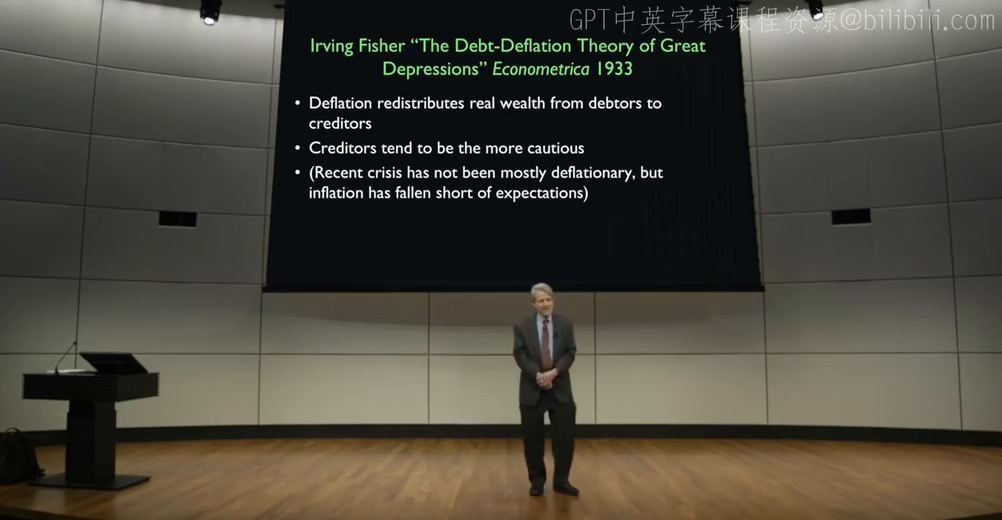
So no wonder we're in a depression in 1933. Now the recent crisis, that is of 2008-9, it's not quite so recent anymore, but it's still with us did not bring much deflation, not like 1933. But what it did do is it produced lower consumer prices than people expected because inflation often practically disappeared. And there was some deflation at times. So that means that relative to expectations, wealth had been redistributed from those who borrowed money to those who lent money.
So it's still true, and it may be an important factor to consider. This brings up a question that I've already alluded to. Why aren't debt, why isn't debt index to inflation? Well, it isn't. This is a puzzling thing about human nature. People just don't get it. And it happens again and again that we have major shifts in the price level, and it redistributes debt, value between debtors and creditors.
People just don't get it. I think they're afraid of index numbers. It's calculations. The consumer price index is some calculation. Or you want my debt to be tied to a formula. So anyway, I've already alluded to the fact that I think we should create an indexed unit of account like they have in Chile or Mexico or some other countries. So that would be easier for people to contemplate but they don't. This is the real world.
So any time we see unexpected behavior of consumer prices, it has real effects on the economy. John Acopoulos here at Yale has written a number of papers on what he calls the leverage cycle. And pointing out that leverage has varied quite a bit through time. Notably, recently, in the industry, United States, in just before the, like in 2006, just before the financial crisis, leverage became extremely high, particularly in the housing market.
Banks were allowing people to borrow, typically something like 97% of the value of the house to borrow a house. So this leverage, you think anyone who takes a risky investment and borrows 97% of the money, that's really a daring thing to do. But everyone was doing that. Anyone who was in that stage of the life cycle where you would buy a house, it's funny how people value, you know, I don't think that people are consistent at all in their thinking about risk.
A view developed in 2006 that the housing prices are going up, I'd say before 2006, housing prices are going up so fast you can make a lot of money by, In fact, you could make a huge amount of money, percentage-wise, by just buying a house. If you bought a house in 2000, home prices went up, well, I don't know, I should have this memorized, but let's say they went up 50% after that.
You make 50% on your investment, it's pretty good. But if you borrow 97% of the money, it's just astronomical what you could make. People got into, they got excited about leverage because they also had the perception that home prices don't fall. I know this was out there. People had this idea. Why do they think home prices don't fall? There's some law of economics?
House prices never fall. Well, we know the law is wrong because in 1933, they were falling rapidly. And so I guess that's beyond people's memories. So people got kind of an optimistic bias in the, or just before the financial crisis. And the economy leveraged itself up. It isn't the government that, the government, if anything, was leaning against that with regulations.
So, anyway, so that's the end of my thoughts. So is debt immoral? I tend not to think of it at all as immoral. We talked about the Irving Fisher diagram, how the ability to borrow and lend raises utility. Think of it at various times in life. You need. money. The extreme case is you need money for illness. You're sick. You're going to die. You need expensive treatment.
And then you live. Of course you borrow the money. So lenders are not evil. Even if they lend, we talked about this letter, even if they lend for your honeymoon, for a vacation, that's not evil either. You may know psychologically your fiancé needs that. You want the marriage to succeed. and there's just something you have to do. It's not crazy. It's not self-indulgent.
So I think debt is a good thing, but it's not always well managed.
Excess Reserves: Why Banks May Hold Money Instead of Lending
There have been, in history, many banking crises where banks are subjected to a run. Depositors lose faith in the bank, and the bank runs out of money. During a bank run, everybody goes to the bank and demands their money at the same time. And banks can't handle this. So government regulators long ago imposed in the United States and in other countries reserve requirements that banks have to keep a certain amount of cash on reserve to meet any sudden increase in demand from their depositors.
And so the government then put a requirement that was binding. Banks would hold some reserves anyway because they recognize the risk. But the government in the United States put reserve requirements high enough that banks were forced to hold more than they wanted. Excess reserves are the reserves that banks hold beyond what they're required to hold by regulation.
And it's an interesting chart. They never did hold any excess. Well, actually, you can't see it. But there was a little blip. But basically, when you make a regulation, it's either binding or it's not. If it's binding, that means they don't want to hold that much. Why don't they want to hold excess reserves? Well, because they didn't pay any interest. And so you can, banks like to lend out the money so they didn't want to.
But then, suddenly they started holding excess reserves. And why is that? Very simple explanation. You see this gray shaded area that represents the recession. In fact, this is the great recession. These are a minor, relatively minor recession. This is the big one. And it was so bad that. in many countries all over the world, central banks cut interest rates as far as they could, and that was zero, in order to stimulate the economy.
So the problem is, now banks don't care. They can only invest at zero. And putting it under your mattress. Yeah, the banks have no place to go with this money. So they think, well, we'll just leave it in reserves. we don't care. So we're holding much more reserve than the central bank requires. And you can really see it. They were holding, this is in millions of dollars.
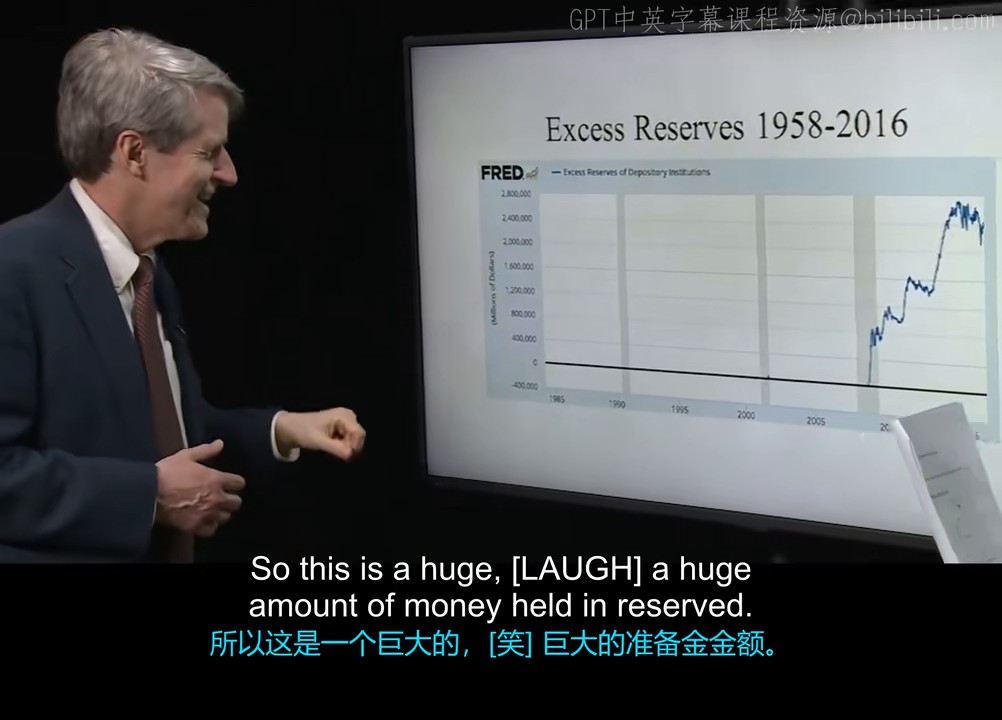
So this is a huge amount of money held in reserves. And it has just keep going up. It's really remarkable that there's so much cash just lying around, now not being lent out. and interest rates are, well, they've come up a little bit. This chart ends. But they're so close to zero anyway that banks don't see lending opportunities that appeal to them. Also, regulation has made it harder for them to make risky loans.
So this is the source of our concerns about what's called secular stagnation. That there's something different. about now compared to any other time, going back decades, what's different is there's just no place to invest. You wouldn't leave money lying around earning zero interest. These are professional finance people running banks. They're letting it just lie there earning nothing.
So it's a sign of some kind of fundamental weakness in the world economy that came on with the financial crisis. Moral hazard and adverse selection are fundamental issues. Let's put it in the context of fire insurance. If you open up a company that insures homes against burning down, you run two risks. One of them is moral hazard. That's the risk that one of your, you sold a policy to someone who owns a house to insure to ensure that house against fire, then the person deliberately burns the house down in order to collect.
That's a real problem. Now, you might be able to prove that it was arson, but maybe not. Maybe the guy can make it look real, normal. So the protection against that kind of moral hazard is don't lend the, don't ensure the full value of the house. Make it always in the interest of the home buyer to sell the house. rather than burn it down. The other thing is adverse selection.
If you're doing fire insurance, even if people are moral and ethical and they won't play tricks on you, it could be that people might know that their house is not fireproof, that their house is in danger of burning down. So all the people will flock to you who have homes that are in danger of burning down. And so you will get a selected part of the potential insurance market, the worst, it's always the worst for you.
So what do you do about that? You have to carefully examine the kinds of properties and you get a fire expert to look and see whether this house is different from others. And you have to then maybe add a little bit more to the premium than you would normally charge because you're worried about the adverse selection. Now, how can I relate it to this? Now, some people will say when I look at this, that all this money is sitting in the bank's reserves, not earning any interest.
But then I say, I look around, I can see interest rates that are higher than that, are higher than zero, well above zero. Like, for example, so-called junk bonds, they might pay an interest of $10. percent even now. So what's going on here? Well, this could be considered adverse selection. If you go to the, at this time in history, when interest rates are practically zero, and you go out and say, no, I'm going to invest in high interest rate loans, you might be suffering an adverse selection problem. You might be suffering the problem that some of these borrowers are going to burn their house down or their, or they're very subject to fires or disasters.
And so you will always see what look like investment opportunities. But to professional bankers, they're not opportunities. You could, as a bank, or you could advertise, you know, we're making loans at a good interest rate. Who's going to come to you? If business is bad, it's going to be these, I'd hate to say it, losers, people who are not good prospects. So the banks then, because of fear of adverse selection having gotten worse, when nobody else is lending, you think, am I going to be the guy who goes out there and makes these loans?
Not now. I'm going to wait, too. And so in both of these cases, there's kind of either an asymmetry of information or the inability to monitor, let's say, the homeowner when you're insuring them. So in the same lecture, you'd also mention a very key point that the institution of banking is, in some ways, helps to mitigate these frictions. And so I was wondering if you could kind of talk about that a little.
Any business in insurance or banking or finance more generally has to be. worry about adverse selection, moral hazard, and they have to worry about they're being manipulated or deceived. So what you need is a business that invest in information and invest in relationships, trusting relationships. So a bank, a well-run bank will have local offices in every city. The local banker then gets involved.
with people in that city. He or she plays golf with them. Here's the gossip. Gets to know important people in that regional economy. And then when someone comes for a loan, you can call up your friend and say, what do you think of this guy? And then you develop a relationship with the borrower as well. You know, you have coffee with him. You say hi when you meet him on the street.
And you can judge the expression on his face. whether he's doing well or not. And bankers then use their gut intuition and their information to decide whether to make loans, whether to take risks.