Financial Regulation
Regulation Overview: Why Competition Can Produce a Cheating Equilibrium
So today I wanted to talk about crises, misbehavior, and regulation. It's a huge topic, financial regulation. So I wrote a book with George Akronoff called Fishing for Fools. We're using the word fishing more generally than it's usually to me, any manipulation or deception. And we coined a new word, fool. Well, actually, it's already a Hindi word, and it's used in India, English, to mean a flower, I guess, or somebody's name.
But for us, fool with a pH is somebody who doesn't appreciate how much he or she is being manipulated. And most people are fools that we want to open their eyes to manipulation. So regulation is substantially aimed at dealing with human problems and with manipulation and deception. We just talked about it, for example, with the mortgage regulation, which is intensive.
It has to be detailed because there's so much involved and so many people playing games. They're not all playing games. One theme of our book here is that it's not that people are bad. It's that people are constrained by the market. If everybody else is doing something, you have to do it too, or you won't stay in business. If there's some manipulation that works.
So, for example, when you go to the store, this is a trivial example, you go to the store and look at prices. you'll see something priced at $9.99. Now you think, wait a minute, why don't they just round that to $10? Well, you know why they don't. There's a psychological tendency to just look at the first digit or to count how many digits in the price. You don't want to add another digit and go from $9 to $10.
You're playing a trick. It's fishing, as we define it. And why do you do this? because everyone else's doing it. And in a competitive market with narrow profit margins, you can't escape it. You've got to do it, too. I remember in my own company, Alan Weiss called me one night, Kay Shiller Weiss, and he said, what should we price our online mortgage service? We had an online, I think we were the first to give, I'm sorry, we gave price estimates for individual homes.
You'd type in your address, and then we would give you an estimated value instantly based on our models. Zillow later came in and took over that business, but we had it for a while. What should we price it? And the question is should we price it at $29, $29, $29 and $99, or $30. And we felt in a quandary because you know that business is better if you lower the price a little bit below a pricing point. But we finally decided, no, we don't play that game.
We're a firm of integrity, and we priced it at $30. But you know what? We had no competitors. There was nobody else on the web at that time, giving you an instant value for your house. So it didn't matter. We did all right, finally. We sold that company, by the way, in 2002, a long time ago. But I remember the doubts we had about playing the game, and some companies stay above it, but you can't do it in a tightly competitive market.
You can stay up. above it, but you'll be thrown out. You won't make any profits, and you go out of business. That's the, what we call the fishing equilibrium. So you need regulation. And our book is a plea for regulation. And not, when I mentioned that the QRM rule was 680 pages, 689 pages long, I'm not saying it was evil or corrupt. I'm saying they're dealing with a very complex problem and a huge industry with tons of lawyers.
at representing their interest. And I have to hand it to the people in the regulatory agencies. It looks like they came up with a reasonable set of regulations. Now, one thing we have to do is distinguish between micro prudential and macro prudential regulation. Actually, these words are, I haven't looked them up on engrams, but I think the word macro prudential is a new, relatively new word in the last 10 years.
Most regulation in the past has been to protect individuals from abuse. But now after the financial crisis, there's more of an, that's called microprudential, because it's looking at one guy or one small business. Macroprudential is regulation to help prevent big crises, big events, the macroeconomy. And it's a revolution in regulation that occurred since the financial crisis, that regulators are not just their to protect you as a stockholder or you as a purchaser of a product.
It's to protect the whole economy. Business wants regulation. They might talk as if when you, well, when you bring up a specific regulation, there will always be some business people who will oppose it, namely the business people whose interests are harmed by the regulation. But on the other hand, business people want regulation because they don't want to live in a system that forces them to do corrupt things or to do things that obviously are not in the public interest.
They would rather compete in an environment that encourages good behavior. Otherwise, they're forced to having the lowest common denominator. It's analogous to sports events, and you have a referee. Do the players want a referee? Sure they want a referee. They want it to be a good game. They don't want a roughhouse. They don't want someone who's going to kill them during the game, or risk.
killing them or give them lifetime injuries. They want a regulator. But of course, when they get regulated, when the referee says you've just committed a foul, they object at that point. But players may have a hate relationship with regulators, but they know that they need regulators, namely referees. With more regulation, obviously, the key is to lower the risk.
But do you think by doing that, is that hindering the entrepreneurs at all? of companies being going to grow. The smaller ones. Yeah. There is a trade-off there. I was in, I found in a couple of countries, companies in my life. And I am very aware of the lags that were imposed on us by regulators. But on the other hand, when I met, the regulators I met, I thought we're impressive people and public-spirited.
That was my impression. so I don't know that they're not driving a good balance.
Housing Regulation Salon: Ability to Repay, Price Floors, and Homeownership
Yeah, shifting back towards the U.S., we've discussed in class about how one of the causes the financial crisis was that many low-credit people were encouraged to buy homes and then they subsequently defaulted when home prices dropped. So what regulations has the Dodd-Frank Act put in place to prevent this from happening again? Well, the Dodd-Frank Act wanted to get banks responsible for ability to pay and responsible for checking out borrowers.
They didn't take their word for it. They shouldn't take their word for it. So there's been a lot of Dodd-Frank set in motion a lot of regulatory rulemaking that is supposed to prevent that thing from happening again. And the rulemaking puts specific requirements on mortgages that are qualified, namely that are QRMs, as they're called, in Dodd-Frank lingo, mortgages that are not subject to the 5% retention rule.
So basically, mortgages follow the guidelines that were issued in 2014 by regulatory agencies in the United States. And the rules specify that the debt payment, your monthly debt payment cannot be more than 43% of your monthly income. That's a rule now. What's that? It's still high, 43%. That sounds awfully high to me. So you take home a paycheck and you give almost half of it.
Poverty level is 33%. If your housing costs are 33% of your monthly income, it's considered poverty level. Yeah, well, it's, of course, it depends on what your income is. If your income is $10 million a year, there's no problem. But, and they have to verify that you have a job, they have to verify what your total debt payments are. They have to check on things like you may have alimony payments or other obligations that go into the calculation.
So it's going to be harder. that should keep prices more under control. At least you won't be able to borrow to bid these prices up. What about regulations that might tamper about solidium prices? Well, this brings me back to China and the U.S. when they put on short sale restrictions that prevented sellers who doubted prices from selling. These things may be important.
Maybe government should defend the price of the stock market if it's in a free fall panic. They tend to do that. The problem is that the public starts to expect the government to do that, and then they lose their sense of connection to reality. Especially true in China. There have been a... There have been... big drops in home prices at certain times in China and the public gets very upset when you bought a house just a year ago or six months ago and now it's selling for less than you paid.
So people get angry and they protest to their local government. This has led to some pressure being put on firms to try to keep the price up. And so it leads again to public expectations that prices can never fall. This has been a factor in a number of countries that they think that real estate is just such a fundamental right of citizens that a competent government will never let the price fall.
But then that just produces a high equilibrium level price. So it could be that prices will stay high for a long time because of this perception. And there'll be a bad investment. I personally think that for many people housing, an owner-occupied home is not the greatest investment because it takes up so much of your time and energy to worry about this, you'd be better living in an apartment building and just enjoying life.
You can go out to dinner more and go to entertainment more, not be out there fixing things. And then people imagine that there are benefits. But who knows whether they're right or not. You know? Maybe there are neighborhood benefits. Maybe living in a nice neighborhood with friendly neighbors is invaluable. Well, there is a tax subsidy right to home ownership in the United States.
And this was, I think, the purpose of creating a tax benefit to home ownership is to encourage home ownership, because it's long benefit. that homeowners are better citizens. In fact, there's even research showing that. If you ask people, who is the mayor of your town? More people can answer that who are homeowners and are renters. Surprising, a lot of people don't know those things.
So they're more connected. But see, there's a downside to that. So you're connected to your community. You know the mayor, you know somebody else in the government, and you know what the people are doing. there. That's good. But the other side of it is you can't be as flexible in taking a new job as you might have been, which might involve you're moving, or just moving a little bit.
You know, you take a job on the other side of town and now you're commuting 45 minutes every day. You'd think, I just move to the other side of town. It's almost a taste thing, whether home ownership is a great idea or not. I suppose it should, maybe it should be subsidized a little bit. Maybe not as much as it is. Oh, by the way, the other problem with the tax subsidy for homeownership is that it takes the form of a deduction, but most people don't take deductions in the United States because you have to reach a certain threshold before it's worth doing that.
There's something called the standard deduction. So especially low-income people often miss even taking their mortgage payment as a deduction. So they don't have the same incentives. It doesn't profit them as much. So it becomes a subsidy for rich people to buy a house. Maybe that's not what we want. Hinging on the conversation about the Dodd-Frank Act, and comparing that to the implementation of the Sarbanes-Oxity Act, to kind of help usher in an era of internal controls and accountability in our firms.
What are your thoughts about Dodd-Frank? Did it go far enough? And should bankers and those who administer home loans, should they not be complaining, given the impact that the low-income mortgages had on society? Yeah, well, business people like to complain, especially when it comes to regulators. And I can imagine feeling that way myself. But I think that it's probably a better world after Dodd-Frank.
The so-called liars' loans that were prohibited where that was a bad thing, where they weren't checking. whether someone even had a job who was taking out a loan. And then they packaged these mortgages into securities and then just sold them to unsuspecting innocence. So we've made real progress. Could there be more progress? Absolutely. I'm not sure it all comes from legislation.
I think it comes from innovation in finance. I think there should be better markets for real estate. In fact, I've tried to start them. I mentioned this in class that worked with the Chicago Mercantile Exchange to create futures markets for a single-family homes. That hasn't taken off. It's there. It's still going after 10 years. But I would like to see it a better market like that.
Now, if we had better markets for real estate prices that are liquid and well-defeited. and well-defined so that you had a better idea of what prices levels really are. We might develop new risk management vehicles for homeowners, like home equity insurance, that would insure you against the loss in market value of your home. That would have been a huge benefit in the financial crisis.
These are things for the future. One theme I made in this course is that innovation proceeds slowly over decades and centuries. Things like insurance came in very slowly over centuries. Over millennia, actually, you could define it. These ideas, which seem very clear and sound after the fact, looked very experimental before they happened. So I think that we have to get our mortgage institutions, our risk management institutions, sharpened.
so that they work better to prevent this kind of crisis. This crisis was a mistake. The crisis of 2008, 2009 was a big mistake. But we have to have the right institutions to prevent that from happening again.
Internal Corporate Regulation I: Boards, Reputation, and Tunneling
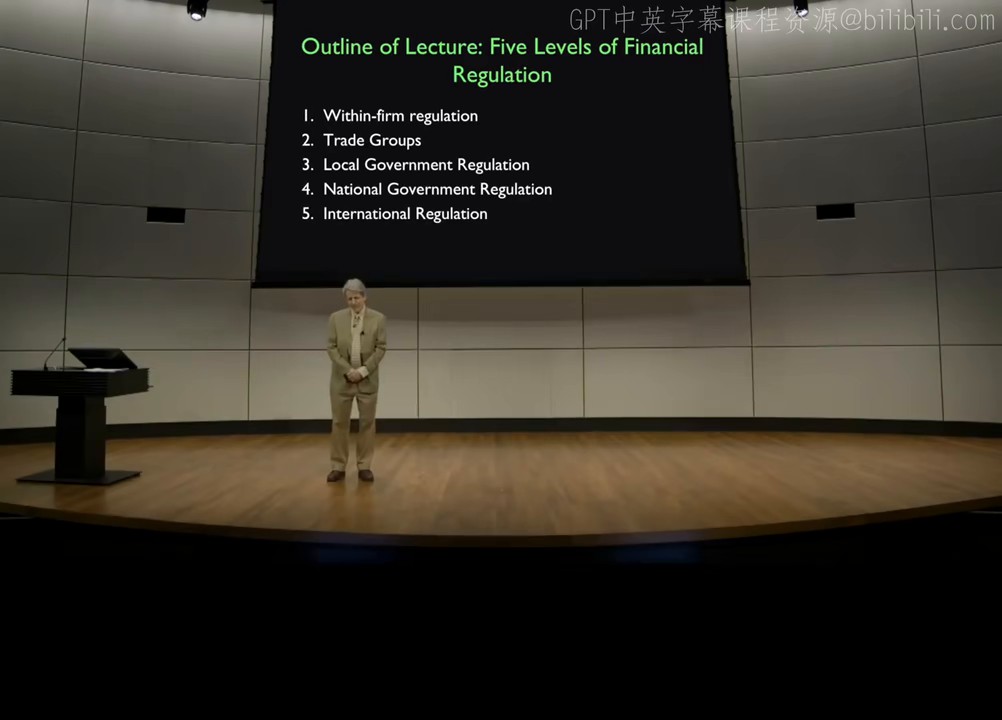
So I'm going to talk about five levels of financial regulation. I'll call it regulation within a firm. That's one. Number two is trade groups. These are organization, voluntary organizations of firms. Then there's local government regulation, national government regulation, and finally international regulation. We've got all of these. So let me start with within firm regulation.
The Board of Directors is a... uniform policy, I think, practically everywhere in the world. So they typically have outside directors, people from other walks of life who come in to represent the community, or to just give them a sense of perspective. The board of directors hires the president and fires the president if he or she is not acting properly. The board of directors, you can't make their burden too heavy because you want people who are connected to the world and you value that.
So you can't ask them to make it a full-time job. So a board of directors is usually a part-time job and they're out there and involved in different things. So you put people in with reputation. I talked earlier about personality disorders, like the antisocial personality disorders. People who are like that are hard to diagnose, but you can diagnose them. You could get an impression.
We're all forming impressions of people's personalities. When you're appointing directors, you don't appoint people who have any shade of suspicion of having a personality disorder. So that's part of what makes directors work. It may not look fair who gets put on the directors, but it's somebody that there's an agreement, relative agreement, is not a criminal, is not a criminal, is not a liar and has some sense of community spirit. So that's how it really does work in most cases.
Now, a problem with companies is, part of the thing we put people on the corporation, or on a board of directors, who have such good reputations that they're not going to compromise it, right? If someone says, let's at Yale College, let's do some devious trick. This guy will say, not on my watch, you know, and resign. because if you have a reputation, it's precious.
So that's partly what prevents devious tricks from being played. Now, I want to talk about devious tricks. The word tunneling is often used to describe tricks that people in companies use to steal money from the company. I'm referring particularly to a nice article by Johnson, Laporta, Lopez de Salinas, and Schleifer in 2000. It's expropriation by minority shareholders or by board members or by officers, as if by an underground tunnel. Now they conclude in this paper that tunneling is a real and big problem and it's bigger in civil law countries than in common law countries. Now what's the difference?
Common law is what we have in the United States, which means that we have legislatures making laws, but we also have courts making laws. in a different environment. Their laws are not public laws officially, but they're legal precedent. So the courts, when the Supreme Court declares something, it's like making a law. The difference is that, oh, by civil law, as exemplified on much of continental Europe, is entirely legislative.
You have a parliament or Congress that makes laws, and there's no consideration of precedent by the courts. Common law has an advantage in that the courts are making judgments in a specific case where there's a dispute. So that makes them really close to the problem and really close to human issues. When there's a dispute between two sides and a legal case, you hear them on their two sides and you sense, there's some issues.
emotion here, I can see the conflict. I'm going to try to find a nice way to resolve it, and that becomes law. So I think common law, I'll just say that common law is better than civil law, because it has this aspect to it. And it's better able to deal with tunneling, because tunneling comes up in specific cases where somebody has stolen money from a company, and the shareholders are furious, and they come to you and say, this was thie, but usually it's subtle thievery, it's trickery, and it becomes hard to disentangle.
I think the courts do better at disentangling this kind of thing. So Johnson et al argue that tunneling is more frequent in civil law countries. Common law is very useful in preventing tunneling and other kinds of abuse. It's something that we don't often see. When you ask why is the UK so successful, it's common law in business or the U.S. It has something to do with this.
Internal Corporate Regulation II: Hiding Self-Dealing in Complex Transactions
So how do you achieve tunneling? So, okay, suppose you are in control of a company. You're on the board of directors or your major stockholder who can pack the board of directors with cronies or you might be a CEO who's not being watched carefully by the board of directors. But let's just say generally you have a major ownership in the country company. You might own a good fraction.
of the shares, what do you do to steal from the company? You've got to disguise it. in business complexities so that when somebody sues you, it gets all into a quagmire that they can't figure out. What did you do? So one thing you do is you sell assets of the company at a below market price to some crony of yours. So you have a factory that you're not using anymore and you just sell the building.
But you don't take bids on it. You just don't. You'll say, you have some excuse why you didn't. You say, I don't know what it. This is my business partner. We have a trusting relationship. I sold it to him, but maybe for 20% of its market value. And then later, he'll do me a favor too. But I can't take the money right now because then I would look like I'm a thief.
All right. So will the shareholders ever figure out that you just did this? You see that you've taken value out of the company. They've got to figure out what that factory is worth. How do they know? They're just shareholders. So they can't see it. So you do this, obviously you do this if you're only slightly corrupt and very loyal to your friends. Also, you can make contracts with other companies and pay way too much for the service.
Now, so you sign a contract with your friend's company. Your brother-in-law, maybe it's family. And you pay, you pay. three times the market price for that service. So then the shareholders might find out and call up and complain. And so, all right, here's what you do. You make the contract a thousand pages long. They can't even read it. It's got so many ins and outs.
How do they know, how can they know that you're paying too much? Also, excessive executive compensation. This appears to be a problem, especially in your United States. You get people to write letters saying that our new president is just genius, business genius, and maybe some people believe that, but you pay this guy $50 million a year. Loan guarantees typically occur in inter-corporation loans. So my corporation will lend money to another corporation or guarantee someone else's loan to the other corporation. And it's all hid behind a corporate veil. One corporation line into another corporation. Who's going to figure it out? But in fact, the other corporation is just my crony, my friend. And I'm making
a loan. I know he's not going to pay it back. He's going to tunnel it out of his company. Also, expropriation of corporate opportunity. So a corporation has been developing expertise and technology and a certain line of business. The way progress occurs in corporations typically is that some slightly different business suddenly appears that you only know about because you're in the business and so you can jump on it. But instead of jumping out, you the CEO, you get your friend to do it and you teach him all the secrets of your own corporation and that he takes the great business opportunity. You can also do dilutive share issues, issue a lot of shares and then tunnel the money out some other way. And the stockholders are hurt without even seeing it.
And insider trading, you can announce news about the company that's good after you bought extra shares and then sell your shares before you announce bad news. So all these are forms of tunneling. Directors have a duty to prevent tunneling. In U.S. law, when you finally are called by the Yale College Corporation to ask to serve on the corporation, you have to know, I'm telling you, now. You have a duty of care. And that means to act as a reasonable, prudent, or rational person would. You can't neglect your duties as a member of the board. And you have a duty of loyalty. That means preventing insiders from benefiting at the expense of shareholders.
You have to be loyal to the shareholders. That's your constituent. You are a representative. That wouldn't be true of Yale. There are no shareholders. But for other companies. And you have to avoid self-dealing transactions. So here, loyalty is not just a moral principle, it's a legal principle. That's what you are supposed to do as a director. Here's an example of tunneling from France, where tunneling is, according to Johnson et al, much more common than in the United States.
So a French company, S-A-R-L-Paron-A is a French company owned by the Peronet family at a high price. This is a true case. Minority shareholders sued saying this was tunneling. The French court ruled that the transaction had a legitimate business purpose and that it was beyond the court to judge whether the price was too high. So they refused to take the case. That means the tunneling was successful. Now it is difficult for a court to take such a case because then the judge has to get involved in judging whether the price was right. And in France, they don't think they can do that. But in the U.S. or the U.K., it would have been a factor. So I think this accounts for the bigger success of stock markets
in the U.S. and the U.K. So I guess the banks argue that this regulation of risk destroys their ability to do their job, which is to take on risk, I guess. How do you weigh the two against each other? Well, this is an ongoing, complicated issue. There are complaints that there are too many regulations and too many forms to file, that it's costly, just compliance is costly.
There are complaints that sometimes the regulations kick in when the company is above a certain size. So that means that companies never want to rise above that size because they don't want to deal with all these regulations. And that sounds harmful as well. I think it's a matter of case-by-case basis. Regulators have to appreciate that too many regulations will gum up the whole system and make people despair of doing anything. Also, there is sometimes a problem with corrupt regulators that have to be bribed, and that's a bad situation. So I think that the important thing for regulation is to create an environment for regulators, which is conducive toward their having the real spirit of doing good for society.
We are professionals, we're trying to do good for everyone, and not to be bureaucratic or insensitive to the cost they're imposing on others. With that, I think regulators can be a huge benefit to our, and they're really necessary. for a modern economy.
Trade Groups: From the Buttonwood Agreement to Exchange Self-Regulation
Trade groups is another example. One example of a trade group is the stock exchange. The first stock exchange in the United States, not the first in the world, was founded in 1792, and they signed an agreement, which is still, I'll show you, that's the actual agreement. We, the subscribers, brokers for the, I can't read it too easily, read it here, for the purchase and sale of public stock do hereby solemnly promise and pledge ourselves to each other that we will not buy ourselves from this day for any person whatsoever, any kind of public stock at a less rate than one quarter of 1% commission on the species value, and that we will give preference to each other in our negotiations.
So that's all it says. Basically, it's a price fixing agreement. It sounds like fishing to me. They don't want to compete with each other. And in order to prevent someone, undercutting them, they also promise not to trade with any other broker that doesn't sign this agreement. Now the New York Stock Exchange website has this summary of the agreement. At the heart of the Buttonwood agreement was the need for fairness, responsibility, and trust. Wait a minute, we just read the whole agreement. It's not there. Maybe at the heart, they say at the heart. So in their hearts, the people who signed the buttonwood agreement thought that they we're helping deal with fairness, responsibility, and trust. But basically, it's trust
that you won't charge a lower price than I am. So it's collusion, as we call it. But this sounds to me a little bit whitewashing it. Oh, they mentioned William Dura, a former assistant secretary of the Treasury, had defaulted on his debt, causing a brief panic in the New York financial markets. That was the crash of 1792. The first big stock market, the first big stock market crash in the United States. So the importance of being able to trust those with whom you deal. William Dure was a man of questionable ethics who borrowed heavily to buy into the stock market bubble, deceiving others and manipulating. He was a controversial guy. He was one of the rich men of the time, and he did things like have liveried servants. He had his
servants like a small army and they wore military uniforms. This is un-American. Not many people, the but the butler comes, he's wearing a tuxedo, right? But there's an older European that you have all of them wearing uniforms, as if you had a private army. He almost got tarred and feathered in 1792. That's what they used to do with controversial figures. So the New York Stock Exchange was a monopoly. It was enforcing The commission is what you pay for the service of having your shares sold or for being able to buy a share through a broker.
So in the United States finally outlawed fixed commissions and took until 1975, long after 1792. Oh, by the way, Yale College people were involved. President Ford, Garrett and we're involved in doing this. The Big Bang of London was a similar thing under Margaret Thatcher, abolished fixed commissions to eliminate the elitist old boys network. By the way, the Deutsche Boers, they're still trying to combine into a bigger group.
The Deutsche Berza, which is the German stock exchange, attempted to buy the New York Stock Exchange and NASDAQ as well. but failed. But the intercontinental exchange, ICE, bought New York Stock Exchange. Now the Deutsche Burza is trying to buy the London Stock Exchange. It's all this effort to combine, but they don't have fixed commission, so it has a lesser impact.
Local Regulation: How U.S. Financial Power Shifted from States to the Federal Government
I'll focus mainly on the United States. So the United States started out as a confederation of individual states. And financial regulation was mostly a local, if I'm calling a state, a local government. We had two banks of the United States. One created in the 1790s called the Bank of the United States. It was a central bank of sorts, but it didn't conduct monetary policy.
but it expired according to the original legislation after 20 years. They renewed it in 1816 with what was called the Second Bank of the United States, which also had a 20-year charter and it expired in 1836. And after that there was really no central government regulation of financial activities until the National Banking Act of 1863 under President Lincoln during the Civil War, which created a...
system of national banks that were regulated by the federal government instead of the state government. So a lot of cities then started setting up, starting right after the legislation with national banks that had a national bank charter, so they weren't regulated by the local state government. And some of them listed their name as first national bank of whatever city, meaning they were created right after the act.
But even so, then still, most of the state, the regulation was in the state governments. The big change came in 1934 when the federal government set up the Securities and Exchange Commission. At this point, the securities law passed substantially to the central government. There has been a trend towards centralization. However, corporate law is still held by the central government.
state governments. It was partly inspired by the observation that there was a lot of shenanigans being played in the financial sector. Lewis Brandeis wrote a book called Other People's Money in 1914 that argued for more regulation of financial activities. There was before the Securities and Exchange Commission there was some expansion of regulation in what was called the progressive era in the United States.
That was the first 20 years or so of the 20th century. And a lot of states created what were called blue sky laws, which were laws regulating tricks and deception in the financial markets. There was a lot of fraud and deception in the 1920s, brought on perhaps by the telephone, which made it possible for people to make cold calls with financial deals offered to the general public.
And they could easily get away because the person never met the person on the other side of the phone call. The blue sky laws, the first one was in Kansas in 1911, and it became a model for other states. They virtually all established blue sky laws, which took. typically required the registration and regulated the offering and sale of securities.
National Regulation I: The SEC, Public Disclosure, and Public versus Private Securities
Where's the limit? Can there be too much regulation if we look for example in the case of China, right? Would you say there's too much regulation sometimes and what do you strike the good balance between? Well my guess would be that China does not have too much regulation. That they are still a developing or an emerging country and they do have a problem with corruption as the Chinese will tell you their opinion polls there list that as a high problem for the country.
So they have a need for regulators to, well, and Chairman, President Xi has also launched an anti-corruption campaign, but I think this still has a place to go. It's part of the development of a country that regulation becomes more thoroughgoing and that in the stages of growth of a country, corruption is an early stage phenomenon that declines through time. In the United States, in the 19th century, corruption was much more widespread than it is now. It's something that is gradually taken care of. It takes resources to do proper regulation and enforcement of anti-corruption laws. And an early emerging country doesn't have those resources, but as time goes on, it develops those resources and it encourages
a culture which itself is inimical to corruption. After the sense that you can't regulate financial activities at the local government level because they spread across state borders. The Securities and Exchange Commission was set up in 1934. It was highly opposed by many people in the business community thinking that it was usurpation of powers. The Constitution grants to the states anything not enumerated in the Constitution as federal.
And the Constitution doesn't mention financial regulation. But somehow they passed the Supreme Court as constitutional. And the idea of a Securities and Exchange Commission is an essential U.S. Invention. The critical thing is that the Securities and Exchange Commission following Lewis Brandeis emphasized disclosure. So Lewis Brandeis said in that book that, you know, if you force people to be seen, if you force people to come out with all the details of what they're doing, that will expose manipulations and frauds.
So his famous quote is, Sunshine is the best disinfectant. I don't know if that's true in medicine, but it's true in finance. So the idea of the Securities and Exchange Commission was to put out, was to require securities issuers to submit standardized forms about what they're doing, statements about what they're doing, and public corporations to put up for public view about balance sheets and law statements regularly.
And Lewis Brandeis said, it's not enough that they file them in Washington, D.C. They have to be theirs for people to see. Otherwise, it's not real, it has to be easy for people to come and see these things. Well, the way we do it now is on the Internet. So the Securities and Exchange Commission website, SEC.gov, you get on their website and you look for Edgar.
is the name of their program that dispenses financial statements. And you can get financial statements that were reported by law to the SEC for all public corporations and even for others to a certain extent. William O. Douglas was a Yale Law School professor, who at that time was a leader in what was called the Legal Realist Movement. It's something like the behavioral economics revolution that came much later, but this was a revolution in law schools.
And as we know from Jillian Tatt, different divisions of a university don't speak to each other generally. That's what she calls the silo effect. So this was a law school movement, which I think enhanced the law enormously, recognizing human limitations, that there was too much of putting in legal documents things in the fine print that you know nobody is going to figure out.
So the idea is that you have to force companies or financial institutions to put it out in a clear and consistent, standardized way. So that was partly his doing as well as Lewis Brandeis. So he actually replaced Brandeis on the Supreme Court when Brandeis retired. He wrote a book in 1940 called Democracy and Finance about his adventures as chair of the Securities and Exchange Commission.
And it is an adventure because you have a lot of devious people trying to play games with you. Arthur Levitt was another chair of the Securities and Exchange Commission, who after he retired, wrote a book called Take On the Street, meaning Wall Street. It was sort of a book. like up against the wall on the street type thinking. He had a tough time as SEC Commissioner because his effort to police what he thought was clear wrongdoing led to attacks on him.
Congressman would call him up, who had been bribed essentially by some financial interest, would call him up and try to threaten him. Not mafia-type threatening, but some sort of government regulation threatening. So the one thing that happened in regulation was some of the regulation was captured. The regulators until 1975 allowed stock exchanges to fix commissions that brokers would charge.
I talked about this last time with the original Buttonwood agreement for the New York Stock Exchange, which was signed outdoors underneath the Buttonwood tree and became known as the Buttonwood Agreement. These guys all were into fixing commissions to make a good amount of money, but that was anti-competitive. A major thing that the SEC did was to define the distinction between public and private securities. Public securities are securities that the SEC has approved for general public investment. And it had to go through an approval process through the SEC.
If you want to be listed, your company's shares to be listed on the stock exchange, you have to get approved. You have to make the appropriate filings and get approval as a public company on the SEC, and then you can go, then you have to make these quarterly filings that appear on the Edgar database. And initial public offering is the procedure of going public.
Okay? It means most, all companies, I guess, start as private companies, but they, there's a point in the life of a company when they do an IPO, which means they issue stock to the public. whether or not on an exchange. And the SEC has an announced procedure for going public. Companies can also go private. That is, a public company may not want to stay public.
Why wouldn't they? Well, it may be because they have secrets. They feel that having their stock traded in the public domain requires filing all these statements, and they may feel that they may feel that their business And they may feel that their business is threatened by that. For example, it's easier for someone to take them over if they're a public company.
And they think, may think that I don't want this roller coaster ride of all of our secrets out there. We have a good company. We're a family, maybe even a family-owned company. We don't want that. So sometimes companies are taken private through a procedure, again, which the SEC recognizes. Hedge funds are examples of companies that are private. Moreover, they are for wealthy investors only.
You have to circumvent the SEC rulings as an investment company if you want to do certain things like charge high commissions or high salaries for your leaders. So, there are different kinds of hedge funds. One of those are called 3C1s. A 3C1 is, that refers to some line in the SEC regulations, is a kind of investment company that the SEC requires takes no more than 99 investors.
And all of the investors have to be accredited investors. I mentioned this before. But it means income of 200,000. a year, or investable assets of $1 million a year. Now they've left it at this level a long time. I don't remember when it received this definition, but it was decades ago. So a million dollars was worth a lot more than it is today. And now, you know, it's not that uncommon to have a million dollars.
This investable assets doesn't include your home. But the median home price is up to something like 300,000 If you live in a nice neighborhood, it wouldn't be hard for your home to be worth a million dollars. It's just now, a million dollars isn't what it used to be, because the price level has gone up something like 20 times in recent decades. So the SEC proposed in 2006 to raise the million dollars to $2.5 million.
And they got a core, they always do these things this way. They raise proposals and they put them up on their website. and they invite comment. They got an awful lot of negative comment. People were saying, you know, it's hard enough for us to invest in hedge funds anyway. I've got to have a million dollars besides my house. You may say that's not much money, but it seems like a lot of money to me.
So they didn't change it. So it's still only a million dollars. It gets you into this. So you have to go to your broker and prove to the broker that you have a million dollars, or your income is 200,000. And then you can invest in 3C1. But no more than 99 people can invest. It has to be under 100. So it kind of limits them. Again, this is to protect the small investor. So that's the motivation who can't afford financial advice. There's another kind of hedge fund called the 3C7 that can take 500 investors, but there's another standard for that as a qualified purchaser.
with a net worth of at least 5 million, or institutions with net worth of at least 25 million. The law wants to protect not just poor individuals, but also poor institutions, like a church or something. They might have $20 million. But the SCC thinks, that's not enough for you to participate in this hedge fund. You've got to get more contributions before you reach the level.
So the SEC rules that every broker must register with the Securities Exchange Commission, every stock exchange must register, every security issue must be registered. Now the registration doesn't mean approval, although it's some form of approval, but it's not guaranteeing that this is a good investment or anything at all like that. It's just that they've kept by the rules that satisfy Lewis Brandeis instructions about disclosure, so that it's just all out there.
National Regulation II: Regulatory Careers, Insider Trading, and Accounting Standards
There is a concern though on Wall Street that a lot of these people that create this legislation don't have any real experience in this world. So do you think that sometimes they take it too far or more importantly they don't truly understand the dynamics of the Wall Street environment? Well I'm sure there are times when they take it too far. I've had my own experience with regulators and I don't know, although I'm an academic.
I don't know that they always have an enlightened view. I remember, for example, in 1996 I wrote a paper advocating indexed bonds. So I talked to people in the U.S. government saying we should see inflation indexed bonds issued by the government. And I thought that they were intelligent people that I spoke with, but I thought that I thought that maybe they were being awfully slow to adopt to an important new idea.
Why was that? I think it's difficult for them to innovate as regulators. They maybe need more public discussion to support it. They end up being, as I said, rules-based. So that means that they might be skeptical of new things. like they're not that complicated or that new, but the person I talked to, actually he wasn't irregularly that he was in Treasury, but I'm thinking of government mentality.
He joked with me when I talked to him on the phone in 1996. He said, if the U.S. ever issues inflation index bonds, we'll be sure, this is a joke, he said, around Treasury, we'll be sure to send the prospectus to the members of the American Economic Association. Because they will want them. Nobody else will want them. Well, it turns out he was wrong, and we now have a substantial number of U.S. government inflation index bonds.
But I think innovation requires a spirit of innovation. I think it's really, you know, I think it is there amongst our regulators, but I think that the government has to make the career as regulator attractive enough that it brings in people who are motivated in order to understand business, what you may be saying, they have to be motivated a bit like an entrepreneur. They have to have the sense of excitement that something new, but they're not, but they can share in the excitement, but they're not making money off of it. They're a salaried employee. And I think it's possible to get excited about an innovation that you are involved in as a regulator.
I thought I actually saw this somewhat. But in order to make that happen, we have to have a government that supports regulators. It should be a career that young people aspire to, not as a revolving door, stepstone to a private job, but as a real career. Now, by the way, the revolving door going as a regulator to the private sector is not all bad either or the other way, because that's how people develop their sense of professionalism.
And it's good if a regulator had worked in the private sector or go the other way. But I do think it's also important that regulators have a sense of career as a regulator, that I don't do this as a stepping stone to something else. I'm doing this because it's interesting and valuable to society. So as a student here, you have a sense of idealism and what you do, I hope.
Are you thinking of becoming a regulator? Personally, no. But nobody here is thinking of become, well, I want to put that thought into your mind if I can. Okay, Insiders versus Outsiders is another SEC concept. So insiders are people with special knowledge because of connections about a company. Inside information represents wealth. If you know something that the general investing public doesn't know, that's an opportunity for you to trade on that information.
So the SEC wants to block that. They want to block insider trading. So amongst the things that the SEC has done, is issue regulations about disclosure, like Regulation FD, which they issued in 2000. Regulation FD came long after Lewis Brandeis. They had telephones when Brandeis wrote, but they didn't have the internet. They didn't have the kind of access that's now possible.
So regulation FD requires that when a company tells any material fact to an analyst, it must be also immediately told to the general public. So typically companies will have open analysts discussion where you can log in and listen to the discussion with the analysts. But some companies haven't, countries really haven't had insider trading laws. Germany did not have them at all until 1994.
Some people like Hain Leland have argued that insider trading is good. Why don't we just let it go? And the insiders will compete against each other. And maybe they won't make so many profits after all. And everything will leak out and everything will be known. But the general opinion is that it's not a good thing. You don't want people who are in a company trading on company's secrets.
That just doesn't sound right. And it discourages people from investing if they think they're being disadvantaged. by insiders. So the SEC has asked companies that are and stock exchanges to help them to try to find insider trading. So the stock exchanges have sophisticated computerized systems and self-regulation, SROs are self-regulatory organizations that follow the SEC directive to themselves regulate against insider trading.
So I'll give you an example of insider trading. In 1995, a secretary at IBM Corporation was asked to Xerox some documents related to a secret plan to take over Lotus Corporation. was the, I guess, the first major spreadsheet company. Now it's been taken over. It's no longer important. But anyway, she told her husband, who was a beeper sales. They used to have beepers.
You don't need those anymore with your cell phone, but it was something in your pocket that would beep and warn you when information was just coming, and you could find out what it is. This was on, okay, by June 2, he told two friends who immediately bought. By June 5, 25 people spent, it's only half a million dollars, not a whole lot. But these were a pizza chef, an electrical engineer, a bank executive, a dairy wholesaler, a school teacher, and four stockbrokers.
They figured it all out by subpoenaing telephone records and questioning people. They traced through the whole scheme, and they were penalized for doing it. You're not supposed to do this. So if someone tells you, my wife works at such and such a company, and she was Xeroxing something, they're going to have a big deal in three days. You don't go out. and buy on that.
Because you know you're trading on insider information, and that's illegal. I give another example, Emulex Corporation. Mark Jacobs was an employee at Emulex. And I don't know what happened. He quit or he was fired. And so he got kind of miffed, and so he shorted the stock of Emulex Corporation. So he held a negative amount of it. He was hoping it would go bad.
But, you know, as a short seller, it might go well, in which case you lose. So he thought, I have to generate bad news about Emilex Corporation. And he could do that because he was formerly an employee of Emulex Corporation. He knew how they act. So he sent out a fake news release on the Internet. And it was picked up by these very, very susceptible, news stories, news agencies who don't check.
It looked like it came from Emulex Corporation. So he then sold his stock in Emilex, or he covered his short in Emulex right after. That means, to cover your short means you buy the shares back at a low price, so that cancels your short. So they had to figure out who did it. Now, he thought he was being very clever. He didn't use his own internet. He went to a public.
internet service at El Camino Community College Library. And he thought, I'm perfectly safe. They can't trace that to me, but he was wrong. They did. They went to the El Camino Community College Library and showed the librarians' photographs. Do you remember this guy? And they did. So he was caught. So that's insider trading. Another crime of financial markets is something called front running.
So when you place a large order with your stockbroker, let's say you want to buy a lot of shares in some company? Well, if you're going to buy a lot of shares, it will affect the market price. Say it's a really big order, you know, millions of shares. It's big news, and if you tell your broker, I want to buy this, and please do it. So the broker then has some time and discretion about exactly when he tries to find a good price for you.
But meanwhile, you're going to find a good price for you. But meanwhile, your broker could trade on his or her own account or tell some other broker, I'm going to put in a big order now. You might want to buy ahead of the order. So the other person can buy at the still low price and sell it, you know, an hour later at a much higher price. That doesn't sound right, does it?
That's called front running. It's also illegal. Decimalization makes, it has been claimed to, favor front running. It used to be until 2001 that stock exchanges quoted prices of stocks in 16th of a dollar. They moved to pennies. You know, it seems unnatural to be quoting prices in $6 and $16th of a dollar, or at other times, eighth. But they moved to doing it in the way that seems natural in 2001.
It makes it a little bit more possible to squeeze in between, suppose the stock is selling for $30 a share and then you think after the order it will be selling at $30.5 a share. That's with, if shares are traded in 16th, that's a narrow window. But if it's traded in pennies, you can get between those two prices. Accounting standards is another thing that the SEC is involved with.
It has the statutory right to establish how the company's accounts are done. But it doesn't want to do it. doesn't want to be the maker of all standards in business. So in 1973, the Securities and Exchange Commission officially recognized an organization called the Financial Accounting Standards Board. in Norwalk, Connecticut, as a authoritative for accounting standards.
But FASB, as it's referred, is not a government agency. It's, I guess it's a nonprofit created by the business community. So FASB defines what are called generally accepted accounting principles or GAAP. We talk about GAAP earnings or GAAP other concepts. So GAAP defines a concept called net income, which is the bottom line, the earnings of a company. And it also defines something called operating income, which is a narrower concept of a narrower concept of earnings.
It equals revenue minus cost of doing business. Gap would also take off charges for special events. Say they lost money through a hurricane or a financial crisis. And they think it's not really reflective of our business because we're doing our business as normal and then something totally out of the blue came. So it should be, according to the gap, according to FASB concepts, it should be considered, the event should be considered part of net income.
But let's provide also to investors operating income, which gives them a sense of what's happening here with this business. There are lots of other concepts like core earnings, pro, former earnings, EBIDDA, which is earnings before interest, taxes, depreciation and amortization, and amortization. and adjusted earnings. But these are not gap. They're not gap because they're not defined by FASB.
If you go to the FASB website, you'll get totally confused because there's so many disputes about earnings definitions. And they have to decide amongst them.
National Regulation III: SIPC, Crisis Accountability, and Systemic Institutions
So I wanted to tell you about insurance of corporate accounts. We have the SIPC, which I'll come to in a minute, which was created in response to failures of brokerage firms. So Good Body and Company in 1970 was a brokerage firm, which failed in 1970. It went bankrupt. Now, what does a brokerage firm do? Well, there are members of that firm, our stockbrokers, stock brokers, you have to call a stock broker.
They didn't have online brokerage back then. You would get on the phone. If you want to buy shares, you'd say, who is a good broker? And your friends would tell you, call so-and-so at good body. And then you would call this person and say, I'd like to buy 100 shares of Ford Motor Company stock. And the guy would say, would execute the order for you on the floor of the New York Stock Exchange.
and then you would own the shares. Then the broker would send you a statement and show you how many shares you own. But the funny thing is that the standard was that the shares, unless you asked for the certificates, you could say, I want the certificates mailed to me. And then the broker would tell you, well, I can do that, but do you really want to worry about those?
You know, I can just hold them for you. And so, and then it's easier when you want to sell it. You don't have to mail them back to me and all that. So then most people said, okay, fine. That meant that the shares were held by the brokerage service on your behalf. And they were sold, actually, as far as the company knew, they didn't even know that you existed.
You were now a shareholder in the company, until the brokerage service reports your name to the company. They're just held in what's called street name. So the good body in company is the official owner of the security, although they're operating on your behalf as a state. behalf as a stockholder. So what happened when Good Body went bankrupt? Well, this was a big issue because it could threaten the public confidence in the whole brokerage system.
So the financial community, Merrill Lynch took over at Good Body, New York Stock Exchange, pledged $30 million to cover losses, and in fact none of Goodbodies, retail customers lost anything. But it wasn't because of the government. It was because the financial community had some sense of integrity. What was happening with Good Body? They weren't running the business right.
And so, yeah, they held your shares, but they were doing something else. And they just got wiped out. But nobody lost. But it led then to thinking that we have to do something. So Senator Ed Muskie took that example of Good Body and Company to think that we need something like deposit insurance. for shareholders in securities. If we're going to have things held in street name, it's just like a bank.
You know, you have to trust them that they really have the shares for you. So they created a public insurance, well, it's like the FDIC, the Federal Deposit Insurance Corporation, the SIPC is Securities Investor Protection Corporation. And like the FDIC, it has limits on how much they'll support you for. So the current limit is $500,000 per account. And also they separately, you might also have a cash account at your stock broker.
You would deposit in the, you could write a check to your broker for $100,000 and say, I'll think, you know, we're going to think about what I'll invest it. And you hold the $100,000 for me. Well, that kind of account is only limited to $100,000. So there have been a lot of complaints about SIPC. The SIPC has been very worried about, over the years, has been very worried about its own integrity.
It is on its own feet as a corporation that would probably be bailed out by the government if it failed. So it disallows claims that aren't filed properly, claims against bad behavior of your stockbroker. And it doesn't cover everything. And it's also extremely slow to pay. Nonetheless, it's a positive thing. The 2008 financial crisis, a lot of our regulation is always a reaction to crises.
So we've talked about the 2008 crisis. So in the 2008 crisis, it was substantially a mortgage crisis. Banks led to homeowners on their mortgages, on their homes, to buy their home. And it became a period, as we've talked about, of high leverage. Banks were allowing homeowners to borrow a lot against their home. And banks often concealed their liabilities in what's called off-balance sheet accounting, which needed to be regulated more.
Home appraisers were, in effect, bribed by mortgage lenders. Well, it wasn't a literal bribe where they would hand you a suitcase full of $100 bills. It was simple, very simple. When you take out a mortgage, okay, part of due diligence in approving a mortgage is to find out is, is that house really worth what you paid for it? Because you could be playing tricks on the broker.
You might have paid too much. for a house. The other side of the transaction was your crony, is going to pocket the money. So you have a sales certificate for a lot of money, but it's phony. So in order to protect against that, banks have to hire someone to go look at the house and appraise it, give an independent guess, what the house is worth. Unfortunately, some of the banks would tell the appraiser what the sale price was.
And then the appraiser would come back. with the value slightly above that all the time. So you'd think that the home, the bank would catch on to that. You know, this guy's a sleazy appraiser. There has to be sometimes when he disagrees with the purchase price. If he's constantly coming out with an appraisal just a little bit above the purchase price, this guy is a phony, right?
I mean, there has to be some instances. But banks didn't care. That's partly because that was before the 5% retention rule and qualified mortgage, qualified residential, mortgage regulation, so they just didn't care. And in fact, some brokers, which were the more reliable and higher integrity, who didn't play that game, they just wouldn't get called back by the bank anymore.
The bank just wanted to see it approved. It became cynical. So there are other examples they give here, like rating shopping. Banks who are issuing mortgages or other mortgage originators would call the ratings services, Moody's and S&P and Fitch and others. And they would say, you know, we're thinking of floating this kind of security. Can you give us any indication what the rating would be before we send it to you and have you officially rate it?
And if the rating agency gave it on the phone a bad rating, they'd say, okay, I think we'll rethink that. Talk to you later and they never call them back. That's called rating shopping. So if you have a number of raters and you only submit your securities to be rated to the one that told you on the phone, they'd give it a good rating, then something's wrong.
So Dodd-Frank created the Financial Stability Oversight Council, which is the F SOC, which is headed by a number of regulatory agent heads, which is supposed to look at all these problems that might lead to another crisis. And it also created the Bureau of Consumer Financial Protection. I'm sorry, CFPB, usually, Consumer Financial Protection Bureau, CFPB.gov.
That was Elizabeth Warren's idea, who is now a U.S. Senator. Similar things happened in Europe. Again, in response to the financial crisis, the European Systemic Risk Board, the European Banking Authority, European Securities Market Authority, and European Insurance and Occurances, insurance and occupational pension authority. They spread them out over different cities.
That's the European Union style. So how do you think they have actually balanced the innovation of the financial institutions while also try to risk management? Right. Now here is a problem. The government agencies tend to become bureaucratic. And they, you know, you are, they've, you are, they've been, you are, they've been a problem. you are, they assign specialized functions to different people.
So what tends to happen is they have rules with numbers and they have different kinds of vehicles with numbers and letters associated with them. And you come in to this maze of rules that they themselves can't even change overnight. You know, you have to, if you want to appeal to changing some basic rule that they have, they're going to have to put it out for comment, they're going to have, and they'll get 10,000 comments.
It becomes hard for any individual, even a well-meaning regulator to do the right thing. These are just occupational hazards. So they, the regulators that I have met, I've been impressed, I've been impressed. as I think many people are attracted to the job as regulator. You might think, why would anyone want to do that? Well, I can see why one wants to do it because one's interested in, let's say, finance, if it's a financial regulator.
And one is a well-meaning person. Isn't it an interesting job to be trying to get the system to work well-well well? Now, some people say, I'm naive to suspect that anyone would be interested in doing that. But I kind of feel that I know that they are because I've met these people and it seems like it's a good thing to do. And not everyone is motivated the same way.
So I think that this is something that's not mentioned enough in finance discussions that we do really have well-meaning people who are confronted with a system that may not always function well for them to feel good about what they're doing and so they want to fix it.
International Regulation: From the BIS and Basel to the G20
And finally I wanted to get to international regulation. One of the most venerable international regulators, I don't know if it's really a regulator, it's like a banker's bank. The bank for international settlements was set up in 1930, which was a central bank for central bankers. At that time in 1930, there was some tension, international tension, that led them to think that, central banks didn't want to deal directly with each other.
They wanted an intermediary so that they didn't have public. This became more important later when the Nazi government appeared in Germany. And well, even by 1930 with Mussolini and Italy, they wanted to deal with them, but they didn't want to deal with them directly. So the BIS was set up. Now it has 57 member central banks who are in terms. national regulators and it's located in Basel, Switzerland, which is a charming little town in the mountains in Switzerland, far away from any international intrigue.
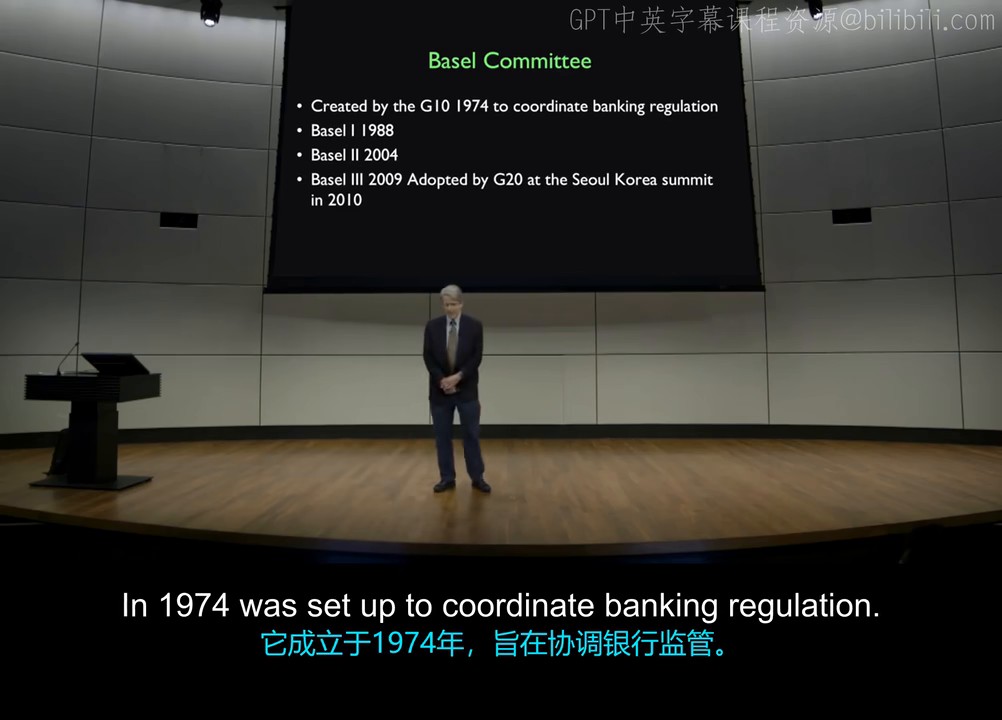
And Switzerland, of course, is a country that's been neutral since time immemorial, so they tend to set up things like this in Switzerland. Separate from that is something called the Basel Committee in 1974 was set up to coordinate banking regulation. In 1988, they set up Basel 1, which was their first statement about proposed banking regulations for countries. They didn't have any authority to impose these regulations, but they recommended them, and most countries of the world took them on. It was revised in 2004 as Basel 2, and it was revised again in 2009 after the financial crisis with Basel 3.
which was adopted by the G20 countries in 2010. The G20, I'll come back to that, here we are. There are these different international organizations which have no official regulatory power, but they are meeting places where governments of countries get together and discuss regulatory issues. And they make statements at the end of each meeting, which often lead to parallel regulatory issues, changes across countries.
So the G8, they started out as the G6, I guess, and then they were the G7, and then they're G8. And now they're G7 again because they kicked Russia out, at least temporarily. So these countries, they typically have two separate meetings, one for the finance ministers, and then one for the heads of state. The meetings of the heads of state get the most attention.
So then there's the G20, which is more comprehensive. Now it's 20 countries. I've got them listed here. They haven't kicked Russia out of this one. The G20 is less collegial. It's everybody. It's really all the, right, all the big countries in the world. And there's some tension among these countries. So if you look at the G7 countries, they're all kind of, I can't seem to go back.
they're all sort of, Europe and Japan, and U.S. and Canada, you wouldn't expect big disagreements among these countries now. But the G20 is more, I've talked to people who attended both of them in claiming that the G20 is more countries' reading statements that were written by their propaganda experts. But they function well. One thing they did is approve the Basel 3 agreement.
Their next meeting is in Hangzhou in China. So financial stability board is another thing that was created by the G20. Actually, it was a reconstitution of something earlier called, in Basel also, called the Financial Stability Forum. So Financial Stability Board makes, or FSB, makes proposals about financial regulations to the G20, which often tend to be adopted in many countries.
So those are, we have international financial regulatory organizations, which in effect set policy. But we don't have international regulation, which is becoming a problem because we have more and more multinational firms, that operate across national borders, where you as an employee don't quite know what country you live in because they might transfer you to another country any day now.
And your corporate offices are in some other country. I think this will grow and grow through time as the economy gets more developed. So we'll need to more and more international regulation. But it's a theme. I'll go back to, I assigned as a reading for this part of the course, the introduction to my book with George Akelaugh called Fishing for Fools. And again, the basic thing that we want to get across is that regulation has always been the secret to success of free markets.
That is, the markets have to be regulated within limits. In the United States, after the Great Depression, before World War II, the reaction to the complaints about the financial community by the Franklin Roosevelt administration was to, let's make capitalism work by regulation. The reaction in other countries wasn't quite the same. But I think it led to relative success of the U.S. economy.
And the SEC is now copied by other countries widely, the general concepts of regulation. So I think it is to set up free markets, unregulated free markets as an ideal, is just being ignorant of history. These markets have generally been regulated by the state governments in the United States or the federal government, and in other countries. They've never been left completely free.