Behavioral Finance
The Intellectual Origins of Behavioral Finance: The Other Adam Smith
have been very much involved with this field since around the late 1980s, joining psychology and finance. And it's a deep belief of mine that it really matters. So I'm trying not to overemphasize this in this course because this is a general course in finance and I don't want to overemphasize one aspect of it. On the other hand, it sounds to me extremely relevant.
Maybe I'm influenced by the fact that my wife is a psychologist, but I don't think it's just that. I think there's a problem in academia that departments are too separated. They don't go to each other's, professors don't go to each other's seminars and get to know other fields as well as they ought to. Though there's so many topics in behavior, oh by the way, it's a revolution.
I don't know if I said this before. The first one we just talked about was the efficient markets revolution. It came in with also the capital asset pricing model and mathematical finance. That was an important revolution. I'm not saying they were wrong. Everything is half-truth in life. Isn't that true? No simple model will explain everything. But the next one was behavioral finance, or more broadly, behavioral economics.
And that came in around, well, it's fuzzy, but around 1990. Well, I think the term behavioral economics appeared then, and it became a sort of revolution. But the ideas go back very far. And they go back, in fact, to the father of economics. Adam Smith. Now, you know Adam Smith for his book, The Wealth of Nations, which he wrote in 1776, which describes free market economics, and is interpreted widely to be a libertarian or free market tract.
Adam Smith was a champion of letting prices go where they may because they allocate scarce resources. I don't think he used that term exactly, but had that meaning. He's famous for the, quote, invisible hand, that the free market is the invisible hand that's directing the economy. And he said that, who makes sure that enough coal is being dug out of the ground for next winter?
Is there a government department of coal production? Well, there wasn't, there isn't now, and there wasn't in 1776. So what determines it? Well, it? it's the profit motive. This is Adam Smith in his famous book, The Wealth of Nations. And prices guide it. If price gets high, the coal mines will produce more because it's profitable for them to do that. And so the price equilibrates at a level that is just right for the upcoming winter when people have to heat their homes. There will be enough coal.
But the other side of Adam Smith is in this other called The Theory of Moral Sentiments. He said that he, he's not any academic psychologist. He's just writing as a public intellectual in 1759. He said that he has noticed throughout life that people really like to be praised. Now, I guess that's obvious, right? You notice this in young children. You tell them you did something good.
They seem to respond. And it goes throughout life. But then Adam Smith points out, are you happy with being praised for something that you didn't do? Suppose somebody makes a mistake and thought that the achievement was, some achievement was yours. But in fact, it's just a mistake. He's not going to, and suppose you also know that the mistake will never be revealed, so you've got this on your resume, some great achievement.
Do you get pleasure? from being praised for this. And he said, probably not, right? It just doesn't, you want to be praised for something you really did. And so he said, especially as one gets more mature and thinks more about life, as people mature, the desire for praise morphs into a desire for praiseworthiness. So people want to be suitable for praise, even if nobody knows it.
So he gives the example of mathematicians. are not famous, usually. That's because the public can't see or understand what they do. In contrast, even in 1759, actors and singers were famous, we're wildly famous compared to most. compared to mathematicians. So why don't mathematicians despair? Nobody knows who I am. I'm doing all this work. It is because they have a small community of mathematicians who've read your work and respect it.
And you know that you are praiseworthy for this work, even if you're totally unknown. So that's what he said. And I think there's some real insight that he has. This is really true, at least for mature adults. that you develop a sense of your own praiseworthiness. So that's very different from the usual assumption in economics that one wants to maximize consumption.
Prospect Theory: How People Perceive Gains, Losses, and Probabilities
So let me start with more modern behavioral economic and talk about prospect theory. So the term prospect theory was coined by psychologist Daniel Kahneman and Amos Tversky in an economic journal, Econometrica, 1979, a very important paper. And in fact, at least as of some years ago, the most cited paper ever published in Econometrica, which is the top journal for economic mathematical economists.
What they are criticizing is the core theory of economics, and they're replacing it with a constructive alternative. The core theory being expected utility theory. So the economic profession tends to use the idea that everyone has a utility function which depends on the things that they consume and it represents their happiness. You've heard of indifference curves, those are contours of the utility function.
And that people in a world with no uncertainty will choose how much to buy at the market prices to maximize their utility function. And then if there's uncertainty, then, People use the probabilities of possible events to calculate the expected utility and they maximize expected utility. Kahneman and Tversky changed two things in expected utility theory. One, they replaced the utility function with what they called a value function.
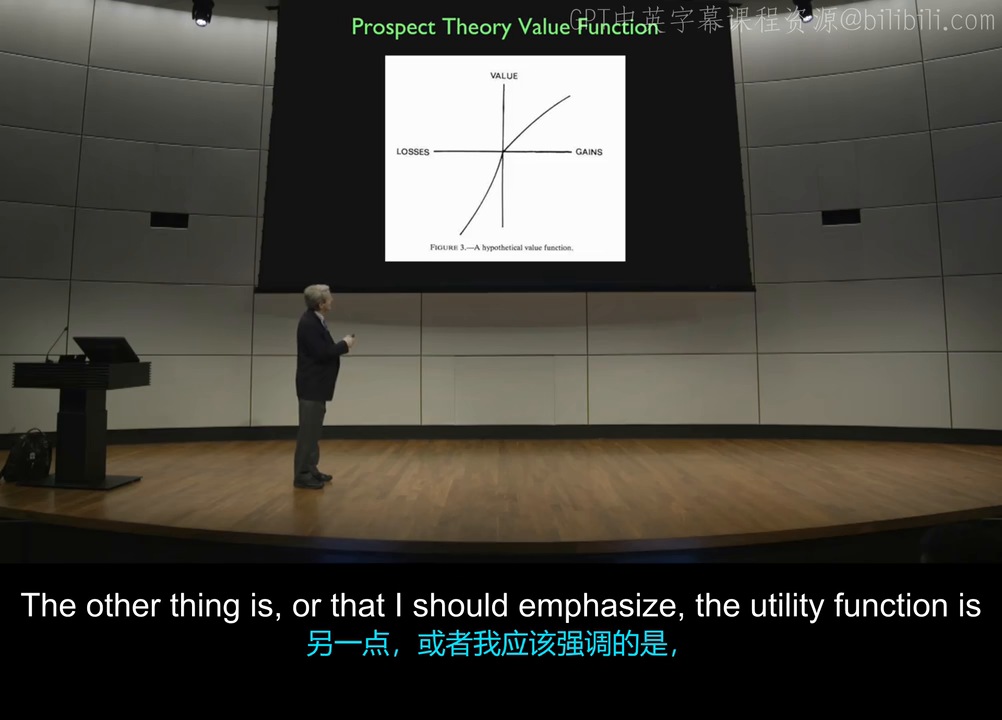
And two, they, they, replaced the probabilities with subjective probabilities determined by a weighting function in terms of the actual probabilities. So this, let me talk about these two elements here. The first thing is the value function. That's a plot from their 1979 paper of what the value function might look like. This is based on the value function. their experiments, but this is just a hand-drawn story.
Now the utility function, if you think of from elementary economics, the utility function exhibits diminishing marginal utility everywhere. And it's concave down, right? So a utility, the upper right segment of their curve looks like a utility function. You see it's concave down and it's growing. The axis, okay, the horizontal axis is the amount of money gained or lost, and the vertical axis is their counterpart, their replacement for utility, which they call value.
But if you look at it, there's a funny kink here at the origin, and then they have it concave upward, not downward, for losses. The other thing is, I should emphasize, the utility function is not usually put at, in this term, between gains and losses in economic. Your utility is determined by how much you have, and it doesn't apply, it doesn't make a distinction, it doesn't focus on what you have now.
What they're talking about here is how you react to an opportunity on any given day. And what they said is that on any given day, you form a reference point for today, and that's this reference point, okay? And the utility depends on relative to your reference point, what your gains and losses might be. There's a kink at the reference point. which means that there's something special going on.
But this reference point is kind of arbitrary. It's just where you see yourself today. So that is, I'm not going to get into details of this, but this is the idea which they proposed instead of utility based on experimental evidence. So let me talk about evidence quickly through this. The king, the first thing is that the origin moves through time. You're not consistent through time.
If I get more money, then I move my reference point up to more money for the next choice that I make. And if I have less money, I'll move it back. That doesn't happen with utility. What they're saying is that it's... subjective. I'm thinking always relative to where I am now. So for example, there's a kink in the slope. You see the slope is high here and then it becomes low at a point, which is today's reference point.
And so what it means is that people, one implication of this, is people will not take small bets. So I'll get it. So I'll give you an example. The famous example occurred at lunch at MIT about a half century ago. And Professor Paul Samuelson, who was a famous professor, was seated with E. Carey Brown, another professor, not so famous. And Samuelson said, on the spur of the moment at lunch, hey, let's try a little gamble here.
Let's flip a coin, and if it comes up heads, I will pay you two. $200. But if it comes up tails, you pay me $100. So he proposed, you see the, he's being very generous here because he's giving the other guy $200 as against 100. What's the expected value of that bet? Well, it's 0.5, assuming it's a fair coin with the probability of coming up heads, 0.5 times 200, minus 0.5 times 100.
So that's $50. So Samuelson thought he would immediately take it. But E. Carey Brown said, No, I don't, what are you talking about? I don't want to do that. He didn't want to do it. And Samuelson said, are you sure? I gave you a positive, expected value bet. It's only a couple hundred dollars, right? Well, that sounded like a lot. Back then it was worth more than it is now.
It sounded like a lot of money. but he just didn't want to do it. So Samuelson then said to E. Carey Brown, okay, how about doing it a hundred times? Well, I'll do this. is hypothetical, I'm not really offering this, but if I offered to do it a hundred times in a row, would you do it? And then E. Carey Brown said, gee, I mean, by the law of large numbers, I'm going to make something like $5,000 practically for sure.
So E. Carey Brown said, Okay, I would do that. So then Sammussen went back to his office and wrote out a mathematical proof that E. Carey Brown is irrational. Because if you would take a hundred of them, you should take one of them, right? But E. Carey Brown was just behaving the way this value, the kink at the value function means the gains look so much smaller than the loss.
So psychologically, so I don't want that. But if it's a hundred of them, then it's just moving him up here for sure, so of course he'll do it. But see, there's a fundamental human error here that we focus on little things and we panic at little bets. You should be doing, I don't know if you're ready for, if I actually offered, I should have asked for a show of hands.
If I asked, if I offered you a coin toss like that, you'd take it, right? I assume, at least if you learn anything from this course about rationality, you should do it. Anytime you get a bet like, it's a small bet, you should, with a positive expected value, expected utility theory says you take it because there's not much concavity to the utility function, but people don't.
The other thing is that this thing curves up for losses. And what that refers to is a, there's risk preference for losses. People, it's a little bit hard to explain. But what the, key idea is that people are willing to take big risks to escape losses. So for example, someone at a gambling casino who's lost a lot of money, and now is in the reign of losses, starts to think maybe of taking a really big bet that might have the possibility of bringing them away so they could close the day up instead of down.
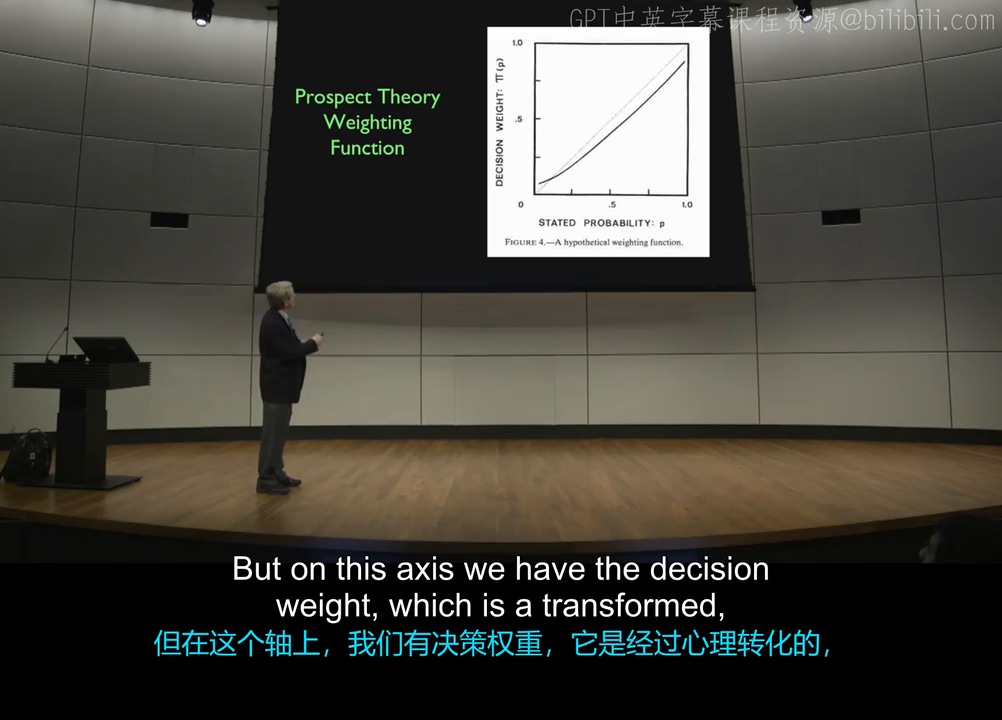
so that people have a tendency to take risks in the domain of losses, to try to get them back. So that's the value function. The other thing is the weighting function. Now on this axis, we have the stated probability. Now probabilities range from zero to one. And on this, and so that's the actual probability of an event. But on this axis, we have the decision weight.
which is a transformed, psychologically transformed probability. And you can see that the curve, this is the 45 degree line. If people were completely rational, they would use the actual probabilities in their calculations. But they do not actually behave completely like that. They tend to transform their weighting function, so it looks like a curve, with a slope less than one.
Also, it doesn't show, for very low probabilities and very high probabilities, the line stops. You notice that it doesn't tell you, or by some versions it drops to the zero, or jumps up to one. So what they're referring to, let's talk about the fact that it doesn't go to zero or one. What it means is, for very, low probabilities, you have a tendency to not appreciate them, and actually often to drop them to zero.
I'm not going to think about that. If it's a probability of 10% of happening, you might worry about it. But if it's 1%, I'm going to round that to zero and not worry about it. Similarly, on the upper end, if something has a very high probability, people don't accept that high probability. accept that high, they don't take that probability into account, and they round it to one.
So I'll give you an example of the application of the waiting function. And that is in, when you're, it used to be that when you board an airplane, they had vending machines that offered you insurance against dying on this flight. It's one flight, and they would charge you like a dollar for an insurance policy. And they would put the machine right there. where you're boarding the airplane.
A lot of people would buy this because they're boarding an airplane. They just get a little scared about this flight. Well, actually, the probability of this flight crashing. What is it? One flight? It's one in 10 million. Right? So that $1 insurance should give you a coverage of $10 million. But it doesn't. It gives you something remotely, very remote from that.
And people still buy it. Why do they buy it? It's because they buy it. They're nervous. You hear about all these plane crashes. You think this could be my last day on Earth. I feel like I want to have done something. But in effect, you see the probability is exaggerated. So most people didn't buy it. So those are the people who were down here. They rounded it to zero.
But some people are right there. There's a little bit of fluidity in this theory. And you either exaggerated or you ignore it. And so there's a whole business exploiting people who are exaggerated. Also, the curve has a slope less than one. And you could caricature this by saying there's three possible weighting values. Zero, a half, or one. And so emotionally, I can't process these numbers.
That would be the case if this curve. were actually flat through a half. But it's not absolutely flat. But it is true that in this realm, people don't, they don't take full account of the differences in probabilities of events. They tend to blur them a little bit. So that's prospect theory. People are overly focused on little losses, little gains in losses.
I can get you worrying about a $2. dollar plus or minus two dollar loss. I can get you overly concerned by that. You should not worry about plus or minus two dollars. That's nothing. But people do worry about it. You should be worrying about the big things. And that's one mistake that Connman-Ferski put in their prospect theory. Another thing is that people will often try to gamble out of losses.
If you went to the casino and you lost money, you think, I think maybe I should gamble some more, maybe I can get back to where I was. That only makes things worse, but that's what people do. That's also part of prospect theory. So what I think prospect theory is is a experimentally based set of knowledge about mistakes that people make. And I think it's good to learn about prospect theory to help yourself from making those mistakes.
It sounds like there's a large intersection between social psychology and finance. Yeah. I mean, this is a bit more abstract, but in terms of the chicken and the egg, what do you think comes first? Do you think that people have biases, which are then reflected onto the market make changes? Or do you think that the market is currently structured in a way that confuses the average investor?
Well, you said, which comes first? I know chronologically. There were two important revolutions in finance over the last half century or so. First was the efficient markets mathematical finance revolution. The second one was that started in the 50s, 1950s, maybe. It's hard to define exactly when it started, but let's say the 50s. And then there was the behavioral finance revolution which brought psychology in.
So I think these two revolutions are kind of incompatible views of the world, but they both offer insights. They're both exciting. And so which one comes first? I don't know. I think that it's just a matter of models that you have in any science are models that abstract from certain details and offer you insights into what is happening. But then if you are an engineer trying to design, thinking of physics and engineering.
An engineer has to have a different way of thinking than a physicist does. He has to say, I want to know all the frictions, all the problems. What if someone tries to use my device in freezing weather? Will it still work? Things like that. So we have to really, financial engineering is an important field these days, not using that term disparagingly. Sometimes people use the word financial engineering to describe manipulative practices.
I don't mean it that way. I mean in terms of innovation. Financial engineering takes a somewhat different personality than financial theory. Financial theorists like to develop beautiful models. But a financial engineer wants a beautiful device that works in various conditions with real people. And so that requires. I think you, like engineers will tell you, you can't rely on any one physical model.
You have to realize that the world is complicated and funny things happen to machines and they jam up or something goes wrong. Same with financial machines.
Chalk Talk: Why Reference Points Make Losses Feel Larger
Professor, I was wondering if we could go over some of the key features of prospect theory at a very high level and just kind of talk about what features it has as well as how it might be different from more traditional approaches? Well, prospect theory is written by two psychologists and not economists, Daniel Kahneman and Amos Tversky over 30 years ago. Over turning, yeah, a key assumption of much economics that represents people as rational and calculating in a sensible way.
So what Kahneman and Tversky said is that people, maybe that's a little bit rational, but it looks a little screwy what people do, actually. And what they did is a number of experiments that show about decisions under uncertainty that show funny behavior of individuals. So how to present the thing that it takes off from is the economist's idea that people are maximizers.
You know, we're all calculating, we're all out there figuring out. Now, to some extent, we are. But what is it that we maximize? So economists say, utility. And then they also have to recognize that people, utility is happiness or something like that. But they also recognize that you don't know the outcome before you make your decision. So it's random. So we have to say expected utility.
This is traditional economists. I know what I want. And I'm very consistent in pursuing that under uncertainty. But Kahneman and Tversky said, Well, you know, people don't always do that. Let's talk, okay, let's talk about flipping a coin. I'm going to propose to you, let's toss a coin. If it comes up heads, I will pay you $200. If it comes up tails, you pay me $100.
You want to do it? Yeah, I'm a little hesitant. But it's a positive, expected value because it's equally likely the two outcomes. And one of them, I pay you 200, but you only pay me 100 if it goes the other way. Right. So you have an expected gain of $50. So, yeah, you said you're a little hesitant. Since I'm a grad student. You're not going to say no, because you know what the right answer, the rational answer is.
Right. The rational answer from an expected utility theory is, of course I'll take it. Because it's, it has positive expected value. I will take lots of those bets, and they'll all average out to a gain. And so you should take it unless there's something very unusual about your utility. So what Connman and Thversky said is that people have a value function.
So I'll draw a curve here. It won't be a curve. This is gains on this axis, and this is, they call it value, but it's happiness or utility. And it's, the curve is kinked like this. All right. This is where we are now, the reference point. This is for you, plus two. and this is for you minus, this is minus 100, right? So you're looking at your happiness. Well, you're thinking, well, plus 200 only gives me a little happiness, this amount.
But losing 100 gives me a lot of unhappiness. So I, I won't, you won't do it. this kink here represents this is where we are now in prospect theory there's always a kink where you are now You could make $10,000 more in your work, let's say, and it push you way over here. The kink moves with you. It's always there. So at any point of time, you're always worrying about losses.
Okay. Relative to where you are now. Yes, relative to where you are now. But this is irrational because you should, any time anyone offers this bet to you, should always take it. And, you know, if you do it many times, you'll come out ahead on average. But people don't. That represents an irrational behavior that Conneman and Tversky called loss aversion. We worry so much about losing money.
We don't have the idea that. On average, I'll be fine. I just don't, but you don't feel that way. Anytime you make a loss, you kick yourself and you feel bad. So you don't want to take that chance. I see. And that's an irrational behavior. And it's demonstrated that people behave this way. Okay. And so, just to reiterate, it's this steep curve that is kind of what is the key to all this.
Right. That kink that he said follows you around. Yeah, follows you. You're always, worried about little losses today.
Overconfidence, Cognitive Dissonance, and the Disposition Effect
The second thing is overconfidence. And psychologists, well, you can just do a survey. Most people think they're above average. Most people think they're a better driver than the average person. Most people think they're, if they tried hard, they would be a better investor than the average person. Most people think they understand something that are not widely understood.
Wishful thinking bias is actually a term used in a science term used in the psych literature that people overestimate the probability of things that they identify with and want to see happen. Very simple. You ask people what they think the probability of their team winning is, and it's always higher if it's their team, or a political candidate. So this wishful thinking bias also helps explain the immense volume of trade in financial markets.
There's so many shares traded every day that it seems a puzzle. Why would people need to change their holdings so often? But it must be because of wishful thinking bias. There's also a tendency for overconfidence in friends and leaders. Well, I say here the central bankers tend to be thought to be a genius. Throughout history, They're always geniuses, until they mess up, maybe.
But there's also overconfidence in your own friends. You tend to think that your own friends are really smarter than average. It's not just you. Anyone you identify with, you tend to be overconfident in. So there was a book by Rakesh Karana at the Harvard Business School that documents the way CEO's chief executive officers are chosen by corporations. Now companies will bring in a CEO from another company that was a success to transform their own company and pass over someone in their own company who knows the business really well and has been there 30 years and might well be promoted up to CEO.
But they'll take in someone from another company that was a success there without regard for the fact that It was probably mainly luck that this person was success. And they'll put him in in place of their own guy. And then he feels that he has to make some transformation. He's supposed to be a genius. They're paying him $50 million. So he does some dramatic things and totally destroys the company because he doesn't know what he's talking about.
Also, Nassim Talab in his book Fooled by Randomness, which is another great book, to read describes how people in business are overly influenced by the random successes of themselves or others. Now, Irving Fisher was a professor here at Yale, and he wrote a book, he was writing a book in 1929 about how the stock market will continue to make us richer and richer.
But the crash interrupted his book. So he had to change the title of the book. So he called it the stock market crash and after. But what he said is the stock market crash of 1929 is a terrific buying opportunity. I was right all along. The stock market will just keep going up, or at least stay at a, quote, permanently high plateau. He ultimately borrowed money to try to stay in the market.
He borrowed money from his relatives. He lost everything. He lost his house. He had no place to live. His house is right near here on Prospect Street. It was. They tore it down. It's gone. Yale had to give him a place to live. But he never gave up. He kept saying that the stock market will keep going up. Why do people do this? Well, this is overconfidence. I mean, he's a great speaker, but he wasn't a great stock market forecast.
stock market forecaster. Cognitive dissonant. This is a term used by social psychologist. It refers to the mental conflict that occurs when one's beliefs are discovered to be wrong. So I'll give you a famous experiment that revealed cognitive dissonance. The experimenters went to get a list from car dealers of people who had just bought a new car. They knew that the person had bought a new car and they knew what model it was.
They then didn't tell the subjects how they had found them. And they asked them, what magazines do you read? And whatever, when they named the magazine, they would pull out a copy. They had all the new magazines there and say, let's go through the magazine and you tell me which ads you read in the magazine. and also whether you thought about them and read them carefully.
So what do you think people did? they read ads for the car they just bought? Yes, they did that strongly. They read and re-read and congratulated themselves about how great a car it was. Do you think they read the ads of a car, a different make of car, that they were thinking of buying but did not buy? As you expect, no. They don't read those ads. So why are they?
isn't this irrational behavior? You've already bought the car. Why bother to read any ads? But on the other hand, why would you selectively ignore the ads for the other cars? Well, you're just trying to make yourself feel good, right? And so it's irrational behavior. Once you've made a decision, you kind of identify with that decision, and it's me. Now I want to hear more about why I was right.
I don't want to hear that I might be wrong. It's a personal thing. This isn't really talking about being embarrassed by a bad decision. It's just perfectly internal to you. That you just get a bad feeling when you made a mistake. So the disposition effect might also be partially explained by that. If you bought a stock and its price goes down, you're feeling that maybe you were wrong, and that gives you the cognitive dissonance.
So you just avoid it. I'm not going to think about that stock. I didn't buy that. I'm not here. And then until it goes up, if it goes back up, then you might sell it as soon as it comes back. So Will Getsman here at Yale with Nadav Pellis looked at mutual fund investors. These tend to be small retail investors. And they found evidence for cognitive dissonance.
basically the disposition effect. But they also found that when they talked to investors, they didn't even remember the performance of funds that had declined. So there's a tendency of human thought because of cognitive dissonant just to blank out your bad memories of times when you were wrong and don't even know that they happen. We live in an economy that incentivizes people to capitalize on your cyclone on your psychological quirks.
And they strongly incentivize people to do that. That's what the profit motive is all about. So do you think that we're not rational with these quirks? Or would you agree that most people are rational? We're not rational. I'm not rational. I don't know about you. We're not rational in the sense that we have some consistent, logical way of deciding thing. We all make little mistakes.
And we learn, by the way. we hear from others about when they were really taken advantage of, so we avoid some things, some gimmicks. And we have laws against them. You know, the government regulates lotteries. You can't start a lottery. You can't do it at all. Or maybe you could do it as part of a state government. But, and that's because they know that there are, there are lots of giveaway contests, but they don't charge, because it's illegal to charge for them.
They can't charge for them. They can just use them as publicity. So we have a legal system that protects us against our own psychological failings.
Mental Accounting, Attention, Anchoring, and Representativeness
Fourth is mental compartments. So Hearst Sheffron and Richard Thaler said that these are economists now, talking about investors, that people don't look at the whole portfolio, the way the capital asset pricing model assumed. The theory says that you should care about what your whole portfolio does, what's its expected return and what's its variance. But that's not the way people think.
In fact, Schaeffron and Stapman said that people have two portfolios often, or maybe even more than two mental compartment, but let's just talk about two. You have a safe part of your portfolio that you will not risk, and you have a risky part that you can have fun with. In fact, some people even said, I talked to my spouse, and we agreed that I can have fun investing for 20% of our portfolio.
But again, see, that's totally a variance with, and then at cocktail parties, he or she will boast about how the fund portfolio did rather than talk about the, they don't talk about the overall thing, that's boring. So option salesmen try to get you to buy a put on a single stock and they will advertise it to you in such a way that does not make any reference to the impact this will have on your whole portfolio.
which is probably minuscule. They don't think that way. Fifth is attention anomalies, and that is that we tend not to pay attention. Well, first of all, psychologists have long understood that you can't pay attention to everything. You have to decide, am I going to pay attention to the stock market? Should I watch it every day? Or is it a waste of my time? Should I be watching other things?
So the problem is that too many people watch the stock market every day. And if the market moves a lot, then they will even pay more attention to it, even though a day-to-day move is irrelevant generally. There's a social basis for attention, and that is that you tend to pay attention to the same things that other people pay attention. Now this social basis for attention may have evolved for good reason. So for example, in a primitive cavemen society, if somebody else is looking, what's that over there? You'll look too. And so, well, everybody, maybe it's a wolf coming to attack, or who knows what it is. So we have that tendency to pay attention to everyone else at the same time. But what that means is there's going to be mispricings in markets. If everyone
is paying attention to some stock, it creates the probability that it will be overpriced. In finance, we tend to talk about the no arbitrage assumption. That is that there's no way to make money without written, no $10 bills lying around on the sidewalk. That works counter to a, this is a theory that is not so vulnerable to attention anomalies. Have you ever found a $10 bill lying on the sidewalk?
Probably not, right? Maybe you have once in your life. Doesn't happen very often. That's because somebody will pick it up before you got to it. We do have an ability to pay attention to independently of others. So $10 bills get picked up. That means there's no sure money machine. But when it comes to more ambiguous, investing. Then we become vulnerable to the attention anomaly. So some stocks get overpriced and others are just forgotten. They're underpriced because people aren't thinking about them.
Anchoring refers to a tendency in ambiguous situations to allow one's decisions to be affected by some anchor. So the famous experiment that Kahneman and Tversky did involved a device called a Wheel of Fortune, which you might see on quiz shows. So what they did is they had a wheel with the numbers, well, maybe 1 to 100 on the wheel. And the guy would spin the wheel and it would stop randomly on some number between 1 and 100.
So this is their experiment. They asked them questions that had numerical answers between 1 and 100. So one of the questions was, what percent of African nations belong to the United Nations? Most people haven't thought about that. Then they spin the wheel, but they said before you answer, I want, I'm just going to spin this wheel, ignore it, but they spin the wheel and it comes up with a number between one and a hundred.
And then, okay, now I want to hear the answer to your question. People tended to give a number close to the one that just can't. up on the wheel. Amazing. So then after the experiment, they pointed it out after the experiment was over. They said, did you know that you tended to pick a number close to the wheel? And they would say, no, I didn't. I wouldn't pay attention to that.
It was subconscious. They were influenced by it. That's anchoring. So it's the same way, I think, with stock prices, that stock prices are anchored to past values. Nobody knows what this company is. worth, but it was worth something yesterday, and so our opinions tend to be influenced by anchoring just as they were in the Kahneman and Tversky experiment. So companies know that stock prices are anchored to past values.
They also like to do splits where they, if a stock reaches $60 a share, they'll split it so that it becomes $30 a share, just because that seems to be a good, solid anchor. I formed a company with my student here at Yale, Alan Weiss, K. Shiller Weiss Incorporated, in 1991. And shortly after, in the late 1990s, we were trying to raise money for our company. And we went to an investment bank that hurt us out.
And he said, well, maybe we can come up with money for your business. But could you consider changing the name of your company? I don't want it to be CSW Inc. We want it to be CSW.com. Now, if you know, this is the dot com bubble days in the late 1990s. So we had a meeting at our company. Should we change the name? We had a website in the late 90s. So we could call ourselves.com. We were selling on the web. But we didn't do it. That was fake. That was trying to anchor us to the dot com's But you know there was a horrible dot-com bubble at the end of the 1990.
People would pay anything for a dot-com company. So it just didn't make a lot of sense. Seven is the representativeness heuristic. People judge things by familiarity to familiar types. So there was a famous example illustrating the representativeness in heuristic. This is Khanman-Torriski again. They described people in terms of their characteristic and then asked you to guess their occupations.
For one of the persons, for example, they describe a woman and said that she's sensitive, artistic. And then you're asked then, what would you just guess her occupation is? And the choices involve bank teller or sculptor. Well, people tended to pick sculptress rather than bank tellers. Now, Kahneman and Thversky said that's totally wrong because there are so many more bank tellers than there are sculptruses.
It's not a rational choice. But they look to see the best fit rather than what is statistically probable. So for example, 1929 stock market crash is still widely remembered. I don't know how well it is remembered for your generation. You've heard of it, right? So you tend to look to see, is it 1929 again? And if it fits 1929, you'll exaggerate the probability that we're facing 1929 again.
The disjunction effect is the inability to make decisions in advance in anticipation of future information. So for example, Shafir and Thorski I actually did experiments with Samuelson's lunch colleague bet. But then they did a variation of the experiment. They asked people to decide in advance whether they'll take the second bet. And then most would not take the second bet before they knew the outcome of the first bet.
What I'm saying is people couldn't understand how they will feel later. They don't anticipate their emotions later. So they can't work through a decision tree correctly. So with these biases people have, do you think there's any way to try to mitigate them, or do you think it's better to try to accommodate them when we think about planning for our financial futures?
Well, one thing that we can do is financial education, and that is important. Many people, there have been studies of the level of knowledge among the general population of financial basics. And the general conclusion is it is extremely low. For example, it's pointed out that people don't understand compound interest. But it goes even beyond that. They don't even understand interest, a lot of people, maybe a minority.
A lot of people, if you say, if the interest rate is 2%, and there's no compounding, how much do you have after five years? They can't answer that. They'll say, 2%. So I don't mean to be disparaging of these people, but there is a definite need for financial education. We also have to try to get a standard for presentation of facts about investments to people that are done in a way that's not exploitive or manipulated.
And we already have a lot of, they go back a long time, rules about how advertising can work for financial products. It's a difficult situation. But hey, we have a lot of young professionals who can work as regulators. And it's not just government regulation, it's also self-regulation within the industry. Things like better business bureaus and chambers of commerce that impose a higher standard on business.
Magical Thinking and Trustworthy Financial Advice
Nine is magical thinking. This is a term invented by B.F. Skinner in 1948, describing not human beings, but pigeons. The very simple experiment, you had pigeons in cages, and they had a mechanical feeder. These were hungry pigeons. They kept them, they weren't getting enough food. Maybe this is a cruel experiment. Not that cruel, they were just hungry, like on a diet.
And they had a mechanical feeder that would drop one pellet of food every 15 seconds into the cage. This was really annoying to the pigeon because it was hungry and they had to eat at such a slow pace. But what he found was the pigeon started doing bizarre things, dancing around or stomping their feet. And he wondered what it was. We watched more closely. He discovered that they did the same thing that they did.
before the last pellet. They noticed that they stomped their foot randomly, and then a pellet came out. And so they thought, well, maybe that caused the pellet to come out. And they tried it again. And since it was only 15 seconds between pellets, one came out, of course. Then they thought they'd learned that it affects the pellets, even though it had not. We know by construction that the machine was just passing out a pellet, every 15 seconds.
But the pigeons started repeating behaviors because they thought they were connected to the pigeon. So in effect, they developed superstitions. Then there's something else called quasi-magical thinking. And in this case, we had, this relates to Newcomb's paradox. So let me tell you about Newcomb's paradox. The simplest way is to say, people vote, don't they?
Why do they vote? Okay? Well, you know that in reality, the probability that the decision will be won by one vote in the election is minuscule, right? There's millions of people voting. The only way that it will make any difference to the outcome is if it's almost exactly tied and you win in and broke the tie. But you know that that's a 100 million chance. So you shouldn't vote because you're not going to have any impact.
But people do vote. And that's a paradox. What do people think when they vote? Well, what they'll often say if you ask someone, don't you know that the probability that you'll decide the election is zero, zero, zero, zero. So why do it? People will say, well, I know, but I'm a good citizen, and if everybody thought that way, we wouldn't have a functioning system.
But Newcomb thought, well, there's a fallacy here. You're not going to affect by your decision whether you vote. You're not going to affect what everybody else does. Shafir and Tversky demonstrated this in the lab in which they had, the subject was playing a game with a computer and is told that the computer had observed the subject's behavior and they said, we have this really neat program, that can predict what you're going to do in your next decision.
The computer knows what you're going to do. So he's told that the computer, there'll be two boxes that appear on the screen, box A and box B. Now you're told that the computer has been programmed to put $1,000 in box A, and you're going to give a choice between A or B or both. But the computer knows which people will pick both. If it thinks the software, will pick box B alone, it will put a million dollars in box B.
Needless to say, this wasn't done with real money. This is a hypothetical. But they asked people, which would you pick, A or B or both? What do you think happened? Well, a lot of people pick B only, because I don't care about that $100, I'll get the million. But wait a minute, the computer has already, they were told, the computer has already decided the answer.
So, why would you, take, you should take A too, because it's already there. What you decide now can't possibly affect what the computer did in the past. But people do that. So that's a sort of magical thinking. Ellen Langer, who's a professor of psychology at Harvard, found out that people will bet more on a coin not yet tossed. So one option is to say, let's flip the coin, it falls.
We don't look at it. cover it up. Now, you want to make a bet that it comes up heads. People will bet more if it's not yet tossed, as if they think that they can somehow influence the toss by psychic powers. Do you think there's some point where the average market participant, the average investor, should avoid trying to make their own decisions about financial markets and should rely on expertise?
Or do you think that it's imperative that everyone really achieve the level to where they can take control of their own financial future. Well, I think a medical analogy might be appropriate here. I think people are getting better at managing their illnesses by reading up learning on the internet or various publications. They don't rely just on their doctor.
They're good at, they're getting better at recognizing symptoms that might be dangerous and they'll go to the doctor and talk about that. But they shouldn't try to treat themselves. Not generally, they should go to a doctor. I think it's similar with finance. I think that it should be similar, but I think that people don't respect financial advice as much as they do medical advice.
Partly that is warranted, I think. that medical doctors, my impression, I can't. prove this. Medical doctors take an oath of loyalty to their patients in, well, in medical school. And I think that colors their thinking. They're more idealistic about, they're doing it because they want to help you. Not always, I mean, they're profit-oriented too. But I think that there are some opportunities for financial.
advisors to strengthen their commitment to their clients. So, and I think that government policy could strengthen it further too. So, for example, I have advocated that the government should give a tax break for fees spent on financial advice if the financial advisor signs a statement of loyalty to the client. And that the financial advisor signs the financial advisor signs a statement of loyalty to the client.
The advisor will not steer the client toward financial products that profit the advisor. That will help, I think. Then we will, I think we can develop a better sense of loyalty to the client. And I would like to see a world where there is more respect for financial advisors, more talk about, you talk to your neighbor and say, do you know a good financial advisor?
And you develop a relation with your advisor. So you're up late at night arguing with your spouse about finances. And you say, let's call our advisor. That would be a good idea, but not many people do that. Not people of modest means, or middle class people. They don't do that very much. So I think we want to move. toward a world where there is more financial advice and that it's more focused on the real needs of clients.
Culture, Story Transmission, and Ethics in Finance
Now, culture I talked about earlier and social contagion, but I can, there's so much to say about this, but culture is our society's values and norms. Social cognition is our thinking in generally. And Emil Durkheim in 1897 was a pioneer in cultural, in sociology. So we have a collect, actually the word collective memory was used by Durkheim. We remember the same thing. We talk, we all have the same facts and statistics in our minds, so we reach similar decisions. There's social contagion and there's a tendency for us to adopt beliefs of other people. There's a mathematical theory of disease epidemics that can be applied to speculative behavior. So I talk, I've assigned for this lecture of
the course, some page. from the book Irrational Exuberance that I wrote. We talk about moral anchors for the market in the form of stories. There's a whole branch of psychology called narrative psychology, which reminds people that we are, the human mind is influenced fundamentally by stories about people that we derive motivation from these stories. Robert Abelson at Yale was involved with that too.
We have a sense of identity and ego involvement with stories that we think relate to our life. We have a story of our life. And this story can be tied in with other events that help promote one's sense of ego. And finally, my last of my categories is antisocial personality disorder. This is a disorder which has been recognized by psychiatrists. It has been called sociopath.
sociopaths or psychopaths. And so the American Psychological Association publishes a diagnostic and statistical manual. From their fifth edition, we define this disorder in the following terms. Identity, ego-centric, self-esteem from personal gain, self-direction, absence of pro-social internal standards, lack of empathy, incapacity for intimacy, manipulative, deceitful, callous, hostile, risk-taking.
Boy, those are a hurl, a lot of insults. But what they're referring to in the DSM-5 is that this is a pattern that there are people who show all of these things. There's something in their brain that is different. And so certain emotions, which we take for granted, are not Now in DSM-5 as opposed to DSM-4, it used to be all-or-nothing diagnosis. Now they wanted to acknowledge gradations or levels of, it's not all or nothing.
We might all be antisocial at sometimes, but not at others. There's also, this is different from borderline personality disorder, which is more common among women than men. About 3% of men are antisocial personality disorder. at least according to the fourth edition, and only 1% of women. But women reverse, it's reversed with borderline personality disorder.
So, instability of relationships, extremes of over-idealization, and then devaluation. They swing from thinking this is a perfect friend to not, depressed moods lasting hours to days, inappropriate, intense anger, frantic efforts to avoid real or imagined and banishable. or imagined abandonment. But I want to talk about anti-social personality disorder. The movie, the big short, suggests that some people in the finance profession have anti-social personality disorder.
Is that true? Well, I tried, there's a literature on this. I think the answer is, no, those guys are in jail. That the profession is that the professional like the finance profession, like other professions, is pretty successful in discovering these disorders, and people don't get, but on the other hand, there might be an attraction. If you read the list of symptoms of antisocial personality disorder, it does fit.
So, but I think that it's not true, that like in any other profession, we're successful, and you can't hide these things for two long and you'll end up caught. It's unfortunate. We have to deal with these, it's 3% of our male population has this disorder. We have to live with it. Anyway, I'm just going to conclude with the these psychological principles that I talked about are involved in many things that happen in the financial world.